NS-Dokumentationszentrum München: What to Know Before You Visit
Opened in 2015 on the site of the former Nazi party headquarters, the NS-Dokumentationszentrum München is Munich's principal memorial and research centre dedicated to the history of National Socialism. Entry is free, the permanent exhibition is extensive, and the building itself carries as much weight as the displays within.
Quick Facts
- Location
- Max-Mannheimer-Platz 1, 80333 München (Maxvorstadt)
- Getting There
- U2 to Königsplatz; Tram 27/28 to Karolinenplatz; Bus 100, 150, 58, 68 to Königsplatz
- Time Needed
- 2–3 hours for the permanent exhibition; add an hour for temporary shows
- Cost
- Free of charge; no advance booking required
- Best for
- History students, conscientious travelers, educational groups, anyone seeking context beyond Oktoberfest and beer halls
- Official website
- www.nsdoku.de
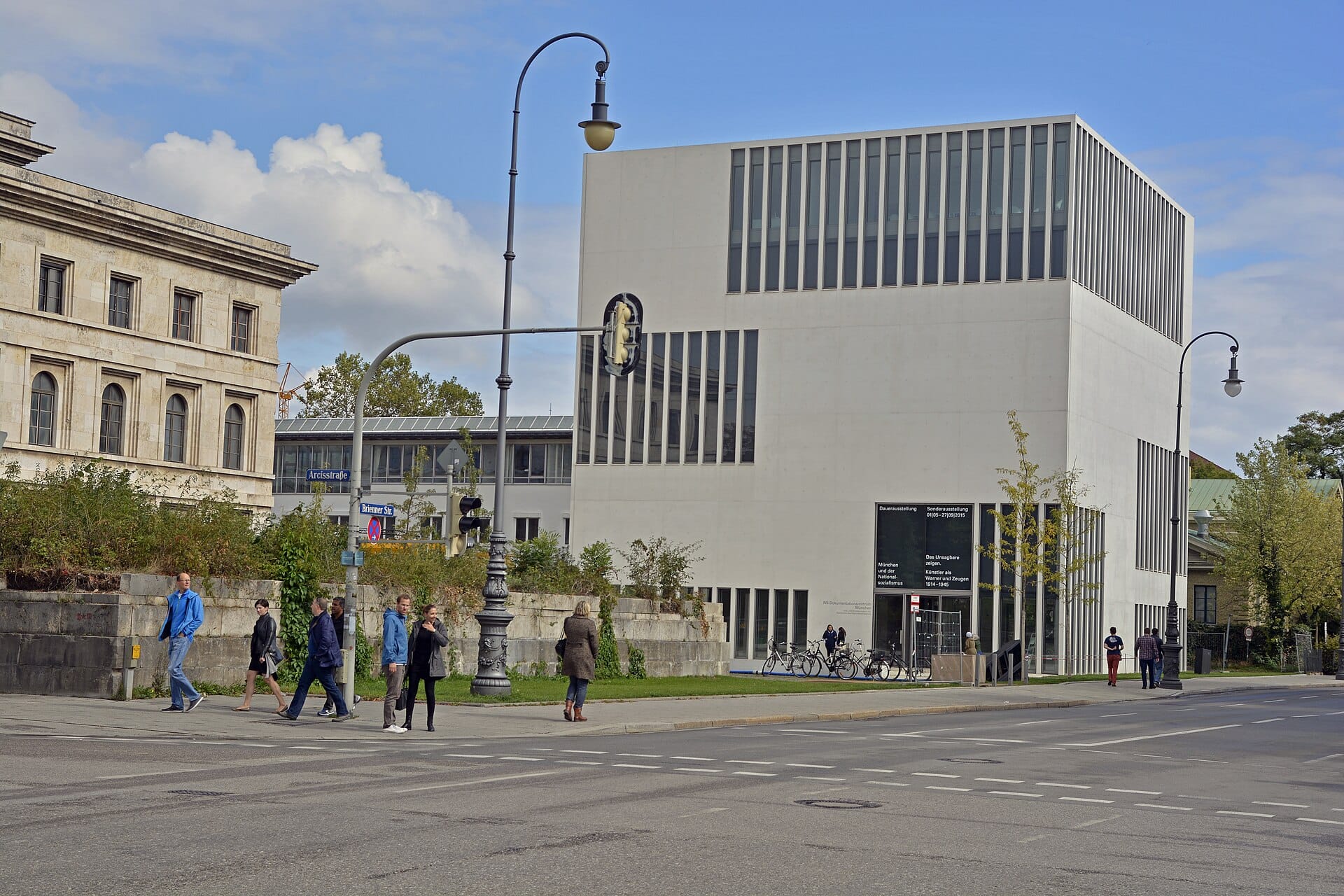
What Is the NS-Dokumentationszentrum and Why Does It Matter?
The NS-Dokumentationszentrum München, officially the Munich Documentation Centre for the History of National Socialism, is not a monument to suffering in the conventional sense. It is a research-driven museum and civic education institution that asks a specific and uncomfortable question: how did Munich, a cultured European city, become the ideological cradle of the Nazi movement?
Munich occupies a particular place in this history. It was here that Hitler staged the failed Beer Hall Putsch in 1923, here that the NSDAP built its administrative empire throughout the 1920s and 1930s, and here that the "Brown House" stood as the symbolic nerve centre of the party. The documentation centre opened on 30 April 2015 directly on the former footprint of that building. The choice of date and site was deliberate and has been widely discussed by historians.
The centre sits in Maxvorstadt, Munich's university and museum district, a short walk from the Königsplatz and its neoclassical temples. This proximity matters: the Nazis deliberately co-opted this grand civic space for mass rallies and ceremonies, turning a symbol of Enlightenment classicism into a stage for authoritarian spectacle. Walking here from the museum puts that transformation into physical perspective.
ℹ️ Good to know
Opening hours: Tuesday to Sunday, 10:00–19:00. The museum also opens on public holidays when they fall on a Monday. Admission is free, and tickets are not bookable in advance — simply arrive and enter.
The Building Itself: Architecture as Statement
The building designed by the Berlin firm Georg Scheel Wetzel Architekten is a deliberate act of restraint. From the outside, it reads as a compact, almost severe cube clad in light-coloured concrete and glass, five storeys tall. It does not shout. Standing at Max-Mannheimer-Platz 1, you may walk past it without registering its full weight if you are not looking for it, which is partly the point: the building refuses the kind of dramatic architectural gesture that might itself become spectacle.
The interior is organised around a central atrium that draws natural light downward through all floors. The exhibition runs from the basement level upward, tracing the chronological and thematic arc of National Socialism from its Munich roots through the war years and into the question of post-war memory and responsibility. The decision to move upward through the floors rather than downward gives the narrative a particular quality: you ascend through history toward the present, emerging on the top floor with views across the city and a set of questions the building refuses to resolve for you.
The name of the square on which it stands, Max-Mannheimer-Platz, honours Max Mannheimer, a Holocaust survivor, painter, and tireless advocate for remembrance who lived until 2016. The naming was approved in 2015. That institutional detail is worth knowing before you visit: it encodes the centre's philosophy in the address itself.
Tickets & tours
Live prices and dates from our booking partner. If you book, we may earn a commission at no extra cost to you.
Luggage Storage in Munich
From 6 €Instant confirmationFree cancellationOne hour city sightseeing bus tour in Munich
From 21 €Instant confirmationFree cancellationMunich Third Reich walking tour
From 32 €Instant confirmationFree cancellationRomantic Road Day Trip to Rothenburg and Harburg
From 74 €Instant confirmationFree cancellation
Inside the Permanent Exhibition: What You Actually See
The permanent exhibition is titled "München und der Nationalsozialismus" (Munich and National Socialism). It covers approximately 1,300 square metres across four floors and is presented in both German and English, which makes it genuinely accessible to international visitors without an audio guide, though audio guides are available.
The ground and lower levels deal with the pre-1933 period: the conditions in Munich's political culture that made the city receptive to radical nationalism, the failure of the Weimar Republic, and the mechanics by which a fringe movement gained mainstream traction. Display cases hold original documents, propaganda materials, photographs, and personal objects. The curatorial tone is analytical rather than emotive. Captions explain mechanisms and decisions, not just outcomes.
The middle floors address the consolidation of power, the persecution of Jews and other targeted groups, and Munich's specific role as the self-styled "Capital of the Movement." There is substantial material on the Dachau concentration camp, which was established just northwest of Munich in 1933 as one of the first in the Nazi system. If you plan to visit the memorial site there, seeing this exhibition first gives you historical scaffolding that the Dachau site itself does not always provide.
The upper floors move into the war years, the Holocaust, and the long process of post-war reckoning. There is an honest treatment of how slowly denazification proceeded and how thoroughly many perpetrators reintegrated into West German society. For more on the specific Dachau site, see the Dachau Concentration Camp memorial guide.
💡 Local tip
Allow at least two hours for the permanent exhibition if you read the panels carefully. Three hours is more realistic for anyone with a serious interest. The museum is not a place to rush through, and the density of information means fatigue is real — consider a break in the ground-floor café before the upper floors.
How the Experience Changes by Time of Day
Weekday mornings between 10:00 and 12:00 are the quietest period. The atrium is calm, the lighting is soft, and you can spend time at individual panels without feeling the pressure of crowds behind you. School groups typically arrive mid-morning and can fill certain floors with organised tours, particularly on weekdays during the academic year. These groups are generally well-managed, but if you want sustained quiet, arriving at opening time or after 16:00 on weekdays is the better strategy.
Weekend afternoons between 13:00 and 17:00 are the busiest windows, drawing a mix of domestic visitors, tourists, and family groups. The museum handles this without feeling chaotic, partly because the layout distributes visitors across multiple floors, but the reflective atmosphere of the space is harder to maintain when it is full. If you are visiting as part of a wider museum day in Maxvorstadt, consider the NS-Dokumentationszentrum as your first stop and the other Kunstareal institutions afterward.
The top-floor terrace, when accessible, offers an unobstructed view toward the Königsplatz and the surrounding district. On a clear morning, the visual connection between the Nazi-era urban planning in this area and the contemporary city is particularly legible. The contrast between the neoclassical axis of the Königsplatz and the quiet residential streets around it is something you register differently once you have been through the exhibition.
Practical Notes: Getting There, Accessibility, and What to Bring
The most direct public transport option is the U2 line to Königsplatz, from which the museum is a two-minute walk. Trams 27 and 28 stop at Karolinenplatz, roughly five minutes on foot. Several bus routes including 100, 150, 58, and 68 also serve the Königsplatz stop. From Munich's central Marienplatz, the U2 journey takes around ten minutes.
If you are combining this with the wider museum district, the Glyptothek and the Alte Pinakothek are within walking distance. The walk along Brienner Strasse toward the Königsplatz itself takes about five minutes and passes the site where the Nazi party's ceremonial buildings once stood, most of which were demolished after the war.
The building is fully accessible. Lifts serve all floors, surfaces are smooth, and the ground-floor entrance is step-free. Baby pushchairs and wheelchairs move through the space without difficulty. Staff at the information desk speak German and English; a limited range of languages may be available on request.
No special clothing is required, but be prepared for the interior temperature typical of a climate-controlled museum: a light layer is useful year-round. Photography is permitted in most areas of the permanent exhibition; some temporary exhibitions may have restrictions and will be signposted clearly. There is a cloakroom for large bags.
⚠️ What to skip
The content of the exhibition is graphic in places. Photographs of atrocities, documents describing persecution, and personal testimonies are presented without softening. This is appropriate to the subject, but parents should consider whether it is suitable for young children, and anyone sensitive to such material should be aware of what to expect.
Context: Munich's Relationship with Its Nazi Past
Munich took decades longer than many German cities to establish a central memorial institution of this kind. The NS-Dokumentationszentrum opened in 2015, seventy years after the end of the war, which is a fact the institution itself acknowledges. The history of the Beer Hall Putsch and the city's complex relationship with its role as the "Capital of the Movement" shaped a long civic debate about whether and how to commemorate this history prominently.
The exhibition does not treat Munich as uniquely culpable, nor does it attempt to exonerate the city. It proceeds from the premise that understanding how the movement grew here, specifically, is necessary for understanding how such movements grow anywhere. That framing gives the institution a contemporary relevance that goes beyond historical record-keeping.
For visitors building a fuller picture of Munich's twentieth-century history, the 1972 Olympics guide addresses a later chapter in how the city has tried to reposition its international image. The tension between those two episodes, the Third Reich and the post-war Olympic project, runs through much of how Munich understands itself.
Who Should Skip This
The NS-Dokumentationszentrum is not for visitors seeking a quick cultural checkbox. The exhibition demands reading, attention, and a willingness to sit with uncomfortable material. If you have fewer than 90 minutes and a long list of sights to cover, you will not do justice to what is here, and the visit may feel unsatisfying as a result.
Very young children will find the format inaccessible, and as noted above, the visual content is not curated for younger audiences. Visitors with no interest in German or European history will find the contextual material dense and may struggle to follow the exhibition's thematic arc without background knowledge.
It is also worth saying plainly: this is not a place that offers resolution or reassurance. Visitors expecting a narrative that ends with clear lessons and optimistic conclusions will find the exhibition deliberately open-ended. That is a curatorial choice, and an honest one, but it is worth knowing before you go.
Insider Tips
- The museum's ground-floor bookshop carries one of the better selections of academic and accessible history titles on National Socialism and Munich specifically. It is worth browsing even if you do not buy.
- On the square outside, look for the small informational markers embedded in the paving that indicate the former footprint of the Brown House. They are easy to miss if you walk straight to the entrance.
- The free audio guide (available in several languages) adds significant depth to the permanent exhibition and is genuinely worth picking up at the entrance desk, especially if you want context beyond the written panels.
- Combine the visit with a walk along the Königsplatz immediately afterward. The neoclassical square was used for Nazi ceremonies, and understanding that history makes standing in the space feel quite different from a standard sightseeing stop.
- The museum is closed on Mondays except when a public holiday falls on that day, in which case it opens and the following Tuesday becomes the closed day. Check the official website if your visit falls around a public holiday.
Who Is NS-Dokumentationszentrum For?
- History-focused travelers who want to understand Munich's specific role in the rise of National Socialism
- Students and educators looking for a well-structured, bilingual (German/English) institutional resource
- Visitors planning a trip to the Dachau memorial who want historical context before arriving at the site
- Conscientious travelers who want their Munich itinerary to engage with the city's full history, not only its Baroque and beer-hall identity
- Anyone interested in how cities grapple with difficult heritage through architecture and institutional design
Nearby Attractions
Other things to see while in Maxvorstadt:
- Alte Pinakothek
The Alte Pinakothek in Munich's Maxvorstadt district houses one of the world's foremost collections of European paintings from the 14th to 18th century. From Dürer and Rubens to Rembrandt and Raphael, this is where Bavaria's centuries-long obsession with collecting art reaches its peak.
- Antikensammlungen (State Collection of Antiquities)
The Antikensammlungen (State Collection of Antiquities) at Königsplatz presents one of Europe's finest collections of ancient Greek vases, Etruscan bronzes, and Roman jewelry. Housed in a neoclassical building from the 1840s, it rewards slow, attentive visitors far more than a quick walk-through.
- Glyptothek
Built by Leo von Klenze for King Ludwig I and opened in 1830, the Glyptothek on Königsplatz is Munich's oldest public museum. Its collection of Greek and Roman sculpture spans roughly 900 years, housed in one of Europe's finest Neoclassical buildings. This guide covers what to see, when to go, and how to make the most of your visit.
- Königsplatz
Königsplatz is Munich's most architecturally ambitious public square, designed by King Ludwig I as a Bavarian answer to the Athenian Acropolis. Flanked by a Doric propylon gate, a neoclassical art museum, and a hall of Greek sculptures, it is simultaneously a monument to royal ambition, a scar of Nazi history, and today one of the city's most quietly dramatic open spaces.
Planning a trip? Discover personalized activities with the Nomado app.