Alte Pinakothek: Munich's Cathedral of Old Master Painting
The Alte Pinakothek in Munich's Maxvorstadt district houses one of the world's foremost collections of European paintings from the 14th to 18th century. From Dürer and Rubens to Rembrandt and Raphael, this is where Bavaria's centuries-long obsession with collecting art reaches its peak.
Quick Facts
- Location
- Barer Straße 27, Maxvorstadt (Kunstareal), Munich
- Getting There
- Tram 27/28 or Bus 100 to 'Pinakotheken'; U2 to Königsplatz or Theresienstraße
- Time Needed
- 2–3 hours for highlights; 4+ hours for the full collection
- Cost
- €9 regular / €6 reduced / €1 on Sundays / free under 18
- Best for
- Art lovers, history enthusiasts, rainy-day visitors, solo travelers
- Official website
- www.pinakothek.de/en/alte-pinakothek
What the Alte Pinakothek Actually Is
The Alte Pinakothek is one of the oldest and most important art museums in the world. Founded as a museum in 1836 and managed by the Bavarian State Painting Collections (Bayerische Staatsgemäldesammlungen), it was built to house the extraordinary art collection assembled by the Wittelsbach dynasty over four centuries of Bavarian rule. The name simply means 'Old Picture Gallery,' and the collection lives up to that plainspoken description: around 700 European paintings from the 14th to the 18th century, spanning German, Flemish, Dutch, Italian, French, and Spanish schools.
This is not a local or regional museum. The Alte Pinakothek ranks alongside the Louvre, the Uffizi, and the Prado as a reference institution for pre-modern European painting. Rubens alone occupies an entire wing. Albrecht Dürer's self-portraits are here. So is Raphael's Canigiani Holy Family and Rogier van der Weyden's Columba Altarpiece. For anyone seriously interested in Western art history, a visit is not optional.
💡 Local tip
Sunday admission is just €1 for all visitors, making it the best-value cultural experience in Munich. Expect slightly larger crowds than on weekdays, but the museum's size absorbs them well.
The Building: Leo von Klenze's Neoclassical Landmark
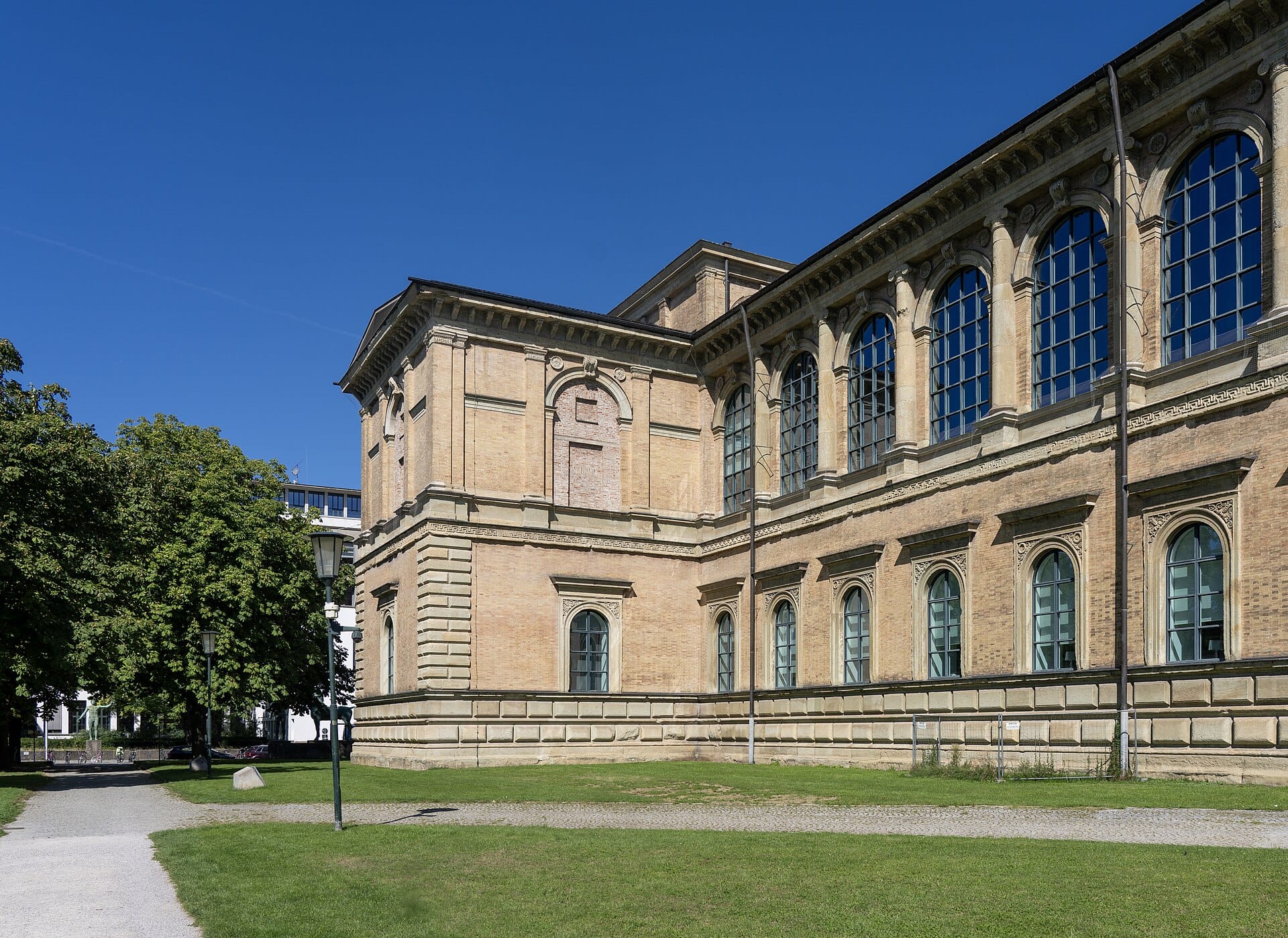
The building itself is worth pausing to consider before you walk in. Architect Leo von Klenze designed the Alte Pinakothek in a neoclassical style with Italian Renaissance influences, completing it in 1836 for King Ludwig I of Bavaria. At the time, it was among the first purpose-built public art museums in the world, a building conceived specifically for the viewing of paintings rather than the storage of royal property. The long north façade faces Barer Straße with a rhythm of arched loggia windows; the south side is punctuated by projecting pavilions. The scale is deliberate: it communicates civic seriousness.
The building was severely damaged during World War II and required extensive reconstruction. The postwar restoration, completed under architect Hans Döllgast in the 1950s and 1960s, took an unusual approach: rather than fully erasing the bomb damage, Döllgast used a contrasting red brick to fill gaps in the original sandstone exterior on the north façade. This visible repair has become part of the building's history and remains a subject of architectural discussion. Once you know to look for it, the patchwork is unmistakable and sobering.
Tickets & tours
Live prices and dates from our booking partner. If you book, we may earn a commission at no extra cost to you.
Inside: How the Collection Is Organized
The Alte Pinakothek is arranged across two main floors, with galleries running along the upper level for the largest works and smaller cabinet rooms along the side. The organization follows national and regional schools, which makes navigation intuitive once you understand the layout. Ground floor: smaller panels, early German and Netherlandish painting. Upper floor: the major canvases, including the monumental Rubens rooms and the Italian masters galleries.
The Rubens collection is exceptional by any standard. The museum holds more than 60 works by Peter Paul Rubens, including the vast Last Judgment and the more intimate Rape of the Daughters of Leucippus. The sheer physical scale of Rubens's paintings here is something reproductions cannot convey. Standing in front of the Great Last Judgment, which measures roughly six by four meters, the composition's energy becomes physically present in a way that no art history textbook prepares you for.
The German painters wing is equally significant, with Albrecht Dürer's Self-Portrait (1500) being perhaps the single most recognized work in the building. This frontal, almost Christ-like depiction was painted when Dürer was 28 and represents a radical assertion of the artist's status and identity. Nearby hang Lucas Cranach the Elder and Hans Holbein the Elder. The depth of the German Renaissance collection here is unmatched outside of Germany.
The Italian collection occupies the upper east galleries and includes Raphael, Leonardo da Vinci (Madonna and Child), Botticelli, and Titian. The Dutch and Flemish cabinet rooms offer an entirely different scale of experience: intimate, domestic paintings that reward close attention. If you want context for how Munich's art scene evolved beyond these historical works, the Pinakothek der Moderne sits directly across the square and covers the 20th and 21st centuries.
When to Visit: Time of Day and Day of Week
Tuesday and Wednesday evenings offer extended hours until 20:00 (10:00–20:00), and these late slots are genuinely uncrowded. By 17:30 on a Tuesday, you can have the Rubens rooms almost entirely to yourself, which is an unusual privilege for a museum of this caliber. The natural light through the large windows fades after around 16:00 in winter, but the artificial lighting is well-calibrated throughout.
Sunday mornings between 10:00 and 12:00 are the predictable peak, drawn by the €1 admission. If you visit on a Sunday, arriving right at opening helps. Weekday mornings between 10:00 and 13:00 are consistently the quietest windows, with school groups occasionally arriving mid-morning in spring.
ℹ️ Good to know
The museum is closed on Mondays. Plan accordingly, especially if visiting as part of a broader tour of the Kunstareal, where the Pinakothek der Moderne also has a Monday closure and the Neue Pinakothek is currently closed for renovation.
Getting There and Practical Logistics
The most direct approach is Tram 27 or 28, or Bus 100, alighting at the 'Pinakotheken' stop directly in front of the museum. From Königsplatz U-Bahn station (U2), the walk east along Barer Straße takes around five to seven minutes. The surrounding Kunstareal neighborhood in Maxvorstadt is flat and walkable, and many visitors combine the Alte Pinakothek with the Glyptothek or Antikensammlungen on Königsplatz in a single afternoon.
Driving is not recommended. Parking is extremely limited in Maxvorstadt and reserved primarily for visitors with disabled parking permits. The area is well-served by trams and the U-Bahn, and if you are exploring the broader Maxvorstadt district on foot, the museum fits naturally into a walking circuit of Munich's art quarter.
The museum has a cloakroom for bags and coats. Bags larger than A4 size typically need to be checked. Audio guides are available, and the museum shop near the entrance stocks serious art history titles alongside the expected postcards.
Sensory Notes: What the Visit Actually Feels Like
The entrance hall is cool and quiet, with polished stone floors that amplify footsteps into something ceremonial. The upper gallery corridor runs the full length of the building with high ceilings and large windows facing south over the museum's courtyard. In summer, the light through these windows can be very strong in the afternoon, creating glare on some of the glazed paintings. Morning visits in summer offer better viewing conditions.
The cabinet rooms along the north side are dimmer and more intimate, designed for smaller panel paintings. The contrast between these spaces and the grand upper galleries creates a natural change of pace that prevents the museum fatigue common in institutions of this size. The Alte Pinakothek's layout was thoughtfully designed for sustained viewing, not just spectacle.
The museum sits within a cluster of cultural institutions that makes Maxvorstadt one of Europe's most concentrated art districts. After your visit, the Glyptothek on Königsplatz offers Greek and Roman sculpture, while the Lenbachhaus nearby focuses on the Munich Blaue Reiter movement. Together, these institutions represent Munich's ambition to be a serious European cultural capital, not just a festival city.
Who Should Skip This (And Why)
The Alte Pinakothek is not the right museum for young children. There are no interactive displays, no children's trails in the permanent galleries, and the works themselves require sustained attention to reward the viewer. Visitors looking for something hands-on or experiential will find the format demanding. For families with young children, the Deutsches Museum or BMW Welt are better fits.
If your interest in art is primarily contemporary, the Alte Pinakothek's chronological ceiling of the 18th century may feel like a poor match for your time. The Haus der Kunst or the Pinakothek der Moderne would be more relevant choices. The Alte Pinakothek rewards visitors who are prepared to slow down and engage closely with historical painting. It does not accommodate casual browsing as well as some larger encyclopedic museums do.
Insider Tips
- The €1 Sunday ticket is valid for the full museum. If you are on a tight budget, this is the single best-value cultural experience in Munich, but arrive before 11:00 to get ahead of the crowds.
- Pick up the free room-by-room map at the entrance desk. The gallery numbering system is not always intuitive, and the map prevents backtracking across the long upper corridor.
- Dürer's 1500 Self-Portrait draws the most attention in the German gallery, but his Four Apostles, displayed in the same room, is arguably the more technically accomplished work. Most visitors spend 30 seconds on it before moving on.
- The museum café in the lower level offers a quiet stop during the visit. It is less crowded than the entrance-level areas and a useful mid-visit break if you are spending a full morning or afternoon.
- If you plan to visit multiple Pinakothek museums, check whether a combined ticket or the Munich City Pass offers savings. The three Pinakotheks are all managed under the same Bavarian State Painting Collections umbrella.
Who Is Alte Pinakothek For?
- Art history enthusiasts and students who want direct access to canonical works of the European tradition
- Solo travelers who can move through the galleries at their own pace without compromise
- Visitors on rainy or cold days who want a full half-day of indoor culture
- Budget travelers visiting on Sundays, when admission is just €1
- Anyone building a full tour of Munich's Kunstareal art district in Maxvorstadt
Nearby Attractions
Other things to see while in Maxvorstadt:
- Antikensammlungen (State Collection of Antiquities)
The Antikensammlungen (State Collection of Antiquities) at Königsplatz presents one of Europe's finest collections of ancient Greek vases, Etruscan bronzes, and Roman jewelry. Housed in a neoclassical building from the 1840s, it rewards slow, attentive visitors far more than a quick walk-through.
- Glyptothek
Built by Leo von Klenze for King Ludwig I and opened in 1830, the Glyptothek on Königsplatz is Munich's oldest public museum. Its collection of Greek and Roman sculpture spans roughly 900 years, housed in one of Europe's finest Neoclassical buildings. This guide covers what to see, when to go, and how to make the most of your visit.
- Königsplatz
Königsplatz is Munich's most architecturally ambitious public square, designed by King Ludwig I as a Bavarian answer to the Athenian Acropolis. Flanked by a Doric propylon gate, a neoclassical art museum, and a hall of Greek sculptures, it is simultaneously a monument to royal ambition, a scar of Nazi history, and today one of the city's most quietly dramatic open spaces.
- Städtische Galerie im Lenbachhaus
The Städtische Galerie im Lenbachhaus houses the world's largest collection of Der Blaue Reiter art inside Franz von Lenbach's ornate 19th-century villa in Munich's Kunstareal museum district. From Kandinsky's electric canvases to Joseph Beuys installations, this is one of Germany's most focused and rewarding art museums.
Planning a trip? Discover personalized activities with the Nomado app.