Antikensammlungen Munich: What to Know Before You Visit
The Antikensammlungen (State Collection of Antiquities) at Königsplatz presents one of Europe's finest collections of ancient Greek vases, Etruscan bronzes, and Roman jewelry. Housed in a neoclassical building from the 1840s, it rewards slow, attentive visitors far more than a quick walk-through.
Quick Facts
- Location
- Königsplatz 1, 80333 München (Maxvorstadt)
- Getting There
- U2 to Königsplatz, or Bus 100 to Königsplatz
- Time Needed
- 1.5 to 2.5 hours
- Cost
- €6 regular / €4 reduced / €1 on Sundays; under 18 free
- Best for
- Ancient history enthusiasts, archaeology students, quiet museum days
- Official website
- www.antike-am-koenigsplatz.mwn.de
What the Antikensammlungen Actually Is
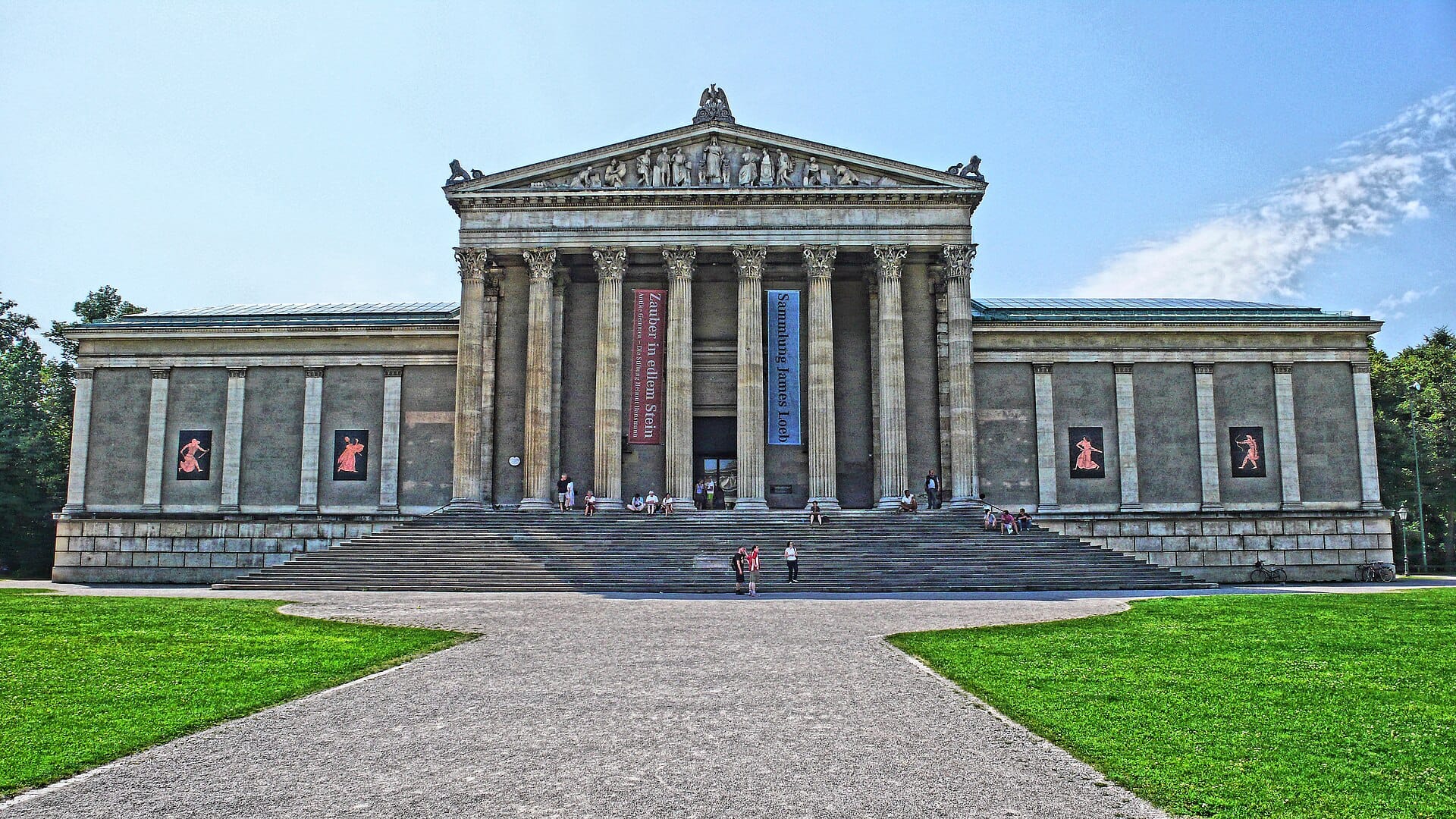
The Antikensammlungen, officially the Staatliche Antikensammlungen (State Collection of Antiquities), is a state-run museum on the south side of Königsplatz in Munich's Maxvorstadt district. It holds one of the most significant collections of ancient art in the German-speaking world, with particular strengths in Attic painted pottery, Etruscan bronzes, and ancient gold and silver jewelry. The building itself is neoclassical in design, constructed between 1838 and 1848 to plans by Georg Friedrich Ziebland, and it forms part of the monumental ensemble that defines Königsplatz alongside the Glyptothek directly opposite.
The collections were consolidated under one roof in 1967, though the objects themselves have been accumulating in Bavarian royal and state collections for centuries. Today the museum operates as part of the broader Antike am Königsplatz institution, which it shares administratively with the Glyptothek across the square. If you are planning to visit both, allow a full half-day.
ℹ️ Good to know
The Antikensammlungen and the Glyptothek face each other across Königsplatz. A combined visit to both makes sense logistically and thematically — the Glyptothek covers ancient sculpture, while the Antikensammlungen focuses on smaller applied arts, ceramics, and metalwork.
The Building and Its Setting
Approaching from the U2 exit at Königsplatz, the first thing you notice is the scale of the square itself. Königsplatz was conceived in the early 19th century by Crown Prince Ludwig I of Bavaria as a Grecian forum in the heart of Munich, a deliberate architectural statement connecting Bavaria's royal ambitions to classical antiquity. The Antikensammlungen occupies the southern edge of this ensemble, its eight-columned Corinthian portico facing north toward the Glyptothek's Ionic facade.
On a clear morning, the square is broad and quiet. The gravel surface, lined by plane trees, amplifies footsteps. There is very little commercial noise here — no café terraces or souvenir stalls immediately around the museum, which gives the approach a degree of civic seriousness. In winter, the pale stone of the facade reads almost white against grey skies. In late spring, the contrast between stone and new green foliage on the surrounding trees is particularly sharp, and photographers working the exterior tend to arrive early before tour groups cross the square.
Königsplatz sits in the heart of Maxvorstadt, Munich's museum and university quarter. Within ten minutes on foot you can reach the Glyptothek, the Lenbachhaus, and the three Pinakothek buildings, making this the densest concentration of major collections in Bavaria.
Tickets & tours
Live prices and dates from our booking partner. If you book, we may earn a commission at no extra cost to you.
Luggage Storage in Munich
From 6 €Instant confirmationFree cancellationOne hour city sightseeing bus tour in Munich
From 21 €Instant confirmationFree cancellationMunich Third Reich walking tour
From 32 €Instant confirmationFree cancellationRomantic Road Day Trip to Rothenburg and Harburg
From 74 €Instant confirmationFree cancellation
Inside: The Permanent Collection
The interior is organized across two floors, with the ground floor housing the Greek and Etruscan holdings and the upper level devoted to Roman objects and the jewelry collection. The rooms are high-ceilinged and relatively sparse by modern museum standards — the Bavarian state museums have not renovated this building into a contemporary white-cube experience. Display cases are traditional, labels are in German and English, and the lighting is kept at levels appropriate for fragile painted surfaces rather than theatrical effect.
The painted Attic vases are the collection's most visited objects. Black-figure and red-figure pottery from the 6th and 5th centuries BCE fill multiple rooms, with pieces depicting mythological scenes, athletic contests, and funerary rites. The detail preserved on some examples is remarkable given their age. Look closely at the shoulder registers on the large amphorae — narrative sequences that most visitors walk past while focusing on the main body panels.
The Etruscan bronzes occupy a quieter section that tends to receive less visitor attention than the Greek ceramics, which is worth noting if you prefer to look at objects without crowds at your elbow. Fibulae, mirrors, and votive statuettes from central Italian sites fill the cases, documenting a culture that Greek and Roman writers documented but often misrepresented. The jewelry collection upstairs — Greek, Etruscan, and Roman gold work — is genuinely exceptional, with pieces of a refinement that makes clear why ancient metalworking occupied such high social and economic status in these cultures.
💡 Local tip
Wednesday is a late-opening day (10:00–20:00), with extended evening hours that attract a post-work crowd after 17:00; between 10:00 and 17:00 visitor numbers are typically lower than on weekend days.
When to Go and How Long to Allow
Tuesday through Friday mornings are the quietest windows. Weekend afternoons bring school groups and families from across Munich, which does not make the collection inaccessible, but it changes the atmosphere in the vase rooms considerably. Sunday admission drops to €1 per house, making it the most affordable entry point, though predictably the most popular — arrive at opening (10:00) to get ahead of the midday crowd.
A focused visit covering the highlights on both floors takes around 90 minutes. If you intend to read the case labels carefully, or if ancient Greek pottery is a genuine interest rather than a curiosity, two to two-and-a-half hours is more realistic. The museum is not enormous, but the density of objects rewards slow looking rather than fast coverage.
The museum is closed on Mondays, which is standard for Bavarian state museums. Public holiday hours can vary — the official visitor information page lists specific exception dates, and it is worth checking before planning a visit around a German public holiday.
⚠️ What to skip
The Antikensammlungen is listed as not fully barrier-free accessible. Visitors with mobility considerations should check current accessibility details directly with the museum before visiting, as the neoclassical building presents physical constraints that a modern purpose-built facility would not.
Who Will Get the Most From This Museum
The Antikensammlungen rewards visitors who come with some prior interest in or knowledge of ancient Mediterranean cultures. The collection is specialized: if you are drawn to painted narrative vessels, ancient jewelry, or the material culture of Greece and Etruria specifically, this is a serious and satisfying museum. The depth of the vase collection in particular is not easily matched in Germany outside Berlin.
Visitors who are primarily general tourists working through Munich's highlights in limited time may find the collection requires more contextual knowledge to appreciate than, say, the Deutsches Museum or even the Neue Pinakothek. The museum does not over-interpret its objects — the approach is scholarly and restrained. That is a strength for the right visitor and a potential frustration for those expecting immersive or multimedia presentation.
If ancient sculpture is your primary interest, prioritize the Glyptothek across the square. If you want a broader introduction to Munich's cultural landscape first, the best museums in Munich guide covers how the major collections compare and helps you sequence a multi-day itinerary.
Getting There and Practical Logistics
The most direct route from central Munich is the U2 subway line to Königsplatz station, which deposits you at the northwest corner of the square. The museum's entrance on the south side is a short walk across the square. Bus route 100 also stops at Königsplatz. From Marienplatz, the U2 journey takes about 7 minutes.
There is no dedicated car parking immediately adjacent to the museum, and driving to Königsplatz specifically for the Antikensammlungen is not practical given Munich's generally good public transport connections in this part of the city. If you are combining the visit with a broader exploration of Maxvorstadt's museums, arriving by transit and walking between venues is the standard approach.
Maxvorstadt is also well suited to exploring by bicycle. The area is flat, the streets are wide, and several of Munich's main cycling routes pass through the district. The Munich cycling guide covers the most useful routes connecting the major museum quarter attractions.
Photography policies inside the museum should be confirmed at the entrance, as policies for specific rooms or temporary exhibitions can differ from the permanent collection rules. Bag storage lockers are typically available near the entrance. The museum has a shop but no dedicated café on site, so plan your coffee stop at one of the cafés on Brienner Strasse or closer to Odeonsplatz before or after your visit.
The Broader Königsplatz Context
Königsplatz has a complicated history that extends well beyond its original neoclassical ambitions. During the National Socialist period, the square was paved over with granite slabs and used for mass rallies and ceremonial events, becoming one of the most visible public spaces in the Third Reich's use of Munich as a symbolic capital. The Propyläen at the western end of the square dates from this same 19th-century Ludwig I construction project, but the square's 20th-century history added a layer that the NS-Dokumentationszentrum nearby documents in depth. The granite paving was removed after the war and replaced with grass, partially restoring the square's earlier appearance.
Understanding the square's full arc, from neoclassical royal project to Nazi ceremonial space to post-war cultural precinct, adds considerably to a visit to either of the Königsplatz museums. The Glyptothek directly opposite the Antikensammlungen is the logical companion visit, covering ancient Greek and Roman sculpture in the same monumental architectural setting.
Insider Tips
- The €1 Sunday admission applies per museum house, meaning you can visit both the Antikensammlungen and the Glyptothek on the same Sunday for €2 total. Arrive at 10:00 to beat the midday influx.
- The upper-floor jewelry collection sees far less foot traffic than the ground-floor vase rooms. If crowds arrive on the ground floor, move upstairs early and return to the ceramics when the groups have moved on.
- The annual pass costs €20 regular or €15 reduced and covers both the Antikensammlungen and the Glyptothek for twelve months. If you are spending more than a week in Munich and have genuine interest in antiquity, it pays for itself in two or three visits.
- Wednesday evening (17:00 to 20:00) is underused. The extended hours draw a post-work local audience, but between opening and early evening the museum is significantly quieter than at any point on weekends.
- The Königsplatz square itself is worth time before or after your museum visit. The proportions of the ensemble are best understood from the center of the square, and the architectural relationship between the three buildings — Glyptothek, Propyläen, and Antikensammlungen — is clearest from that vantage point.
Who Is Antikensammlungen (State Collection of Antiquities) For?
- Travelers with a specific interest in ancient Greek pottery, Etruscan metalwork, or Roman jewelry
- Architecture enthusiasts drawn to early 19th-century neoclassical civic design
- Students and researchers in classical archaeology or art history
- Budget-conscious visitors on Sundays, when admission drops to €1
- Anyone spending a full day in Maxvorstadt covering the Kunstareal museum cluster
Nearby Attractions
Other things to see while in Maxvorstadt:
- Alte Pinakothek
The Alte Pinakothek in Munich's Maxvorstadt district houses one of the world's foremost collections of European paintings from the 14th to 18th century. From Dürer and Rubens to Rembrandt and Raphael, this is where Bavaria's centuries-long obsession with collecting art reaches its peak.
- Glyptothek
Built by Leo von Klenze for King Ludwig I and opened in 1830, the Glyptothek on Königsplatz is Munich's oldest public museum. Its collection of Greek and Roman sculpture spans roughly 900 years, housed in one of Europe's finest Neoclassical buildings. This guide covers what to see, when to go, and how to make the most of your visit.
- Königsplatz
Königsplatz is Munich's most architecturally ambitious public square, designed by King Ludwig I as a Bavarian answer to the Athenian Acropolis. Flanked by a Doric propylon gate, a neoclassical art museum, and a hall of Greek sculptures, it is simultaneously a monument to royal ambition, a scar of Nazi history, and today one of the city's most quietly dramatic open spaces.
- Städtische Galerie im Lenbachhaus
The Städtische Galerie im Lenbachhaus houses the world's largest collection of Der Blaue Reiter art inside Franz von Lenbach's ornate 19th-century villa in Munich's Kunstareal museum district. From Kandinsky's electric canvases to Joseph Beuys installations, this is one of Germany's most focused and rewarding art museums.
Planning a trip? Discover personalized activities with the Nomado app.