Lenbachhaus Munich: The Blue Rider Museum Worth Every Minute
The Städtische Galerie im Lenbachhaus houses the world's largest collection of Der Blaue Reiter art inside Franz von Lenbach's ornate 19th-century villa in Munich's Kunstareal museum district. From Kandinsky's electric canvases to Joseph Beuys installations, this is one of Germany's most focused and rewarding art museums.
Quick Facts
- Location
- Luisenstraße 33, 80333 Munich (Maxvorstadt / Kunstareal)
- Getting There
- U2/U8 to Königsplatz; Tram 27 to Karolinenplatz; U1/U7 to Stiglmaierplatz
- Time Needed
- 1.5 to 3 hours depending on depth of interest
- Cost
- Regular €10, Reduced €6; Free admission first Thursday of month 18:00–22:00
- Best for
- Modern art lovers, architecture fans, Blue Rider devotees, museum day itineraries
- Official website
- www.lenbachhaus.de/en
What the Lenbachhaus Actually Is
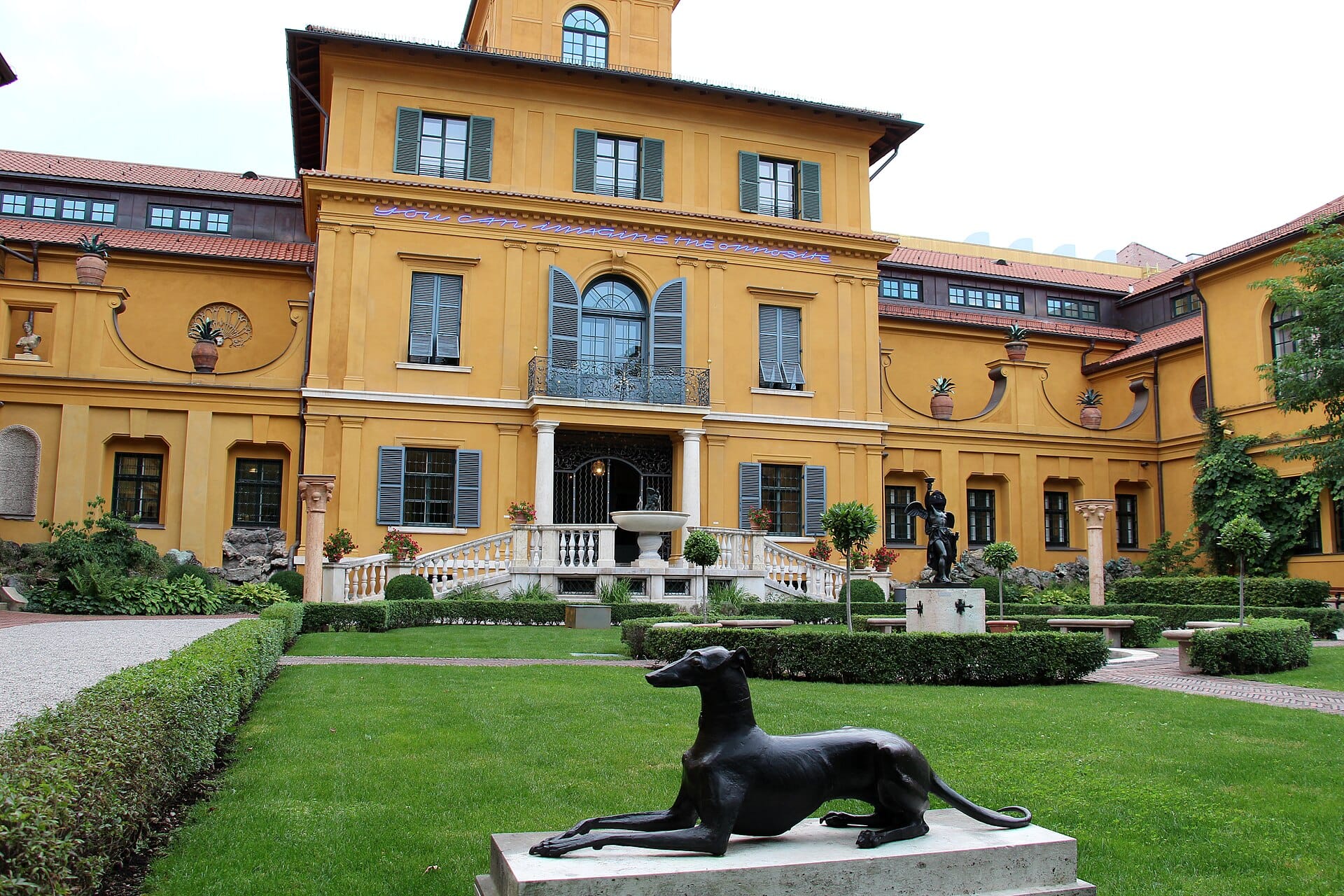
The Städtische Galerie im Lenbachhaus is Munich's municipal gallery, and it delivers far more than that modest title implies. Founded in 1929 as a municipal gallery, it occupies the Florentine-Renaissance-style villa built for and by painter Franz von Lenbach (1836–1904), one of the most commercially successful portrait painters of 19th-century Germany. Lenbach designed the villa with the deliberate intention of impressing clients, and the warm ochre facade, arcaded loggia, and formal garden still signal that confidence from the street.
The building's architectural ambition sets an interesting stage for what's inside: the world's largest collection of Der Blaue Reiter, the short-lived but seismically influential expressionist movement founded in Munich in 1911 by Wassily Kandinsky and Franz Marc. The contrast between the ornate villa exterior and the charged, color-drenched canvases within is one of the museum's most distinctive qualities. It's not a contradiction so much as a useful reminder that radical art has always grown in the shadow of established wealth.
💡 Local tip
The audioguide is included in your ticket price. Pick it up at the entrance — the Blue Rider rooms in particular benefit from context on Kandinsky's theory of color and spiritual abstraction.
The Blue Rider Collection: Why It Matters
Der Blaue Reiter (The Blue Rider) existed as a coherent movement for barely three years, roughly 1911 to 1914. Yet in that time, Kandinsky, Franz Marc, August Macke, Gabriele Münter, Alexej von Jawlensky, and their circle produced some of the most significant works in the history of abstraction. The Lenbachhaus holds this collection in remarkable depth, largely because Gabriele Münter, Kandinsky's companion, donated her private holdings to the museum in 1957 on her 80th birthday. That single gift transformed the gallery.
Standing in the Blue Rider galleries, the energy is immediately legible even to visitors with no art history background. Kandinsky's compositions use color as a structural force rather than a descriptive tool; Franz Marc's animals glow in fractured planes of blue and gold. These are not works you need to decode. They act on the eye before the brain has time to interpret. The rooms are relatively small and the hanging is considered, which prevents the viewing fatigue that larger encyclopedic museums can produce.
For visitors building a Munich art itinerary, the Lenbachhaus sits within the city's Kunstareal district, where the Alte Pinakothek, Pinakothek der Moderne, and the Glyptothek are all within a 10-minute walk. A focused museum day in Maxvorstadt requires planning — the Lenbachhaus alone deserves at least two hours if you engage seriously with the collection.
Tickets & tours
Live prices and dates from our booking partner. If you book, we may earn a commission at no extra cost to you.
Luggage Storage in Munich
From 6 €Instant confirmationFree cancellationOne hour city sightseeing bus tour in Munich
From 21 €Instant confirmationFree cancellationMunich Third Reich walking tour
From 32 €Instant confirmationFree cancellationRomantic Road Day Trip to Rothenburg and Harburg
From 74 €Instant confirmationFree cancellation
Beyond Blue Rider: The Full Collection
The permanent collection doesn't begin and end with expressionism. On the ground floor, the villa rooms have been preserved with period furnishings and a selection of Lenbach's own portraits — heavily gilded, psychologically direct works that were enormously fashionable in Wilhelmine Germany. These rooms offer a very different sensory register from the upper floors: darker walls, heavy frames, the smell of old wood and parquet. Spending a few minutes here before ascending contextualizes just how dramatically Munich's art scene shifted within a single generation.
The museum also holds significant holdings in postwar and contemporary art, including works by Joseph Beuys, whose political and material experiments represent a sharp pivot from the figurative traditions downstairs. Rotating temporary exhibitions occupy the main gallery spaces and regularly feature internationally significant shows, so the experience of a return visit can differ substantially from the first.
ℹ️ Good to know
Note for visitors: The Kunstbau, the Lenbachhaus's underground exhibition space beneath Königsplatz, is currently closed until further notice. Check the official website for updates before planning a visit specifically around Kunstbau programming.
The Building and Garden: Architecture Worth Noticing
Franz von Lenbach commissioned the villa in 1887, working with architect Gabriel von Seidl to create a building that fused a working studio with a residence for entertaining Munich's cultural elite. The result is a complex that wraps around a central courtyard garden — a genuinely unusual feature for a Munich city address. In warmer months, the garden is accessible and makes an underrated spot to sit between rooms, away from the flow of visitors.
The museum's 2013 extension by Foster + Partners added a gleaming gold-panel facade along the street frontage, creating one of Munich's more discussed architectural juxtapositions. Up close, the new wing's angled gold cladding reads as a deliberate counterpoint to the villa's ochre plaster. From Luisenstraße, the combination is bold. Opinions on whether it succeeds are genuinely divided among architecture observers, which makes it worth forming your own view before entering.
The Lenbachhaus is located on the edge of Maxvorstadt, Munich's university and museum district. The neighborhood's wide streets and neoclassical civic buildings set a consistent architectural tone that makes the Foster extension feel especially conspicuous — not a criticism, simply an observation about how it reads in context.
Practical Visit: Timing, Crowds, and What to Expect
The Lenbachhaus is open Tuesday through Sunday from 10:00 to 18:00, with extended hours on Thursdays until 20:00. It is closed on Mondays. Thursday evenings are a good option if you prefer quieter rooms — foot traffic noticeably thins after 17:00, and the extended Thursday hours mean you can take your time without feeling rushed by closing announcements.
Weekend mornings between 11:00 and 13:00 tend to see the highest visitor density, particularly in the Blue Rider galleries, which are the primary draw. If you arrive at opening on a Tuesday or Wednesday, you will often have those rooms nearly to yourself for the first 30 to 45 minutes — a genuinely different experience from a Saturday midday visit.
On the first Thursday of each month, admission is free from 18:00 to 22:00. This is a known event among Munich residents, so expect a livelier atmosphere than usual — more social, with a noticeably younger crowd. It's worth experiencing once for the energy, though serious study of the collection is better suited to a paid daytime visit when crowd flow is more predictable.
⚠️ What to skip
Photography is permitted in most permanent collection rooms without flash, but restrictions apply in temporary exhibitions. Check signage at each room entrance rather than assuming blanket permission.
Getting There and Nearby Context
The museum sits on Luisenstraße at the western edge of the Kunstareal. By public transport, the most direct option is the U2 or U8 to Königsplatz, which drops you a three-minute walk from the entrance. Tram 27 to Karolinenplatz adds another option from the city centre, while the U1 or U7 to Stiglmaierplatz works if you're approaching from the north or west.
Cycling is practical and consistent with how locals move through this part of the city. The Munich cycling network connects Maxvorstadt well to the city centre and to the Englischer Garten to the northeast, making a bike-and-museum day a genuinely sensible combination in good weather.
The Königsplatz square itself is directly adjacent and worth a few minutes before or after the museum. Its neoclassical Propyläen gate and the surrounding symmetry feel deliberately monumental — the square was heavily used for Nazi mass rallies in the 1930s, a history addressed more directly at the nearby NS-Dokumentationszentrum a short walk to the east.
Who Should Reconsider
Visitors primarily interested in traditional Bavarian art or local folk culture will find relatively little here — the Lenbach portrait rooms aside, the collection is oriented toward international modernism and contemporary practice. Those expecting a sweeping encyclopedic survey of European painting should instead prioritize the Alte Pinakothek or the Pinakothek der Moderne. And if the Kunstbau closure in 2026 affects your specific interest in large-scale temporary exhibitions, confirm current programming before making the trip the centerpiece of your day.
Insider Tips
- The audioguide included with your ticket covers both the Blue Rider rooms and the Lenbach villa interiors — use it for the Lenbach section too, which most visitors rush through. Understanding the social context of Lenbach's portrait commissions makes the contrast with Kandinsky's abstractions on the floor above genuinely striking.
- Thursday evenings (10:00–20:00) offer the best combination of extended time and reduced crowd pressure. If you arrive at 17:30, you often get the Blue Rider galleries to yourself as daytime visitors clear out before the evening crowd builds.
- The courtyard garden between the old villa and the new wing is easy to miss but worth locating — it offers an unusual exterior view of both building phases side by side and is a calm place to sit if museum fatigue sets in mid-visit.
- The first Thursday of each month brings free admission from 18:00 to 22:00. The crowd is different in character from a regular visit — younger, more social — which makes for a different experience. If you want maximum access to the artwork without competition, a paid Tuesday or Wednesday morning remains the quieter option.
- Combine the Lenbachhaus with the Glyptothek and Antikensammlungen on Königsplatz for a full Kunstareal day that spans ancient Greek sculpture, 19th-century portraiture, and 20th-century abstraction — three entirely different registers of art within a 10-minute walking radius.
Who Is Städtische Galerie im Lenbachhaus For?
- Modern art enthusiasts, especially those with an interest in expressionism and the roots of abstraction
- Architecture travelers who want to see the Foster + Partners gold extension alongside the original Lenbach villa
- Museum-focused day-trippers building a Kunstareal itinerary in Maxvorstadt
- Visitors on a budget looking for Munich's free first-Thursday evening option
- Travelers who prefer focused, curated collections over sprawling encyclopedic museums
Nearby Attractions
Other things to see while in Maxvorstadt:
- Alte Pinakothek
The Alte Pinakothek in Munich's Maxvorstadt district houses one of the world's foremost collections of European paintings from the 14th to 18th century. From Dürer and Rubens to Rembrandt and Raphael, this is where Bavaria's centuries-long obsession with collecting art reaches its peak.
- Antikensammlungen (State Collection of Antiquities)
The Antikensammlungen (State Collection of Antiquities) at Königsplatz presents one of Europe's finest collections of ancient Greek vases, Etruscan bronzes, and Roman jewelry. Housed in a neoclassical building from the 1840s, it rewards slow, attentive visitors far more than a quick walk-through.
- Glyptothek
Built by Leo von Klenze for King Ludwig I and opened in 1830, the Glyptothek on Königsplatz is Munich's oldest public museum. Its collection of Greek and Roman sculpture spans roughly 900 years, housed in one of Europe's finest Neoclassical buildings. This guide covers what to see, when to go, and how to make the most of your visit.
- Königsplatz
Königsplatz is Munich's most architecturally ambitious public square, designed by King Ludwig I as a Bavarian answer to the Athenian Acropolis. Flanked by a Doric propylon gate, a neoclassical art museum, and a hall of Greek sculptures, it is simultaneously a monument to royal ambition, a scar of Nazi history, and today one of the city's most quietly dramatic open spaces.
Planning a trip? Discover personalized activities with the Nomado app.