Englischer Garten (English Garden): Munich's Great Outdoor Escape
Stretching 5.5 kilometres through the heart of Munich, the Englischer Garten is one of the largest urban parks in the world. Free to enter year-round, it draws everyone from surfers and sunbathers to families and history buffs, offering a rare combination of open meadows, manicured paths, and century-old beer gardens.
Quick Facts
- Location
- Schwabing / central-northeast Munich; south entrance near Prinzregentenstraße 1, 80538 München
- Getting There
- U3/U6 Universität (central area); Bus/Tram Nationalmuseum/Haus der Kunst (south end); Tram Tivolistraße (Chinese Tower area)
- Time Needed
- 1–2 hours for a focused walk; a full day if you plan to linger at the beer garden or sunbathe
- Cost
- Free (no entrance fee). Beer garden and restaurant prices apply inside.
- Best for
- Picnics, long walks, people-watching, cycling, and authentic Munich outdoor life
- Official website
- www.schloesser.bayern.de/englisch/garden/objects/mu_engl.htm
What the Englischer Garten Actually Is
The Englischer Garten is a public park of roughly 375 hectares running north from the edge of Munich's Altstadt through the Schwabing district and into the city's northeastern outskirts. To put that in context: it is larger than Central Park in New York and larger than Hyde Park in London. Yet it charges no admission, has no fences, and closes for no season. You walk in off the street and you are simply there.
Despite the English name, this is a thoroughly Bavarian institution. It was established in 1789 under Elector Karl Theodor, with the southern section laid out between 1789 and 1792 and the northern portion, incorporating former military gardens, completed around 1800. The principal designers were Benjamin Thompson (an American-born scientist and statesman who held the title Count Rumford) and Friedrich Ludwig von Sckell, a landscape architect who shaped the park into the flowing, informal style that gave it its name. The 18th-century English landscape movement favoured naturalistic forms over the geometric rigidity of French formal gardens, and that philosophy is still legible in every curving path and undulating meadow you walk through today.
The park is managed by the Bavarian Palace Administration (Bayerische Schlösserverwaltung), the same authority that oversees Nymphenburg Palace and other Bavarian state properties. That institutional backing ensures consistent upkeep of its bridges, waterways, and historic structures.
The South End: Where the City Meets the Park
The most-visited section is the southern tip, accessible from Prinzregentenstraße near the Haus der Kunst. This is where the park transitions sharply from the urban density of the Altstadt. Within a few steps of the tram stop you are on a gravel path beneath old plane trees, the street noise behind you dropping faster than you would expect.
Just inside the south entrance, the Eisbach stream passes under a small bridge. At the bridge, a standing wave forms where the channel narrows, and on most days of the year you will find surfers riding it. The wave operates continuously and the riders queue on the bank. It is one of Munich's most photographed sights, and while it looks spontaneous, it has been a fixture here since the 1970s. If you want to watch without the crowd pressing in, arrive before 9 AM or after 7 PM. For a fuller picture of this phenomenon, see our dedicated page on the Eisbach wave.
💡 Local tip
The south entrance (Nationalmuseum/Haus der Kunst tram stop) is the quickest way in from the city centre, but the park extends far north. If you only have an hour, stay south of the Chinese Tower. If you have a half-day, keep walking north and you will find significantly fewer tourists.
Tickets & tours
Live prices and dates from our booking partner. If you book, we may earn a commission at no extra cost to you.
Luggage Storage in Munich
From 6 €Instant confirmationFree cancellationOne hour city sightseeing bus tour in Munich
From 21 €Instant confirmationFree cancellationMunich Third Reich walking tour
From 32 €Instant confirmationFree cancellationRomantic Road Day Trip to Rothenburg and Harburg
From 74 €Instant confirmationFree cancellation
The Chinese Tower and the Beer Garden
About 1.5 kilometres north of the Eisbach bridge, the Chinesischer Turm (Chinese Tower) rises above the treetops. This five-storey wooden pagoda was built in 1789 and is one of the park's most recognizable structures. Around its base sits one of Munich's largest beer gardens, with seating for several thousand people. It is self-service, which means you carry your own food and drink from the stalls, and you are welcome to bring your own food as long as you buy drinks at the counter.
On a warm Saturday afternoon the beer garden can feel genuinely packed: long wooden benches fill with families, cyclists who have locked up at the nearby racks, and groups of friends who have claimed spots hours earlier. The noise level is celebratory rather than overwhelming, a mix of Bavarian dialect, tourist German, and a dozen other languages. A brass band occasionally plays on the tower's lower gallery. The smell is of fresh pretzels and roasting chicken from the kiosks, and on sunny weekends it reaches you before you turn the corner.
Weekday mornings are a different experience entirely. The same benches hold a fraction of the weekend crowd, mostly locals on a long lunch break or older residents who come daily. This is arguably the more enjoyable version if you want a beer and conversation without shouting.
⚠️ What to skip
Weekends from late April through September are very busy around the Chinese Tower beer garden, especially between noon and 6 PM. If you are visiting with young children or have limited mobility and need accessible seating, arriving before 11 AM gives you a much better chance of finding space at a table.
The Open Meadows: Munich at Its Most Unguarded
Between the Chinese Tower and the park's northern sections are wide, gently sloped meadows that serve as Munich's collective sunbathing ground from roughly May through September. On hot days the grass is covered with towels, cyclists weave along the perimeter paths, and the sounds carry across the open space in a particular way: distant laughter, the creak of bicycle gears, the occasional splash from one of the park's streams.
Nudity is permitted in designated areas of the park, a long-standing and openly practiced norm that surprises some international visitors. These areas are marked and well-known to locals; they are not hidden or provocative in context, simply a part of the park's culture. Visitors who find this unexpected should be aware before arriving.
The meadows are also the best place to observe the daily rhythm of the park across the hours. Early morning brings runners and dog walkers on the gravel paths. By mid-morning on a weekday, the grass starts to fill with people sitting with coffee cups. The lunch period sees a surge of office workers from the surrounding Schwabing district. Late afternoon is the most photogenic time: the light comes in low and golden from the west, and the meadows glow in a way that makes the city skyline visible to the south feel surprisingly distant.
Structures Worth Seeking Out
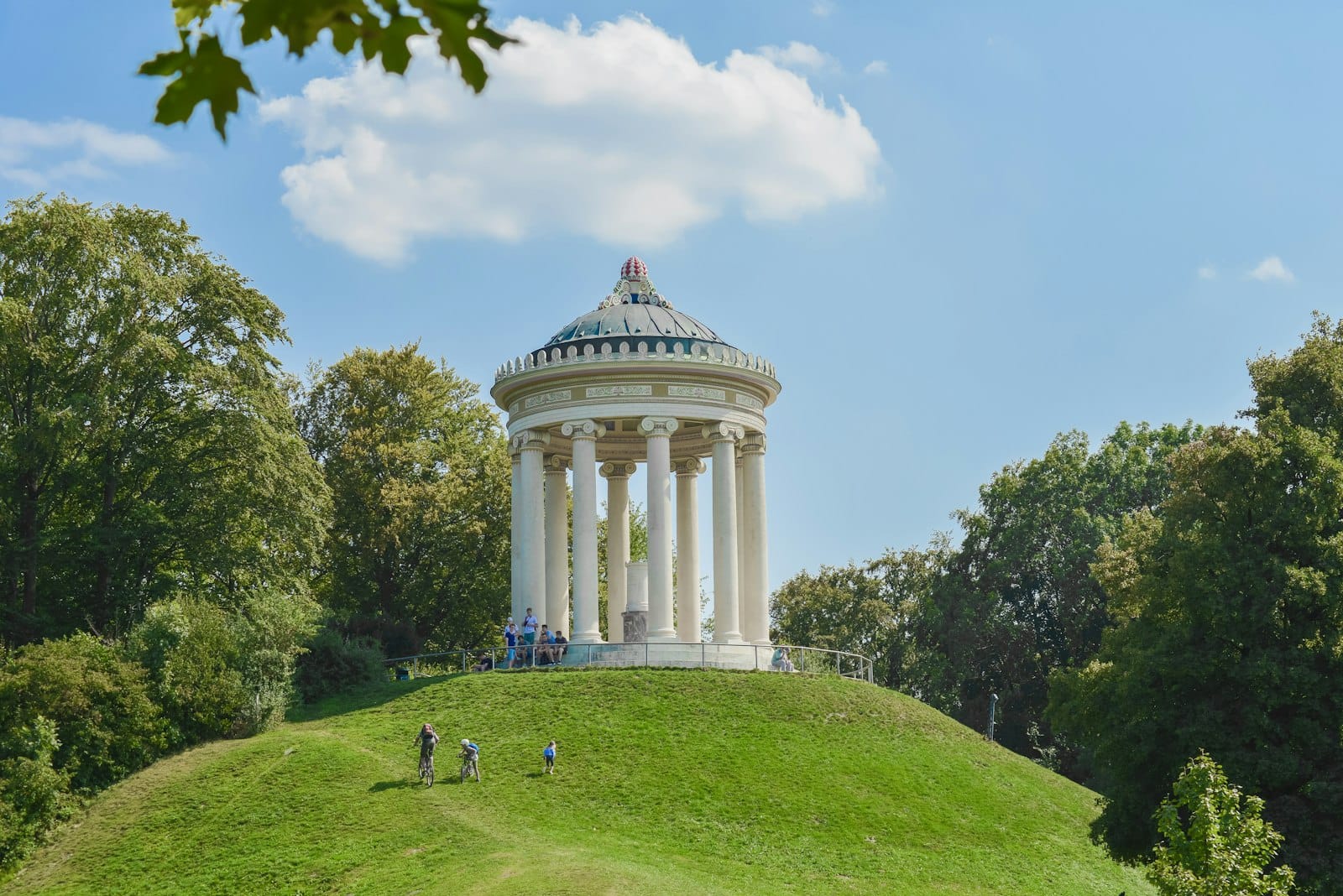
Beyond the Chinese Tower, three other structures reward a short detour. The Monopteros is a Greek-style circular temple on a small hill about 600 metres south of the Chinese Tower. Built in 1838, it offers one of Munich's best urban views from its steps: the city skyline to the south, the park spreading out in every other direction. The hill below is a popular picnic spot and in summer is almost always occupied.
The Japanese Tea House (Japanisches Teehaus) sits at the edge of the Kleinhesseloher See, a lake in the northern section of the park. It was a gift from Japan in connection with the 1972 Munich Olympics and is used for formal tea ceremonies, though public entry is limited. The lake itself offers rowing boats for hire seasonally and has a restaurant on its eastern bank.
The Kleinhesseloher See is also the best landmark for understanding the park's scale. From its northern shore you are roughly 3.5 kilometres from the south entrance. From here, the city feels genuinely absent. For context on what surrounds this area of Munich, the Schwabing neighborhood runs along the park's western edge and has good cafés and restaurants for a post-walk stop.
Getting There and Getting Around
The park has no single entrance: it is accessible from dozens of points along its entire 5.5-kilometre length. For first-time visitors, the most logical starting points are the south end near the Haus der Kunst (bus and tram stop: Nationalmuseum/Haus der Kunst) or the central area accessible from U-Bahn station Universität, served by lines U3 and U6.
Cycling is an excellent way to cover the full length. The park has dedicated cycle paths throughout, and Munich's bike-share network (operated by MVG) has docking stations near several entrances. Traffic within the park is mostly pedestrian and cyclists, with some access roads, but the main meadow and path network is car-free.
On foot, a complete north-south walk from Prinzregentenstraße to the park's northern boundary takes roughly 90 minutes at a steady pace without stops. Most visitors cover the southern third, which contains the main sights. For a broader view of how to plan a day around the park and surrounding attractions, the 3-day Munich itinerary covers how the Englischer Garten fits into a full city stay.
💡 Local tip
If you are cycling, enter from the Tram stop Tivolistraße on the park's northwest side for direct access to the Chinese Tower beer garden and nearby parking. This avoids the busier pedestrian-heavy south entrance entirely.
Seasonal Differences and When to Visit
The park operates year-round without restriction, but the experience changes dramatically by season. Summer (June through August) is when the park is at maximum use: meadows full, beer garden running at capacity, and the Eisbach crowded with spectators. This is also when the park is most photogenic and most social, and when it is worth arriving early or late to avoid the peak.
Spring (April and May) offers the park at perhaps its most pleasant: the trees come into leaf, weekend temperatures rise enough for sitting outside, and the crowds are smaller than midsummer. Early morning in May, when the light catches the fresh green of the meadows and the paths are still quiet, is one of Munich's more underrated experiences.
Autumn brings a distinct atmosphere: the beech and oak trees turn gold and amber from mid-October onward, and the park takes on a quieter character. The beer garden typically reduces hours or closes in October. Winter is cold, with average lows around -3 to -1°C, and the park is used primarily by dog walkers and runners. When snow falls, the Monopteros hill is used for sledding and the landscape is genuinely striking. For an overview of how Munich weather affects sightseeing in general, see the guide to the best time to visit Munich.
Photography and Practical Details
The best light in the park is in the late afternoon when the sun is west of the tree canopy and the meadows catch warm tones. The Monopteros is best photographed from the northeast in morning light, with the city skyline visible behind it. The Eisbach wave photographs well from the bridge railing, but in good weather you will be sharing that position with many others; a position on the west bank a few metres downstream gives a cleaner angle and avoids crowds.
Wear comfortable shoes with grip on the gravel paths. After rain the paths near the Eisbach can be muddy at the edges. There are public toilets near the Chinese Tower beer garden and at several other points in the park. The beer garden accepts cash and cards; smaller kiosks near the meadows are often cash only, so carry a few euros.
The park itself is free, and a morning spent here costs nothing beyond any food or drink you choose. For other free activities nearby and across Munich, the guide to free things to do in Munich is worth reading before your trip.
Insider Tips
- The Eisbach wave is at its clearest and least crowded on weekday mornings before 9 AM. The surfers are often practicing seriously at this hour rather than performing, and you can watch from the bridge without anyone blocking your view.
- The northern section of the park beyond the Kleinhesseloher See is almost entirely visited by locals. If you walk 20 minutes north of the lake you will find meadows and paths that feel nothing like the tourist circuit to the south.
- The Monopteros hill is one of the few elevated viewpoints in central Munich with a genuine city panorama. It is most valuable at golden hour, around 7–8 PM on a summer evening, when the light makes the church towers to the south stand out clearly.
- The park has a second, smaller beer garden at the Seehaus restaurant on the eastern shore of the Kleinhesseloher See. It is significantly less crowded than the Chinese Tower and has a better view of the water, making it worth the longer walk.
- If you are visiting in winter, Sunday mornings after a fresh snowfall are when locals bring children to sled on the Monopteros hill. It is a genuine local scene, not a tourist event, and it is one of the more charming things the park offers outside of summer.
Who Is Englischer Garten (English Garden) For?
- Travellers wanting to experience authentic Munich daily life rather than curated attractions
- Families with children who need open space and flexible timing
- Cyclists looking to cover the park end-to-end as part of a longer Munich cycling day
- Beer garden enthusiasts who want a classic Bavarian outdoor drinking experience without the tourist-facing intensity of the Hofbräuhaus
- Budget-conscious visitors who want a full-day activity that costs nothing to access
Nearby Attractions
Other things to see while in Schwabing:
- Eisbach River Wave
At the southern entrance to the English Garden, a small channel of the Isar River produces one of Munich's most unusual surf spots. The Eisbachwelle is free to watch at any time, and unlike anything else in central Europe.
- Haus der Kunst
Haus der Kunst is Munich's largest contemporary art institution, housed in a monumental 1937 building originally constructed as a showcase for Nazi-approved art. Today it presents ambitious international exhibitions that often challenge the very history embedded in its walls. Understanding both layers makes a visit far more rewarding.
Planning a trip? Discover personalized activities with the Nomado app.