Eisbach River Wave: Where Munich's Surfers Ride an Urban Standing Wave
At the southern entrance to the English Garden, a small channel of the Isar River produces one of Munich's most unusual surf spots. The Eisbachwelle is free to watch at any time, and unlike anything else in central Europe.
Quick Facts
- Location
- Prinzregentenstraße opposite number 22, 80538 Munich (edge of the English Garden, opposite Haus der Kunst)
- Getting There
- Tram/bus stop Nationalmuseum/Haus der Kunst (steps away); U-Bahn Lehel (approx. 5–10-min walk)
- Time Needed
- 30–60 minutes to watch; longer if combining with the English Garden
- Cost
- Free — no ticket required. Surfing is permitted daily 5:30 a.m. to 10:00 p.m. under city safety regulations.
- Best for
- Curious travelers, photographers, sport watchers, families, and anyone with 30 minutes to spare
- Official website
- www.munich.travel/en/pois/sports-leisure/eisbachwelle
What Is the Eisbach Wave?
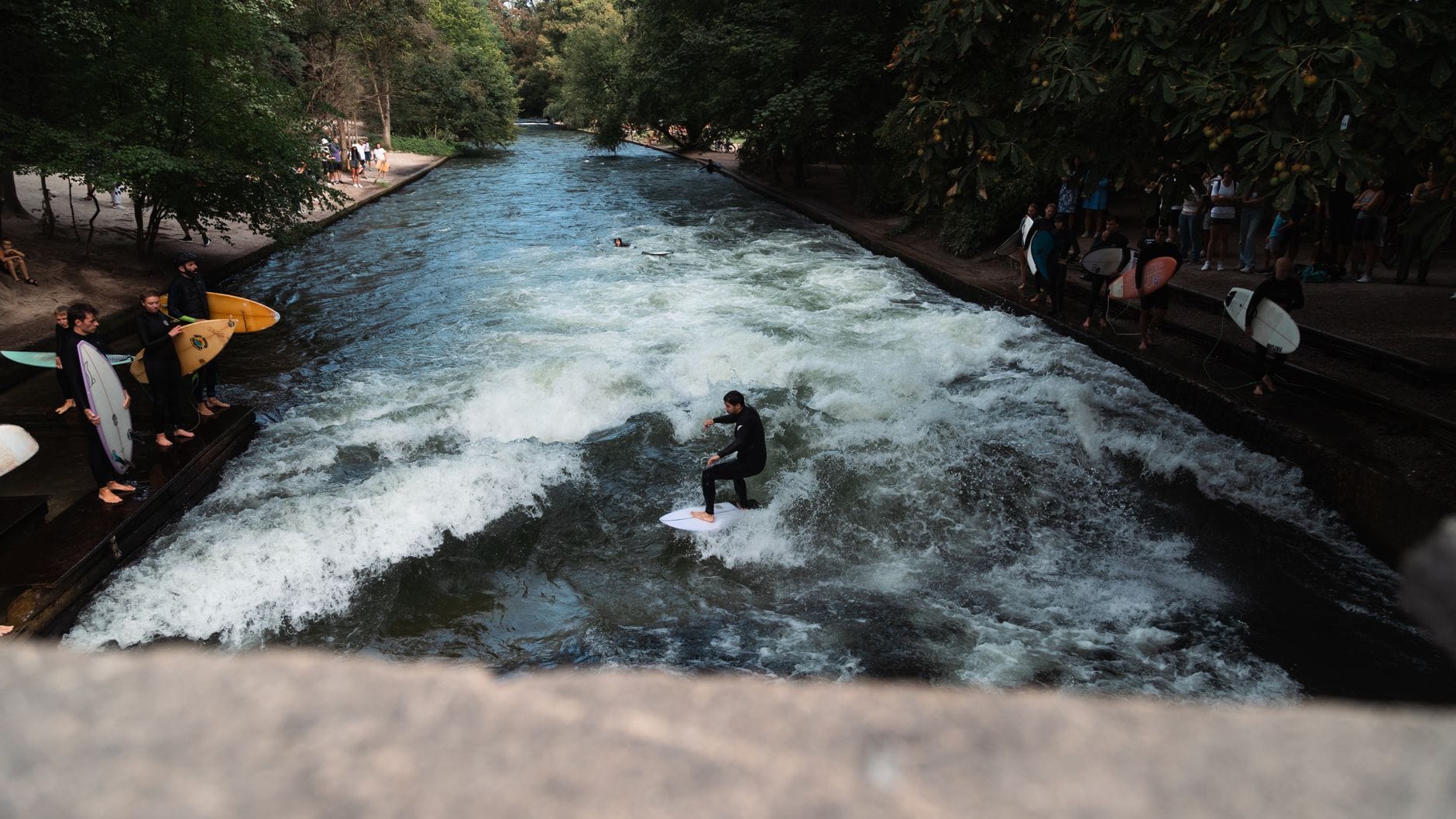
The Eisbachwelle is a permanent standing wave produced where the Eisbach channel narrows and accelerates beneath a low bridge at the southern entrance to the English Garden. The Eisbach itself is a man-made side arm of the Isar River, around 2 kilometres long, and the hydraulics at this particular point create a wave that has been surfable for roughly 50 years. It is not a beach break or a river tidal bore. The wave does not move. Surfers step onto it one at a time from the side, ride it until they fall or choose to exit, and then give way to the next person waiting on the bank.
That simplicity is part of what makes it so watchable. The wave is compact, powerful, and continuous, and the small crowd that gathers on the bridge above creates an atmosphere closer to a street performance than a traditional sporting event. Visitors who stumble across it mid-walk through the park routinely stop and stay far longer than they intended.
ℹ️ Good to know
Swimming and bathing in the Eisbach channel are not permitted. Spectators watch from the bridge parapet directly above the wave. Surfing is allowed daily from 5:30 a.m. to 10:00 p.m., and surfers must use a self-releasing (quick-release) leash as a mandatory city safety requirement.
How It Feels to Be There
You hear the wave before you see it. Walking south along the edge of the English Garden from the Haus der Kunst, a consistent low roar rises from below the road level, somewhere between white noise and the sound of a fast-moving stream over rocks. When you reach the bridge and look down, the water is green and opaque, moving at speed, and a surfer is usually already on it.
The bridge is narrow, so spectators naturally press against the railing and lean over. On a summer afternoon, the crowd is three or four people deep, with cyclists and joggers threading past behind them. There is a faint smell of cold fresh water rising from below, even in warm weather, because the Eisbach runs year-round and the channel is always shaded at that point. The sound is constant and slightly isolating — conversations nearby become harder to follow, which gives the whole scene a focused, concentrated energy.
The surfers themselves are skilled. This is not a beginner wave. The channel is tight, the wave is fast, and surfers who lose their footing get flushed downstream immediately. Watching someone hold a clean line for 30 or 40 seconds draws quiet recognition from the crowd. No one claps loudly, but there are nods.
Tickets & tours
Live prices and dates from our booking partner. If you book, we may earn a commission at no extra cost to you.
Luggage Storage in Munich
From 6 €Instant confirmationFree cancellationOne hour city sightseeing bus tour in Munich
From 21 €Instant confirmationFree cancellationMunich Third Reich walking tour
From 32 €Instant confirmationFree cancellationRomantic Road Day Trip to Rothenburg and Harburg
From 74 €Instant confirmationFree cancellation
Morning, Afternoon, and Evening: How the Experience Changes
Early morning, between 7 and 9 a.m., is the best time for photographers. The light is softer, the crowd on the bridge is thin, and the surfers who arrive at this hour tend to be regulars who have been doing this for years. You can stand at the railing without obstruction and shoot without other people's arms appearing in frame. The water catches the morning light at a low angle and the contrast between the green channel and the white foam of the wave is at its sharpest.
By mid-afternoon in summer, particularly on weekends, the bridge is genuinely crowded. Tourists, locals with dogs, cyclists, and groups of young people form a dense audience. The atmosphere is lively but not unpleasant. If you are travelling with children, the afternoon crowd actually works in your favour, because the collective excitement makes the spectacle more legible to younger visitors who might otherwise be uncertain what they are looking at.
In the evening, especially in summer when light lingers until 9 p.m. or later, a different crowd appears. Fewer tourists, more locals, and surfers who have come after work. The bridge empties out noticeably after 7 p.m. and the whole thing becomes quieter and more intimate. If you are in the area for dinner and want to add a quick stop without the daytime press, early evening is the time to do it.
💡 Local tip
For photographs, position yourself at the eastern end of the bridge for a slight downward angle on the wave. Avoid shooting from directly above, where the bridge railing tends to obscure the surfer's lower body. A lens of 50–85mm equivalent will isolate a surfer cleanly without requiring you to lean out at an awkward angle.
History and Context: How a City Channel Became a Surf Spot
The Eisbach channel was engineered as part of Munich's water management infrastructure, not as a recreation amenity. The standing wave that forms at the Eisbachwelle location is a consequence of the channel's gradient and the structure of the low bridge, not a deliberate design feature. Surfers began riding it informally around the 1970s, initially against regulations. The practice continued regardless, and over roughly 50 years it became embedded enough in Munich's culture that the city eventually formalised access rather than continue trying to prohibit it.
This trajectory, from illicit activity to officially permitted sport, is part of what gives the Eisbachwelle its character. It did not emerge from urban planning or tourism strategy. It emerged from people doing something they loved in a place that was not designed for it, and persisting until the city adapted around them. In that sense, it fits well with the broader identity of the English Garden, which has long hosted informal, self-organised recreation including nude sunbathing on the Schönfeldwiese meadow, open-air bar culture, and informal sport that operates with a light regulatory touch.
The wave's reputation among the global surf community is genuine. It has been featured in surf films and magazines, and visiting surfers from coastal cities sometimes make a specific detour to ride it, not because it is the best wave they will ever find, but because riding a river wave in a landlocked city about 60 kilometres from the Alps carries its own particular appeal.
Getting There and Practical Logistics
The most straightforward approach is to take tram 16 or 36 or bus 100 to the Nationalmuseum/Haus der Kunst stop, which puts you a short walk from the wave. From there, walk south along Prinzregentenstraße and look for the gathering of people leaning over the bridge. Alternatively, U-Bahn line U4 or U5 to Lehel station takes about 5–10 minutes on foot through a pleasant residential stretch. If you are already in the Schwabing area or walking through the park, the wave is at the southern tip of the English Garden and easy to incorporate into a longer walk.
There is no entrance, no ticket booth, and no organised queuing system for spectators. You simply walk to the bridge and watch. The wave operates year-round, but in winter the crowd is thin and the surfers are fewer. In particularly cold winters, when air temperatures drop well below freezing, you may find the bridge almost empty even on a clear day — which is actually a fine time to visit if you enjoy a quieter, more austere version of the scene.
Wear comfortable shoes if you plan to combine the visit with a walk through the English Garden or onward to the Haus der Kunst immediately adjacent. There are no specific dress code requirements and no facilities directly at the wave site — no toilets, no café, no seating area. The nearest amenities are in the park to the north or along Maximilianstraße to the south.
⚠️ What to skip
Do not attempt to enter the channel or touch the water from the bridge. The current is fast and the drop is significant. Surfing is only permitted under the city's official conditions, which include a self-releasing leash. Spectating from the bridge is the correct and safe way to experience this spot as a visitor.
Is It Worth Your Time?
Honestly, yes — if your expectations are calibrated correctly. The Eisbachwelle is not a major cultural institution. It is not a museum or a palace. It will not teach you much about Bavarian history or architecture. What it offers is something rarer on a standard city itinerary: a genuinely unexpected sight that reveals something real about how a city actually lives. Munich is often packaged as beer halls and baroque churches and Alpine views, and those things are real. But a city where people have been surfing a river channel through the middle of a royal park for 40 years, and where the city eventually said yes to it, is a place worth understanding a little better. For that, 30 minutes at the bridge is time well spent. It pairs naturally with a walk through the English Garden and can easily be combined with a visit to the Haus der Kunst or a stop at the Isar River banks a short distance south.
Travelers who find informal, crowd-driven spectacles frustrating, or who are sensitive to noise, may prefer to skip it or visit early morning when the bridge is quiet. If you are visiting Munich primarily for its museums, the wave is likely to feel like a detour. But if you are already in the area on a warm afternoon, walking past without stopping would be an unusual choice.
For a wider picture of where the Eisbachwelle fits in Munich's outdoor life, the free things to do in Munich guide covers it alongside other no-cost attractions across the city.
Insider Tips
- The wait time between surfers is usually short, but if you arrive during a busy Saturday afternoon and want to see extended, uninterrupted rides, weekday mornings produce longer and less-interrupted sessions with fewer people cycling through the queue.
- The bridge directly over the wave is the obvious spectator spot, but walking 20 metres along the bank to the east gives you a side-on view of the wave at ground level — closer to the surfers and without the overhead angle that flattens the action.
- In winter, surfers wear full wetsuits and sometimes gloves. The wave itself does not change significantly with the seasons, but the visual contrast of a surfer in a thick wetsuit against a snowy English Garden backdrop makes for striking photography.
- If you want to see serious surfing rather than learners, come on a weekday. Weekends bring more people trying the wave for the first time, which means more wipeouts and shorter rides. Experienced regulars tend to use quieter morning slots.
- The Eisbach wave is sometimes temporarily closed or surfing is prohibited for safety or maintenance. There is no dedicated advance public notice system for tourists, so if you are making a special trip rather than passing by, check Munich's official city website (muenchen.de) for any current restrictions or closures before committing to the journey.
Who Is Eisbach River Wave For?
- Photographers looking for dynamic action shots without needing specialist access or permits
- Families with children who want something kinetic and visually engaging that costs nothing
- Travelers interested in urban subculture and the informal ways cities adapt to the people who live in them
- Visitors combining a walk through the English Garden with a stop at the Haus der Kunst or the Isar riverbanks
- Anyone with 30 minutes between plans who happens to be in the Maxvorstadt or Lehel area
Nearby Attractions
Other things to see while in Schwabing:
- Englischer Garten (English Garden)
Stretching 5.5 kilometres through the heart of Munich, the Englischer Garten is one of the largest urban parks in the world. Free to enter year-round, it draws everyone from surfers and sunbathers to families and history buffs, offering a rare combination of open meadows, manicured paths, and century-old beer gardens.
- Haus der Kunst
Haus der Kunst is Munich's largest contemporary art institution, housed in a monumental 1937 building originally constructed as a showcase for Nazi-approved art. Today it presents ambitious international exhibitions that often challenge the very history embedded in its walls. Understanding both layers makes a visit far more rewarding.
Planning a trip? Discover personalized activities with the Nomado app.