Haus der Kunst Munich: Contemporary Art Inside a Complicated Monument
Haus der Kunst is Munich's largest contemporary art institution, housed in a monumental 1937 building originally constructed as a showcase for Nazi-approved art. Today it presents ambitious international exhibitions that often challenge the very history embedded in its walls. Understanding both layers makes a visit far more rewarding.
Quick Facts
- Location
- Prinzregentenstraße 1, 80538 München (edge of the English Garden, Schwabing)
- Getting There
- Bus 100 to Königinstraße; U4/U5 to Lehel (then Tram 16 to Nationalmuseum / Haus der Kunst); U3/U6 to Odeonsplatz (then Bus 100 to Königinstraße)
- Time Needed
- 1.5 to 3 hours depending on current exhibitions
- Cost
- €15 standard / €11 reduced / €5 children and youths (up to 18) / €35 family ticket (2 adults + up to 3 children). Closed Tuesdays.
- Best for
- Contemporary art enthusiasts, architecture followers, history-conscious travelers
- Official website
- www.hausderkunst.de/en
What Is Haus der Kunst?
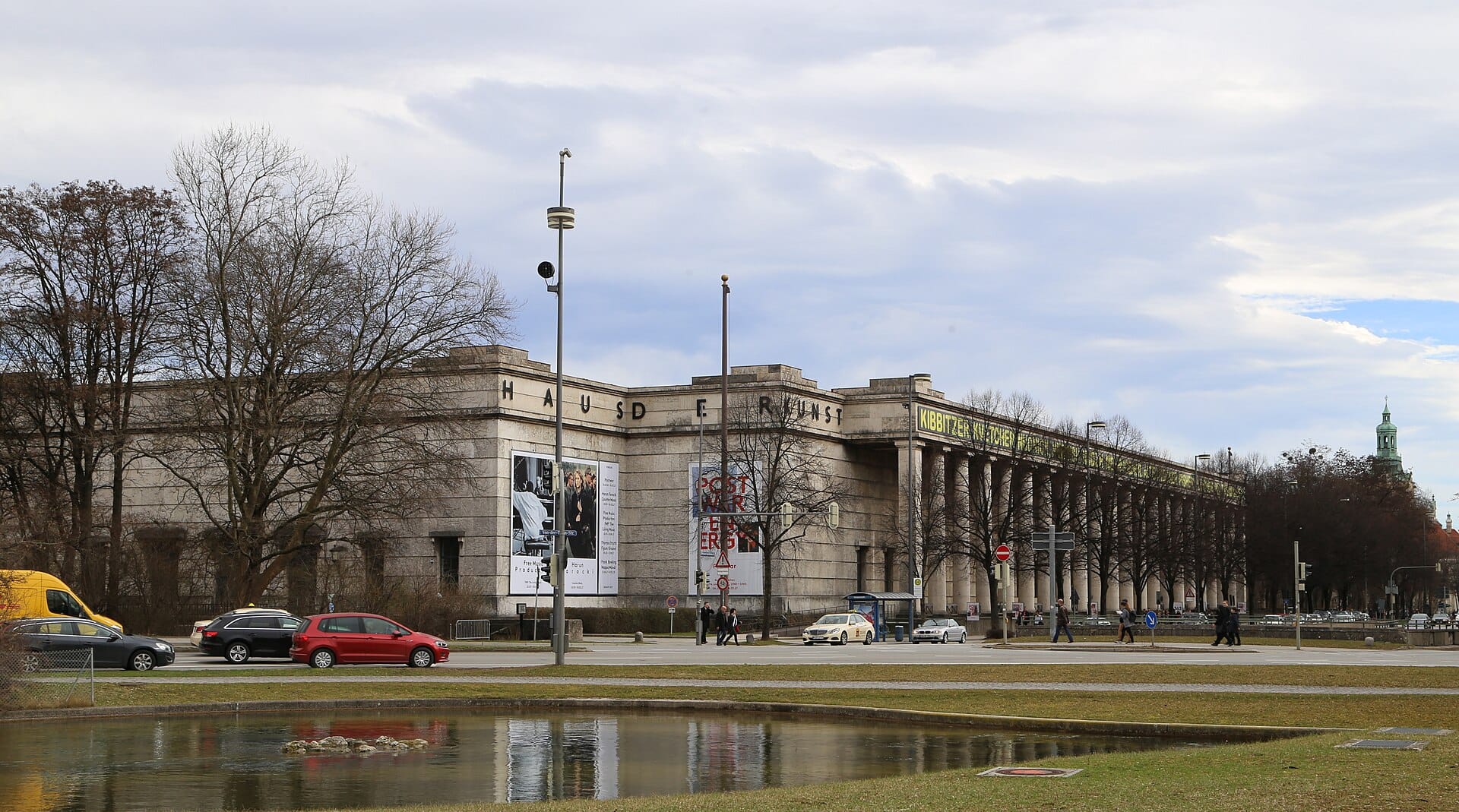
Haus der Kunst, which translates literally as House of Art, is one of Germany's most significant contemporary art museums, and certainly its most architecturally loaded. The building sits at Prinzregentenstraße 1, on the southern edge of the English Garden, its long neoclassical colonnade facing the broad avenue like a declaration. What it was declaring in 1937, when it opened as the Haus der Deutschen Kunst (House of German Art), was the cultural ideology of the Nazi regime. Today, the institution has reoriented itself entirely around international contemporary art, often using that very history as material for critical reflection.
The disconnect between the building's appearance and its current contents is not incidental. It is part of the institution's identity. Curators here regularly commission work that responds to the architecture itself: the massive granite columns, the coffered ceilings, the spatial hierarchy of the interior. For visitors who take a moment to read that context, what would otherwise be a standard contemporary art venue becomes something considerably stranger and more interesting.
ℹ️ Good to know
Haus der Kunst is closed every Tuesday. Opening hours on all other days are 10:00 to 20:00 (Thursday often extended to 22:00 for special programs). Check the official website before visiting, as large exhibition changes occasionally affect access to specific galleries.
The Architecture: A Building That Carries Weight
The building was constructed between 1933 and 1937, designed by Paul Ludwig Troost, Hitler’s favored architect, for the Nazi leadership. It was the first major monumental building of the Third Reich, intended to house an annual juried exhibition of art meeting Nazi aesthetic standards. The style, sometimes called Stripped Classicism, is deliberately severe: a long rectangular block, uniform columns along the main facade, an absence of ornament that reads less as restraint than as aggression. Hitler reportedly called it the first great art temple of the new German state.
Standing outside today, the building is undeniably imposing. The colonnade stretches for 175 meters. The stone has aged to a pale buff-grey. In morning light, particularly in winter, the facade casts long shadows across the pavement and the columns take on an almost theatrical presence. At street level, though, the effect is slightly undermined by the surrounding trees and the easy proximity of joggers crossing from the English Garden. The building intends grandeur; the city has surrounded it with life.
The interior volumes are correspondingly large. Galleries are high-ceilinged and neutrally finished, suited to ambitious installations and large-scale works. This is not an intimate museum. If you are interested in how contemporary artists respond to hostile or charged spaces, Haus der Kunst is a more provocative venue than many of Munich's other cultural institutions. For context on the broader museum district, see the guide to Munich's best museums.
Tickets & tours
Live prices and dates from our booking partner. If you book, we may earn a commission at no extra cost to you.
Adventure rally through murderous Munich
From 12 €Instant confirmationFree cancellationVIP tour to Neuschwanstein and Linderhof with Venus Grotto from Munich
From 169 €Instant confirmationFree cancellationFull-day Trip to Neuschwanstein Castle and Linderhof from Munich
From 0 €Instant confirmationFree cancellationAdventure rally in Munich´s Old Town luxury life undercover
From 12 €Instant confirmationFree cancellation
What to Expect From the Exhibitions
Haus der Kunst does not maintain a permanent collection in the traditional sense. The institution operates entirely through temporary and semi-permanent exhibitions, which rotate regularly and tend toward the ambitious end of the contemporary art spectrum: large solo retrospectives, thematic group shows, and commissions that address political, ecological, or historical questions. The programming is internationally oriented, drawing on artists who are rarely seen in Germany at this scale.
This model has both strengths and limitations. On a good visit, you might encounter a major retrospective that fills the entire building with coherence and force. On a transitional visit, between exhibition cycles, some galleries may be closed for installation work and the experience feels sparse. The quality varies more than it would at a museum with a fixed collection. Check what is currently on the website before you go, rather than arriving with a general expectation of being impressed.
The museum also runs an extensive public program including lectures, film screenings, and guided tours. Some are in English; check the program calendar on the official website if that matters to you. On weekend evenings, the building has a notably different atmosphere: the cafe fills up, the crowd skews younger, and the atmosphere is less reverential than during weekday mornings.
💡 Local tip
Photography policies vary by exhibition. Some shows permit non-flash photography; others restrict it entirely based on artist agreements. Look for posted signage at each gallery entrance rather than assuming.
How the Experience Changes Through the Day
Weekday mornings between 10:00 and noon are the quietest windows. The large galleries feel genuinely spacious and the low ambient noise allows for the kind of sustained attention that large contemporary works tend to require. This is when the scale of the building works most in your favor.
By early afternoon, school groups begin to arrive, and the atrium and main corridors carry considerably more noise. The sound bounces easily off hard surfaces in these volumes. If you are sensitive to that, either arrive early or push through to the later afternoon, when groups tend to leave. By 17:00 the crowd shifts again toward adults, often stopping in after work or before dinner, and the atmosphere settles. The museum stays open until 20:00, which makes it one of Munich's better options for an evening cultural activity when the light outside has already faded.
The building's position at the edge of the Englischer Garten means you can combine a visit with a walk through the park. In summer, the stretch of garden immediately to the north fills with Münchners picnicking and cycling, which creates a pleasant contrast to the museum's austerity. In winter, the bare trees and grey sky make the colonnade look considerably more severe.
Getting There and Practical Logistics
The most convenient public transit option is Bus 100, Munich's art route, which stops at Königinstraße immediately adjacent to the museum. This bus connects many of the major cultural institutions in Maxvorstadt and along Prinzregentenstraße and is a practical choice if you are combining Haus der Kunst with other museums. Alternatively, the U4 or U5 to Lehel followed by Tram 16 to Nationalmuseum / Haus der Kunst puts you roughly a ten-minute journey away through the Lehel neighborhood.
If you are approaching on foot from central Munich, the walk from Odeonsplatz along Prinzregentenstraße takes around twelve to fifteen minutes and passes the Theatinerkirche and several handsome 19th-century facades. It is a worthwhile approach if the weather is reasonable.
Admission is €15 standard (Hausticket large), €11 reduced, €5 for children and youths up to 18 years, and €35 for a family ticket covering two adults and up to three children. Severely disabled visitors receive a discount; confirm current conditions at the box office. There is a cloakroom for larger bags and coats. The museum shop stocks exhibition catalogs and art publications that are genuinely worth browsing.
⚠️ What to skip
Ticket prices and exhibition schedules change. Always verify current admission costs and what is on before your visit at hausderkunst.de. Some blockbuster shows sell out advance slots on busy weekends.
Historical Context: From Nazi Showcase to Critical Institution
The building's original purpose was to house the Große Deutsche Kunstausstellung, the Great German Art Exhibition, an annual show staged annually from 1937 to 1944 that presented figurative, ideologically approved work. Simultaneously, in Munich in 1937, the Nazi regime also staged the Entartete Kunst exhibition, which displayed modernist work it had confiscated and condemned as degenerate. Both shows ran in the city at the same time, and the contrast was deliberate propaganda. Understanding this context makes the institution's current commitment to exactly the kind of international, experimental art the Nazis suppressed feel pointed rather than accidental.
Post-war, the building served various functions before being reconstituted as an exhibition space. The transformation into a contemporary art institution developed across the second half of the 20th century. Munich's broader reckoning with this period of history is addressed in depth at the NS-Dokumentationszentrum, which is specifically dedicated to documenting National Socialist history and is well worth pairing with a visit to Haus der Kunst if you want the fuller picture.
Who Should Think Twice
Haus der Kunst is not for every visitor to Munich. If your interest is in classical painting, Bavarian history, or decorative arts, this institution will feel remote from your priorities. The rotating exhibition model also means there is no guaranteed anchor experience: unlike the Alte Pinakothek, where you know exactly what you will encounter, Haus der Kunst offers something different every visit, and occasionally disappoints when shows are between cycles or when the current program does not land.
Families with young children will likely find the experience difficult unless the current exhibition is specifically accessible. The spaces are large and the works are often conceptually demanding. Visitors with limited time in Munich who need to prioritize might find more immediate return at Deutsches Museum or the Pinakotheken cluster in Maxvorstadt, where the collections are fixed and the experience is more predictable.
Insider Tips
- Bus 100, the so-called Museumslinie, connects Haus der Kunst directly with the Pinakotheken and Königsplatz museums. If you are doing a museum day, this route saves significant walking and costs only a standard MVV single ticket.
- The museum's lower level cafe and bar has a reputation among locals as a good evening spot independent of the exhibitions. The interior design preserves some of the original 1930s spatial logic, which makes it an interesting room to sit in once you know the building's history.
- If you are visiting a large group exhibition, read the exhibition guide (usually free at the desk or downloadable) before entering rather than after. The curatorial framing at Haus der Kunst often recontextualizes work in ways that are not self-evident from the pieces alone.
- The building's exterior colonnade is open to walk through even when you are not visiting the museum. The proportions of the columns and the long perspective toward Prinzregentenstraße are worth examining at street level, especially if you have any interest in 20th-century political architecture.
- Evening visits (17:00 to 20:00) on weekdays are consistently the least crowded and coincide with natural light fading outside, which paradoxically suits many of the interior installations. The final hour before closing is often quieter than any other time of day.
Who Is Haus der Kunst For?
- Contemporary art followers who want to see ambitious international programming outside major capitals
- Architecture and design travelers interested in the aesthetics and politics of 1930s monumental building
- History-conscious visitors who want to experience firsthand how a site of Nazi cultural policy has been reclaimed
- Evening cultural seekers, given the 20:00 closing time is later than most Munich museums
- Those pairing a museum visit with a walk through the English Garden, which begins immediately behind the building
Nearby Attractions
Other things to see while in Schwabing:
- Eisbach River Wave
At the southern entrance to the English Garden, a small channel of the Isar River produces one of Munich's most unusual surf spots. The Eisbachwelle is free to watch at any time, and unlike anything else in central Europe.
- Englischer Garten (English Garden)
Stretching 5.5 kilometres through the heart of Munich, the Englischer Garten is one of the largest urban parks in the world. Free to enter year-round, it draws everyone from surfers and sunbathers to families and history buffs, offering a rare combination of open meadows, manicured paths, and century-old beer gardens.
Planning a trip? Discover personalized activities with the Nomado app.