Theatinerkirche St. Kajetan: Munich's Most Striking Baroque Church
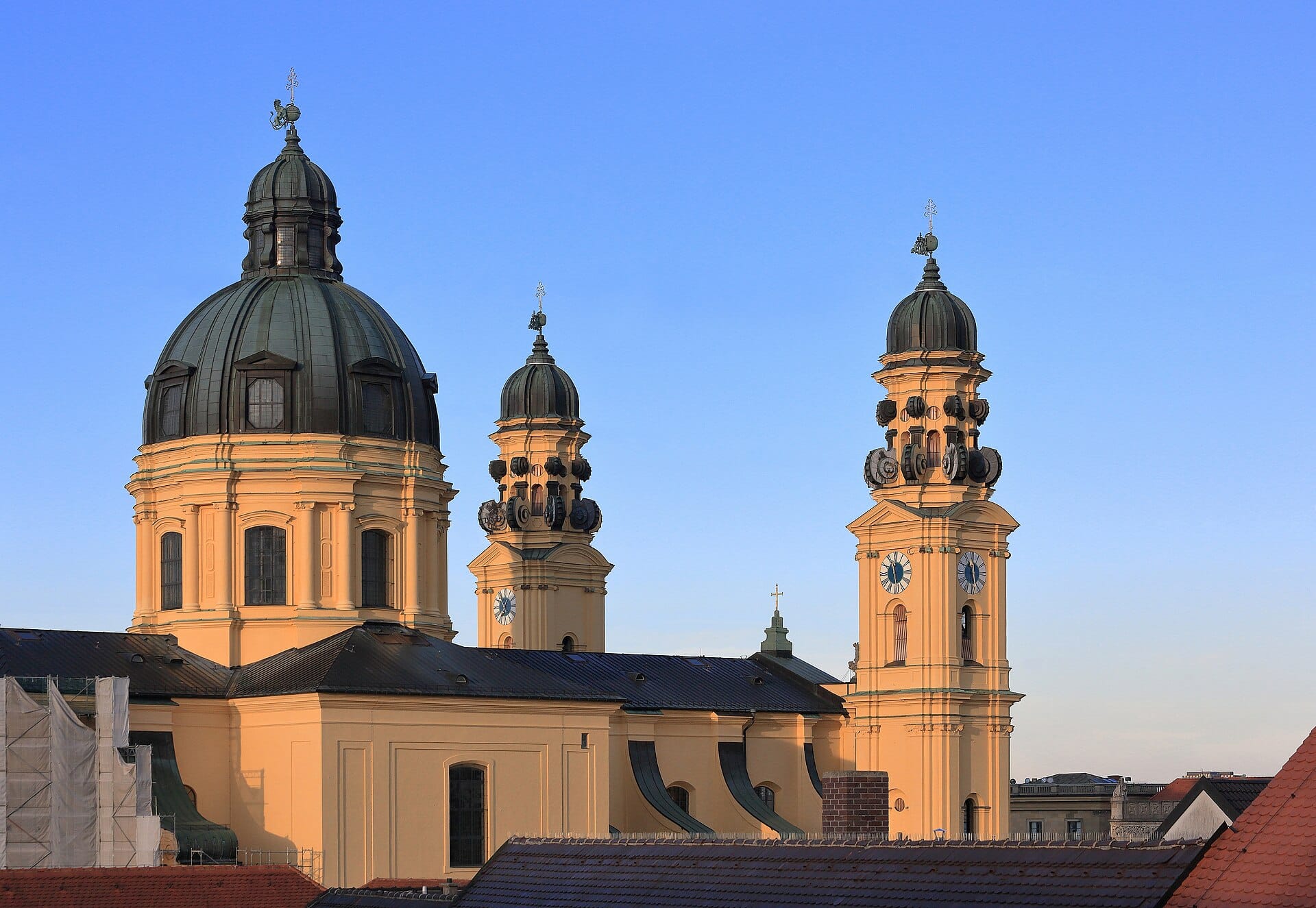
Standing on the west flank of Odeonsplatz, the Theatinerkirche St. Kajetan is one of Munich's most recognizable religious buildings. Its distinctive ochre-yellow facade, twin bell towers, and soaring roughly 60-metre dome have anchored the Altstadt skyline since the 17th century. Entry is free, and the interior rewards anyone who steps inside.
Quick Facts
- Location
- Theatinerstraße 22, 80333 München (Odeonsplatz, Altstadt)
- Getting There
- U-Bahn: Odeonsplatz (U3, U4, U5, U6); Bus 100 at Odeonsplatz
- Time Needed
- 20–40 minutes for a thorough visit
- Cost
- Free admission
- Best for
- Architecture lovers, history seekers, quiet reflection in the city centre
- Official website
- http://www.theatinerkirche.de
What the Theatinerkirche Actually Is
The Theatinerkirche St. Kajetan (full German name: Hof- und Stiftskirche St. Kajetan) is a Roman Catholic church sitting on the western edge of Odeonsplatz, one of Munich's main ceremonial squares. The building is impossible to miss: its pale yellow facade, flanked by two identical bell towers and crowned by a copper-green dome, creates one of the most photographed compositions in the entire city. It was commissioned as a court church for the Wittelsbach ruling family, and that royal ambition is still legible in every detail.
Unlike many Munich landmarks that charge admission, the Theatinerkirche is free to enter. That makes it both an architectural destination and a genuinely usable sanctuary from the surrounding crowds. Opening hours are approximately 7:00 to 21:00 daily (sometimes closer to 6:00 to 19:30), though hours can shift around religious services and events — verify with the parish before planning around a specific window.
💡 Local tip
If you arrive at Odeonsplatz by U-Bahn, the church entrance on Theatinerstraße is about a 30-second walk from the exit. The U3, U4, U5, and U6 lines all stop here, making it one of the most accessible churches in Munich.
A History Built Around a Royal Birth
Construction began in 1663, commissioned by Elector Ferdinand Maria and his wife Henriette Adelaide of Savoy to give thanks for the birth of their long-awaited heir. The choice of architect, Agostino Barelli, and the deliberate modeling of the church on Sant'Andrea della Valle in Rome signaled something clear: this was Munich staking a claim as a city of European cultural weight.
The church was consecrated in 1675 while still structurally unfinished. Construction continued until around 1690, but the ornate Rococo facade visible today was not completed until 1768, when François de Cuvilliés the Younger — son of the designer behind the Residenz's celebrated rococo interior — finished the twin-tower frontispiece. What you see from Odeonsplatz, then, is not a single moment in time but a century of evolving ambition compressed into one facade.
The church served as the court church of the Wittelsbach dynasty and remains closely associated with Bavarian royal history. The crypt beneath the church holds the remains of several members of that dynasty, giving the building a significance that goes well beyond architectural spectacle. For fuller context on Munich's royal past, the Munich Residenz — directly across Odeonsplatz — completes the picture of Wittelsbach power in the city centre.
Tickets & tours
Live prices and dates from our booking partner. If you book, we may earn a commission at no extra cost to you.
Luggage Storage in Munich
From 6 €Instant confirmationFree cancellationOne hour city sightseeing bus tour in Munich
From 21 €Instant confirmationFree cancellationMunich Third Reich walking tour
From 32 €Instant confirmationFree cancellationRomantic Road Day Trip to Rothenburg and Harburg
From 74 €Instant confirmationFree cancellation
The Exterior: What You See Before You Even Step Inside
The Theatinerkirche's facade is one of the defining visual anchors of central Munich. The ochre-yellow paint — a colour closely associated with Bavarian court architecture — contrasts sharply with the white stucco detailing and the weathered green of the copper dome. In bright morning light, the facade glows with an almost theatrical warmth. On overcast winter afternoons, that same yellow reads as serious and imposing against a grey sky.
The twin towers rise prominently and create a visual frame for the dome behind them, which reaches roughly 60 metres in height. Photography from the square works best in the morning when the sun hits the facade directly. By mid-afternoon, the facade falls into shade and the shot becomes flatter. For the classic Odeonsplatz composition that includes the Feldherrnhalle to the south, position yourself on the square's central axis and use a moderate focal length.
The church sits immediately next to the Feldherrnhalle, the 19th-century loggia that closes the southern end of Odeonsplatz. The two buildings together form a kind of compressed architectural history of Munich, with the Baroque church and the Neoclassical hall in direct proximity. Neither overshadows the other, which makes the square itself worth walking slowly rather than crossing in a hurry.
Inside the Church: Light, Stucco, and Royal Tombs
The interior follows a Latin cross plan modeled on Roman High Baroque prototypes, and the effect on entering is immediate. The nave is tall and white, covered in dense ornamental stucco that reads almost like lace in strong sunlight. There are no dark corners and very little stained glass to filter the light, which makes the Theatinerkirche feel luminous compared to Gothic churches of a similar scale.
The stucco work itself was produced by Italian craftsmen and covers virtually every surface of the vaulted ceiling. Up close, you can see the sculptural depth of the decorative borders and figures — it is not painted detail but modeled plaster, with real shadow and relief. For visitors with an interest in decorative arts, this alone is worth the stop.
Beneath the main floor lies the Wittelsbach crypt, which holds the remains of several members of the ruling dynasty. This is not a tourist spectacle in the way that some royal crypts are; it is a functioning part of the church, and the atmosphere is correspondingly quiet and sober. Not all parts of the crypt are accessible on a standard visit and some areas, such as the Fürstengruft, may require a small admission fee — check with the church directly if this is a specific interest.
ℹ️ Good to know
The Theatinerkirche is an active parish church. Masses are held regularly, and during services the church is not available for casual sightseeing. If you arrive during a service, either wait at the back quietly or return at a different time.
How the Experience Changes by Time of Day
Early morning, between 7:00 and 9:00, the Theatinerkirche is largely empty. Odeonsplatz outside is still quiet, the light is soft and directional, and the interior feels genuinely calm. This is the hour when the building functions as it was intended to: as a place of quiet and contemplation. The smell inside is the characteristic cool-stone-and-candle combination common to old European churches, and without the midday traffic noise seeping in from outside, the acoustic is noticeably peaceful.
By late morning and early afternoon, Odeonsplatz fills up. Tour groups move through, the square outside is busy with pedestrians crossing between the Residenz and the Altstadt shopping streets, and the church interior sees a steady trickle of visitors. It never feels overwhelmed the way the Marienplatz can, but it loses some of the early-morning stillness. If you are combining this with other central Munich sights, mid-morning works fine.
In the evening, particularly in summer, the church exterior is lit and the square takes on a different quality. The yellow facade under artificial light is worth seeing even if you do not go inside. The church typically stays open until around 21:00 (with some variation), so an evening visit is possible — but the light inside will be artificial rather than the natural daylight that shows the stucco at its best.
Practical Walkthrough: How to Do This Properly
The logical approach is to combine the Theatinerkirche with Odeonsplatz itself. Exit the U-Bahn at Odeonsplatz, spend a few minutes orienting yourself on the square, then enter the church via the main portal on Theatinerstraße. After your visit, the Munich Residenz is directly across the square and the Feldherrnhalle is adjacent. This cluster of monuments can be covered efficiently in two to three hours without rushing.
There is no bag check and no ticket desk. Walk in, take your time with the nave and the stucco detail, check whether the crypt area is accessible on that day, and leave by the same door. Dress is not formally enforced, but as in any active church, quiet and respectful behaviour is expected. Photography is generally permitted in the nave, but avoid flash and do not photograph during services.
If the Theatinerkirche sparks a broader interest in Munich's ecclesiastical architecture, Frauenkirche — Munich's cathedral with its distinctive twin towers — is about a ten-minute walk southwest, and the Asamkirche on Sendlinger Straße is an even more extreme example of Bavarian Baroque, smaller but denser in decoration.
⚠️ What to skip
Opening hours are reported as approximately 7:00–21:00 but are not fully standardized and can shift around religious observances. Confirm current hours via theatinerkirche.de before planning a visit around a specific time window.
Who Should Skip This
Visitors who find Baroque architecture repetitive after a few churches may not find the Theatinerkirche dramatically different from other Munich ecclesiastical sites. It is not a museum and does not have interactive displays or audio guides in the conventional tourist sense. Travelers focused entirely on Munich's modern culture, food, or beer garden scene — covered in depth in the Bavarian food guide — will find this a quieter kind of stop. It is also not a destination for families with young children looking for activities, as there is nothing specifically designed to engage children beyond the visual spectacle of the interior.
On its own, the church does not justify a special trip across the city. Its strength is in proximity: it happens to sit in one of Munich's most architecturally significant squares, surrounded by other major landmarks. Visitors who are already in the Odeonsplatz area have no reason to walk past without looking inside. Visitors who are not planning to be in the Altstadt at all should prioritize accordingly.
Insider Tips
- For the best exterior shot of the church with clear foreground, position yourself near the centre of Odeonsplatz before 9:00 am — the square is relatively empty and the light hits the facade directly from the east.
- The dome is best appreciated from inside the church at the crossing — look directly up at it from beneath to understand the full scale of the towering structure above you.
- The church is notably cooler than the street outside in summer, making it a practical midday pause as well as a cultural stop. In winter, it is also warmer than standing on the exposed square.
- If you want to see the stucco detail properly, visit on a clear day when natural light fills the nave. Overcast days flatten the relief and make the decoration harder to read.
- The side streets directly behind the church, around Salvatorplatz, are quieter than the main Theatinerstraße frontage and give a less-photographed view of the building's massing and the dome from ground level.
Who Is Theatinerkirche For?
- Architecture and art history enthusiasts interested in Baroque and Rococo design
- Travelers combining an Odeonsplatz walking circuit with the Residenz and Feldherrnhalle
- Anyone looking for a free, central, and genuinely impressive interior without queuing
- Photography-focused visitors working on Munich's architectural skyline
- Visitors who want a few minutes of genuine quiet in the middle of the Altstadt
Nearby Attractions
Other things to see while in Altstadt (Old Town):
- Asamkirche
Squeezed into a narrow slot on Sendlinger Strasse, the Asamkirche is a privately built late Baroque church that packs more ornamental intensity into 22 metres than most cathedrals manage in a hundred. Built by the Asam brothers between 1733 and 1746, it is free to enter and sits in the heart of Munich's pedestrian zone.
- Cuvilliés Theatre
Hidden within the Munich Residenz complex, the Cuvilliés Theatre is an 18th-century Rococo opera house of extraordinary refinement. Its gilded tiers, crimson velvet boxes, and carved ivory ornaments make it one of the most visually concentrated rooms in all of Germany.
- Deutsches Museum
The Deutsches Museum sits on its own island in the Isar river and claims a place among the largest science and technology museums on earth. With 125,000 exhibited objects spanning aviation, mining, chemistry, musical instruments, and far more, it rewards careful planning rather than a casual stroll.
- Feldherrnhalle
Standing at the southern end of Odeonsplatz, the Feldherrnhalle is one of Munich's most architecturally striking and historically loaded monuments. Built between 1841 and 1844, it witnessed the gunfire that ended Hitler's failed coup and remains freely accessible at any hour. Few structures in the city compress so much of Bavaria's and Germany's history into a single loggia.
Planning a trip? Discover personalized activities with the Nomado app.