Munich Residenz: Inside Bavaria's Most Ambitious Royal Palace
The Münchner Residenz is the largest inner-city palace in Germany, a sprawling complex with around 130 show rooms that served as the seat of Bavarian dukes, electors, and kings for over four centuries. From the glittering Antiquarium to the jaw-dropping Treasury, it rewards careful visitors with some of the finest decorative arts in Europe.
Quick Facts
- Location
- Residenzstraße 1, 80333 Munich (Altstadt, between Marienplatz and Odeonsplatz)
- Getting There
- U3/U4/U5/U6 Odeonsplatz or U3/U6 Marienplatz; both are a short walk
- Time Needed
- 2–4 hours for the museum alone; add 45–60 minutes each for the Treasury and Cuvilliés Theatre
- Cost
- Museum or Treasury: €10 / €9 reduced. Combined (both): €15 / €13 reduced. All three: €20 / €16 reduced. Under 18: free (when accompanied by an adult).
- Best for
- History lovers, architecture enthusiasts, art collectors, families with older children
- Official website
- www.residenz-muenchen.de/englisch/residenc/index.htm
What Is the Munich Residenz?
The Münchner Residenz is the former royal palace of the Wittelsbach dynasty, the ruling family of Bavaria for over 700 years. Standing on Residenzstraße in central Munich, it is the largest city palace in Germany by floor area, a complex so large that most visitors only scratch its surface on a first visit. The building that stands today is partly a faithful reconstruction: the original structure was largely destroyed in World War II and meticulously rebuilt over several decades, reopening room by room from the 1950s onward.
The site has roots going back to 1385, when a fortified building called the Neuveste was constructed here. By 1508, the Wittelsbachs had made it their permanent residence, and they continued expanding and embellishing it through the Renaissance, Baroque, Rococo, and Neoclassical periods, each era leaving a distinct stylistic layer. The result is not a single coherent building but a sequence of wings, courtyards, and ceremonial halls accumulated over five centuries of dynastic ambition. Since 1920, it has been open to the public as a museum run by the Bavarian Palace Administration.
💡 Local tip
Buy your ticket at the Max-Joseph-Platz entrance rather than queuing at the museum desk inside. On busy summer days, picking up a combined ticket (Museum + Treasury) from the start saves a second wait later.
The Residence Museum: What You'll Actually See
The Residence Museum occupies the main palace wings and guides visitors through roughly 130 rooms. The self-guided route is clearly marked, but the sheer scale can disorient first-time visitors. The recommended walking order moves roughly from the older Renaissance rooms through the Baroque state apartments and into the 19th-century Nibelungen Halls, giving a loose chronological arc to the experience.
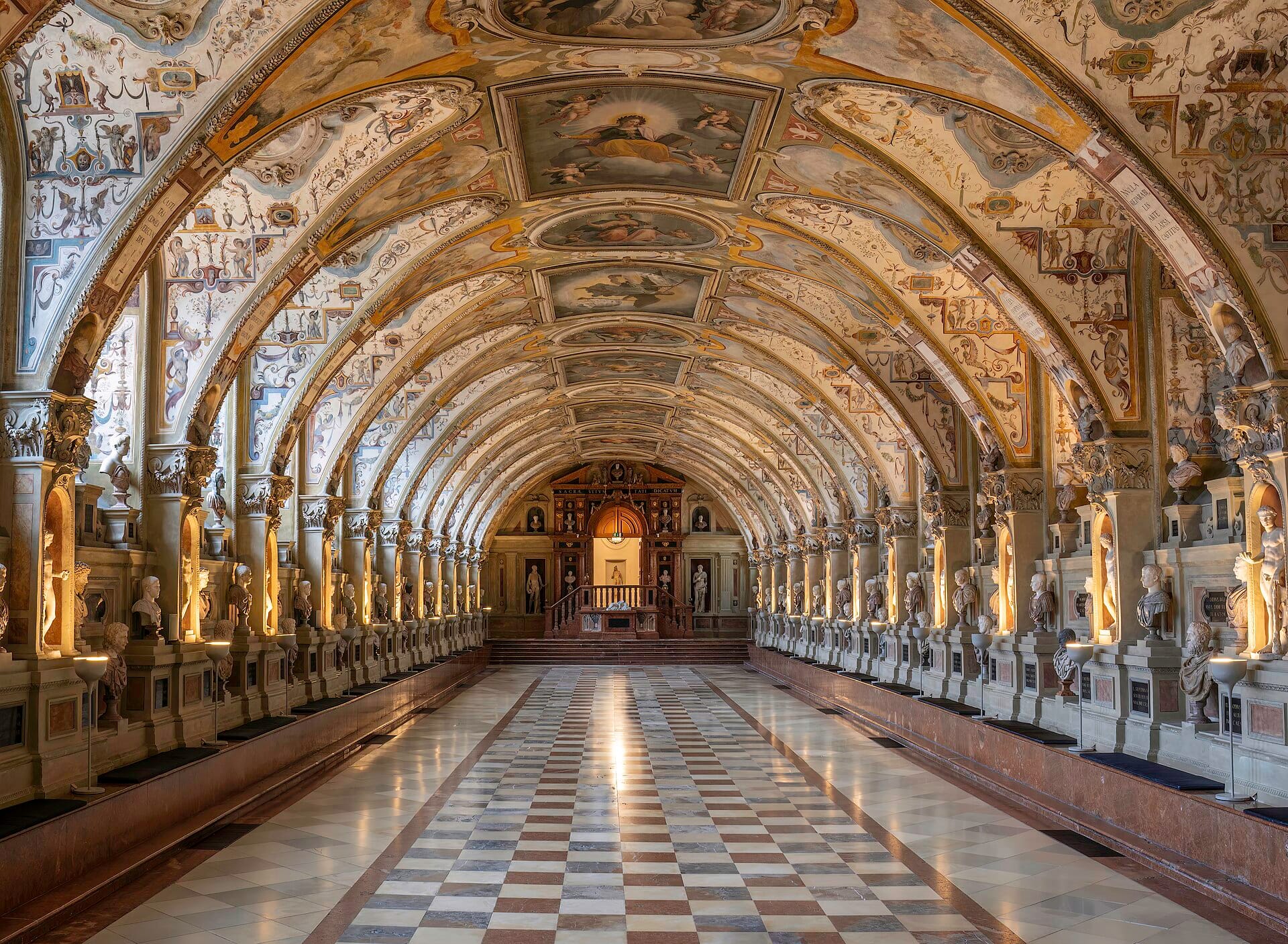
The Antiquarium is the single most striking room in the building. Built between 1568 and 1571, it is the largest surviving Renaissance hall north of the Alps, a barrel-vaulted tunnel roughly 66 metres long lined with antique busts and ceiling frescoes depicting Bavarian towns. The first time you walk in, the scale stops you in your tracks. Light from the arched windows on the south side illuminates the fresco work in the late morning, making this one of the better times to see it.
Deeper into the circuit, the Ornate Rooms (Reiche Zimmer) are a sequence of Rococo interiors from the 1730s, commissioned by Elector Karl Albrecht and executed by François de Cuvilliés the Elder. The carving, gilding, and ceiling painting here are dense to the point of exhaustion, which is partly the point: these rooms were designed to overwhelm diplomatic visitors with displays of wealth and taste. The parquet floors, restored after wartime damage, still creak faintly underfoot.
Toward the end of the museum circuit, the Ancestral Gallery presents full-length portraits of Wittelsbach rulers in strict dynastic order, a room that reads almost like a visual family tree spanning centuries. For visitors interested in broader Bavarian history, pairing the Residenz with a visit to the NS-Dokumentationszentrum offers a striking contrast: the same Altstadt, examined across radically different chapters of history.
Tickets & tours
Live prices and dates from our booking partner. If you book, we may earn a commission at no extra cost to you.
The Treasury: The Most Valuable Room in Munich
The Residenz Treasury (Schatzkammer) is housed separately from the museum and requires either its own ticket or the combined ticket. It contains the accumulated treasures of the Wittelsbach collection across ten rooms: coronation regalia, jewelled orders, devotional objects, goldsmiths' work, ivory carvings, and reliquaries dating from the 10th century onward.
The most photographed object in the Treasury is the statuette of St. George slaying the dragon, a Renaissance masterpiece in gold, enamel, and precious stones. The room lighting is deliberately dim to protect the objects, which means photographs without a steady hand tend to blur. If photography matters to you, lean gently against the display case frame rather than trying to hand-hold at slow shutter speeds.
The Treasury takes about 45 to 60 minutes at a thoughtful pace. It is smaller than the main museum but more concentrated. On weekday mornings it is noticeably quieter than the museum halls, which makes it a good place to start if you arrive at opening time and want to absorb detail before the crowds build.
The Cuvilliés Theatre: A Rococo Gem on the Top Floor
The Altes Residenztheater, better known as the Cuvilliés Theatre, occupies the upper floor of one of the Residenz wings and is included in the full combined ticket. Designed by François de Cuvilliés the Elder and completed in 1755, it is considered the finest surviving Rococo theatre interior in the world. The tiers of boxes are carved and gilded in a riot of red, gold, and ivory, and the total capacity of the house is intimate enough that no seat feels far from the stage.
Mozart's Idomeneo had its world premiere here in January 1781, a fact the theatre notes with understandable pride. The theatre is still used for live performances today; if you have timing on your side, checking the programme before your visit is worthwhile. The Cuvilliés Theatre has its own dedicated page with performance and access details.
How the Experience Changes by Time of Day
Opening time (9:00 in the summer season, 10:00 in the winter season) is when the Residenz is at its calmest. The Antiquarium and the Ornate Rooms are relatively uncrowded for the first hour, and the quality of light in the south-facing rooms is good from mid-morning onward. Tour groups tend to arrive between 10:00 and 11:00, at which point some of the narrower corridors become congested.
Midday and early afternoon in summer can feel overwhelmed. The museum's interior courtyard gardens, especially the Apothecary Garden and the Fountain Courtyard, are a useful place to decompress between sections. These small green spaces are easy to miss if you follow the indoor route too rigidly, but they are included in the circuit and offer a different sensory register: open sky, the sound of water, cooler air.
Late afternoon, in the last 90 minutes before closing, the crowds thin again. The long enfilade of state rooms catches lower, warmer light through the west-facing windows, which softens the gold leaf and deepens the ceiling frescoes. This is arguably the most photogenic time for interior shots.
⚠️ What to skip
Last admission is one hour before closing. If you arrive at 17:00 in summer (closing at 18:00), you will not have time to see more than a fraction of the building. Allow a minimum of two hours, and plan for three if combining the museum with the Treasury.
Getting There and Practical Information
The main entrance to the Residenz is on Max-Joseph-Platz, directly adjacent to the National Theatre. The easiest approach by public transit is the U-Bahn to Odeonsplatz (lines U3, U4, U5, U6), from which the palace entrance is a two-minute walk south. From Marienplatz it is a five-minute walk north along Residenzstraße. There is no dedicated car parking at the complex; visitors driving should use the city-centre car parks near Marienplatz or Odeonsplatz.
Seasonal opening hours are: 28 March to 19 October, 9:00 to 18:00; 20 October to 27 March, 10:00 to 17:00. The complex is closed on 1 January, Shrove Tuesday, and 24, 25, and 31 December.
Admission: the Residence Museum alone or the Treasury alone costs €10 (€9 reduced). The combined ticket covering both is €15 (€13 reduced). The full triple ticket adding the Cuvilliés Theatre is €20 (€16 reduced). Children under 18 enter free. Some city passes may cover entry to the Residenz Museum; check current inclusions when purchasing.
If you plan to visit multiple state museums and palaces during your trip, the Munich City Pass may offer meaningful savings. See our full guide for a breakdown of what is and is not included.
ℹ️ Good to know
Audio guides are available for hire at the entrance and add significant context to the museum rooms, many of which have limited English labelling in the older wings. Highly recommended for first-time visitors.
Photography, Accessibility, and What to Wear
Photography for personal use is permitted throughout the museum without flash. The treasury is dimly lit for conservation reasons, so a phone camera with good low-light performance makes a real difference. Tripods are not permitted in most rooms.
The Residenz involves a great deal of walking across uneven historical floors, stairs, and long corridors. Comfortable, flat-soled shoes are strongly recommended. The museum does have some accessibility provisions, but the historic structure limits wheelchair access in portions of the building. Contact the official administration directly via the palace website to confirm current accessibility arrangements before visiting.
There is a museum shop near the exit and a café accessible from the courtyard, but the food options inside the complex are limited. The surrounding Altstadt has no shortage of places to eat; the Viktualienmarkt is a five-minute walk away for a quick meal between sections.
Is It Worth Your Time?
For visitors with a genuine interest in European history, decorative arts, or Baroque and Rococo architecture, the Münchner Residenz is one of the most rewarding sites in Bavaria. It surpasses many better-known European palaces in the density and quality of what is on display, without the queue times of, say, Versailles. For context on how it fits into Munich's broader royal heritage, our guide to Nymphenburg Palace covers the Wittelsbachs' out-of-town summer residence, which makes a logical companion visit.
That said, the Residenz is not for everyone. Visitors who find repeated rooms of period furniture and gilded ceilings tedious, or who have limited mobility, may find the scale more exhausting than rewarding. Children under about ten typically lose focus after the first 30 minutes, though the courtyard gardens help. If you have only half a day in Munich and are primarily interested in the outdoors or contemporary culture, there are better uses of your time.
For a full picture of what to prioritise across the city, see our guide to the best museums in Munich, which positions the Residenz within the broader Altstadt museum landscape.
Insider Tips
- The six courtyard gardens inside the complex are largely overlooked by visitors following the interior route. The Apothecary Garden in particular is a quiet space with historical plantings, and sitting there for ten minutes resets your attention before the Baroque wing.
- If you are visiting in winter (October to March), the shorter opening hours (10:00 to 17:00) mean the afternoon light through the west-facing rooms disappears earlier. Start with the Treasury in the morning and save the museum's Ornate Rooms for late morning when they are better lit.
- The combined triple ticket (Museum + Treasury + Cuvilliés Theatre) is worth buying even if you are unsure about the theatre. The per-room cost works out significantly lower, and the Cuvilliés interior alone justifies the upgrade.
- Room fatigue is real after 90 minutes in the museum. Use the courtyard exits marked on the floor plan to step outside briefly rather than pushing through the entire circuit in one go.
- The Residenz is directly next to the Feldherrnhalle and Theatinerkirche on Odeonsplatz. Combining all three in a single morning is feasible and gives a concentrated sense of the Altstadt's ceremonial core without requiring much extra walking.
Who Is Munich Residenz For?
- History enthusiasts wanting depth on Bavarian royal and political history from the 14th to 20th century
- Architecture and interior design lovers interested in Renaissance, Baroque, and Rococo styles in a single building
- Decorative arts and jewellery collectors: the Treasury is among Europe's finest collections of goldsmiths' work
- Travellers on a focused Altstadt day who want to combine a major museum with outdoor sights like Odeonsplatz and Marienplatz
- Families with teenagers or older children who have a museum tolerance and an interest in European history
Nearby Attractions
Other things to see while in Altstadt (Old Town):
- Asamkirche
Squeezed into a narrow slot on Sendlinger Strasse, the Asamkirche is a privately built late Baroque church that packs more ornamental intensity into 22 metres than most cathedrals manage in a hundred. Built by the Asam brothers between 1733 and 1746, it is free to enter and sits in the heart of Munich's pedestrian zone.
- Cuvilliés Theatre
Hidden within the Munich Residenz complex, the Cuvilliés Theatre is an 18th-century Rococo opera house of extraordinary refinement. Its gilded tiers, crimson velvet boxes, and carved ivory ornaments make it one of the most visually concentrated rooms in all of Germany.
- Deutsches Museum
The Deutsches Museum sits on its own island in the Isar river and claims a place among the largest science and technology museums on earth. With 125,000 exhibited objects spanning aviation, mining, chemistry, musical instruments, and far more, it rewards careful planning rather than a casual stroll.
- Feldherrnhalle
Standing at the southern end of Odeonsplatz, the Feldherrnhalle is one of Munich's most architecturally striking and historically loaded monuments. Built between 1841 and 1844, it witnessed the gunfire that ended Hitler's failed coup and remains freely accessible at any hour. Few structures in the city compress so much of Bavaria's and Germany's history into a single loggia.
Planning a trip? Discover personalized activities with the Nomado app.