Nymphenburg Palace: Munich's Royal Summer Residence
Nymphenburg Palace (Schloss Nymphenburg) is the largest city palace in Germany and the former summer residence of Bavaria's Wittelsbach rulers. Set within a vast formal park in Munich's western Neuhausen-Nymphenburg district, it rewards visitors who come early, take their time, and look beyond the main hall.
Quick Facts
- Location
- Schloss Nymphenburg 1, 80638 München (Neuhausen-Nymphenburg district)
- Getting There
- Tram 17 or 12 to Schloss Nymphenburg; or Tram 16 to Romanplatz; Bus 51 from S-Bahn Laim
- Time Needed
- 2–4 hours (palace interior + park); full day if exploring all pavilions
- Cost
- Combination ticket: €15/adult (Apr–Oct), €12/adult (Nov–Mar). Children under 18 free. Park entry free.
- Best for
- History lovers, architecture fans, families, and anyone who wants a genuine escape from the city centre
- Official website
- www.schloss-nymphenburg.de
What Nymphenburg Palace Actually Is
Nymphenburg Palace, or Schloss Nymphenburg, is not a single building so much as a royal compound: a broad central palace flanked by long colonnaded wings, surrounded by formal canals, an English-style landscape park, and four satellite pavilions scattered across the grounds. Construction began in 1664, when Elector Ferdinand Maria commissioned the original structure to mark the birth of his heir, Max Emanuel. Over the following century, successive Wittelsbach rulers expanded it into the sweeping baroque complex that stands today.
The palace served as the primary summer residence of the Bavarian royal family for generations. It is where Ludwig II, the eccentric king behind Neuschwanstein Castle, was born in 1845. That historical thread, from the Wittelsbachs' early electorate to the end of the Bavarian monarchy in 1918, runs through every room of the interior.
If you are planning a broader Munich itinerary, Nymphenburg pairs naturally with a visit to the BMW Museum, which sits just a few kilometres northeast in the Olympiapark area. For context on how this palace fits into Bavaria's royal heritage, the Munich Residenz in the city centre offers the winter counterpart: the Wittelsbachs' official state seat.
💡 Local tip
The park surrounding the palace is free to enter and open year-round. Even if you skip the paid interior, walking the canal promenade and the formal gardens in front of the main facade costs nothing and takes about an hour at a relaxed pace.
The Palace Grounds: Before You Even Step Inside
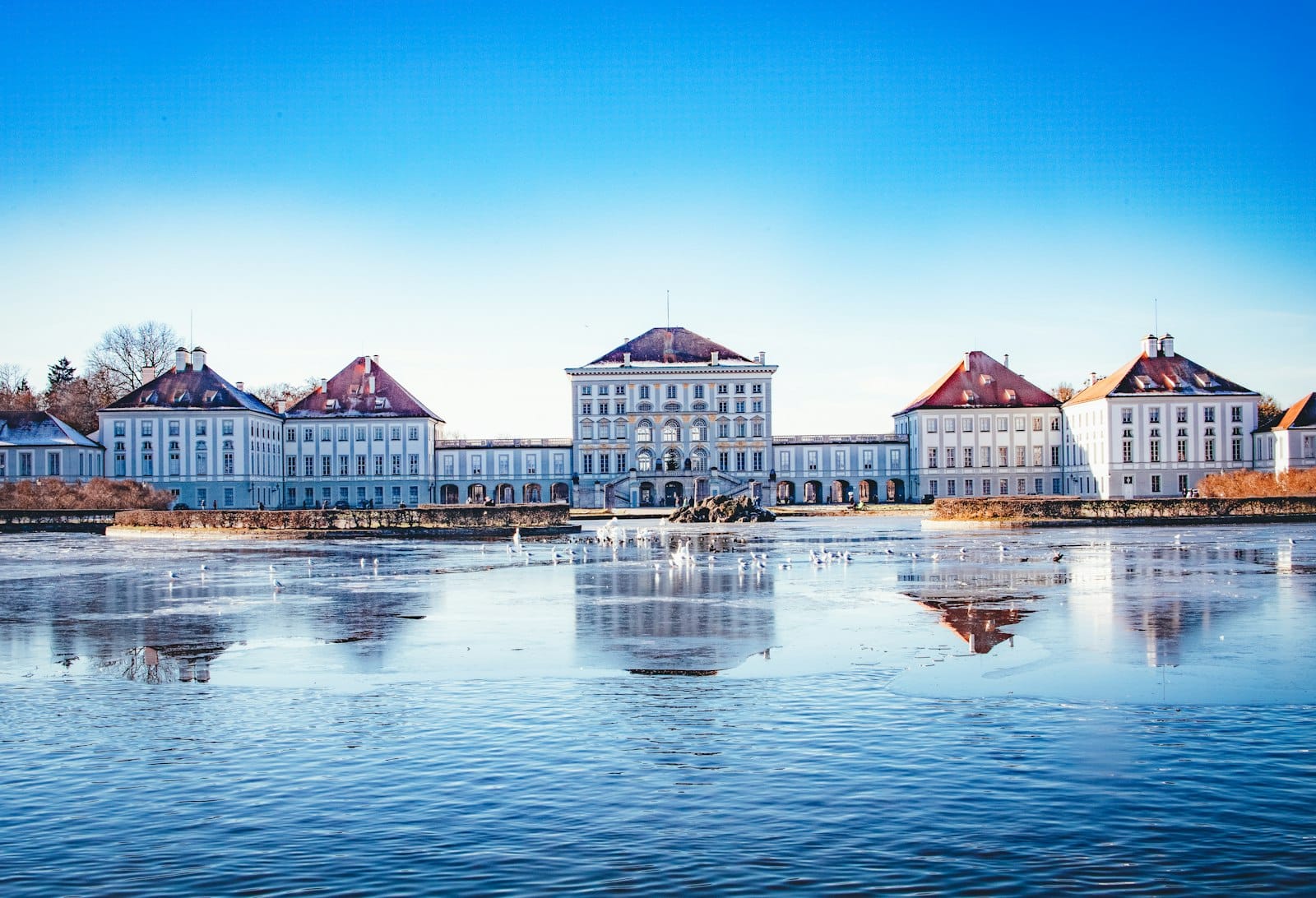
Most visitors arrive via Tram 17, which deposits you directly at the main gate. What greets you first is the forecourt canal: a straight, still waterway lined with gravel paths and low hedges that draws the eye toward the palace's pale central facade. In summer, the reflections are almost too perfect. In winter, ducks cluster on the unfrozen edges and the bare linden trees create a graphic, stripped-back version of the same view.
The formal gardens in front of the palace, with their symmetrical parterre beds, fountains, and low ornamental hedges, were laid out in the French style before being partially transformed into an English landscape park during the early 19th century. The result is a layered space: ordered and geometric near the palace, then gradually loosening into meadows, woodland paths, and small lakes as you move deeper into the 180-hectare grounds.
Early mornings, particularly on weekdays, the park is almost entirely yours. Locals use it as a jogging and cycling route, and the atmosphere before 9:00 feels less like a tourist site and more like a neighbourhood park that happens to have a palace at its centre. By 11:00 on summer weekends, tour groups start to arrive in volume and the main canal promenade becomes noticeably more crowded.
Tickets & tours
Live prices and dates from our booking partner. If you book, we may earn a commission at no extra cost to you.
Inside the Palace: What to Prioritise
The central palace building contains the state apartments, which are the primary reason most visitors pay for a ticket. The highlight is the Great Hall (Steinerner Saal), an expansive baroque ballroom stretching across three stories, decorated with frescoes by Johann Baptist Zimmermann and stucco work that covers virtually every surface. The room is theatrical in scale: standing inside it, the ceiling fresco depicting Olympian gods feels almost uncomfortably close. It is an interior that reads better in person than in photographs, because photographs flatten the depth.
Beyond the Great Hall, the apartment rooms proceed through silk-hung bedchambers, lacquer cabinets, and smaller reception rooms, each reflecting different periods of Wittelsbach taste. The rooms are not large, and the circuit through them is essentially linear, which means that if a tour group enters ahead of you, you will be moving at their pace. Arriving at opening time avoids this almost entirely.
One room that consistently surprises visitors is the Gallery of Beauties, commissioned by King Ludwig I and containing 36 portraits of women from different social backgrounds, each considered beautiful by the king's standards. The gallery is notable not only for the paintings themselves but for what they reveal about 19th-century Bavarian court culture: noblewomen sit alongside shoemakers' daughters, all treated with the same formal treatment. It is an unexpectedly humanising room in an otherwise grand context.
ℹ️ Good to know
Opening hours: 1 April–15 October, daily 9:00–18:00. 16 October–31 March, daily 10:00–16:00. Closed 1 January, Shrove Tuesday, and 24/25/31 December. Verify current hours at the official site before your visit.
The Marstallmuseum and Carriage Collection
The Marstallmuseum, housed in the southern wing of the palace complex, displays the royal stables' collection of ceremonial carriages, sleighs, and riding equipment. This section is covered under the combination ticket and is easily overlooked by first-time visitors who exhaust themselves in the main palace. That would be a mistake.
The collection includes Ludwig II's coronation carriage, an absurdly gilded vehicle encrusted with gold leaf and figurative sculpture that makes an ordinary coach look spartan by comparison. The scale of effort that went into objects designed purely for ceremony clarifies something about the Wittelsbach period that the apartment rooms alone do not convey. Alongside the carriages are porcelain pieces from the Nymphenburg Porcelain Manufactory, which was founded here in 1747 and still operates today.
The Park Pavilions: Worth the Extra Kilometres
The combination ticket gives access to four pavilions scattered through the park: Amalienburg, Badenburg, Pagodenburg, and Magdalenenklause. Of these, Amalienburg is by far the most rewarding. Built as a hunting lodge for Electress Maria Amalia in the 1730s, it is a single-story structure that conceals one of the finest rococo interiors in Europe. The central Hall of Mirrors is small, intimate, and covered floor-to-ceiling in silver stucco work: pheasants, hunting horns, and foliage pressed into the plasterwork in extraordinary detail. Visitors who miss it because they ran out of time or energy tend to list it as their single biggest Munich regret.
Badenburg contains an 18th-century indoor bathing hall with a heated pool. Pagodenburg reflects the era's fascination with East Asian aesthetics. Magdalenenklause, designed as an artificial hermitage, is the strangest of the four: a building made to look like a picturesque ruin, complete with irregular stonework and deliberately unfinished interiors. These pavilions are roughly a 10–20 minute walk from the main palace, depending on which one you choose, so factor the walking time into your planning.
⚠️ What to skip
The park pavilions are only open during the summer season (1 April–15 October). If you visit in winter, the combination ticket covers only the main palace and Marstallmuseum, and is priced accordingly (€12 regular).
How the Experience Changes by Season
Summer brings the palace to its fullest form: the parterre fountains are running, the park pavilions are open, and the formal gardens are in bloom. Tour group numbers peak in July and August, which pushes interior crowd levels up noticeably between 10:00 and 14:00. If you visit in this window, the Great Hall in particular can feel uncomfortably full. Arriving at 9:00 on the dot and starting with the main palace before the groups arrive solves most of this.
Spring, particularly April and May, offers moderate crowds, pleasant temperatures for walking the park, and the gardens beginning to fill out. Autumn shortens the opening window and closes the pavilions after mid-October, but the landscape park becomes genuinely beautiful as the trees turn, and the lower light gives the palace's pale facade a warmth it lacks in summer's flat midday glare.
Winter visits are underrated. The interior rooms are unchanged by season, the Marstallmuseum is equally compelling in January as in June, and the park, though stripped back, has a quiet that summer cannot offer. The shorter 10:00–16:00 window requires planning: arrive early, work through the palace, then walk the main canal promenade before heading back.
For broader seasonal planning across Munich, the best time to visit Munich guide breaks down what each month offers across the city's major attractions.
Practical Logistics: Getting There and Getting Around
Tram 17 is the most straightforward connection from the city centre, stopping directly at Schloss Nymphenburg. From the city centre, the ride typically takes around 25–30 minutes. Trams 12 and 16 serve Romanplatz, which is a 10-minute walk from the palace gate. Bus 51 connects from S-Bahn station Laim for those coming from the western S-Bahn lines. All of these fall within the standard MVV fare zones, so a day ticket covering the inner zones covers the journey.
The palace complex is large enough that comfortable shoes make a real difference. The gravel paths through the park are easy walking, but if you intend to reach Amalienburg and Badenburg in the same visit as the main palace and Marstallmuseum, you will cover several kilometres over a half-day. There are a cafe and basic food options within the complex near the palace entrance, though they are not exceptional. Bringing water is sensible in summer.
Photography is permitted in the park and exterior areas without restriction. Interior photography rules vary by room and season; check current guidelines at the entrance. The light inside the Great Hall is diffuse and relatively consistent throughout the day, but the Gallery of Beauties rooms receive stronger directional light in the morning hours, which helps with portrait photography.
If you are managing Munich on a tight budget, note that the Nymphenburg park itself is free. The free things to do in Munich guide covers this and other no-cost options across the city.
Who Should Think Twice
Visitors with very limited time in Munich, say one or two days, face a genuine trade-off. Nymphenburg sits about 7 kilometres west of the city centre, and getting there and back takes around 45 minutes of transit time. If your priority is the historic Altstadt, the Deutsches Museum, or the Pinakothek museums, those are closer together and may collectively offer more per hour of available time. Nymphenburg rewards visitors who can dedicate at least half a day without feeling rushed.
Visitors primarily interested in Bavarian history concentrated in the city centre may find the Munich Residenz and its Treasury a more efficient use of time, with comparable historical depth and far less walking distance from Marienplatz.
Insider Tips
- Amalienburg is the single most impressive room in the entire Nymphenburg complex, yet many visitors never reach it because they spend too long in the main palace. Budget at least 45 minutes to walk to it and take it in properly.
- The canal that runs in front of the palace freezes in cold winters, and when it does, locals ice-skate on it. If you happen to visit on such a day, the scene is genuinely remarkable and almost never photographed by tourists.
- Combination tickets are sold at the palace entrance but also at the individual pavilions. If you arrive and the main palace queue is long, buying your ticket at the Marstallmuseum entrance on the south wing often has no wait at all.
- The rear of the palace, facing the park, is architecturally richer than the formal front facade and much less photographed. Walk around the south wing to see the garden-facing elevation before heading into the park.
- The Nymphenburg Porcelain Manufactory, which traces its origins to 1747, has a small shop within the complex where you can see and purchase contemporary pieces made using traditional methods. It is easy to walk past without noticing it.
Who Is Nymphenburg Palace For?
- Architecture and baroque art enthusiasts who want to understand Bavarian royal taste in depth
- Families with children: the park is free, spacious, and easy to navigate at any pace
- Photographers looking for a large-scale palatial exterior with reliable morning light and minimal crowds
- History-focused travellers tracing the Wittelsbach dynasty across Munich's landmarks
- Visitors seeking a half-day itinerary away from the crowded city centre
Nearby Attractions
Other things to see while in Nymphenburg:
- Hirschgarten Beer Garden
Königlicher Hirschgarten is Munich's largest beer garden, with roughly 8,000 seats spread beneath centuries-old chestnut trees in a 40-hectare park between the Laim and Nymphenburg districts. Founded as a royal hunting ground in 1780, it draws everyone from office workers to tourists to families with strollers, and remains one of the most honest expressions of Bavarian outdoor culture in the city.
- Munich Botanical Garden (Botanischer Garten)
The Botanical Garden Munich-Nymphenburg is one of Central Europe's most significant scientific gardens, covering 21 hectares and cultivating over 16,000 plant species. Set beside Nymphenburg Palace Park in western Munich, it rewards visitors in every season with changing outdoor displays and year-round tropical greenhouses.
Planning a trip? Discover personalized activities with the Nomado app.