Botanical Garden Munich-Nymphenburg: A Serious Garden Worth Your Time
The Botanical Garden Munich-Nymphenburg is one of Central Europe's most significant scientific gardens, covering 21 hectares and cultivating over 16,000 plant species. Set beside Nymphenburg Palace Park in western Munich, it rewards visitors in every season with changing outdoor displays and year-round tropical greenhouses.
Quick Facts
- Location
- Menzinger Straße 65, 80638 München (Neuhausen-Nymphenburg district)
- Getting There
- Tram 17 to Botanischer Garten; Bus 143 or Bus 180 to Botanischer Garten
- Time Needed
- 1.5 to 3 hours depending on pace and greenhouse visits
- Cost
- €5.50 regular; €4.00 concessions; under 18 free; outdoor area free in winter.
- Best for
- Nature lovers, families with older children, photography, quiet weekday escapes
- Official website
- botmuc.snsb.de/?lang=en
What the Botanical Garden Munich-Nymphenburg Actually Is
The Botanical Garden Munich-Nymphenburg is not a decorative city park. It is a working scientific institution, part of the Bavarian State Natural Science Collections (SNSB), and it functions as both a research facility and a public garden. That dual identity shapes the experience: the planting is systematic and purposeful, the labeling thorough, and the breadth of species genuinely impressive at around 16,240 plant species and subspecies across 21.2 hectares.
Established in 1914 as the 'New Botanical Garden' at Nymphenburg, the site replaced the older botanical garden that had operated since the 17th century near the city center. The greenhouse complex was completed in 1958 and remains the architectural spine of the site. From the street outside, the garden presents a modest face: a low entrance building on Menzinger Straße gives little indication of the scale behind it.
The garden adjoins Nymphenburg Palace Park to the north, and visitors arriving from the palace grounds can enter through a south gate near Maria-Ward-Straße. This makes a combined visit genuinely logical rather than forced: you could spend a morning in the palace grounds and walk directly into the botanical garden for the afternoon.
💡 Local tip
In winter, admission to the outdoor area is free. Only the greenhouses require a ticket (€5.50 regular). This makes a cold-weather visit unusually good value, especially if you are primarily interested in the tropical and arid house collections.
Opening Hours and Tickets: What You Need to Know
The garden operates on two seasonal schedules. During summertime (late March to late October), the outdoor area is open from 09:00 to 18:00 with last admission at 17:30, and the greenhouses from 09:00 to 17:30 with last admission at 17:00. During wintertime (late October to late March), the outdoor area closes at 16:30 (last admission 16:00) and the greenhouses at 16:00 (last admission 15:30). The garden closes entirely on 24 and 31 December.
Admission is €5.50 for adults and €4.00 for eligible concessions. Children and young people under 18 enter free, as do pupils over 18. Children under 12 must be accompanied by an adult. These prices reflect the 2026 season; always verify on the official site before visiting as fees are subject to change.
⚠️ What to skip
Last admission is 30 minutes before closing, not at closing time. If you arrive late, you may be turned away at the greenhouse entrance even if the outdoor area is still accessible. Plan to arrive at least 90 minutes before closing if you want to see the full site.
Tickets & tours
Live prices and dates from our booking partner. If you book, we may earn a commission at no extra cost to you.
Guided tour of Nymphenburg Palace and Carriage Museum
From 59 €Instant confirmationFree cancellationChild-friendly city rally in Munich Adventure in the English Garden
From 15 €Instant confirmationFree cancellationGuided bike tour through Munich with English Garden and Isar meadows
From 28 €Instant confirmationGuided bike tour through Munich with English Garden and Isar meadows
From 28 €Instant confirmation
How to Get There
The most direct route from central Munich is Tram 17, which stops at Botanischer Garten directly outside the main entrance on Menzinger Straße. From Munich Hauptbahnhof the tram journey takes roughly 20 to 25 minutes. Bus lines 143 and 180 also serve the same stop. If you are coming from Nymphenburg Palace itself, Bus 51 to Maria-Ward-Straße is a reasonable option, followed by a short walk to the south entrance.
For visitors combining the botanical garden with other sites in the area, Munich's MVV public transport network makes the western district easy to navigate without a car. There is a parking lot with limited spaces opposite the main entrance on Menzinger Straße, but given the tram connection, driving adds little advantage unless you are arriving from well outside the city.
The Outdoor Garden: What to Expect by Season
The outdoor areas are organized thematically and geographically: an arboretum, a rhododendron and heather garden, a systematic section arranged by plant family, a rock garden representing Alpine flora, a section dedicated to useful and medicinal plants, and areas of ornamental planting. The layout is coherent without being rigid, and most paths are wide enough for prams and wheelchairs, though a few sections on slopes are less accessible.
Spring, from March through May, is the high season. The rhododendron collection peaks in May and draws dedicated visitors specifically for that display. The Alpine section comes alive with low-growing perennials as snow retreats. Mornings on clear May days are particularly quiet before 10:00, with soft light through deciduous trees and birdsong from species nesting in the arboretum canopy. By midday in peak season, school groups and families move through in numbers, so the early hours reward those who want a more contemplative pace.
Summer brings dense green cover and the ornamental beds at their fullest, but the outdoor experience becomes somewhat routine compared to spring or autumn. The garden is shaded enough to remain comfortable on warm days, and the systematic beds become genuinely educational in high summer when everything is in leaf and can be identified. Autumn sees the arboretum shift through color across October, and the shorter hours concentrate visits pleasantly. Winter outdoors is sparse but not without interest: the structure of the garden becomes clearer, bark and branch textures are visible, and the contrast with the lush greenhouses makes moving between the two feel like crossing climatic zones.
ℹ️ Good to know
Photography note: The rhododendron garden in May and the Alpine rock garden in April offer the most photogenic conditions. Overcast days actually work better than direct sun in both locations as the flowers retain color without harsh shadows. A wide-angle lens suits the greenhouse interiors; a standard zoom covers outdoor use well.
The Greenhouses: The Garden's Most Distinctive Feature
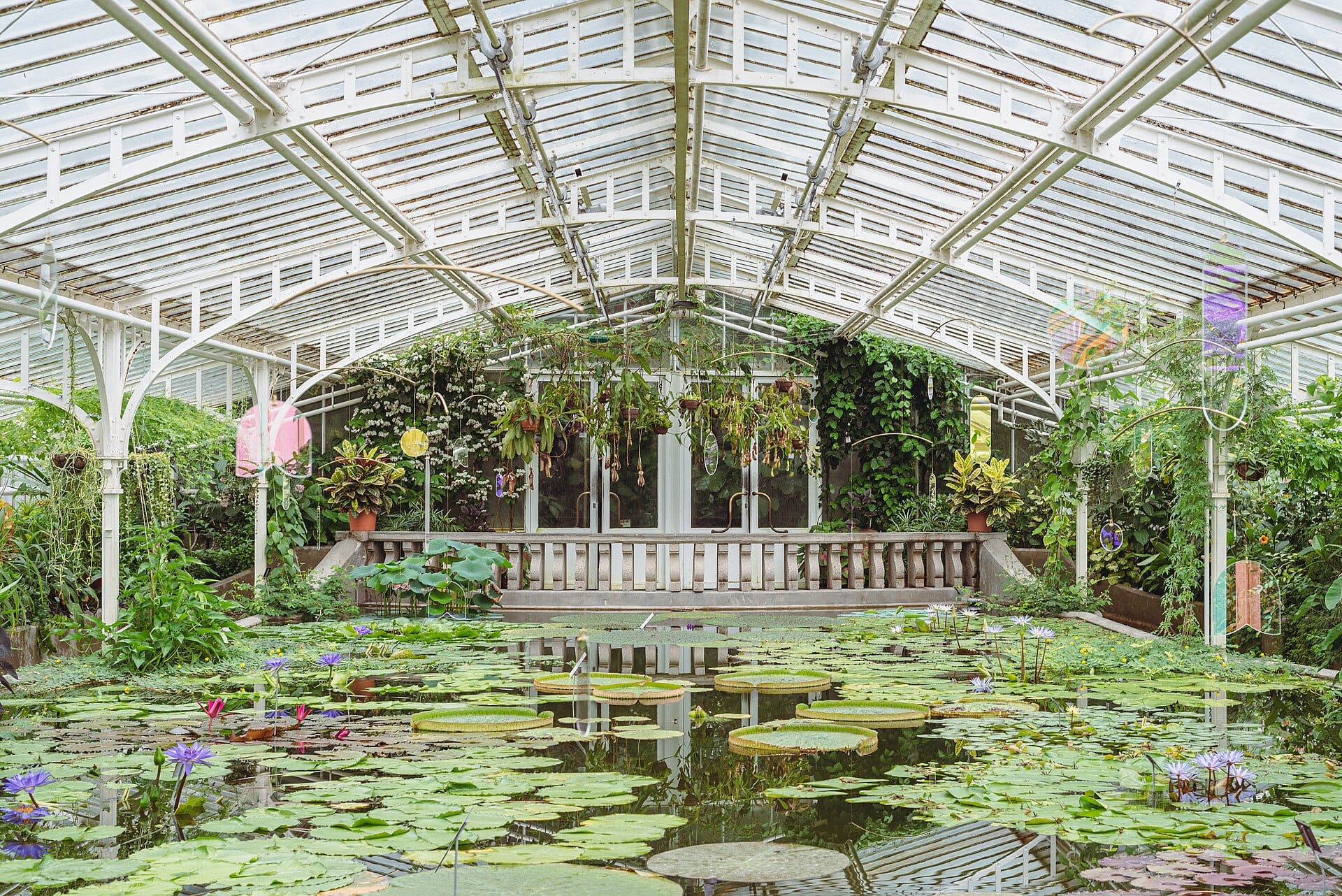
The greenhouse complex, completed in 1958, houses a sequence of distinct climate environments. Moving through them in order takes you from tropical rainforest conditions through succulent and desert collections to a fern and aquatic house. The transition between houses is part of the experience: you step through a set of doors and the air changes from humid and warm to dry and cool within a few meters.
The tropical house is tall enough to accommodate tree-sized specimens, and the overhead canopy creates genuine shade at floor level. The scent is a specific combination of soil moisture, flower nectar, and the particular green smell of large-leafed tropical plants in still air. Carnivorous plants, orchids, and cycads each have dedicated sections. The succulent house, by contrast, is bright, low-humidity, and almost clinical in the way it arranges cacti and desert species by origin.
In winter, the greenhouses become the primary reason to visit. On a grey January morning, spending an hour moving through tropical warmth while Munich is 3°C outside is genuinely restorative, not just informative. The greenhouses are rarely crowded on winter weekday mornings, and this is when the staff tend to be most visible and willing to answer questions.
Fitting the Botanical Garden Into a Munich Itinerary
The Botanical Garden Munich-Nymphenburg sits in the Nymphenburg district, a part of Munich that most visitors pass through specifically for the palace. Combining both in a single day is straightforward and logical. Spend the morning in Nymphenburg Palace and its parkland, then walk or take a short bus to the botanical garden for the early afternoon. The two sites together fill a full day comfortably without rushing.
If you are working from a broader Munich base, this visit pairs well with the museum district in Maxvorstadt on a multi-day itinerary. Our 3-day Munich itinerary shows how a stop here fits into typical multi-day Munich itineraries.
For families, the botanical garden functions as a calmer alternative to more stimulating attractions. It works particularly well for children who have an interest in nature or who need a lower-stimulation environment mid-trip. The Munich with kids guide covers how to structure a family visit to the Nymphenburg area more broadly.
Who This Attraction Suits — and Who Should Look Elsewhere
The Botanical Garden Munich-Nymphenburg suits visitors who are genuinely interested in plants, natural science, or quiet outdoor spaces. It also works well for anyone looking for a slow, unhurried hour in a city that can otherwise feel relentlessly full of things to do. The entry price is low relative to Munich's major museums, and the combination of outdoor and greenhouse environments gives it year-round relevance.
It is not the right choice for visitors who are primarily looking for a manicured formal garden experience in the English or French tradition. The garden is scientific in its intent, and while it is attractive, it does not prioritize visual spectacle in the way that purpose-built ornamental gardens do. Visitors expecting a floral showpiece similar to Kew Gardens or Keukenhof may find parts of the site underwhelming. Similarly, travelers with only a day or two in Munich and a long list of priorities should consider whether the roughly 20–25-minute tram journey from the city center represents the best use of limited time.
If your primary interest is green space and a long walk, the Englischer Garten is larger and more centrally located. The botanical garden's value is specifically in its collection depth and the greenhouse experience, not in open parkland.
Insider Tips
- Arrive before 10:00 on spring weekday mornings to have the rhododendron section almost entirely to yourself. By 11:00, school groups and organized tours move through the area and the paths become noticeably busier.
- The south entrance from Maria-Ward-Straße is much less used than the main Menzinger Straße entrance. If you are walking from Nymphenburg Palace Park, enter from the south and work your way toward the greenhouses — you will experience the garden in a more logical botanical sequence.
- In winter, the greenhouse ticket covers all greenhouse houses in a single pass. There is no additional charge to move between the tropical, succulent, fern, and aquatic sections. Budget around 45 to 60 minutes for a thorough greenhouse circuit.
- The medicinal and useful plants section is one of the more underrated parts of the outdoor garden. The planting labels include historical uses and regional names, which makes it genuinely interesting even for visitors who do not have a specialist botanical background.
- If you are visiting during a heat wave in July or August, the tropical greenhouse is not the place to cool down. The outdoor garden's arboretum section provides the most shade and is often overlooked by visitors who head straight for the greenhouses on arrival.
Who Is Munich Botanical Garden (Botanischer Garten) For?
- Botany and natural science enthusiasts who want to engage with a serious research collection rather than a decorative garden
- Families with children who respond well to a calm, nature-focused environment with clear educational labeling
- Photographers seeking seasonal floral subjects, particularly the rhododendron collection in May and the Alpine rock garden in April
- Visitors in winter looking for a warm, interesting escape that is not a museum or indoor cultural site
- Travelers combining a full Nymphenburg day with the palace and park who want a distinct second attraction on the same side of the city
Nearby Attractions
Other things to see while in Nymphenburg:
- Hirschgarten Beer Garden
Königlicher Hirschgarten is Munich's largest beer garden, with roughly 8,000 seats spread beneath centuries-old chestnut trees in a 40-hectare park between the Laim and Nymphenburg districts. Founded as a royal hunting ground in 1780, it draws everyone from office workers to tourists to families with strollers, and remains one of the most honest expressions of Bavarian outdoor culture in the city.
- Nymphenburg Palace
Nymphenburg Palace (Schloss Nymphenburg) is the largest city palace in Germany and the former summer residence of Bavaria's Wittelsbach rulers. Set within a vast formal park in Munich's western Neuhausen-Nymphenburg district, it rewards visitors who come early, take their time, and look beyond the main hall.
Planning a trip? Discover personalized activities with the Nomado app.