Königsplatz Munich: Ancient Athens in the Heart of Bavaria
Königsplatz is Munich's most architecturally ambitious public square, designed by King Ludwig I as a Bavarian answer to the Athenian Acropolis. Flanked by a Doric propylon gate, a neoclassical art museum, and a hall of Greek sculptures, it is simultaneously a monument to royal ambition, a scar of Nazi history, and today one of the city's most quietly dramatic open spaces.
Quick Facts
- Location
- Königsplatz 1, 80333 München, Maxvorstadt
- Getting There
- U-Bahn Königsplatz (U2); Tram 27; Bus line 100
- Time Needed
- 30–45 min for the square; 2–3 hours if visiting the museums
- Cost
- Free to enter the square; museum admission charged separately
- Best for
- Architecture lovers, history buffs, museum visitors, photographers
What Königsplatz Actually Is
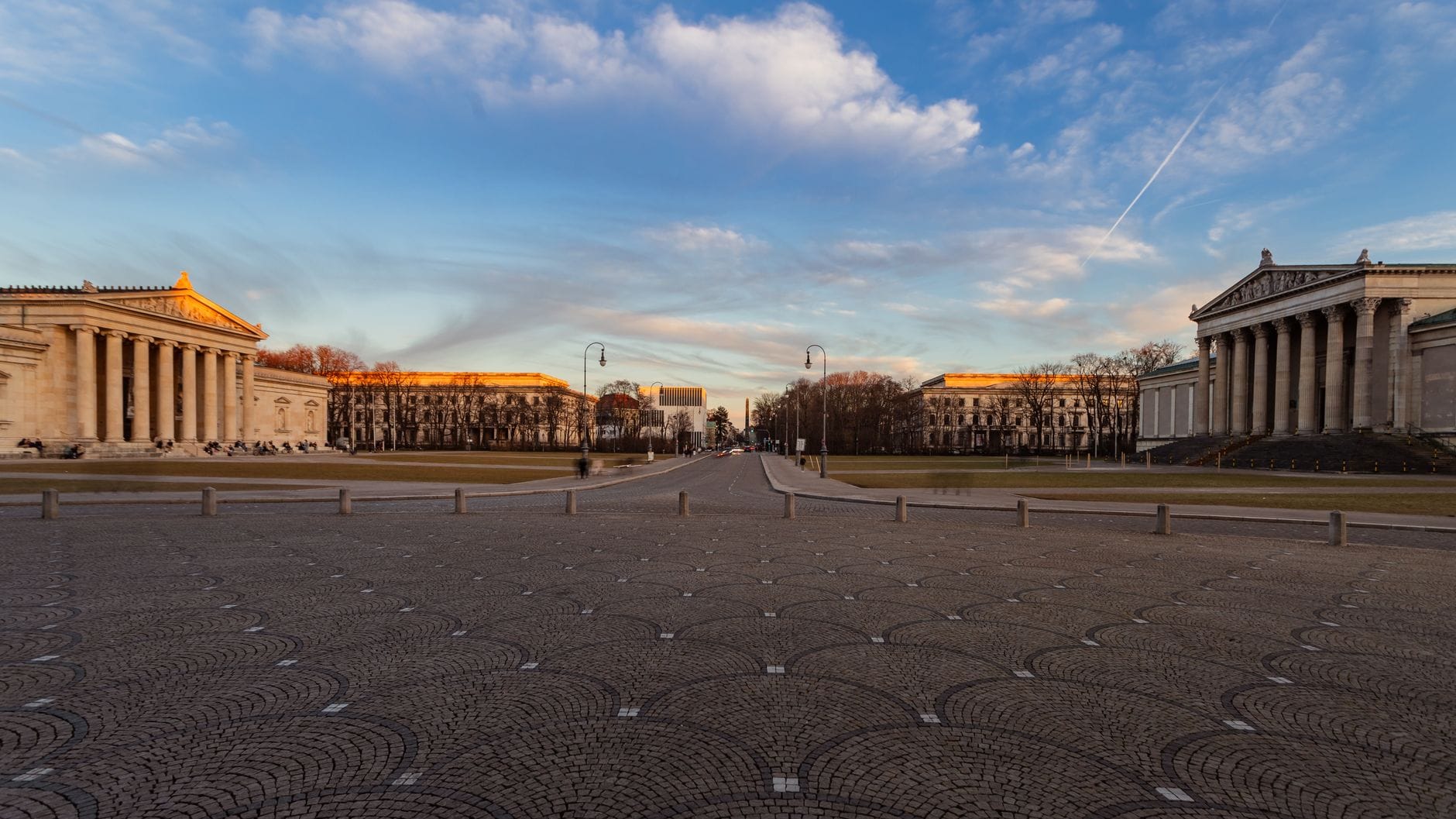
Königsplatz, or King's Square, is a large neoclassical plaza in the Maxvorstadt district of Munich, framed on three sides by stone buildings modeled directly on ancient Greek architecture. The effect is unlike anything else in Germany: you step off a modern tram corridor and find yourself looking at a Doric propylon that could plausibly be standing on the slopes of the Acropolis. The scale is ceremonial, the silence — on quieter mornings — is almost startling.
The square itself is a public green space, open at all hours and free to enter. Visitors walk across wide lawn panels bordered by gravel paths, with the three monumental buildings arranged to create a sense of architectural theater. The open southern end frames a long vista toward the Maxvorstadt streetscape, which prevents the whole ensemble from feeling oppressive despite its grandeur.
💡 Local tip
The square is always accessible and costs nothing. If you're short on time, a 20-minute walk through the plaza and past all three facades is a satisfying standalone visit. Combine it with the Glyptothek or Antikensammlungen if you have two or three hours.
The Architecture: Ludwig I's Dream of Athens
King Ludwig I of Bavaria conceived Königsplatz in the early 19th century as a cultural gathering point, referring to it as a 'Platz der Kultur.' Planning began in 1806, but construction stretched across decades, with the last buildings completed in 1862. The court architect Leo von Klenze designed the most significant structures, drawing explicitly on Athenian models rather than Roman ones — an unusual choice for the era, and a deliberate statement of Bavarian cultural ambition.
The Propyläen, the monumental gateway at the western end, is modeled on the Propylaia entrance to the Athenian Acropolis, though it was never intended to serve as a functional gate. Flanking it to the north is the Glyptothek, a hall of Greek and Roman sculpture built between 1816 and 1830, whose Ionic colonnade gives it a lighter, more serene presence than its counterpart across the square. The Staatliche Antikensammlungen (State Collection of Antiquities) occupies the southern side with a Corinthian portico, completing the three Greek orders — Doric, Ionic, and Corinthian — arranged around a single space.
This concentration of classical architecture in a single district was deliberate. Königsplatz anchors what is now called the Kunstareal, Munich's museum quarter, stretching through Maxvorstadt and containing some of the most significant art collections in German-speaking Europe.
Tickets & tours
Live prices and dates from our booking partner. If you book, we may earn a commission at no extra cost to you.
Stories and treasures of Munich's Koenigsplatz area self-guided audio
From 10 €Instant confirmationLuggage Storage in Munich
From 6 €Instant confirmationFree cancellationOne hour city sightseeing bus tour in Munich
From 21 €Instant confirmationFree cancellationMunich Third Reich walking tour
From 32 €Instant confirmationFree cancellation
A Darker Chapter: The Square Under National Socialism
Königsplatz carries a weight that its serene neoclassical facades don't immediately reveal. From 1933, the Nazi regime commandeered the square as a central stage for its public spectacle. The grassed surface was paved over with granite slabs to create a vast hard-standing for rallies, and two 'Ehrentempel' (Honour Temples) were constructed at the eastern end to house the remains of those killed in the 1923 Beer Hall Putsch — Hitler's failed coup attempt.
Book burnings took place here in May 1933. The square became, in the language of the regime, the 'Forum of the Movement,' a consecrated space for National Socialist ritual. After the war, Allied forces demolished the Honour Temples in 1947 and removed the granite paving, restoring the lawns across the 1980s. The site's Nazi-era history is documented in depth at the NS-Dokumentationszentrum, which stands just a short walk to the east.
For visitors who want to understand this history in full context, the NS-Dokumentationszentrum offers one of the most rigorous and accessible accounts of Munich's role in the rise of National Socialism.
ℹ️ Good to know
The restored grassed surface you walk across today is itself a historical statement. The deliberate removal of the Nazi-era granite paving and the return to open lawn was part of a post-war effort to reclaim the square's original civic identity.
What It Feels Like to Visit: Morning, Afternoon, and Evening
Early mornings on Königsplatz have a quality that the midday rush erases. Before 9am, the square is largely empty, and the pale stone of the Propyläen catches low light from the east in a way that makes the whole structure seem carved rather than built. The only sounds are typically distant tram noise from Gabelsbergerstrasse and the occasional cyclist cutting across the gravel. This is when the architecture reads most clearly, without tour groups or event installations interrupting the sightlines.
By mid-morning, particularly in summer, students and office workers from the nearby university buildings begin crossing the square, and museum visitors start congregating outside the Glyptothek's portico. The atmosphere becomes relaxed and functional rather than reverential. Locals sometimes eat lunch on the grass when the weather allows, which softens the square's monumental character considerably.
Evenings are worth seeing even if you don't plan a visit around them. When the natural light drops, the stonework takes on a warm grey tone and the surrounding trees — mature lindens and planes — create a canopy that makes the space feel more contained. The museums close and the square empties out, returning to something closer to its contemplative design intent. In winter, with frost on the grass, the effect is stark and striking.
The Museums: Glyptothek and Antikensammlungen
The two museums flanking the square are among the most important collections of Greek and Roman antiquities in Germany. Both charge separate admission fees, which should be verified with the institutions directly as prices are subject to change. The Glyptothek holds sculpture, including the celebrated Aeginetan marbles recovered from the Temple of Aphaia and restored under the direction of the sculptor Thorvaldsen in the early 19th century. The rooms are quiet, whitewashed, and designed for sustained looking rather than rapid movement through.
The Staatliche Antikensammlungen across the square focuses on smaller objects: vases, bronzes, jewellery, and terracottas. It is less visited than the Glyptothek despite holding extraordinary pieces, which means shorter queues and more room to stand in front of individual cases. If you are choosing between the two on a limited schedule, the Glyptothek is typically the higher priority for first-time visitors, but the Antikensammlungen rewards a second visit considerably.
The broader concentration of world-class museums in this district means Königsplatz pairs naturally with a visit to the Glyptothek, the Lenbachhaus, or the cluster of Pinakothek galleries a few blocks north. Serious museum visitors should consider allocating a full day to the Maxvorstadt rather than treating Königsplatz as a standalone stop.
Practical Details: Getting There and Getting Around
The U-Bahn station Königsplatz, served by the U2 line, deposits you at the eastern edge of the square within a two-minute walk. This is the most straightforward approach. Tram 27 (stop Karolinenplatz) and bus line 100 (museum line, stop Königsplatz) also stop nearby, providing useful connections from the city centre if you prefer surface transport. The address is Königsplatz 1, 80333 München.
The square is a large, mostly level open space with wide gravel paths, making it generally manageable for visitors with mobility considerations, though the grass panels are not paved. The nearest step-free transit access should be confirmed with MVV for the most current information. Paid parking is available in the adjacent streets, but spaces are limited, so arriving by public transport or on foot is the practical default.
Königsplatz is an easy 15-minute walk from Odeonsplatz via Brienner Strasse, a broad axial boulevard that Ludwig I also planned as part of his transformation of Munich. Walking this route gives a clear sense of the scale of the 19th-century urban project that reshaped the city.
Photography and What to Wear
For photography, the Propyläen faces east, so morning light falls on its front colonnade. The Glyptothek across the lawn faces south-southeast and catches good light from mid-morning onward. Both buildings photograph best when the square is empty, which means either early morning or late evening. Midday light in summer tends to be flat and contrasty against the pale stone.
There are no dress requirements for visiting the square. In winter, the exposed plaza can be cold and windy, so layers are advisable. Summer visits are comfortable in light clothing, though museum interiors are kept cool regardless of outdoor temperatures.
⚠️ What to skip
Königsplatz is occasionally closed or partially restricted for large outdoor events, including concerts and public screenings during major sporting events. Check the city's event calendar before planning a visit if you specifically want to see the open square rather than an event setup.
Insider Tips
- Walk the full length of Brienner Strasse westward from Odeonsplatz to arrive at Königsplatz as Ludwig I intended — the approach reveals how the Propyläen functions as an urban terminus and makes the scale of the 19th-century planning legible in a way that arriving by U-Bahn does not.
- The Antikensammlungen is far less crowded than the Glyptothek and holds exceptional pieces, particularly its Greek vase collection. If queues at the Glyptothek are long, cross the square — you'll likely have the Antikensammlungen largely to yourself.
- Stand at the centre of the square and look north past the Glyptothek colonnade: on clear days in autumn and winter you can see the outline of the Alps on the horizon above the roofline. This view is best in the hour before sunset.
- The square is a regular venue for open-air summer concerts, some of which are free. The city's cultural calendar lists events at Königsplatz seasonally — these can be a genuine reason to plan an evening visit rather than a reason to avoid the square.
- If you visit on a Sunday, note that the Bavarian state museums — including the Glyptothek and the Antikensammlungen on Königsplatz — charge just €1 admission every Sunday. Verify current policies directly with the museums before your visit, as these schemes change.
Who Is Königsplatz For?
- Architecture and classical history enthusiasts who want to see neoclassical design at genuine scale
- Museum visitors building a full day in the Maxvorstadt Kunstareal
- Photographers looking for dramatic, empty cityscapes in early morning light
- Visitors interested in the history of National Socialism and its physical footprint in Munich
- Travellers who want a calm, crowd-free alternative to the tourist density of Marienplatz
Nearby Attractions
Other things to see while in Maxvorstadt:
- Alte Pinakothek
The Alte Pinakothek in Munich's Maxvorstadt district houses one of the world's foremost collections of European paintings from the 14th to 18th century. From Dürer and Rubens to Rembrandt and Raphael, this is where Bavaria's centuries-long obsession with collecting art reaches its peak.
- Antikensammlungen (State Collection of Antiquities)
The Antikensammlungen (State Collection of Antiquities) at Königsplatz presents one of Europe's finest collections of ancient Greek vases, Etruscan bronzes, and Roman jewelry. Housed in a neoclassical building from the 1840s, it rewards slow, attentive visitors far more than a quick walk-through.
- Glyptothek
Built by Leo von Klenze for King Ludwig I and opened in 1830, the Glyptothek on Königsplatz is Munich's oldest public museum. Its collection of Greek and Roman sculpture spans roughly 900 years, housed in one of Europe's finest Neoclassical buildings. This guide covers what to see, when to go, and how to make the most of your visit.
- Städtische Galerie im Lenbachhaus
The Städtische Galerie im Lenbachhaus houses the world's largest collection of Der Blaue Reiter art inside Franz von Lenbach's ornate 19th-century villa in Munich's Kunstareal museum district. From Kandinsky's electric canvases to Joseph Beuys installations, this is one of Germany's most focused and rewarding art museums.
Planning a trip? Discover personalized activities with the Nomado app.