Glyptothek Munich: Inside the City's Greatest Ancient Sculpture Museum
Built by Leo von Klenze for King Ludwig I and opened in 1830, the Glyptothek on Königsplatz is Munich's oldest public museum. Its collection of Greek and Roman sculpture spans roughly 900 years, housed in one of Europe's finest Neoclassical buildings. This guide covers what to see, when to go, and how to make the most of your visit.
Quick Facts
- Location
- Königsplatz 3, 80333 München (Maxvorstadt)
- Getting There
- U2 to Königsplatz, or Bus 100
- Time Needed
- 1.5 to 2.5 hours
- Cost
- €6 regular / €4 reduced / €1 Sundays / Free under 18
- Best for
- Classical history enthusiasts, art lovers, quiet museum-goers
- Official website
- www.antike-am-koenigsplatz.mwn.de/en/glyptothek-en
What the Glyptothek Is — and Why It Matters
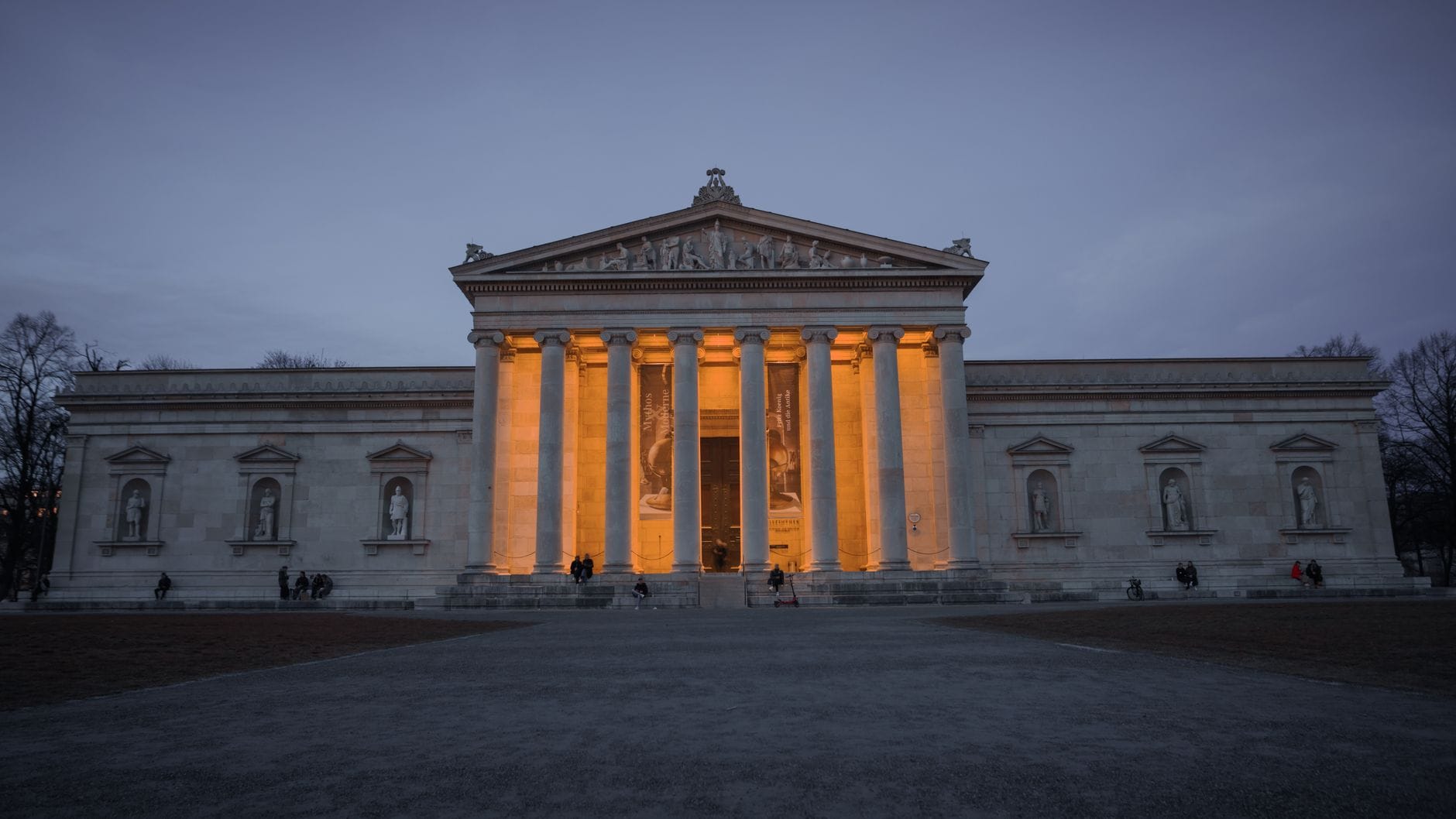
The Glyptothek is Munich's oldest public museum, opened in 1830 on the western side of Königsplatz. Commissioned by Crown Prince Ludwig I of Bavaria and designed by the architect Leo von Klenze, it was purpose-built for a single function: to house an extraordinary private collection of ancient Greek and Roman sculpture. That singularity of purpose is still visible today. Every room, every window proportion, every ceiling fresco was conceived around the works inside. This is not a repurposed palace or a converted warehouse. It is one of the few museums in the world where building and collection were designed as a unified whole.
The collection spans roughly 900 years of sculptural history, from Archaic Greek kouros figures of the 6th century BC through to Roman Imperial portrait busts of the 3rd century AD. What makes it compelling is not sheer scale, but depth and authenticity. Many pieces are originals, not casts, and the museum presents them in relatively uncrowded rooms where you can actually get close. The Ionic façade, the central courtyard, and the sequence of gallery halls lined with marble and terracotta all contribute to a visit that feels contemplative rather than rushed.
💡 Local tip
Admission drops to €1 on Sundays per house — making the Glyptothek one of the best-value museum visits in Munich. Thursday evenings extend opening until 20:00, and can often be quieter than daytime hours.
The Building: Leo von Klenze's Neoclassical Masterpiece
Leo von Klenze is the architect who shaped much of central Munich's monumental character, and the Glyptothek is arguably his most refined work. Completed in 1830 after more than a decade of construction, the building draws on the vocabulary of Greek temple architecture: an Ionic colonnade of 18 columns runs across the entrance façade, flanked by niches containing statues of Hephaestus, Daedalus, Pheidias, Pericles, and Apollo. These figures were not decorative afterthoughts. They announce the museum's intellectual ambition before you step inside.
The interior suffered severe bomb damage in World War II, and the postwar reconstruction made a deliberate aesthetic choice: rather than restore the original ornate interior decorations, the walls were stripped to bare plaster and brick. The result is paradoxically powerful. The sculptures now stand against neutral white surfaces, with nothing competing for attention. Some visitors find this stark; others consider it the most honest possible context for ancient works that have already lost most of their original paint and gilding.
The Glyptothek sits on the northern edge of Königsplatz, which Ludwig I modeled on the Athenian Acropolis. The square's formal symmetry, framed by the Glyptothek to the north and the Antikensammlungen (State Collection of Antiquities) directly opposite, creates one of Europe's most architecturally coherent public spaces. Arriving from the U2 station, the sequence of the square opening up before you — grass, gravel, and stone — prepares you for the museum's interior mood.
Tickets & tours
Live prices and dates from our booking partner. If you book, we may earn a commission at no extra cost to you.
Luggage Storage in Munich
From 6 €Instant confirmationFree cancellationOne hour city sightseeing bus tour in Munich
From 21 €Instant confirmationFree cancellationMunich Third Reich walking tour
From 32 €Instant confirmationFree cancellationRomantic Road Day Trip to Rothenburg and Harburg
From 74 €Instant confirmationFree cancellation
Navigating the Collection: Room by Room
The galleries are arranged roughly chronologically, moving from the Archaic period through Classical and Hellenistic Greek sculpture into Roman work. The progression is not always linear — the floor plan is a loop of interconnected rooms rather than a corridor — but the logic is clear enough to follow without a guide.
The Archaic rooms contain some of the oldest pieces: kouros and kore figures with their characteristic rigid posture and faint, enigmatic smiles. These early Greek statues served as grave markers and votive offerings, and up close you notice how the carving concentrates on surface pattern, the hair rendered in tight geometric rows, the musculature stylized rather than observed. They feel less like representations of people than formal problems being worked out in stone.
The museum's most celebrated works are the pediment sculptures from the Temple of Aphaia on Aegina, dating to around 500-480 BC. These figures, depicting warriors from the Trojan War, were acquired by Ludwig I in 1812 and briefly restored by the sculptor Bertel Thorvaldsen before their arrival in Munich. They occupy a central hall and deserve serious time. The figures are caught in the compressed drama of battle, some fallen, some kneeling, some still fighting, arranged to fill the triangular pediment shape. The detail in preserved areas — fingers, hair, individual facial expressions — is arresting.
The Roman rooms shift the tone considerably. Where Greek sculpture explores idealized human form, the Roman portrait busts are exercises in psychological realism: furrowed brows, asymmetrical features, the specific wear of a specific face. These include notable examples from the Republican and Imperial periods, and the contrast with the idealized Greek figures in adjacent rooms is one of the collection's great unplanned conversations.
How the Experience Changes Through the Day
Morning visits on weekdays are the least crowded. The light entering through the high windows is cooler and more diffuse in the first hours after opening, which suits the pale marble well. By midday, particularly on weekends, school groups and tourist parties from central Munich's main sights begin arriving. The rooms are not large, and a group of thirty students can change the entire acoustic texture of a gallery.
Thursday evenings, when the museum stays open until 20:00, offer a genuinely different experience. Many visitors who come specifically for the late opening are repeat visitors or locals, which often creates a quieter, more contemplative atmosphere. The artificial lighting emphasizes surface texture in ways that natural light does not, and the Aegina pediment figures take on a more theatrical quality after dark.
Sunday admission at €1 per house makes the museum popular with Munich residents, particularly families. The trade-off is that it is the busiest regular day. If you are visiting primarily to spend time with individual pieces rather than to sample the collection broadly, a Tuesday or Wednesday morning is more appropriate.
ℹ️ Good to know
Opening hours: Tuesday to Sunday, 10:00–17:00. Thursday until 20:00. Closed Monday. Opening hours may change seasonally — check the official website before your visit.
The Glyptothek in Context: Königsplatz and the Kunstareal
The Glyptothek does not stand alone. Directly across Königsplatz, the Antikensammlungen holds the complementary collection of ancient Greek and Roman decorative arts: ceramics, bronzes, gold jewelry, and glass. A combined visit to both museums on the same day gives a much fuller picture of ancient Mediterranean culture than either building offers independently. The collections were always intended to be read together.
A five-minute walk east along Arcisstrasse puts you in the heart of Munich's Kunstareal, the city's museum district in Maxvorstadt. The Alte Pinakothek, Neue Pinakothek, and Pinakothek der Moderne cluster within easy walking distance, along with the Lenbachhaus. A full day in this area, starting at the Glyptothek and moving east, is one of Munich's most rewarding cultural itineraries.
The Lenbachhaus is particularly worth combining with a Glyptothek visit if you want to move from ancient to modern in a single afternoon — the contrast between Greek Archaic sculpture and the Blue Rider movement paintings of Kandinsky and Münter is unexpectedly stimulating.
Photography, Practicalities, and Honest Caveats
Photography without flash is generally permitted in the permanent collection, and the stripped-back white walls make for clean, uncluttered images. The Aegina pediment hall is the most photographed space. For the best light on individual sculptures, aim for late morning on a clear day when direct sunlight enters from the upper windows at an angle that reveals surface texture.
The museum shop is small but well-curated, with scholarly catalogs and quality reproductions. There is no café inside the Glyptothek itself. For food and coffee, the surrounding Maxvorstadt neighborhood has numerous options, and Königsplatz itself becomes a pleasant outdoor space in good weather.
Visitors with mobility considerations should contact the museum in advance, as the official site recommends reaching out by email or phone to discuss specific accessibility requirements. The building's 19th-century structure and postwar reconstruction mean facilities vary by area.
⚠️ What to skip
The Glyptothek is not the right choice for visitors looking for broad European art coverage or blockbuster-style exhibitions. It is a specialist collection of ancient sculpture, and the experience is quiet and scholarly by nature. If that does not appeal, the Alte Pinakothek next door covers an entirely different scope.
If you are planning a broader museum day, the best museums in Munich guide covers how the Glyptothek fits into the city's wider cultural landscape and which combination of venues suits different interests and time budgets.
Visitors on a tight budget will find the Sunday €1 admission particularly useful alongside other free and low-cost options across Munich, several of which are concentrated in the same Maxvorstadt neighborhood.
Insider Tips
- The Aegina pediment sculptures are the collection's anchor, but allow time in the Roman portrait rooms at the end of the circuit — the psychological intensity of those busts is easy to rush past after the grandeur of the Greek galleries.
- Thursday evening visits (open until 20:00) can be among the quieter times in the building. Arrive at 18:30 and you may find some rooms almost to yourself.
- The Glyptothek and Antikensammlungen opposite offer a combined day ticket. If you have even a passing interest in Greek ceramics or Etruscan bronzes, buy the combined version — the Antikensammlungen's collection of painted pottery is one of the finest outside Athens.
- The museum's stripped postwar interior divides opinion. If you want to understand what the original elaborate painted decoration looked like, the museum publication available in the shop includes historical photographs — worth looking at before you leave rather than after.
- Königsplatz becomes a temporary outdoor concert venue in summer. Check the Munich events calendar — attending an open-air event on the square after a Glyptothek visit in the evening is one of the more unusual Munich cultural experiences.
Who Is Glyptothek For?
- Travelers with a serious interest in Greek and Roman antiquity
- Architecture enthusiasts drawn to Neoclassical design
- Museum-goers who prefer depth and quiet over scale and crowds
- Budget visitors on Sundays, when admission is €1
- Anyone doing a full Kunstareal day across Maxvorstadt's museum district
Nearby Attractions
Other things to see while in Maxvorstadt:
- Alte Pinakothek
The Alte Pinakothek in Munich's Maxvorstadt district houses one of the world's foremost collections of European paintings from the 14th to 18th century. From Dürer and Rubens to Rembrandt and Raphael, this is where Bavaria's centuries-long obsession with collecting art reaches its peak.
- Antikensammlungen (State Collection of Antiquities)
The Antikensammlungen (State Collection of Antiquities) at Königsplatz presents one of Europe's finest collections of ancient Greek vases, Etruscan bronzes, and Roman jewelry. Housed in a neoclassical building from the 1840s, it rewards slow, attentive visitors far more than a quick walk-through.
- Königsplatz
Königsplatz is Munich's most architecturally ambitious public square, designed by King Ludwig I as a Bavarian answer to the Athenian Acropolis. Flanked by a Doric propylon gate, a neoclassical art museum, and a hall of Greek sculptures, it is simultaneously a monument to royal ambition, a scar of Nazi history, and today one of the city's most quietly dramatic open spaces.
- Städtische Galerie im Lenbachhaus
The Städtische Galerie im Lenbachhaus houses the world's largest collection of Der Blaue Reiter art inside Franz von Lenbach's ornate 19th-century villa in Munich's Kunstareal museum district. From Kandinsky's electric canvases to Joseph Beuys installations, this is one of Germany's most focused and rewarding art museums.
Planning a trip? Discover personalized activities with the Nomado app.