Pinakothek der Moderne: Munich's Four-in-One Modern Art Powerhouse
Opened in 2002 in Munich's Maxvorstadt district, the Pinakothek der Moderne combines four distinct museums under a single roof: modern and contemporary art, architecture, design, and works on paper. It is the largest museum building of its kind in Germany, and far more rewarding than its understated exterior suggests.
Quick Facts
- Location
- Barer Straße 40, 80333 München (Maxvorstadt)
- Getting There
- Bus 100 or Tram 27/28 to Pinakotheken; U3/U6 to Odeonsplatz
- Time Needed
- 2–4 hours (longer if visiting all four collections)
- Cost
- €10 standard, €7 reduced, €1 on Sundays. Closed Mondays.
- Best for
- Art lovers, design enthusiasts, architecture students, rainy-day culture
- Official website
- www.pinakothek-der-moderne.de/en
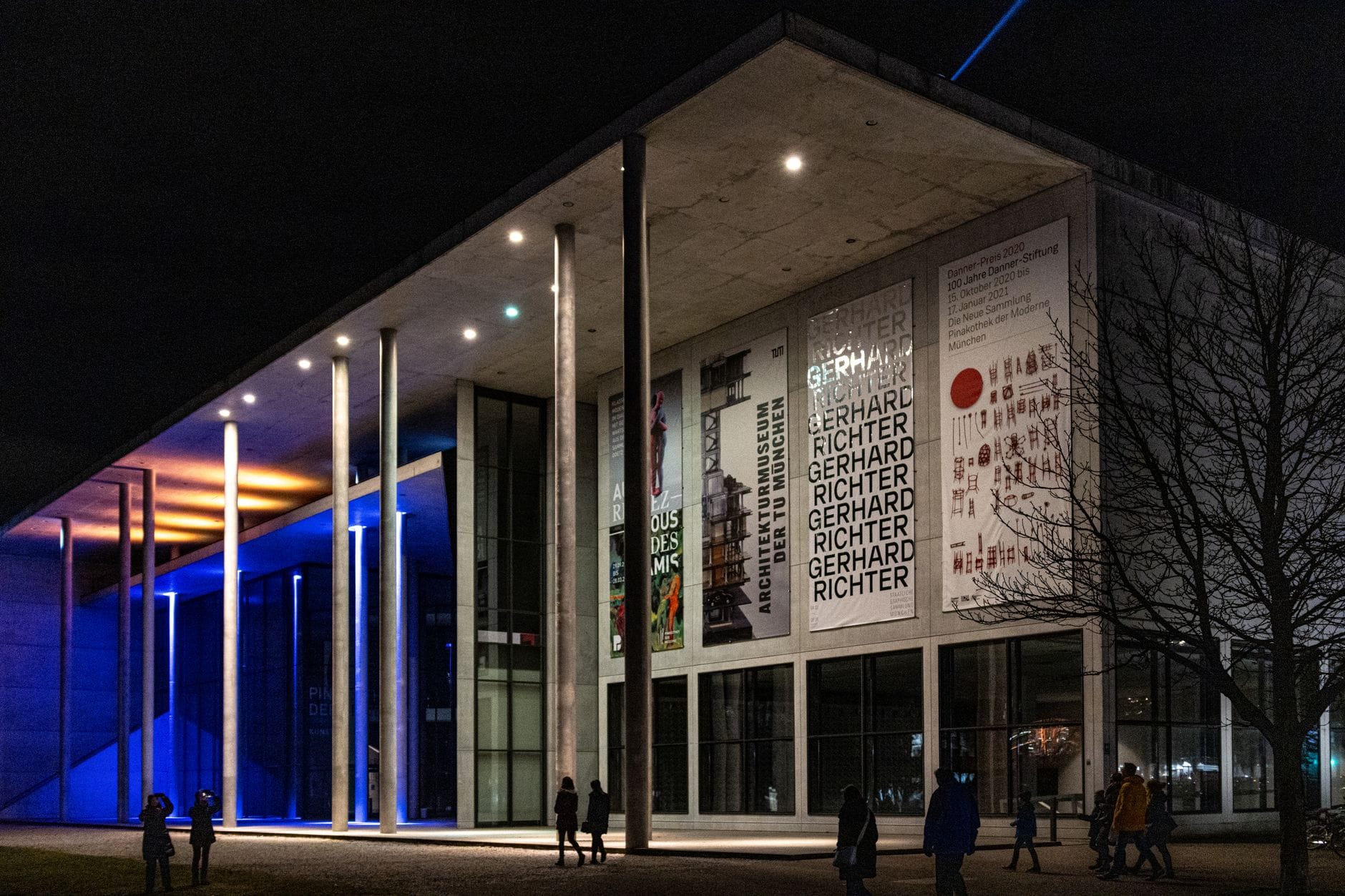
What Is the Pinakothek der Moderne?
The Pinakothek der Moderne is not simply one museum. The building at Barer Straße 40 houses four institutions: the Staatsgalerie moderner Kunst (modern and contemporary art), the Architekturmuseum der TU München (architecture), the Neue Sammlung (design and applied arts), and the Staatliche Graphische Sammlung (drawings and prints). Each has its own permanent collection and exhibition schedule, which means a single visit can feel like attending four separate exhibitions simultaneously.
The building opened in 2002, designed by Munich architect Stephan Braunfels. From the street, the façade is deliberately austere: pale concrete, large planes of glass, and a quiet confidence. Inside, a massive central rotunda flooded with natural light from a glass dome overhead acts as the building's orientation point. Corridors and galleries radiate outward from this core in each direction. First-time visitors sometimes feel briefly disoriented, but the rotunda pulls you back whenever you need it.
💡 Local tip
Sunday admission is €1 for all visitors. The museum gets noticeably busier on Sunday afternoons, so arrive before noon to get breathing room in the galleries.
The Four Collections: What You Actually See
Modern and Contemporary Art (Staatsgalerie moderner Kunst)
This is the collection most visitors come for. The permanent galleries cover roughly the 20th century from Fauvism and Expressionism through postwar abstraction and into contemporary installation work. You will find major pieces by Picasso, Klee, Beckmann, Ernst, and Beuys, alongside large-scale works by more recent international artists. The galleries themselves are generous in scale: high ceilings, minimal clutter, and enough distance between works that nothing feels crammed.
The German Expressionist holdings are particularly strong, which reflects Munich's historical role as a major centre of early 20th-century European modernism. Works by Franz Marc and Wassily Kandinsky connect this building intellectually to the Lenbachhaus across the neighbourhood, where the Blaue Reiter collection is held.
If contemporary German and international art is your primary interest, the Lenbachhaus and the Haus der Kunst are useful complements nearby, though their focuses differ enough that visiting all three is not redundant.
Architecture (Architekturmuseum der TU München)
The architecture museum holds one of Europe's most significant collections of architectural drawings, photographs, and models, with a particular strength in German and Central European modernism. The permanent display rotates, meaning the presentation changes more frequently than at a conventional art museum. On any given visit, you might encounter the drawings of Le Corbusier alongside documentation of Bavarian modernist projects, or a temporary exhibition dedicated to a single postwar housing project. Architecture students from the adjacent Technical University use the collection for research, so the audience in these galleries often skews toward the professionally engaged.
Design (Die Neue Sammlung)
The Neue Sammlung is one of the world's largest design collections, covering industrial design, craft, typography, and digital culture. The permanent display in the basement level of the Pinakothek der Moderne presents objects ranging from Bauhaus prototypes and postwar Italian furniture to contemporary tech products and vehicle design. Objects are displayed with the same care you would give a painting: on pedestals, in cases with detailed lighting, labelled with production context. A 1950s espresso machine placed next to a modernist chair placed next to a contemporary car seat illustrates the century's developing relationship between function and aesthetics in a way that text cannot.
This section deserves more time than most visitors give it. If you have limited hours and deep interest in design history, consider prioritising the Neue Sammlung galleries first, before museum fatigue sets in.
Works on Paper (Staatliche Graphische Sammlung)
The prints and drawings collection holds around 400,000 works, making it one of the largest of its kind in the world. Because works on paper are light-sensitive, only a fraction of the holdings are on display at any time, presented in changing thematic or monographic exhibitions. If you are not specifically interested in printmaking or drawing as disciplines, this section can feel like a brief coda to the larger galleries. For those who are, the depth is extraordinary.
Tickets & tours
Live prices and dates from our booking partner. If you book, we may earn a commission at no extra cost to you.
Adventure rally through murderous Munich
From 12 €Instant confirmationFree cancellationVIP tour to Neuschwanstein and Linderhof with Venus Grotto from Munich
From 169 €Instant confirmationFree cancellationFull-day Trip to Neuschwanstein Castle and Linderhof from Munich
From 0 €Instant confirmationFree cancellationAdventure rally in Munich´s Old Town luxury life undercover
From 12 €Instant confirmationFree cancellation
The Building and Its Architecture
Stephan Braunfels designed the building to be experienced as a procession of changing light conditions. Natural light enters from the dome above the rotunda, from perimeter skylights in the upper-floor galleries, and from floor-level glazing in some lower sections. At midday in summer, the rotunda is bright and sharp-shadowed. On overcast winter mornings, the same space becomes softer, more atmospheric. Neither is better; they are simply different conditions for the same space.
The exterior, facing Barer Straße, sits within Munich's Kunstareal, the art district that clusters the three Pinakotheken and several other major institutions within a few hundred metres of each other. From the street, the Pinakothek der Moderne reads as deliberately understated compared with the neoclassical grandeur of the older Alte Pinakothek across the road. This contrast was intentional. The building does not attempt to compete with 19th-century civic architecture; it simply exists alongside it, in a different register.
The Kunstareal as a whole repays a half-day of exploration. The Alte Pinakothek and Glyptothek are within easy walking distance, giving you access to collections spanning antiquity to the early 20th century without ever needing public transport.
When to Visit and What to Expect at Different Times
Tuesday through Friday mornings are consistently the quietest. By 10:30 on a weekday, the rotunda is largely empty and the upper-floor art galleries see few other visitors. This is the best time for slow, unobstructed viewing, particularly in the larger contemporary installations where crowds genuinely interfere with the work.
Thursday evenings, when the museum extends its hours until 20:00, attract a different crowd: fewer families, more adults who have come directly from work, and a slightly more relaxed atmosphere overall.
Sunday afternoons at €1 entry are, predictably, the busiest period. The art galleries become noticeably crowded and the rotunda fills with visitors who are often exploring casually rather than systematically. If you visit on a Sunday, arrive at opening time and work through the less-visited sections first.
ℹ️ Good to know
The museum is closed every Monday. This catches many visitors off guard, especially those spending a single weekend in Munich. Check the schedule before planning your day.
Getting There and Getting Around
The most direct public transport option is Bus 100 (the Museumslinie, or Museum Line), which connects the Hauptbahnhof to the Pinakotheken stop and continues through the Kunstareal. Tram 27 and Tram 28 also stop at Pinakotheken. From Odeonsplatz (served by U3 and U6), the museum is a short walk or bus ride away.
If you are planning a broader day in Maxvorstadt, the museum district is compact enough to walk between major institutions. Parking in the area is limited and the side streets surrounding Barer Straße are subject to residential permit restrictions, so arriving by public transport is more practical.
The building is wheelchair accessible, with lifts connecting all floors and ramp access at the main entrance. Coat check and locker storage are available near the entrance, useful for winter visits when coats and bags add friction to moving through tight gallery spaces.
What Works and What Does Not
The Pinakothek der Moderne is genuinely one of the more substantial modern museum experiences in Germany. The breadth of the four collections under one roof means almost any culturally curious visitor will find something of real interest. The building itself holds up as an architectural object, even two decades after opening.
The main practical frustration is navigational. The floor plan is less intuitive than it appears in diagrams, and the divisions between the four museums are not always clearly marked in the galleries themselves. Picking up a printed floor plan at the entrance counter is worth doing, even if you rarely use maps in museums.
Visitors with very limited time in Munich and no particular interest in 20th-century art, design, or architecture may find the €10 admission a difficult case to make against other uses of a few hours. The museum rewards visitors who engage deliberately rather than those looking for a quick cultural tick. If your priorities are the city's historic core, its churches, or its beer halls, this is a longer detour that requires genuine interest to justify.
For those building a fuller itinerary around Munich's cultural institutions, the best museums in Munich guide provides a useful framework for deciding which collections fit your available time.
Insider Tips
- The Neue Sammlung (design collection) in the basement is frequently overlooked by visitors who assume the contemporary art galleries upstairs are the main event. The design galleries are less crowded and often more engaging, especially if you have any interest in industrial or graphic design history.
- Thursday late opening until 20:00 is the best option for visitors who want the art galleries with minimal company. The evening light through the dome is also different from daytime conditions and worth experiencing if you are interested in how the architecture performs.
- The Sunday €1 admission applies to all visitors without any qualification. If you are on a budget and willing to manage the crowds, arriving at 10:00 on Sunday and working through the less-trafficked design and architecture sections first gives you quieter viewing before the main galleries fill.
- Ask at the information desk about the current temporary exhibitions across all four museums before you start.
- The combined ticket, if available during your visit, can cover multiple institutions in the district. Check with the ticket desk whether it makes economic sense given the museums you plan to visit on the same day.
Who Is Pinakothek der Moderne For?
- Art enthusiasts with specific interest in 20th-century European modernism and contemporary international work
- Design and architecture students or professionals looking for one of Europe's deepest institutional collections
- Travellers visiting Munich in winter or on rainy days who want several hours of genuinely engaging indoor culture
- Budget-conscious visitors planning a Sunday visit at the €1 rate
- Anyone building a full day in the Kunstareal across multiple Pinakothek institutions
Nearby Attractions
Other things to see while in Maxvorstadt:
- Alte Pinakothek
The Alte Pinakothek in Munich's Maxvorstadt district houses one of the world's foremost collections of European paintings from the 14th to 18th century. From Dürer and Rubens to Rembrandt and Raphael, this is where Bavaria's centuries-long obsession with collecting art reaches its peak.
- Antikensammlungen (State Collection of Antiquities)
The Antikensammlungen (State Collection of Antiquities) at Königsplatz presents one of Europe's finest collections of ancient Greek vases, Etruscan bronzes, and Roman jewelry. Housed in a neoclassical building from the 1840s, it rewards slow, attentive visitors far more than a quick walk-through.
- Glyptothek
Built by Leo von Klenze for King Ludwig I and opened in 1830, the Glyptothek on Königsplatz is Munich's oldest public museum. Its collection of Greek and Roman sculpture spans roughly 900 years, housed in one of Europe's finest Neoclassical buildings. This guide covers what to see, when to go, and how to make the most of your visit.
- Königsplatz
Königsplatz is Munich's most architecturally ambitious public square, designed by King Ludwig I as a Bavarian answer to the Athenian Acropolis. Flanked by a Doric propylon gate, a neoclassical art museum, and a hall of Greek sculptures, it is simultaneously a monument to royal ambition, a scar of Nazi history, and today one of the city's most quietly dramatic open spaces.
Planning a trip? Discover personalized activities with the Nomado app.