Montreal Forum: Inside the Legendary Arena That Shaped Hockey History
Once the most storied hockey arena in North America, the Montreal Forum is now a National Historic Site housing a cinema complex, shops, and occasional events. It rewards curious visitors who know what they're looking for, but it's not a conventional museum experience.
Quick Facts
- Location
- 2313 Sainte-Catherine Street West, at Atwater Street, Montreal
- Getting There
- Atwater métro station (Green Line) — the Forum is visible from the exit. STM buses also serve Sainte-Catherine West.
- Time Needed
- 30–60 minutes for a self-guided historical walk; longer if attending a cinema screening or event
- Cost
- Free to enter public areas; cinema tickets and event prices vary — check Cineplex for current rates (CAD)
- Best for
- Hockey fans, architectural history enthusiasts, and anyone curious about how Montreal shapes its past
- Official website
- www.cineplex.com
What the Montreal Forum Is Today
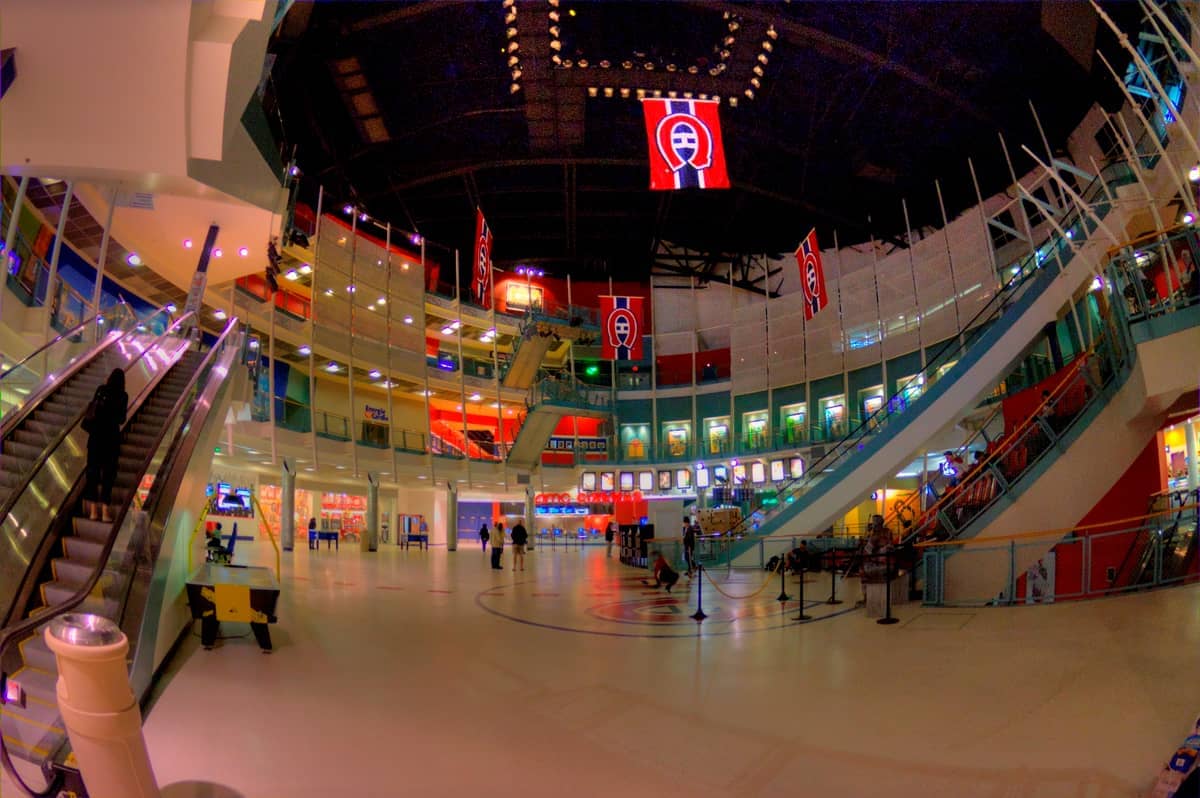
Walk past the corner of Sainte-Catherine Street West and Atwater Street, and the Montreal Forum announces itself with its low, curved facade and the faded scale of a building that was once the emotional center of an entire city. Officially designated the Montréal Forum National Historic Site of Canada by Parks Canada, the Forum stopped functioning as an arena in 1996. This is a converted entertainment complex: a Cineplex multiplex cinema occupies much of the interior, with the former arena no longer operating as a sports venue.
This is not a hockey museum and it is not a shrine you walk through with a guided audio tour. If you arrive expecting the smell of ice and a gallery of championships, you will be disappointed. What you will find is a building with genuine historical weight, some permanent commemorative elements in public corridors, and an honest sense of how cities adapt beloved spaces to economic realities. For the right kind of visitor, that tension is itself interesting.
ℹ️ Good to know
There is no single attraction-wide admissions desk or ticket counter. Public areas are generally accessible during complex hours (typically around 10:00–23:00), but verify with specific tenants before visiting, as schedules vary by cinema programming and events.
A History Worth Understanding Before You Arrive
The Forum opened in 1924, originally constructed for the Montreal Maroons; the Canadiens became tenants in 1926 and remained there until 1996. The building was expanded and rebuilt over time, including major work in 1968, and became one of the most significant venues in Canadian hockey history.
The Forum was also the site of events that reached far beyond hockey. The Richard Riot of March 1955, triggered by the suspension of Canadiens star Maurice Richard, began inside the building and spilled into the streets of Montreal, becoming a flashpoint in the complex relationship between French-Canadian identity and English-speaking NHL ownership. The building witnessed concerts, boxing matches, political gatherings, and cultural moments that accumulated meaning across generations.
When the Canadiens moved to the Bell Centre in 1996, the Forum was redeveloped into its current commercial form. The conversion preserved the exterior shell while gutting the interior entirely. For deeper context on how the Forum fits into Montreal's broader architectural legacy, the Montreal architecture guide places it alongside the city's other structurally significant buildings.
Tickets & tours
Hand-picked options from our booking partner. Prices are indicative; availability and final rates are confirmed when you complete your booking.
Montreal evening cruise on the St. Lawrence River
From 54 €Instant confirmationFree cancellation3-hour e-bike guided tour in Montreal
From 68 €Instant confirmationFree cancellationWalking tour of Old Montreal
From 20 €Instant confirmationFree cancellationMontreal helicopter tour
From 156 €Instant confirmationFree cancellation
What You Actually See Inside
The public corridors on the ground level display commemorative plaques, historical photographs, and some original artifacts embedded into the walls and floor. The most visible tribute is a large mosaic on the floor near the main entrance, referencing the Canadiens' championship history. The corridor walls carry black-and-white photographs from different eras of the building's life, including images of capacity crowds, championship celebrations, and the arena in its prime configuration.
The scale of the former arena is suggested rather than experienced. You can sense the footprint, and the ceiling heights in some transitional spaces give away the building's original proportions, but there is no viewing platform or preserved section of seating. The ice surface, the penalty boxes, the press gallery, all of it is gone. What replaces it is a standard multiplex layout, functional and entirely ordinary.
The most atmospheric time to visit the public areas is a weekday morning, when foot traffic is minimal and you can move through the corridors without competition for wall space. By late afternoon and weekends, the cinema crowds make the commemorative areas harder to appreciate.
💡 Local tip
Spend time on the Sainte-Catherine Street exterior before entering. The original curved facade and marquee details are the most intact physical remnant of the Forum's sporting history. Natural light in the morning makes it easier to read the building's proportions.
Getting There and Moving Around
The Atwater métro station on the Green Line is beside the Forum, at the corner of Sainte-Catherine and Atwater streets. From the station, the Forum is a short walk away.
Several STM bus routes run along Sainte-Catherine Street West, which is one of downtown Montreal's principal east-west corridors. If you are orienting yourself within downtown Montreal more broadly, the Forum sits at the western boundary of the main commercial strip, about a 15-minute walk from the heart of the shopping district near Peel and McGill stations.
If you have specific accessibility requirements, confirm directly with the venue or Cineplex before your visit, as conditions can vary by event configuration.
The Cinema and Events Side
Cineplex operates a cinema at the Forum. Check Cineplex directly for current showtimes and ticket pricing, as these change frequently.
The complex occasionally hosts live events, comedy performances, and special screenings. During major cultural periods in the city's calendar, the Forum can take on a livelier character. Outside of those periods, it functions mostly as a quiet retail and cinema block.
If you are building a broader downtown itinerary, the Forum pairs naturally with a visit to Atwater Market, which is a short walk southwest along the canal, or with the stretch of Sainte-Catherine West toward the Montreal Museum of Fine Arts, about ten minutes east on foot.
Who Should Visit and Who Should Skip It
Hockey fans with a strong sense of the sport's history will find the Forum worthwhile, even in its current state. The building carries genuine weight for those who understand what happened inside it, and the commemorative corridor elements reward people who arrive with some background knowledge rather than expecting everything to be explained on-site.
Architecture enthusiasts interested in adaptive reuse will find the Forum a useful case study. The conversion is not celebrated or particularly elegant from the inside, which is itself instructive. Seeing what was kept and what was lost tells a story about how Canadian cities value, or fail to value, their sporting heritage.
Travelers who want a fully curated hockey experience should instead visit the Bell Centre, the Canadiens' current home, which offers organized tours with proper exhibition space. Those interested in Montreal's broader cultural and historical depth will find that the Pointe-à-Callière Museum provides a far more structured and rewarding experience of the city's past.
Visitors expecting a proper heritage attraction with interpretive programming, guided tours, or ticketed exhibitions should skip the Forum entirely. It is not that kind of place. Families with young children who are not specifically interested in hockey history will find little to hold attention here beyond a cinema outing.
Photography and Practical Notes
The exterior offers the best photography opportunities. The south-facing Sainte-Catherine facade is well-lit from mid-morning through early afternoon. The curved brick and the marquee details photograph well from across the street, and the Atwater Street corner gives you a sense of the building's full footprint. Overcast days reduce harsh shadow lines on the facade, which works in your favor here.
Inside, lighting is standard commercial interior lighting, which is flat and uninteresting for photography. The commemorative floor mosaic at the entrance is the most photogenic interior element. Shoot it from above if you can find a slightly elevated position on the escalator.
⚠️ What to skip
The Forum does not have a dedicated visitor center, information desk, or printed guide to the historical elements inside. If you want context before arriving, read about the building's history beforehand. Arriving cold without that background makes the visit considerably thinner.
Insider Tips
- The exterior curved facade on Sainte-Catherine West is the most historically intact part of the building. Spend a few minutes reading its proportions from across the street before going inside — most visitors walk straight through the entrance and miss the best of what remains.
- Weekday mornings before noon are the quietest time to walk the commemorative corridor. The cinema crowd builds through the afternoon, and by evening the ground-floor public spaces are busy enough to make it difficult to stop and read the historical plaques.
- Combine a Forum visit with Atwater Market a short walk southwest. The market is significantly more engaging as a standalone experience, and pairing the two gives a fuller picture of this part of western downtown.
- If you are a serious hockey history follower, bring your own knowledge. The on-site commemorative elements assume familiarity with the Canadiens' championship history — they caption photographs but do not explain the broader narrative. A few hours reading about the Richard Riot and the Canadiens' dynasty years before you arrive will make every display more meaningful.
- The Parks Canada National Historic Site designation does not mean Parks Canada manages the property or maintains interpretive programming here. Do not expect the same experience as a Parks Canada national park visitor center.
Who Is Montreal Forum For?
- Hockey fans with knowledge of Canadiens history who want a pilgrimage stop rather than a managed museum experience
- Architecture and urban history enthusiasts interested in how North American cities adapt major civic buildings after their primary use ends
- Travelers building a western downtown Montreal walking itinerary that includes Atwater Market and the Montreal Museum of Fine Arts
- Cinema-goers who want a convenient, transit-accessible multiplex in a historically significant building
- Visitors curious about French-Canadian identity and the cultural role sport has played in Quebec's 20th-century history
Nearby Attractions
Other things to see while in Downtown Montreal:
- Bell Centre
The Bell Centre is Montreal's premier indoor arena, home to the storied Montreal Canadiens and one of North America's highest-capacity NHL venues. Whether you're coming for hockey, a concert, or just to soak up the atmosphere outside, this guide covers everything you need to make the most of your visit.
- Canadian Centre for Architecture
The Canadian Centre for Architecture (CCA) is both a museum and an international research centre devoted to architecture and urbanism. Located on René-Lévesque Boulevard in downtown Montreal, it holds one of the world's most significant architecture collections and stages exhibitions that challenge how we think about cities, design, and space.
- Mary Queen of the World Cathedral
Standing at the heart of downtown Montreal, Mary Queen of the World Cathedral is a one-fifth-scale replica of St. Peter's Basilica in Rome, completed in 1894. Free to enter daily, it offers one of the most striking architectural contrasts in the city: solemn stone and gilded interiors set directly against glass towers and commuter traffic.
- McCord Stewart Museum
The McCord Stewart Museum on Sherbrooke Street West holds one of Canada's richest collections of photographs, clothing, Indigenous artifacts, and everyday objects tracing over 350 years of Montreal and Canadian life. Serious in scope but accessible in presentation, it rewards curious visitors who want more than architecture tours.