Pointe-à-Callière Museum: Walking Through Montreal's Buried Past
Pointe-à-Callière, Montréal Archaeology and History Complex stands on the exact spot where the city was founded in 1642. Beneath the modern building, real archaeological ruins, Indigenous trade routes, and centuries of urban layers tell Montreal's story from the ground up. It is one of the most serious history museums in Canada, and one of the few where the exhibition site is also the artifact.
Quick Facts
- Location
- 350 Place Royale, Old Montreal, QC H2Y 3Y5
- Getting There
- Square-Victoria–OACI metro station (Orange Line), approx. 5-minute walk
- Time Needed
- 2 to 3 hours for the main complex; longer if you linger in temporary exhibitions
- Cost
- Adults C$30 | Seniors C$27 | Youth (18–30) C$20 | Teens C$15 | Kids 5–12 C$10 | Under 5 free | Family C$60
- Best for
- History enthusiasts, architecture lovers, curious travelers, and families with older children
- Official website
- pacmusee.qc.ca/en
What Pointe-à-Callière Actually Is
Pointe-à-Callière, Montréal Archaeology and History Complex is not a museum that happens to be near Montreal's founding site. It is built directly on top of it. The complex occupies the triangular point of land where the St. Lawrence River meets the Little St. Pierre River, the precise location where French colonists established Ville-Marie in 1642, the settlement that became Montreal. Before that, the site was a significant meeting and trading point for Indigenous peoples for centuries.
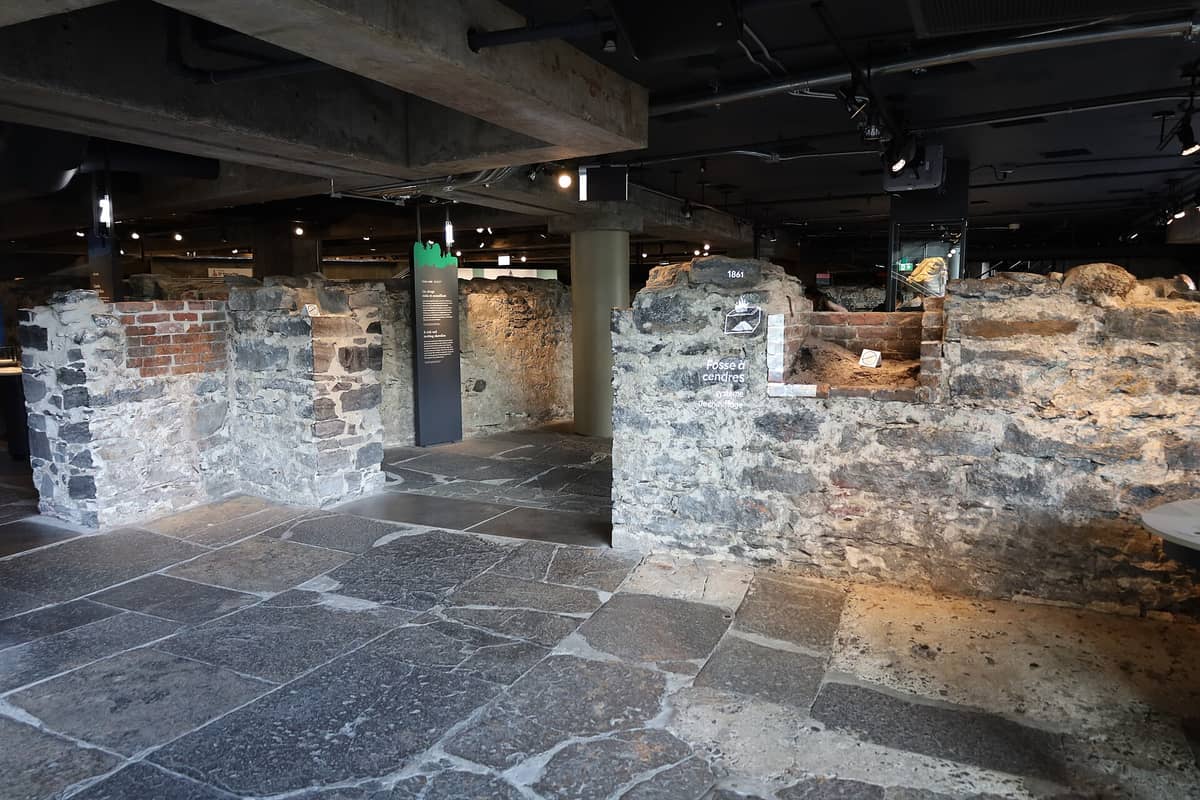
The museum opened in 1992 to mark the city's 350th anniversary. Its main building, the Éperon, is a striking postmodern structure designed by architect Dan Hanganu. It rises above Place Royale in a way that reads as contemporary without trying to compete with the stone warehouses and heritage facades of the surrounding streets. Inside, a multimedia crypt takes visitors underground into actual excavated remains: sewers, foundations, graves, and trade goods left by people who lived and worked on this same ground across more than a thousand years.
ℹ️ Good to know
Opening hours: Tuesday to Friday, 10:00 a.m. to 5:00 p.m.; Saturday and Sunday, 11:00 a.m. to 5:00 p.m. The museum is closed on Mondays. Tickets are sold until 60 minutes before closing. Hours may vary for holidays and special events; confirm on the official website before visiting.
The Underground Experience: What You Actually See
The heart of the museum is the archaeological crypt beneath the Éperon building. Visitors descend into actual excavated soil layers and walk between glass barriers and open trenches where centuries of urban history are visible in cross-section. You see archaeological remains associated with Fort Ville-Marie, Callière’s Residence, and the first location of Place Royale market, along with fragments of everyday colonial life: ceramics, tools, animal bones.
The experience is enhanced by projected multimedia installations that animate the space without obscuring the archaeology. Ghostly figures, period audio, and illustrated timelines layer interpretation over the physical remains. This works better than it sounds. The scale is intimate enough that you can stand close to the exposed foundations, and the lighting is deliberately dim to preserve mood and direct attention to specific elements. It is not a passive experience: there is a lot to read, watch, and process.
From the crypt, a covered underground passageway connects to the Youville Pumping Station, From the crypt, a covered underground passageway connects to the Youville Pumping Station, a 20th-century industrial building constructed in 1915 that has been converted into additional exhibition space.. The passage itself runs beneath Place Royale and surfaces in a building that still has its original stone walls and iron machinery. The shift from archaeological dig to industrial history happens underground and arrives without fanfare, which makes it feel like a genuine discovery.
⚠️ What to skip
The museum is wheelchair accessible, although some areas of the archaeological crypt are not accessible to visitors with reduced mobility. If accessibility is a concern, contact the museum in advance. Guide dogs are permitted throughout public areas.
Tickets & tours
Hand-picked options from our booking partner. Prices are indicative; availability and final rates are confirmed when you complete your booking.
Montreal evening cruise on the St. Lawrence River
From 54 €Instant confirmationFree cancellation3-hour e-bike guided tour in Montreal
From 68 €Instant confirmationFree cancellationWalking tour of Old Montreal
From 20 €Instant confirmationFree cancellationMontreal helicopter tour
From 156 €Instant confirmationFree cancellation
How the Visit Changes by Time of Day
Arriving when the museum opens, at 10:00 a.m. on weekdays, gives you the crypt almost entirely to yourself for the first hour. The multimedia presentations run on loops, and watching them without a crowd pressing behind you makes a significant difference. The underground chambers are narrow in places, and a single school group can fill them quickly.
By midday on weekends, the museum is busiest. Families with children, cruise ship visitors from the Old Port, and guided tour groups converge in the main atrium. The ground-floor reception area can feel congested between noon and 2:00 p.m. If you cannot arrive early, late afternoon is the next best window. The last entry is one hour before closing, and visitors who arrive at 3:30 p.m. or later often find the crypt quieter as earlier crowds cycle out.
The rooftop terrace of the Éperon building offers views across the Old Port and toward the St. Lawrence. On a clear afternoon, particularly in autumn, this is one of the quieter vantage points in the neighborhood. It costs nothing extra once you are inside, and most visitors skip it.
Historical and Cultural Significance
The site's importance begins well before 1642. Archaeological evidence shows that the point of land was used by Indigenous peoples as a trading and gathering place for centuries before European contact. The museum's permanent collection engages seriously with this history rather than treating it as a prologue to colonial settlement, though visitors who want to explore Indigenous history in greater depth will find the McCord Stewart Museum a useful complement.
The French colony of Ville-Marie was established here in May 1642 by Paul de Chomedey de Maisonneuve and a small group of colonists. The choice of this particular point was strategic: it allowed monitoring of river traffic in multiple directions. What the colonists could not have anticipated was how quickly the settlement would outgrow the point and expand inland and upriver. The original settlement footprint is now entirely beneath streets and buildings, which is what makes the excavation here so rare.
Place Royale, the square directly outside the museum, was Montreal's first public market square and remained a commercial hub for nearly two centuries. The museum's address at 350 Place Royale situates it precisely within the oldest continuously used urban space in the city. The surrounding streets of Old Montreal preserve much of the 18th and 19th-century building stock that developed from this original nucleus, which gives the area around the museum genuine historical coherence rather than reconstructed atmosphere.
Practical Walkthrough: Getting There and Moving Through the Space
The most direct transit route is the Orange Line metro to Square-Victoria–OACI station. From street level, it is approximately a five-minute walk southwest along rue Saint-Jacques or rue de la Commune toward Place Royale. The walk itself passes through the commercial core of Old Montreal and is easy to navigate. The museum entrance is marked on the building facade facing the square.
Buying tickets online in advance is advisable for weekend visits, particularly in summer and during major temporary exhibitions. Timed entry slots are sometimes required. On quieter weekdays, walk-in purchase at the desk is generally fine, but it is worth checking the museum's website in advance, especially around public holidays.
The museum complex spans several connected buildings, and the floor plan is more labyrinthine than it appears from outside. Collect the printed map at reception and follow the numbered sequence of spaces rather than exploring freeform. This matters most in the underground sections, where backtracking is annoying and some connections are one-directional. Budget at least two hours for the permanent collection. If there is a major temporary exhibition running, three hours is more realistic. After the museum, Place Jacques-Cartier is a short walk east along rue de la Commune and makes a natural endpoint for the afternoon.
💡 Local tip
Seniors visiting on Wednesdays pay a reduced rate of C$21.60 instead of the standard C$27. This applies to visitors aged 65 and over.
Photography and Sensory Notes
Photography is permitted throughout the permanent collection, though flash is not appropriate in the crypt and is generally unnecessary given the intentional low-light design. The underground sections reward wide-angle lenses because of the layered depth visible through the barriers. The multimedia projections photograph well in short bursts but will require some patience to capture cleanly without crowd interference.
The crypt has a particular quality that is worth noting: it smells of old stone and cool air, the way basements in very old buildings do. The temperature drops noticeably when you descend, which is welcome in summer but can feel cold in winter if you have checked your coat. The sound design in the multimedia installations is well-calibrated, never overwhelming, and the ambient audio of period life, voices, footsteps, and water creates genuine immersion.
Who Will Get the Most From This Museum
Pointe-à-Callière rewards visitors who come prepared to read and engage. There is substantial interpretive text, and the physical artifacts are more compelling when you understand the context surrounding them. Travelers with a strong interest in urban archaeology, colonial history, or the pre-contact history of the St. Lawrence valley will find the permanent collection rich and well-curated. Those exploring Montreal's broader heritage landscape should also consider the Notre-Dame Basilica and the Bonsecours Market nearby, both of which extend the historical narrative into the 19th century.
Families with children under ten may find the museum's density of text and the confined underground spaces less engaging than other options in the city. The multimedia elements hold younger attention reasonably well, but there is limited hands-on programming in the permanent galleries. Older teenagers and adults consistently rate the experience more highly.
Visitors primarily interested in the visual spectacle of Old Montreal, the cafés, the architecture from street level, the waterfront, may find the admission price hard to justify if they have limited time. For that kind of visit, the Old Port waterfront and the nearby Clock Tower offer outdoor historical atmosphere at no cost.
Insider Tips
- The underground passageway connecting the Éperon to the Youville Pumping Station is easy to miss if you follow the crowd back to the main staircase. Look for the directional signage near the lower level of the crypt and continue through rather than turning back.
- Seniors should note the Wednesday discount rate of C$21.60, which represents a meaningful saving over the standard C$27 and is rarely advertised prominently at the entrance.
- The rooftop terrace above the Éperon building is included in admission but receives almost no foot traffic. On afternoons with good light, it offers an elevated view over Place Royale and the Old Port that few visitors find.
- Temporary exhibitions at Pointe-à-Callière rotate several times a year and have included international loan collections of significant scope. Check the museum's website before your visit because the temporary program can substantially change the value proposition of the ticket.
- If you are visiting in summer and the museum is crowded, the permanent crypt exhibition is far less congested before 11:30 a.m. on weekdays. The ticket desk tends to queue from around noon onward on warm-weather weekends.
Who Is Pointe-à-Callière Museum For?
- History and archaeology enthusiasts who want to engage seriously with Montreal's origins
- Architecture-focused travelers interested in the dialogue between Hanganu's postmodern Éperon building and the surrounding heritage streetscape
- Couples or solo travelers who enjoy slow, immersive museum experiences
- Families with children aged 10 and older who can engage with interpretive text and multimedia
- First-time Montreal visitors who want cultural and historical grounding before exploring the rest of Old Montreal
Nearby Attractions
Other things to see while in Old Montreal:
- Bonsecours Market
Marché Bonsecours has stood at the heart of Old Montreal since 1847, surviving its reinventions as a temporary seat of parliament, a city hall, and a concert venue before settling into its current role as a showcase for Quebec designers and cultural exhibitions. Entry is free, the architecture is striking, and its location beside Place Jacques-Cartier makes it a natural anchor for any walk through the historic district.
- Montreal City Hall
Standing at the edge of Place Jacques-Cartier in Old Montreal, Montreal City Hall is a Second Empire civic landmark. Entry is free during its listed weekday hours, and the building carries a history that has shaped Canadian and Quebec political life.
- Musée Marguerite-Bourgeoys
Tucked into a corner of Old Montreal's rue Saint-Paul, the Musée Marguerite-Bourgeoys combines one of Canada's oldest pilgrim chapels with a genuinely surprising archaeological museum. It covers more than 2,400 years of history, costs less than most Montreal museums, and includes free access to the chapel above.
- Notre-Dame Basilica of Montreal
Notre-Dame Basilica of Montreal is a 19th-century Gothic Revival masterpiece at the heart of Old Montreal, recognized as the first church of its kind in Canada. Behind its twin stone towers lies one of the most ornate interiors in North America — deep indigo vaulting, carved wood, and thousands of gold stars overhead. This guide covers what to see, when to go, and how to make the most of your time inside.