Notre-Dame Basilica of Montreal: What to Expect Before You Walk Through the Doors
Notre-Dame Basilica of Montreal is a 19th-century Gothic Revival masterpiece at the heart of Old Montreal, recognized as the first church of its kind in Canada. Behind its twin stone towers lies one of the most ornate interiors in North America — deep indigo vaulting, carved wood, and thousands of gold stars overhead. This guide covers what to see, when to go, and how to make the most of your time inside.
Quick Facts
- Location
- 110 Notre-Dame Street West, Old Montreal, Quebec H2Y 1T1
- Getting There
- Place-d'Armes station, Orange Line (STM Metro) — short walk
- Time Needed
- 45 minutes to 1.5 hours, depending on pace and scheduled events
- Cost
- Paid admission (children 5 and under free); verify current rates at basiliquenotredame.ca before visiting
- Best for
- Architecture lovers, history seekers, photography, couples, first-time visitors to Montreal
- Official website
- www.basiliquenotredame.ca/en
What Is Notre-Dame Basilica of Montreal?
The Notre-Dame Basilica of Montreal, known in French as the Basilique Notre-Dame de Montréal, stands on the south side of Place d'Armes square in the heart of Old Montreal. Construction began in 1824, and the basilica was completed in stages, with its two towers finished in 1841 and 1843. It holds the distinction of being the first Gothic Revival church in Canada, predating the broader Gothic Revival wave that swept Victorian Britain and North America by decades. Today it serves as both an active Roman Catholic parish and one of the most visited landmarks in the country.
From the outside, the basilica's twin towers rise to roughly 69 metres and frame the stone facade with a severity that feels more medieval fortress than traditional French Baroque. That contrast is intentional: architects James O'Donnell and later Victor Bourgeau designed a structure meant to anchor a growing colonial city and signal permanence. What the exterior withholds, the interior more than compensates for.
ℹ️ Good to know
Opening hours: Monday–Saturday 9:00 a.m.–4:00 p.m.; Sunday 12:30 p.m.–4:00 p.m. Hours can shift for religious services, holidays, or private events. Check the official website before you go.
Stepping Inside: The Interior Experience
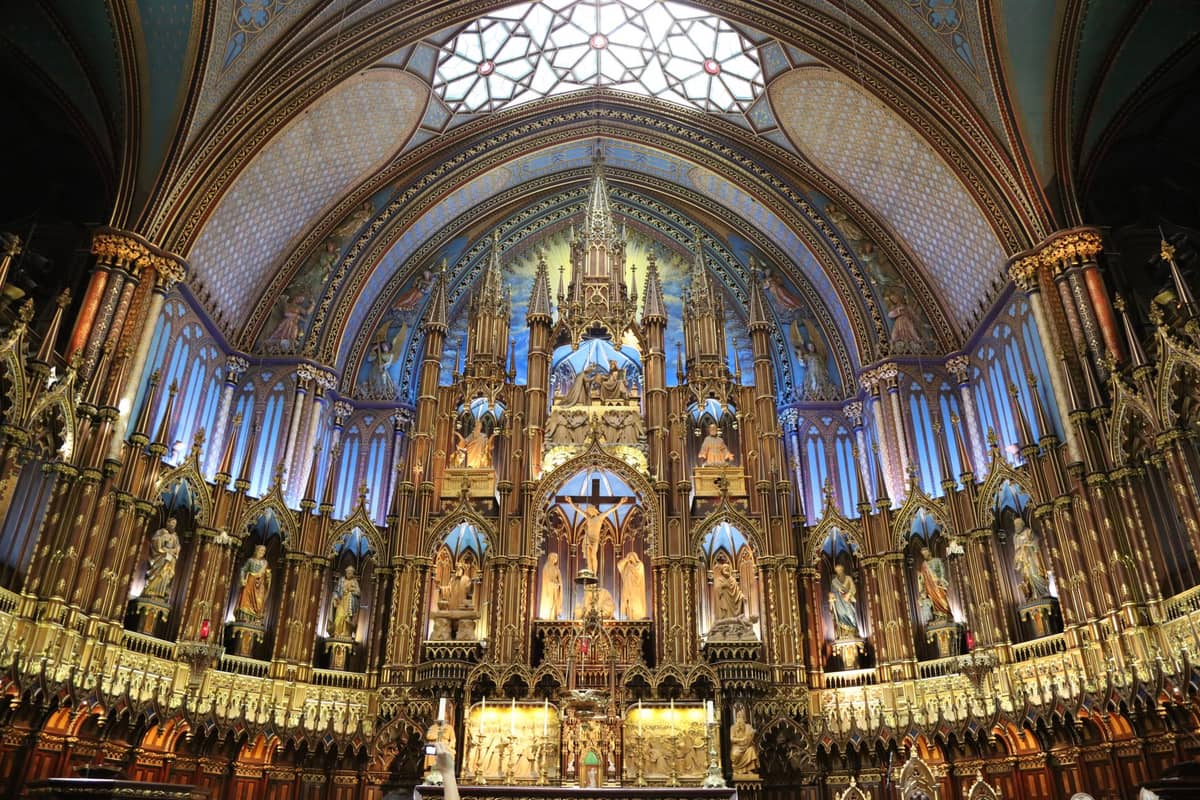
Nothing quite prepares you for the interior on your first visit. The nave stretches roughly 69 metres in length and seats up to 3,000 people, but it is the ceiling that stops most visitors in their tracks: a deep ultramarine blue vault studded with hundreds of 22-karat gold stars, curving overhead like a night sky pressed into stone. The colour is not subtle, and it is not supposed to be.
The pulpit, carved from white pine by Victor Bourgeau's workshop in the 1880s, rises in a spiral staircase draped with figures and foliage. The main altar, which took years to complete, is surrounded by carved wood panels depicting scenes from the life of the Virgin Mary. Look also at the stained glass windows, which do not tell a New Testament story in the conventional sense: they illustrate the religious history of Montreal and New France, making them a genuinely local document in glass and lead.
Behind the main altar, the smaller Sacred Heart Chapel — added between 1888 and 1891 and rebuilt after a 1978 arson fire — has a very different atmosphere. Its centrepiece is a large bronze retable created by Charles Daudelin, installed during the post-fire reconstruction. The contrast between that contemporary bronze and the Victorian Gothic of the main nave is startling, and worth the short walk to see.
💡 Local tip
The Sacred Heart Chapel is where most marriages are celebrated at the basilica. If you visit on a weekend afternoon, access may be temporarily restricted for a ceremony — plan accordingly.
Tickets & tours
Hand-picked options from our booking partner. Prices are indicative; availability and final rates are confirmed when you complete your booking.
Montreal evening cruise on the St. Lawrence River
From 54 €Instant confirmationFree cancellation3-hour e-bike guided tour in Montreal
From 68 €Instant confirmationFree cancellationWalking tour of Old Montreal
From 20 €Instant confirmationFree cancellationMontreal helicopter tour
From 156 €Instant confirmationFree cancellation
How the Visit Changes by Time of Day
Arrive when the doors open on a weekday morning and you will likely share the nave with a small, quiet crowd: a handful of early tourists, perhaps a few locals stopping in briefly, and the particular hush of a large stone building before the day fully starts. The light through the stained glass is at its most concentrated in morning hours when sun angles are lower, casting narrow pools of colour across the wooden pews.
By late morning on weekends, particularly in summer, group tours arrive in rotation. The nave can feel crowded, and the ambient sound shifts considerably. If you prefer space to observe the carved details at your own pace, the difference between arriving at 9:00 a.m. versus 11:00 a.m. on a July Saturday is significant.
Sunday visits require more planning. The basilica does not open until 12:30 p.m., and morning masses mean access is limited. If your priority is photography or architectural observation rather than attending a service, a Tuesday or Wednesday morning offers the most room to move and look without managing crowds.
Historical and Cultural Context
Notre-Dame Basilica is built on the site of an earlier church that dated from the 17th century, making this location arguably the most historically layered square in Montreal. Place d'Armes itself has been a civic and commercial centre since the French colonial era, and the facing building — the Bank of Montreal, opened in 1817 — frames the square as a study in competing institutional powers: church and commerce facing each other across cobblestones.
The basilica is also the recognized mother church of Montreal, a designation that carries substantial weight in a city shaped by French Catholic settlement. Its construction coincided with a significant period of population growth in Lower Canada, and the scale of the building — The basilica is also the recognized mother church of Montreal, a designation that carries substantial weight in a city shaped by French Catholic settlement. Its construction coincided with a significant period of population growth in Lower Canada, and the scale of the building reflects the ambitions of the Sulpician order that commissioned it. For more on how architecture shaped Montreal's identity across centuries, the puts the basilica into broader context alongside buildings from very different eras.reflects the ambitions of the Sulpician order that commissioned it. For more on how architecture shaped Montreal's identity across centuries, the Montreal architecture guide puts the basilica into broader context alongside buildings from very different eras.
The basilica has hosted funerals for several notable figures, including Prime Minister Pierre Elliott Trudeau in 2000 and hockey legend Maurice Richard in 2000 as well. It has also been the venue for high-profile concerts, most famously Celine Dion's album launch performance in 1994. That mixture of the sacred and the cultural is not unusual in Montreal, where the relationship between institutional religion and civic identity has always been complicated.
Getting There and Practical Logistics
The most direct way to arrive is via the Place-d'Armes metro station on the Orange Line. From the station exit, the basilica's towers are visible almost immediately to the south. Old Montreal is also a walkable neighbourhood, so visitors staying nearby can easily incorporate the basilica into a broader itinerary without needing transit at all.Old Montreal is also a walkable neighbourhood, so visitors staying nearby can easily incorporate the basilica into a broader Old Montreal itinerary without needing transit at all.
Admission is charged for most visitors; children aged 5 and under enter free. The pricing structure and any age-band rates should be verified directly at the official website before your visit, as rates are subject to change.
The main entrance has a wheelchair ramp, and the basilica holds a partial accessibility certification from Kéroul, a Quebec organization specializing in accessible tourism evaluation. Visitors with mobility considerations should review the specific facility details on the basilica's FAQ page before visiting, as conditions in certain areas, including the stairs to upper areas, may present limitations.
⚠️ What to skip
The basilica is an active place of worship. Dress modestly — shoulders and knees should be covered. Very short skirts, sleeveless tops, and beachwear are inappropriate and may result in being asked to cover up or leave.
Photography Inside the Basilica
Photography for personal use is permitted in most areas of the basilica. The interior is genuinely difficult to photograph well without some preparation. The ceiling's deep blue absorbs light rather than reflecting it, and the contrast between the bright windows and the dark carved wood is extreme. A smartphone camera will typically struggle with the exposure balance: the windows will blow out, or the nave will go very dark.
If photography is important to you, bring a camera with manual exposure control or use the HDR function on your phone. Shoot in portrait orientation to capture full columns. The best single vantage point for the overall nave is from the rear of the church, looking toward the altar, from around the midpoint of the central aisle. Photography for personal use is permitted in most areas of the basilica, subject to posted restrictions and event-specific rules. Tripods and flash photography are not permitted.
Is It Worth Your Time? An Honest Assessment
For most first-time visitors to Montreal, yes, the basilica is worth visiting. It is genuinely exceptional as a work of 19th-century religious architecture, and it requires no particular interest in Catholicism to appreciate the craft. The interior is unlike anything else in Montreal and stands comparison with the great Gothic Revival buildings of Europe and North America. If you are spending time in Old Montreal for any reason, the basilica is a ten-minute detour that most visitors do not regret.
That said, visitors who have already seen major European Gothic cathedrals and are expecting something of comparable scale or antiquity may find it less overwhelming. Notre-Dame Basilica of Montreal was built in the 1820s, not the 1220s, and the stone does not carry the weight of centuries in the same way. The interior decoration is lavish but was largely executed in wood rather than stone, which gives it a different texture — warmer, in some ways, but less austere.
Travelers who are primarily interested in outdoor experiences or who find religious interiors generally unengaging might prefer to spend equivalent time at the Pointe-à-Callière Museum nearby, which tells the archaeological story of Montreal's founding in a more secular context. But if you have room in your itinerary for both, the contrast is instructive: the basilica is the city as it wanted to see itself; Pointe-à-Callière is the city as it actually began.
Insider Tips
- The AURA sound and light show, staged after regular visiting hours, transforms the interior completely with projected imagery and a music score. It runs on select evenings and requires a separate ticket. Check the official site for current dates — it books out in advance during summer.
- Place d'Armes square directly in front of the basilica offers the best exterior photographs in late afternoon, when the stone facade catches warm light from the west. Midday sun flattens the towers considerably.
- If you want silence, aim for a weekday in November or March. The basilica is heated, and the crowds thin dramatically in the shoulder months. You may have entire sections of the nave to yourself.
- The gift shop near the entrance sells reasonably priced reproductions of the stained glass window designs, as well as books on the basilica's architectural history that go well beyond what the signage inside explains.
- Look up at the wooden vaulting carefully: the blue is not painted stone but rather painted wood, a practical 19th-century compromise that allowed the Sulpicians to build faster and more affordably than true stone vaulting would have permitted. Knowing this changes how you read the space.
Who Is Notre-Dame Basilica of Montreal For?
- First-time visitors to Montreal who want to understand the city's foundational cultural identity
- Architecture and design enthusiasts interested in Gothic Revival and 19th-century ecclesiastical interiors
- Photographers looking for a dramatic interior subject with strong colour and carved detail
- Couples: the Sacred Heart Chapel in particular has an intimate atmosphere very different from the grand nave
- Travelers combining a walking tour of Old Montreal with history-oriented stops
Nearby Attractions
Other things to see while in Old Montreal:
- Bonsecours Market
Marché Bonsecours has stood at the heart of Old Montreal since 1847, surviving its reinventions as a temporary seat of parliament, a city hall, and a concert venue before settling into its current role as a showcase for Quebec designers and cultural exhibitions. Entry is free, the architecture is striking, and its location beside Place Jacques-Cartier makes it a natural anchor for any walk through the historic district.
- Montreal City Hall
Standing at the edge of Place Jacques-Cartier in Old Montreal, Montreal City Hall is a Second Empire civic landmark. Entry is free during its listed weekday hours, and the building carries a history that has shaped Canadian and Quebec political life.
- Musée Marguerite-Bourgeoys
Tucked into a corner of Old Montreal's rue Saint-Paul, the Musée Marguerite-Bourgeoys combines one of Canada's oldest pilgrim chapels with a genuinely surprising archaeological museum. It covers more than 2,400 years of history, costs less than most Montreal museums, and includes free access to the chapel above.
- Notre-Dame-de-Bon-Secours Chapel
Standing at the eastern edge of Old Montreal's rue Saint-Paul, Notre-Dame-de-Bon-Secours Chapel is the city's oldest surviving chapel, with roots going back to 1675. Free to enter, packed with maritime history, and part of a historic site that includes a small museum and archaeological site, it rewards visitors who take the time to look past the cobblestones outside.