Musée Marguerite-Bourgeoys: Old Montreal's Most Underrated Heritage Site
Tucked into a corner of Old Montreal's rue Saint-Paul, the Musée Marguerite-Bourgeoys combines one of Canada's oldest pilgrim chapels with a genuinely surprising archaeological museum. It covers more than 2,400 years of history, costs less than most Montreal museums, and includes free access to the chapel above.
Quick Facts
- Location
- 400 rue Saint-Paul Est, Old Montreal, Quebec H2Y 1H4
- Getting There
- Champ-de-Mars metro station (Orange Line), approx. 10-minute walk west along rue Notre-Dame
- Time Needed
- 1.5 to 2.5 hours for museum plus chapel; allow extra time for the tower lookout in summer
- Cost
- CAD $13 adults / $11 seniors (65+) / $7 students (18–25 with ID) / $7 youth (13–17) and children (0–12). Chapel entry is free, with voluntary contributions.
- Best for
- History enthusiasts, architecture lovers, travelers combining the Old Port waterfront with a deeper cultural stop
- Official website
- margueritebourgeoys.org/en
What the Musée Marguerite-Bourgeoys Actually Is
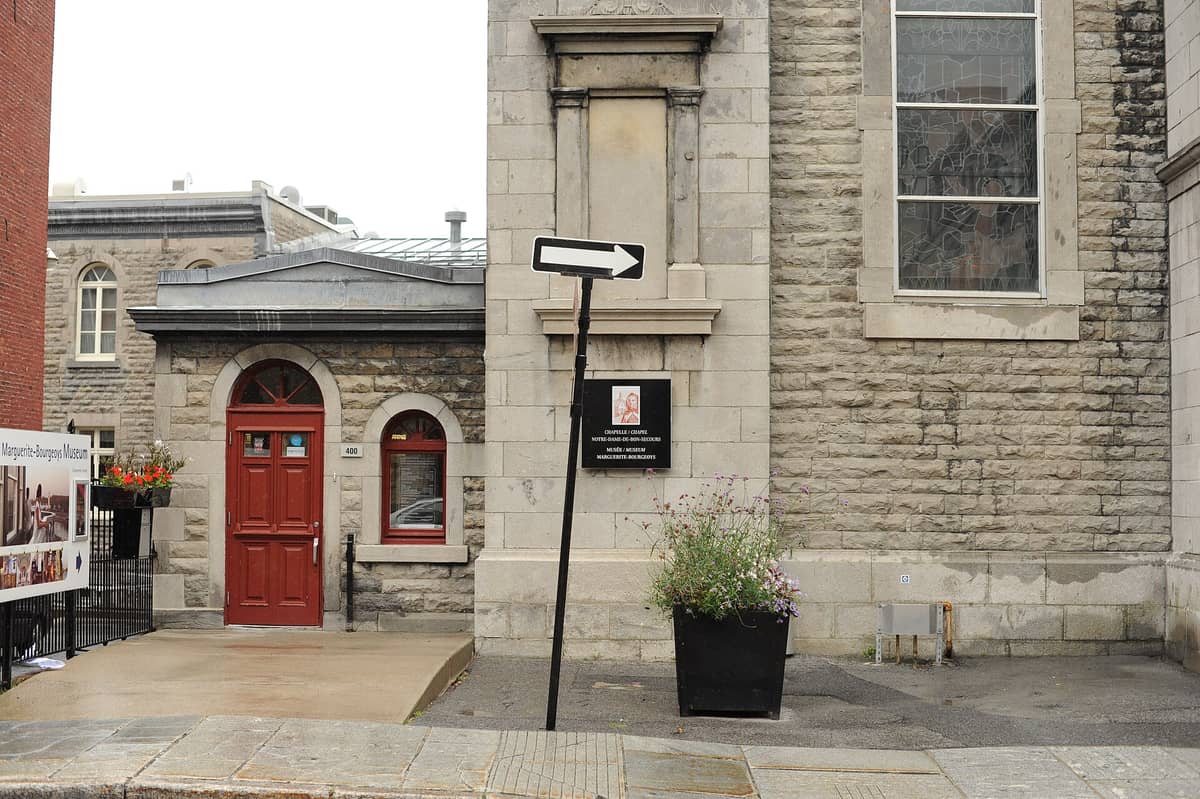
The Musée Marguerite-Bourgeoys is a heritage museum and active religious site combined into a single stone building on the eastern edge of rue Saint-Paul, in Old Montreal. It occupies the Chapelle Notre-Dame-de-Bon-Secours — commonly called the Sailors' Church — and the archaeological crypt beneath it, which descends through successive building layers dating back to the early French colonial period and well beyond.
Most visitors come to Old Montreal for the Basilica or the cobblestones, and they walk straight past this building without realizing what it contains. That partly explains why it stays manageable: crowds here are thinner than at Notre-Dame Basilica, the pace is quieter, and the content rewards attention in a way that grand architecture alone cannot.
The museum is dedicated to Marguerite Bourgeoys, a French-born teacher and religious who arrived in the colony of Ville-Marie (present-day Montreal) in 1653 and founded the Congregation of Notre-Dame — Canada's first uncloistered religious teaching order. She was canonized by Pope John Paul II in 1982, making her one of only a handful of Canadian saints. The chapel she had built on this site between 1675 and 1678 is one of Montreal’s historic stone churches.
ℹ️ Good to know
The chapel itself is free to enter without a museum ticket. If you only want to sit inside the church and see the interior, no admission is charged — though contributions are appreciated. The paid museum includes the archaeological crypt, the tower, and the permanent exhibition.
The Chapel: Light, Stone, and Sailors' Votive Offerings
The Chapelle Notre-Dame-de-Bon-Secours sits at street level, its facade facing rue Saint-Paul with the kind of weathered stone solidity that only centuries of Quebec winters can produce. Stepping inside from the street is a genuine shift in sensory register: the noise of tour groups on the cobblestones outside drops away, replaced by the scent of aged wood and wax, and a quality of light filtered through stained glass that makes the interior feel considerably older than the city around it.
Look up at the ceiling and walls: you will see small wooden boat models suspended at various heights. These are ex-voto offerings, traditionally left by sailors and their families in thanks for surviving dangerous sea crossings on the Saint Lawrence. The practice dates to the chapel's earliest decades as a sailors' pilgrimage site, and the accumulated collection is one of the more unusual things you will encounter in any Montreal church. The chapel faces the Old Port, and sailors arriving in Montreal could see the angel statue on its tower from the water.
For context on how this chapel fits within the broader religious architecture of Old Montreal, the Notre-Dame Basilica sits about 700 metres west along rue Notre-Dame. The two sites make a natural pairing, though they offer very different experiences: one is theatrical grandeur, the other is intimate history.
Tickets & tours
Hand-picked options from our booking partner. Prices are indicative; availability and final rates are confirmed when you complete your booking.
Montreal evening cruise on the St. Lawrence River
From 54 €Instant confirmationFree cancellation3-hour e-bike guided tour in Montreal
From 68 €Instant confirmationFree cancellationWalking tour of Old Montreal
From 20 €Instant confirmationFree cancellationMontreal helicopter tour
From 156 €Instant confirmationFree cancellation
The Archaeological Crypt: 2,000 Years in Layers
The museum's most compelling section is underground. Excavations beneath the chapel have revealed building phases going back through the 17th and 18th centuries, and the site's interpretation extends to cover more than 2,400 years of regional history, incorporating Indigenous presence in the area well before European colonization.
The crypt is not a dusty storage space. Display lighting is well-considered, and the presentation moves through time in a way that makes the layering of history physically legible: you are standing inside it, not just reading about it on a placard. The original stone foundations of Bourgeoys' first chapel are visible, alongside artifacts and interpretive panels that explain what life in the early colonial settlement looked like. The scale is modest and the exhibition is not overwhelming, which is actually an advantage: you leave with a clearer mental picture than you would from a larger institution.
💡 Local tip
The crypt section can feel slightly cool even in summer, given its stone walls and underground position. A light layer is useful if you tend to run cold indoors.
The Tower and the View Over the Old Port
Included in the paid admission is access to the chapel's tower, which provides a rooftop-level view over the surrounding streets and toward the Saint Lawrence River. The climb involves a narrow staircase, and the space at the top is compact, but the vantage point is genuinely useful for orienting yourself within Old Montreal. You can see the clock tower at the Old Port, the river, and the dense pattern of historic rooftines below.
Tower access is seasonal — available during the May 15 to October 15 schedule when the site keeps longer hours. If you are visiting specifically for the outdoor view, this is an attraction that delivers more during the warmer months. For a broader survey of Montreal views, see the best viewpoints in Montreal guide for comparison.
⚠️ What to skip
The museum is listed as not wheelchair accessible in Quebec's official museum directory. The crypt involves stairs, and the tower staircase is narrow and steep. Visitors with limited mobility should contact the museum in advance to understand which sections are reachable.
Hours, Tickets, and How to Get There
Opening hours change by season. From May 15 to October 15, the site is open daily from 10:00 to 18:00. From October 16 to May 14, it is closed on Mondays; Tuesday to Saturday it opens from 11:00 to 17:00, and Sunday from 10:00 to 17:00. Temporary closures can affect the archaeological site and vault, so check the official site before making a trip.
Admission as of the verified September 2026 pricing is CAD $13 for adults, $11 for seniors aged 65 and over, and $7 for students aged 18 to 25 with valid proof of enrollment, as well as for youth aged 13 to 17 and children 12 and under. The chapel itself is free to enter; the fee covers the museum and archaeological site. These are among the more reasonable admission prices for a heritage museum in Montreal.
The site is at 400 rue Saint-Paul Est. The closest metro station is Champ-de-Mars on the Orange Line, roughly a 10-minute walk west along rue Notre-Dame. The building sits near the eastern end of the rue Saint-Paul tourist corridor, so it is a natural last stop if you are walking east from Place Jacques-Cartier, or a logical starting point if you are coming from the waterfront direction.
If you are planning a full day in the area, the Pointe-à-Callière Museum is the other major archaeological heritage institution in Old Montreal, located about 12 minutes' walk west. The two museums cover related historical ground from different angles and make a strong combination for anyone with a serious interest in early Montreal.
When to Visit and What to Expect at Different Times
Morning visits before noon on weekdays are consistently quieter than afternoon slots, particularly in summer when Old Montreal sees its highest foot traffic. On summer weekend afternoons, the street outside gets congested with tour groups, but the museum itself absorbs visitors well and rarely feels packed. The chapel interior in the early morning light, before the crowds arrive on the street, is noticeably calmer and worth the earlier start if you have flexibility.
In winter, the site operates on reduced hours and the tower may not be worth the same effort without the river views obscured by low cloud or cold haze. But the crypt and chapel are fully operational and actually suit the quieter winter pace of the neighborhood well. Old Montreal in January or February has almost none of the summer congestion, and institutions like this one become easier to appreciate without the surrounding noise.
If you are organizing a broader Old Montreal itinerary, the three-day Montreal itinerary includes practical sequencing for combining this site with other nearby stops.
Is This Attraction Worth Your Time?
The honest answer depends on what you are after. If you want spectacle, the Marguerite-Bourgeoys Museum is not the right call. It is a small, carefully curated heritage site that rewards curiosity and patience more than it delivers visual drama. The chapel is beautiful in an understated way, the crypt is genuinely interesting, and the combined admission price is fair.
If you are in Old Montreal primarily for the atmosphere, the restaurant scene, or the views of the Old Port, you can skip the paid museum portion and step into the chapel for free to get a sense of the building. That 10-minute stop alone is worthwhile. The full museum visit, however, offers something harder to find in most heritage districts: an actual excavation beneath your feet that makes the city's layered history concrete rather than abstract.
Travelers who enjoy this kind of site tend to also appreciate the McCord Stewart Museum for its social history collections, or the architectural history of Montreal more broadly. This is a city with more depth than its surface suggests, and this museum is a good place to start understanding that.
Insider Tips
- The chapel's free entry is genuine — you do not need to buy a ticket to walk in, sit down, and look at the votive boat collection. Staff at the door will direct museum ticket buyers separately. This is worth knowing if you are short on time or budget.
- The tower view faces southeast toward the Saint Lawrence. It is most rewarding on a clear day and at a time when the afternoon light is hitting the river. Overcast or hazy conditions reduce the payoff significantly.
- If you are visiting with children, the archaeological crypt works surprisingly well for older kids who are curious about excavations and layers of history. The hands-on sense of standing inside something ancient tends to engage them more than conventional museum halls.
- Guided visits are available and offered in both French and English. If you are genuinely interested in the colonial history context and Marguerite Bourgeoys' biography, the guided option adds substantial detail that the self-guided panels only sketch. Check availability on the official site before your visit.
- The museum sits at the far eastern end of rue Saint-Paul, which means it sees less casual foot traffic than the middle section of the street. This is not a sign that it is less worthwhile — it simply means the immediate surroundings are quieter, and you can often find parking along nearby streets on weekday mornings if you are arriving by car.
Who Is Musée Marguerite-Bourgeoys For?
- History and archaeology enthusiasts who want substance behind the colonial-era streetscapes of Old Montreal
- Travelers combining a walk along the Old Port waterfront with an indoor cultural stop
- Visitors interested in Quebec's religious heritage and the early French settlement period
- Those who want a less crowded, lower-cost alternative to the larger Old Montreal institutions
- Curious travelers with 90 minutes to spare who want to understand what is underneath the cobblestones
Nearby Attractions
Other things to see while in Old Montreal:
- Bonsecours Market
Marché Bonsecours has stood at the heart of Old Montreal since 1847, surviving its reinventions as a temporary seat of parliament, a city hall, and a concert venue before settling into its current role as a showcase for Quebec designers and cultural exhibitions. Entry is free, the architecture is striking, and its location beside Place Jacques-Cartier makes it a natural anchor for any walk through the historic district.
- Montreal City Hall
Standing at the edge of Place Jacques-Cartier in Old Montreal, Montreal City Hall is a Second Empire civic landmark. Entry is free during its listed weekday hours, and the building carries a history that has shaped Canadian and Quebec political life.
- Notre-Dame Basilica of Montreal
Notre-Dame Basilica of Montreal is a 19th-century Gothic Revival masterpiece at the heart of Old Montreal, recognized as the first church of its kind in Canada. Behind its twin stone towers lies one of the most ornate interiors in North America — deep indigo vaulting, carved wood, and thousands of gold stars overhead. This guide covers what to see, when to go, and how to make the most of your time inside.
- Notre-Dame-de-Bon-Secours Chapel
Standing at the eastern edge of Old Montreal's rue Saint-Paul, Notre-Dame-de-Bon-Secours Chapel is the city's oldest surviving chapel, with roots going back to 1675. Free to enter, packed with maritime history, and part of a historic site that includes a small museum and archaeological site, it rewards visitors who take the time to look past the cobblestones outside.