Montreal City Hall (Hôtel de Ville): History, Access, and What to Actually Expect
Standing at the edge of Place Jacques-Cartier in Old Montreal, Montreal City Hall is a Second Empire civic landmark. Entry is free during its listed weekday hours, and the building carries a history that has shaped Canadian and Quebec political life.
Quick Facts
- Location
- 275 Notre-Dame Street East, Old Montreal, QC H2Y 1C6 (accessible drop-off: 510 Gosford Street)
- Getting There
- Champ-de-Mars metro station (Orange Line), a short walk away
- Time Needed
- 30–60 minutes for a self-guided visit; longer during special exhibitions
- Cost
- Free admission during regular weekday hours (Mon–Fri, 8:00 a.m.–5:00 p.m.)
- Best for
- Architecture enthusiasts, history-focused travelers, and anyone doing a walking tour of Old Montreal
- Official website
- montreal.ca/en/places/city-hall
What Montreal City Hall Actually Is
The Hôtel de ville de Montréal, or Montreal City Hall, is a working municipal building and a recognized historic landmark. It is not a museum in the conventional sense, but it functions as one during designated exhibition periods, and its architecture alone justifies a stop on any serious exploration of Old Montreal.
The building sits on Notre-Dame Street East, with its main facade overlooking Place Vauquelin and the wider sweep of Place Jacques-Cartier just to the east. It is, in practical terms, the governing centre of Montreal, which means it is a real working building on weekdays. This matters for how you experience it: the lobbies and exhibition spaces feel civic and purposeful, not staged for tourism.
For visitors building an Old Montreal itinerary, City Hall fits naturally between Notre-Dame Basilica to the west and Place Jacques-Cartier immediately to the east. Allow at least 30 minutes for the building itself, more if there is an active exhibition.
The Architecture: Second Empire Stone and a Reconstruction You Can Trace
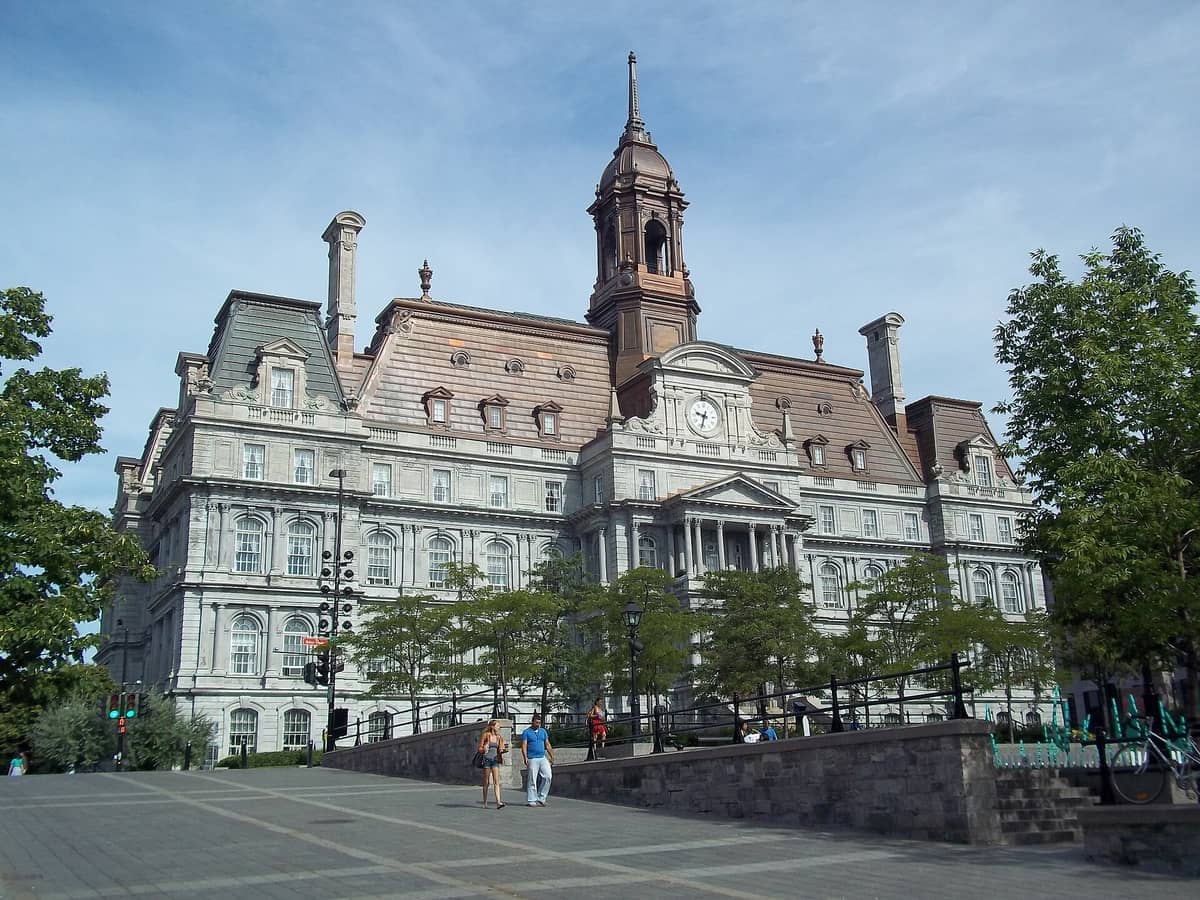
Construction of Montreal City Hall began in 1872 and was completed in 1878. The style is Second Empire, an architectural language that was fashionable in French civic buildings during the reign of Napoleon III and spread to North America in the mid-to-late 19th century. Key identifiers are visible from the street: the mansard roof with its characteristic double slope and dormer windows, the symmetrical stone facade with arched windows, and the central tower that anchors the composition.
The original five-storey building was gutted by fire in 1922. The blaze destroyed the interior completely, leaving the exterior stone walls intact. Reconstruction followed from 1922 to 1926 and added an additional storey to the structure. If you look closely at the roofline and upper sections, you can detect where the post-fire work introduced a slightly different material quality and detailing compared to the original 1870s stonework.
The building has been recognized as a National Historic Site of Canada, placing it in the same category of protected heritage as many of the other stone structures you will see throughout Old Montreal. The heritage designation applies to its architectural and historical significance within Canadian civic life.
💡 Local tip
The best exterior vantage point is from Place Vauquelin, directly in front of the main facade. The full symmetry of the building reads best from the middle of the square, where you get the tower, the mansard roof, and the stone detailing without any foreground obstruction.
Tickets & tours
Hand-picked options from our booking partner. Prices are indicative; availability and final rates are confirmed when you complete your booking.
Montreal evening cruise on the St. Lawrence River
From 54 €Instant confirmationFree cancellation3-hour e-bike guided tour in Montreal
From 68 €Instant confirmationFree cancellationWalking tour of Old Montreal
From 20 €Instant confirmationFree cancellationMontreal helicopter tour
From 156 €Instant confirmationFree cancellation
A Balcony That Became a Historical Footnote
On July 24, 1967, French President Charles de Gaulle stepped onto the balcony of Montreal City Hall and delivered his now-famous "Vive le Québec libre" speech to a large crowd below. The phrase expressed support for Quebec sovereignty and provoked a diplomatic controversy during his state visit.
The balcony where de Gaulle spoke is still there, above the main entrance. It is one of those small architectural features that carries an outsized amount of historical weight. The building has accessible facilities, including an accessible pickup and drop-off zone and washrooms.
Visiting the Interior: What to Expect Inside
Entry is free during the listed weekday hours, Monday through Friday, 8:00 a.m. to 5:00 p.m. The building is closed on weekends. Check the official Ville de Montréal website before visiting for current access information.
The interior includes council chambers, formal reception spaces, and corridors lined with artworks and commemorative pieces from Montreal's civic history. The proportions are generous, the ceilings high, and the stonework visible in places through the post-fire reconstruction. During special exhibitions, additional spaces are opened to the public, and the volume and quality of what you can see increases considerably.
Exhibition programming is not continuous. Guided tours have been offered during specific periods. Check the official Ville de Montréal website before visiting if exhibitions or tours are a specific reason for your visit, because availability is not guaranteed year-round.
⚠️ What to skip
City Hall is closed on weekends. If your Old Montreal day falls on a Saturday or Sunday, plan to explore the exterior unless the official city page lists a special opening.
How the Experience Changes by Time of Day
On weekday mornings, the building operates as a working city office. You will encounter staff, local officials, and residents who have administrative business. The atmosphere is purposeful and low-key. This is arguably the most authentic way to experience a civic building: not as a curated attraction, but as a place that still does its job.
By late morning and early afternoon, the publicly accessible areas see more visitors doing walking tours of the area. The light through the upper windows of the main hall is strong during midday hours in summer, which is useful for photography in the interior. Exterior photography of the facade works best in the morning when the sun hits the stone directly from the east, illuminating the surface texture and the carved details around the windows.
In winter, Old Montreal quiets down considerably compared to summer, and City Hall reflects this. The exterior in snow or frost is photogenic, and the relative emptiness of the surrounding squares means you can photograph the building without a crowd in the foreground. Dress for winter conditions, which can be very cold.
Getting There and Practical Access
The closest metro station is Champ-de-Mars on the Orange Line, a short walk from City Hall. This is a practical approach from many areas of central Montreal.
Old Montreal is also well-served by cycling infrastructure. If you are using the city's Bixi bike-share network or a personal bicycle, there are docking stations near Place Jacques-Cartier. The Montreal cycling network connects Old Montreal to the Old Port waterfront and the Lachine Canal path, so City Hall works well as a starting or ending point for a longer ride.
The building is wheelchair accessible. The official city information lists a pickup/drop-off zone at 510 Gosford Street, and accessible washrooms are available inside. Check the official access information before arrival for the appropriate entrance.
ℹ️ Good to know
The accessible pickup and drop-off address is 510 Gosford Street. If you need step-free access, check the official access information before arrival and use that address as your destination.
Honest Assessment: Who Should Visit and Who Should Not
Montreal City Hall rewards visitors who are genuinely interested in civic architecture, Quebec history, or the political events of the 1960s. The building itself is impressive in a way that many visitors underestimate from the outside: the scale, the stonework, and the internal proportions are more elaborate than the relatively plain street-level view suggests.
If your primary interest is interactive exhibits, high-design museum spaces, or strictly curated historical presentations, this is not the right destination on its own. The experience is architectural and historical, not experiential in the way that a purpose-built attraction would be. Combine it with a broader walk through Old Montreal rather than treating it as a standalone destination.
Visitors who enjoy combining landmarks with outdoor spaces will find that City Hall, Place Vauquelin, and Place Jacques-Cartier form a logical sequence. The three together take roughly an hour to explore at a comfortable pace and can anchor the northern section of an Old Montreal walking route.
For a fuller picture of the area's historical depth, the nearby Pointe-à-Callière Museum offers a far more comprehensive treatment of Montreal's founding and development. It is the natural complement to a City Hall visit if you want archaeological and historical context beyond civic architecture.
Insider Tips
- Visit between 9:00 a.m. and 11:00 a.m. on a weekday for the quietest interior experience. The building gets busier with lunch-hour foot traffic and tour groups after midday.
- The exterior facade photographs best from Place Vauquelin in the morning, when the light hits the stone from the east. Afternoon light moves behind the building and flattens the facade.
- Check the Ville de Montréal website before your visit for active exhibition periods. The building opens additional interior spaces and sometimes offers guided tours during these windows, which substantially increases what you can see.
- The de Gaulle balcony is above the central main entrance. If you look up from directly in front of the door, you are standing approximately where the 1967 crowd was gathered. The scale of what the crowd would have seen becomes clearer from that vantage point.
- If you are visiting in winter, the north-facing Gosford Street side of the building tends to have more ice on its approaches than the main Place Vauquelin side. Use the main entrance in icy conditions unless you specifically need the accessible Gosford ramp.
Who Is Montreal City Hall For?
- Architecture enthusiasts interested in Second Empire design and 19th-century civic construction
- History-focused travelers tracing Quebec's political and cultural identity
- Photographers seeking impressive stone facades with manageable crowds on weekday mornings
- First-time visitors to Old Montreal building a foundational walking itinerary
- Travelers combining free attractions on a tight budget, since City Hall offers free entrance
Nearby Attractions
Other things to see while in Old Montreal:
- Bonsecours Market
Marché Bonsecours has stood at the heart of Old Montreal since 1847, surviving its reinventions as a temporary seat of parliament, a city hall, and a concert venue before settling into its current role as a showcase for Quebec designers and cultural exhibitions. Entry is free, the architecture is striking, and its location beside Place Jacques-Cartier makes it a natural anchor for any walk through the historic district.
- Musée Marguerite-Bourgeoys
Tucked into a corner of Old Montreal's rue Saint-Paul, the Musée Marguerite-Bourgeoys combines one of Canada's oldest pilgrim chapels with a genuinely surprising archaeological museum. It covers more than 2,400 years of history, costs less than most Montreal museums, and includes free access to the chapel above.
- Notre-Dame Basilica of Montreal
Notre-Dame Basilica of Montreal is a 19th-century Gothic Revival masterpiece at the heart of Old Montreal, recognized as the first church of its kind in Canada. Behind its twin stone towers lies one of the most ornate interiors in North America — deep indigo vaulting, carved wood, and thousands of gold stars overhead. This guide covers what to see, when to go, and how to make the most of your time inside.
- Notre-Dame-de-Bon-Secours Chapel
Standing at the eastern edge of Old Montreal's rue Saint-Paul, Notre-Dame-de-Bon-Secours Chapel is the city's oldest surviving chapel, with roots going back to 1675. Free to enter, packed with maritime history, and part of a historic site that includes a small museum and archaeological site, it rewards visitors who take the time to look past the cobblestones outside.