Mary Queen of the World Cathedral: Montreal's Downtown Basilica
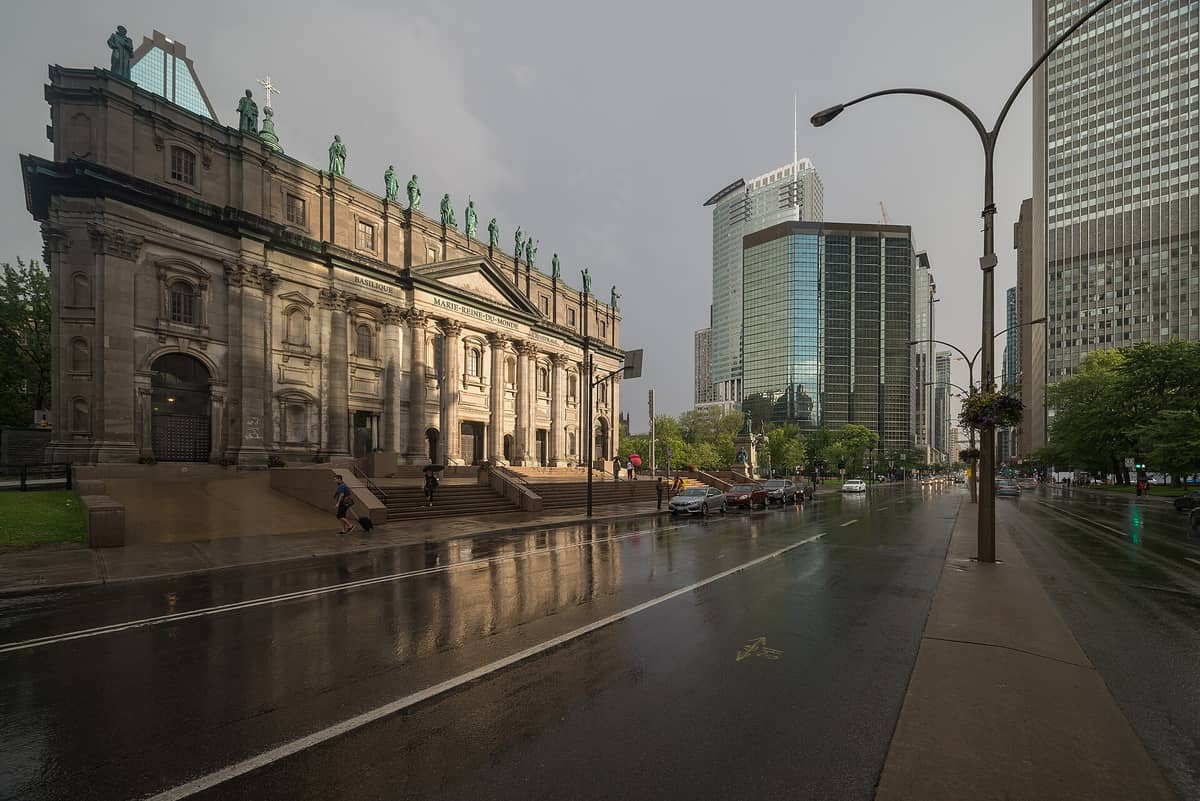
Standing at the heart of downtown Montreal, Mary Queen of the World Cathedral is a one-fifth-scale replica of St. Peter's Basilica in Rome, completed in 1894. Free to enter daily, it offers one of the most striking architectural contrasts in the city: solemn stone and gilded interiors set directly against glass towers and commuter traffic.
Quick Facts
- Location
- 1085 rue de la Cathédrale, corner of René-Lévesque Blvd and Metcalfe St, Downtown Montreal
- Getting There
- Bonaventure metro station (Orange Line), a short walk from the main entrance
- Time Needed
- 30–60 minutes for a thorough visit; 15 minutes if passing through
- Cost
- Free; voluntary donations appreciated
- Best for
- Architecture lovers, quiet seekers, history enthusiasts, rainy-day visitors
- Official website
- mariereinedumonde.org/fr
What You're Actually Looking At
Mary Queen of the World Cathedral, known in French as the Basilique-cathédrale Marie-Reine-du-Monde, is one of Montreal's most architecturally dramatic buildings. It sits at the corner of René-Lévesque Boulevard and Metcalfe Street, in the heart of downtown Montreal. The contrast is immediate and almost theatrical: a renaissance-style stone dome rising above a mid-century grid of office towers, as though Rome were dropped into a financial district.
The building is a one-fifth-scale model of St. Peter's Basilica in Vatican City, measuring approximately 101.5 metres long, 45.72 metres wide, and 76.8 metres high to the tip of the dome. That last figure matters because, standing at street level, the dome doesn't look especially tall. Downtown Montreal's towers dwarf it. But step inside and the proportions reassert themselves: the nave is long and high-ceilinged, the columns thick, the gilded baldachin over the altar an unmistakable echo of Bernini's famous canopy in Rome.
ℹ️ Good to know
The cathedral is open daily from 7:00 a.m. to 7:00 p.m. Admission is free.
History and Why It Was Built Here
Construction began in 1875 and was completed in 1894, under the direction of Ignace Bourget, the ultramontane Bishop of Montreal who deliberately chose St. Peter's as the template. The decision to replicate Rome's most prominent Catholic church was a statement: Montreal's Catholic majority would have a cathedral to match its spiritual importance in North America. At the time of construction, this neighborhood was not downtown in any modern sense. The surrounding area was a Protestant commercial district, and building a grand Catholic cathedral here was explicitly territorial, a claim on the city's symbolic center.
The exterior features thirteen statues along the roofline, representing patron saints of parishes that contributed to construction costs. This mirrors the arrangement of apostle and saint statues at St. Peter's in Rome, though at reduced scale. Those statues are easy to miss from street level; looking up from the plaza on the René-Lévesque side gives the clearest view. The bronze baldachin inside, gilded and intricate, weighs several tonnes and was completed decades after the main structure.
Tickets & tours
Hand-picked options from our booking partner. Prices are indicative; availability and final rates are confirmed when you complete your booking.
Montreal evening cruise on the St. Lawrence River
From 54 €Instant confirmationFree cancellation3-hour e-bike guided tour in Montreal
From 68 €Instant confirmationFree cancellationWalking tour of Old Montreal
From 20 €Instant confirmationFree cancellationMontreal helicopter tour
From 156 €Instant confirmationFree cancellation
The Experience at Different Times of Day
Arriving early in the morning, between 7:00 and 9:00 a.m., means you are likely to encounter the cathedral during Mass or quiet personal prayer. Light enters through the clerestory windows at a low angle, cutting across the nave in ways that shift minute by minute. The smell is characteristic of old stone churches: faint candle wax, cold air from the stone floors, and occasionally incense if a service has recently ended. The acoustics amplify even a whisper into something reverberant. There are rarely more than a dozen people present at this hour.
Midday brings the largest crowds, mostly office workers from nearby towers taking a short break, tourists arriving from the Bonaventure metro, and tour groups that can fill the nave significantly. If you want to study the paintings, the baldachin, or the side chapels without navigating around groups, midday is the least ideal time. Between noon and 1:30 p.m. on weekdays, the pews are frequently used for sitting rather than prayer, which changes the atmosphere considerably.
Late afternoon, particularly between 4:00 and 6:00 p.m., is often the quietest stretch of the tourist day. The light is warmer and comes from the west-facing windows with more intensity. The side altars, each dedicated to a different saint or devotional theme, are worth examining closely at this hour when fewer people are moving through. The cathedral closes at 7:00 p.m., so there is no evening visit option.
What to Look at Inside
The main altar and its baldachin command the most attention, but the ceiling paintings reward those who take the time to crane their necks. The nave ceiling features large paintings depicting scenes from the life of Christ and the Virgin Mary, executed in a style consistent with 19th-century French-Canadian religious art. They are not the equivalent of the Sistine Chapel, and presenting them as such would be misleading. They are competent, devotional works in a specific tradition, best understood in their original context of Catholic parish life in late Victorian Quebec.
The side chapels running along both aisles are individually decorated and house relics, memorial plaques, and votive offerings from different communities and historical periods. Some are still actively used for prayer. Walking the full length of both aisles, rather than proceeding straight up the nave and back, is the more complete way to see the building. Each chapel has its own light source and decorative register, making the walk genuinely varied.
Photography is generally permitted in the main body of the cathedral. Flash is not appropriate during services. The baldachin photographs well from a position at the rear of the nave with a wide-angle lens; the proportions are easier to capture from a distance than from close up. The roofline statues are best photographed from the outdoor plaza facing René-Lévesque Boulevard.
Getting There and Practical Notes
Bonaventure metro station on the Orange Line is the most direct transit option, a short walk from the cathedral entrance. The station connects directly to Montreal's Underground City, so in winter you can walk underground from Central Station or Place Ville Marie without going outside. This matters more than it might seem: winter temperatures in Montreal regularly fall below −10°C, and the cathedral's stone plaza is exposed and windy.
The cathedral sits within easy walking distance of several major downtown landmarks. René-Lévesque Boulevard is a main arterial street, so surface bus routes also pass nearby. Cycling infrastructure exists on adjacent streets, and Bixi bike-share stations are positioned in the surrounding blocks.
Dress modestly if visiting during a service, which means covered shoulders and avoiding shorts. Outside of service times, there are no formal dress requirements, but the building is still an active place of worship and visitors are expected to behave accordingly. Loud conversation and phone calls are noticeable and disruptive in the acoustically live interior.
💡 Local tip
If you want genuine quiet, arrive before 9:00 a.m. or after 4:00 p.m. on weekdays. Weekday mornings are especially calm, with only a handful of people present and the full atmospheric benefit of the space without tour group noise.
Honest Assessment: Is It Worth Your Time?
For visitors whose primary interest is religious heritage architecture, the cathedral is worth a deliberate stop, not just a glance from the sidewalk. Montreal has several significant religious buildings, and this one competes seriously with Notre-Dame Basilica in Old Montreal for architectural drama. The two are genuinely different experiences: Notre-Dame is more ornate and more theatrical, with a ticketed audio-visual show in the evenings; Mary Queen of the World is free, quieter, and more immediately functional as a place of worship.
For visitors who are not especially interested in religious architecture, the cathedral is likely to feel like a dutiful checkbox. It is not as visually overwhelming as its Roman counterpart, and the scale reduction means some of the intended grandeur is diluted. The exterior, hemmed in by modern towers, lacks the approach and forecourt that make St. Peter's so effective. This is not a failure of the building; it is a consequence of a century of urban development around it.
Those visiting Montreal primarily for food, nightlife, or outdoor activities may find the time better spent elsewhere. If you're exploring the downtown area and happen to be nearby, stepping in costs nothing and takes fifteen minutes. If you're building an itinerary specifically around Montreal's architectural heritage, the cathedral belongs alongside a broader tour of the city's ecclesiastical and civic buildings. The Montreal architecture guide covers the wider context in more detail.
Weather and Seasonal Considerations
The cathedral is an interior attraction, which makes it useful in poor weather. Montreal's winters are genuinely cold, with temperatures regularly reaching −15°C or colder with wind chill, and rainy spring and autumn days are common. On those days, the cathedral provides a calm, heated, free space to pause and regroup.
Summer visits bring larger crowds and the outdoor plaza is more pleasant, but the building itself is climate-controlled and roughly the same experience regardless of season. For context on planning around Montreal's climate, the best time to visit Montreal guide outlines what to expect month by month.
Insider Tips
- The roofline statues are modeled on specific patron saints corresponding to parishes that funded construction. A French-language information booklet available inside names each one — worth picking up if you read French.
- Midday on weekdays is the busiest period, mainly due to office workers using the space. If you want silence and the full acoustic effect of the nave, come before 9:00 a.m.
- The plaza on the René-Lévesque side gives the only real exterior view of the dome. The Metcalfe Street side is narrower and more hemmed in by buildings. Start your approach from the boulevard.
- The accessible entrance on René-Lévesque Boulevard is less used than the main doors and often means entering into a quieter part of the building, which can be an advantage for those who want to orient themselves before the nave.
- If you're visiting Notre-Dame Basilica on the same day, do that first. The contrast afterward — from Notre-Dame's high Gothic theatrics to this building's Baroque restraint — is genuinely instructive about the range of 19th-century religious architecture in Montreal.
Who Is Mary Queen of the World Cathedral For?
- Architecture enthusiasts interested in 19th-century religious and ecclesiastical design
- Travelers wanting a free, quiet indoor space in central downtown Montreal
- Those comparing Montreal's major religious landmarks in a single day
- Winter visitors looking for warm, worthwhile cultural stops between outdoor activities
- Photography visitors focused on interior religious art and architectural detail
Nearby Attractions
Other things to see while in Downtown Montreal:
- Bell Centre
The Bell Centre is Montreal's premier indoor arena, home to the storied Montreal Canadiens and one of North America's highest-capacity NHL venues. Whether you're coming for hockey, a concert, or just to soak up the atmosphere outside, this guide covers everything you need to make the most of your visit.
- Canadian Centre for Architecture
The Canadian Centre for Architecture (CCA) is both a museum and an international research centre devoted to architecture and urbanism. Located on René-Lévesque Boulevard in downtown Montreal, it holds one of the world's most significant architecture collections and stages exhibitions that challenge how we think about cities, design, and space.
- McCord Stewart Museum
The McCord Stewart Museum on Sherbrooke Street West holds one of Canada's richest collections of photographs, clothing, Indigenous artifacts, and everyday objects tracing over 350 years of Montreal and Canadian life. Serious in scope but accessible in presentation, it rewards curious visitors who want more than architecture tours.
- McGill University
Founded by royal charter in 1821, McGill University sits at the foot of Mount Royal in downtown Montreal, offering free public access to one of Canada's most architecturally striking campuses. Whether you're a prospective student, a history enthusiast, or simply looking for a quiet green space in the middle of the city, the campus rewards a slow, unhurried visit.