McGill University: Montreal's Most Walkable Historic Campus
Founded by royal charter in 1821, McGill University sits at the foot of Mount Royal in downtown Montreal, offering free public access to one of Canada's most architecturally striking campuses. Whether you're a prospective student, a history enthusiast, or simply looking for a quiet green space in the middle of the city, the campus rewards a slow, unhurried visit.
Quick Facts
- Location
- 3415 McTavish Street, Downtown Montreal (at the foot of Mount Royal)
- Getting There
- McGill Metro Station (Green Line), 5-minute walk to main gates
- Time Needed
- 1–2 hours for a self-guided walk; allow 2.5 hours with a guided tour
- Cost
- Free (general campus access); guided tours — confirm pricing at mcgill.ca
- Best for
- Architecture lovers, history enthusiasts, families on a budget, and anyone walking between downtown and Mount Royal Park
- Official website
- www.mcgill.ca
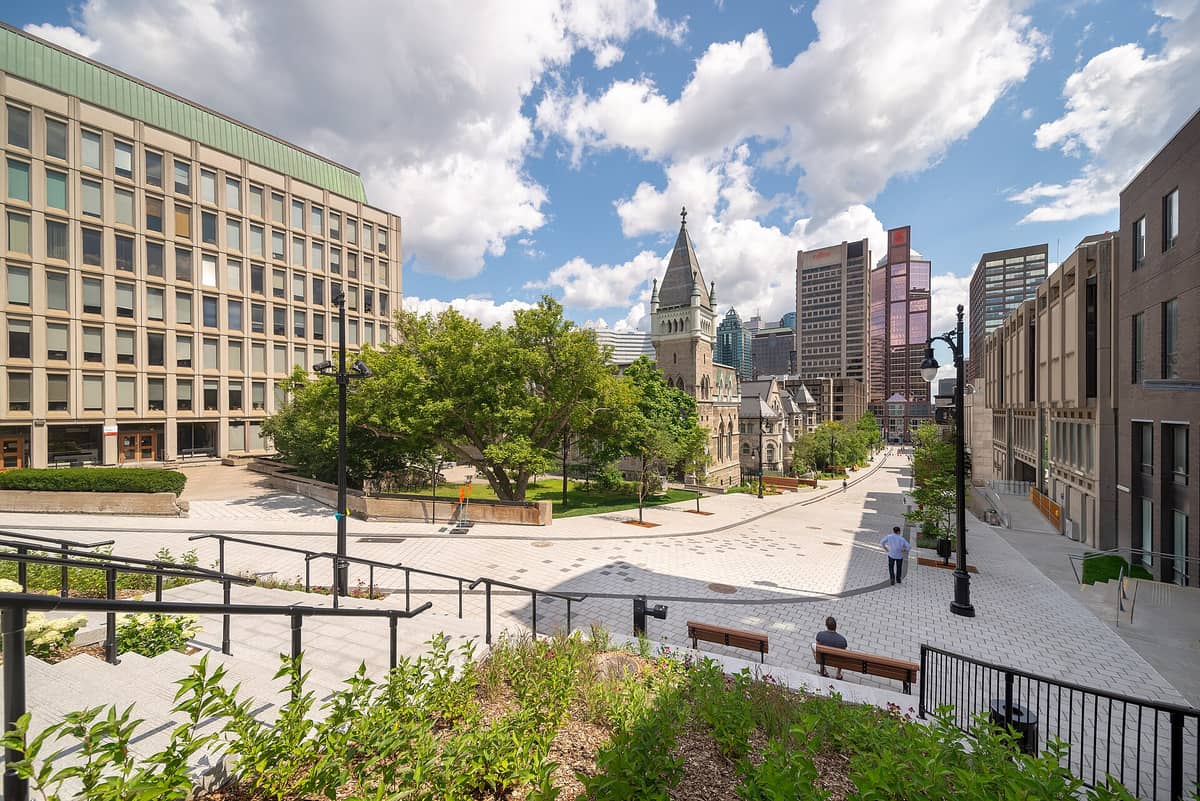
First Impressions: The Roddick Gates and the Lower Field
The main entrance to McGill University, the Roddick Gates on Sherbrooke Street West, sets the tone immediately. The wrought iron gates open onto a long central pathway lined with mature trees, with the Arts Building's Neogothic facade rising at the far end and the pale green slope of Mount Royal visible directly behind it. On a clear morning, the framing is genuinely striking — the kind of view that makes you slow your pace without consciously deciding to.
The lower field, the broad lawn stretching between the gates and the Arts Building, is heavily used between late August and April by students cutting across campus, eating lunch on the grass, or studying on portable chairs during warm weather. In the early morning, roughly before 8:30 a.m., the field is quiet enough that you can hear pigeons and the distant hum of Sherbrooke Street. By midday it becomes one of the more social outdoor spaces in downtown Montreal, so visitors who want contemplative photos should arrive early.
💡 Local tip
The best light on the Arts Building falls in the morning, when the sun comes from the east and the stone facade takes on a warm grey-amber tone. Overcast days flatten the texture considerably.
History You Can Read in the Stone
McGill University was founded by royal charter in 1821, making it one of the oldest universities in Canada. Its origins trace to the 1813 bequest of fur trader James McGill, who left land and funds to establish an institution in his name. The land itself, formerly the Burnside estate, was farmland at the edge of a then-much-smaller Montreal. Today that same plot sits squarely in the urban core, which is part of what makes the campus feel so unexpected: a 19th-century institution in a 21st-century city, with the mountain as a permanent back wall.
The Arts Building, completed in 1843, is the oldest surviving structure on campus. Its central stone tower, Neogothic pointed windows, and symmetrical front steps have changed little externally. The building houses administrative offices and lecture halls rather than a public museum, but the exterior is well worth examining closely. The stonework is local limestone, common to Montreal's earlier institutional buildings, and the surface has the distinctive weathered texture of nearly two centuries of Montreal winters.
Architecture enthusiasts will find McGill a useful companion to a broader exploration of Montreal's institutional heritage. For context on how the university's building style fits into the city's wider architectural history, the Montreal architecture guide covers the range from French colonial to modernist landmarks across the island.
Tickets & tours
Hand-picked options from our booking partner. Prices are indicative; availability and final rates are confirmed when you complete your booking.
Montreal evening cruise on the St. Lawrence River
From 54 €Instant confirmationFree cancellation3-hour e-bike guided tour in Montreal
From 68 €Instant confirmationFree cancellationWalking tour of Old Montreal
From 20 €Instant confirmationFree cancellationMontreal helicopter tour
From 156 €Instant confirmationFree cancellation
Navigating the Campus: A Practical Walkthrough
The downtown campus is compact by North American university standards. A basic loop from the Roddick Gates to the Arts Building, around to the Redpath Museum, up toward the McIntyre Medical Building, and back through the upper campus pathways takes about 45 minutes at a relaxed pace. None of this requires a tour or a map, though a campus map is available at the Welcome Centre at 3415 McTavish Street.
The Redpath Museum, located on the lower west side of campus, is an 1882 natural history museum that is genuinely worth a stop. It houses paleontological specimens, a large mineral collection, and ethnological artifacts, and it remains one of the more underappreciated public attractions in downtown Montreal. Admission policies are worth checking directly, but it has historically offered free or low-cost public access. See the Redpath Museum page for current hours and details.
The upper campus, reached by taking the footpaths north and west of the Arts Building, is quieter and more residential in character. The Macdonald Engineering Building and the various science faculties cluster here, and the paths eventually connect with the lower trails of Mount Royal. This upper section is where the campus transitions almost imperceptibly into parkland — there is no fence, just a gradual change in tree density and a reduction in foot traffic.
ℹ️ Good to know
Campus Tour Office hours: Monday–Friday, 10:00 a.m.–4:00 p.m. Closed weekends. Tours are seasonal and availability varies, so book in advance at mcgill.ca/undergraduate-admissions/meet-mcgill/campus-tours.
How the Campus Changes Through the Day and Year
Between September and April, the academic year, the campus operates at full intensity on weekdays. The stretch of time between 11:30 a.m. and 1:30 p.m. sees the highest foot traffic, with students moving between buildings and the lower field fully occupied on decent-weather days. If crowd-free photography is your goal, Tuesday or Wednesday mornings before 9:00 a.m. are reliably quiet.
Summer — May through August — is the opposite. The campus empties of students, the pace drops significantly, and the grounds staff tend to be more visible. The lawns are better kept, the pathways are less crowded, and some summer programming for prospective students brings small tour groups through. It is an easier, more relaxed time to visit as a casual tourist. Autumn, particularly late September and October, offers the combination of an active campus and changing foliage on the mountain behind, which produces the most photogenic conditions of the year.
McGill's location makes it a natural mid-point stop on a walk between downtown Montreal and Mount Royal Park. From the upper campus, it is less than a 10-minute walk to the lower trails of the mountain. The Mount Royal Park guide covers the best entry points and walking routes from this direction.
Getting There and Getting Around
The most direct approach is via the McGill Metro Station on the Green Line. From the station exit on Sherbrooke Street West, the Roddick Gates are about a 5-minute walk west. The campus also sits within comfortable walking distance of the downtown hotel corridor — most hotels between Peel and Drummond streets are 10–15 minutes on foot.
Cycling access is straightforward; several bike lanes run along Sherbrooke and de Maisonneuve, and BIXI bike-share stations are positioned near the main entrance. There is no public parking dedicated to visitors within the campus; street parking on the surrounding blocks is metered and limited. Driving is not the recommended approach for a short visit.
If you are combining this with a broader downtown itinerary, the guide to getting around Montreal explains how the STM metro and bus network connects most major attractions without the need for a car.
Accessibility and Honest Limitations
Accessibility across the McGill campus is uneven. The lower field and main pathways are paved and manageable for most mobility needs, but the upper campus involves slopes and some uneven stone surfaces. Individual buildings have varying levels of accessibility; McGill publishes building-specific information on its website, and some facilities require an accessible entrance that differs from the main door. If accessibility is a primary concern, checking the McGill Accessibility and Inclusive Facilities page before your visit will save time.
For visitors who are not affiliated with the university and have no particular interest in architecture or institutional history, it is fair to say the campus is pleasant but not destination-level. There are no large public exhibitions in the main buildings, no observation decks, and no guaranteed activities on a given weekday. The appeal is atmospheric: a well-preserved historic space with a mountain backdrop and a noticeably different pace from the retail streets a few blocks south. That is enough for many visitors, but not for all.
⚠️ What to skip
Campus buildings are closed on statutory holidays and during the university's holiday closure period (typically late December to early January). The outdoor grounds remain accessible, but facilities including washrooms and the Welcome Centre will be closed. Check mcgill.ca before visiting on a holiday.
Insider Tips
- The Redpath Museum on the lower west side of campus is inexpensive to enter through its voluntary-contribution admission policy and almost always uncrowded — most tourists walk straight past it heading toward the Arts Building. It is one of the better quiet-hour options in downtown Montreal on a rainy afternoon.
- The footpaths from the upper campus connect directly to Mount Royal's lower trails without any need to return to street level. If you enter McGill from the Roddick Gates and exit from the upper campus northward, you can be on the mountain within 10 minutes of passing through the main gates.
- Campus tour booking is recommended for anyone who wants structured information about the university's history. Walk-in availability during peak periods (September, spring open houses) is limited and not guaranteed. Book through the campus tours page at mcgill.ca before you arrive.
- The benches on the east side of the lower field, near the Strathcona Music Building, offer one of the better-framed views of the Arts Building with Mount Royal behind it. Most visitors photograph from the central pathway, which is more crowded and places you directly in other people's shots.
- On weekday afternoons during the school year, the campus café spaces inside Arts and Leacock buildings are open to the public and provide a quieter, warmer alternative to the coffee chains on Sherbrooke. No obligation to be a student; just walk in.
Who Is McGill University For?
- Architecture and heritage enthusiasts who want to see pre-Confederation Canadian institutional buildings in context
- Travelers walking between downtown Montreal and Mount Royal Park, who want a scenic and historically rich route
- Families looking for a free outdoor space with a green lawn and interesting buildings, without museum fatigue
- Prospective students or parents who want to experience the campus atmosphere beyond a formal open house
- Photographers working in the early morning, when the lower field is empty and the light on the Arts Building's limestone facade is at its best
Nearby Attractions
Other things to see while in Downtown Montreal:
- Bell Centre
The Bell Centre is Montreal's premier indoor arena, home to the storied Montreal Canadiens and one of North America's highest-capacity NHL venues. Whether you're coming for hockey, a concert, or just to soak up the atmosphere outside, this guide covers everything you need to make the most of your visit.
- Canadian Centre for Architecture
The Canadian Centre for Architecture (CCA) is both a museum and an international research centre devoted to architecture and urbanism. Located on René-Lévesque Boulevard in downtown Montreal, it holds one of the world's most significant architecture collections and stages exhibitions that challenge how we think about cities, design, and space.
- Mary Queen of the World Cathedral
Standing at the heart of downtown Montreal, Mary Queen of the World Cathedral is a one-fifth-scale replica of St. Peter's Basilica in Rome, completed in 1894. Free to enter daily, it offers one of the most striking architectural contrasts in the city: solemn stone and gilded interiors set directly against glass towers and commuter traffic.
- McCord Stewart Museum
The McCord Stewart Museum on Sherbrooke Street West holds one of Canada's richest collections of photographs, clothing, Indigenous artifacts, and everyday objects tracing over 350 years of Montreal and Canadian life. Serious in scope but accessible in presentation, it rewards curious visitors who want more than architecture tours.