Mount Royal Park: Montreal's Defining Green Space
Rising 233 metres above the city, Parc du Mont-Royal is free to enter, open daily from 6 a.m. to midnight, and rewards visitors year-round with panoramic lookouts, forested trails, and a pace of life that feels deliberately separate from the streets below. It is the park that Montrealers use, not just visit.
Quick Facts
- Location
- 2000 Chemin Remembrance, Montréal, QC H3H 1A2 (Smith House visitor centre: 1260 Chemin Remembrance)
- Getting There
- Bus 11 from Metro Mont-Royal (Orange Line); Bus 711 daily from mid-June through the end of August and weekends afterward. On foot from Rue Peel and Avenue des Pins Ouest.
- Time Needed
- 2–4 hours for a relaxed walk to the belvedere and back; a full day if you include Beaver Lake and the cross
- Cost
- Free entry. Free entry. Paid parking available on-site (verify current rates). All trails and lookouts are free.
- Best for
- Panoramic city views, weekend walks, autumn foliage, winter snowshoeing, Sunday Tam-Tams
- Official website
- www.lemontroyal.qc.ca/en
What Mount Royal Park Actually Is
Parc du Mont-Royal, known in English as Mount Royal Park, is a 10-square-kilometre municipal park sitting at the physical and psychological centre of Montreal. The park covers three summits and was designed in 1876 by Frederick Law Olmsted, the same landscape architect behind New York's Central Park. Olmsted's brief was explicit: create a park that felt like a natural retreat within an increasingly dense city. Nearly 150 years later, that intention still holds. The forested paths are wide enough to breathe, the carriage roads follow contours rather than grids, and the city disappears quickly once you are a few minutes inside the tree line. For more on how the park fits into Montreal's broader landscape, see the guide to the Mount Royal neighborhood.
The park is open every day from 6:00 a.m. to midnight. Entry is free across all trails and lookout points. The park is open every day from 6:00 a.m. to midnight. Entry is free across the park’s trails and lookout points. Paid parking is available in designated on-site lots, but most visitors arriving by public transit or on foot skip the car entirely, which is the wiser approach given the narrow approach roads and limited parking during peak weekends.
💡 Local tip
The most direct walking entrance is at Rue Peel and Avenue des Pins Ouest. The path up through the forest takes roughly 20–25 minutes at a steady pace and deposits you near the Kondiaronk Belvedere. No transit required.
The View from the Top: Kondiaronk Belvedere
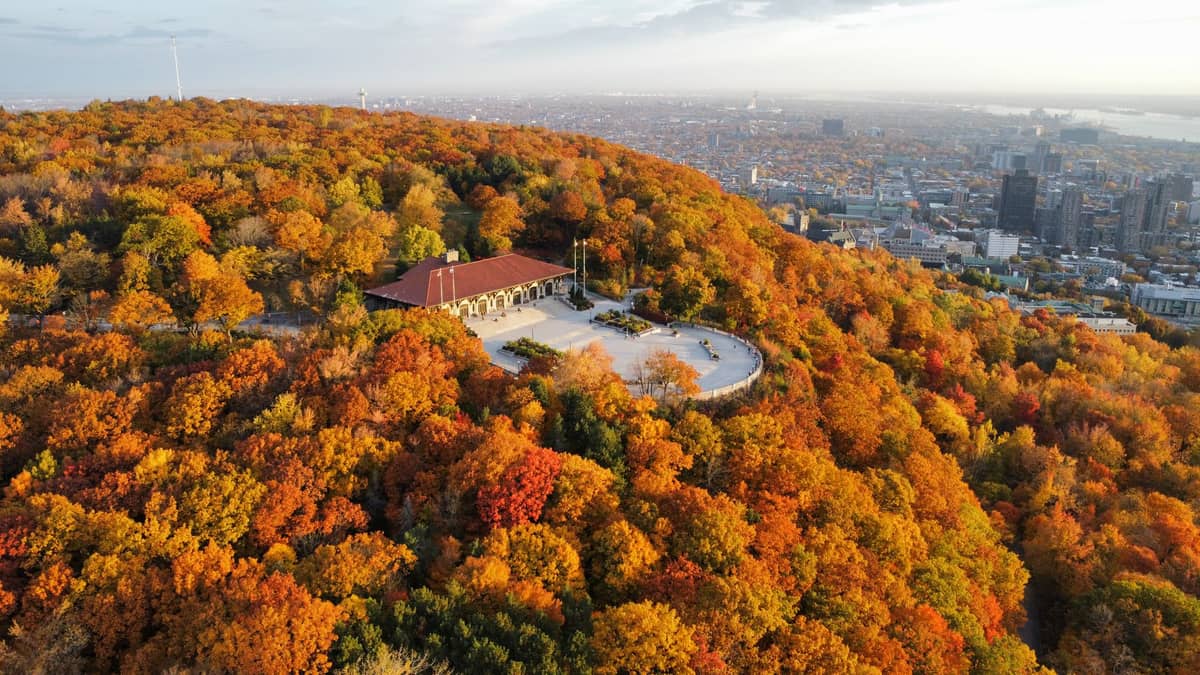
The main lookout on the southern face of the mountain is the Kondiaronk Belvedere, a curved terrace positioned in front of the Chalet du Mont-Royal. The view from here takes in the full downtown skyline, the Saint Lawrence River beyond it, and on clear days, the Green Mountains of Vermont to the south. It is one of the best panoramic points in the city, and it does not require any special access or ticket.
The chalet itself, a stone building completed in 1932, is worth a look inside. The great hall features a series of paintings depicting scenes from Quebec and Canadian history, and the building functions as a warming room in winter and a rest stop year-round. Washrooms are available here, which matters when you are mid-hike.
The belvedere draws consistent crowds on weekend afternoons, particularly from late spring through October. For a calmer experience, arrive before 9:00 a.m. on weekday mornings. At that hour the light falls across downtown at a low angle, the air is noticeably cooler under the tree canopy, and the terrace is shared mostly with joggers and dog walkers. The contrast with a Sunday afternoon, when the terrace fills with families and tour groups, is stark.
💡 Local tip
Photography tip: the belvedere faces roughly south. For the best light on the skyline, visit in the late afternoon when the sun angles from the west and catches the glass of the downtown towers. Midday produces flat, blown-out images on sunny days.
Tickets & tours
Hand-picked options from our booking partner. Prices are indicative; availability and final rates are confirmed when you complete your booking.
Montreal evening cruise on the St. Lawrence River
From 54 €Instant confirmationFree cancellation3-hour e-bike guided tour in Montreal
From 68 €Instant confirmationFree cancellationWalking tour of Old Montreal
From 20 €Instant confirmationFree cancellationMontreal helicopter tour
From 156 €Instant confirmationFree cancellation
Trails, Terrain, and Getting Around Inside the Park
The park contains a network of gravel carriage roads, narrower hiking paths, and some maintained boardwalk sections. The main carriage road up from the Peel Street entrance is wide, well-compacted, and manageable for most fitness levels, though it is a sustained uphill stretch. More experienced walkers can take steeper dirt paths branching off to either side, which pass through denser forest and are quieter at almost all hours.
Beaver Lake, known as Lac des Castors, sits on a flatter section of the western side of the mountain. The lake and its surrounding meadow have a completely different character from the belvedere: open grass, a snack bar and rental facility nearby, and in winter, a skating rink that locals treat as a neighbourhood amenity rather than a tourist attraction. Visit the dedicated page on Beaver Lake for specifics on seasonal programming and winter skating.
The Mount Royal Cross sits on the highest accessible summit at 233 metres. It is illuminated at night and visible from much of downtown. The cross has stood in various forms since 1643, when Paul Chomedey de Maisonneuve, the founder of Montreal, erected a wooden cross in thanks for the city's survival of a flood. The current steel structure dates from 1924 and stands 31.4 metres tall. The area around it is quieter than the belvedere and offers a different perspective over the northern and eastern parts of the city.
ℹ️ Good to know
Accessibility note: The carriage road from the Peel Street entrance is the most accessible route for strollers and visitors with limited mobility. The park also has accessible parking, an adapted-transport drop-off zone, and accessible washrooms near the chalet. Steeper trail sections are not wheelchair accessible. Confirm current conditions with the park before visiting.
Mount Royal Through the Seasons
The park looks and functions differently across all four seasons, and none of them is obviously wrong for a visit. Montreal's climate is classified as humid continental, which means the differences between seasons are real and significant. For a broader sense of how the city shifts across the year, the guide to the best time to visit Montreal is useful context.
From late September through mid-October, the maple and birch canopy on the mountain turns through yellow, orange, and red. The colours are dense because the park's forest cover is substantial and mature. Weekend afternoons during peak foliage bring significant visitor numbers, but the forest paths away from the main carriage road remain walkable without crowds.
Winter changes the park's personality completely. From roughly December through March, groomed cross-country ski trails run through sections of the park, snowshoe rentals are available, and Beaver Lake operates as an outdoor rink. The air at the summit carries a particular cold clarity, and the snow on the tree branches muffles sound in a way that feels unusual in an urban park. Dress in proper layers: temperatures at the summit can feel several degrees colder than street level due to wind exposure on the open terrace.
Summer brings the park's most famous recurring event: the Sunday Tam-Tams. Every Sunday afternoon from late spring through early autumn, a large informal drum circle and gathering forms near the George-Étienne Cartier monument at the base of the mountain (Ave du Parc). This is a Montréal institution with no formal organiser and no admission charge. Thousands of people show up to drum, dance, watch, or simply lie on the surrounding grass. It is also where a medieval-style battle game known as l'Agora des Chevaliers takes place on the same afternoons. The page on Tam-Tams at Mount Royal has more detail on what to expect.
Getting There and Practical Logistics
The simplest transit approach is to take the Orange Line metro to Mont-Royal station, then catch Bus 11 toward the mountain. Bus 711 is also seasonal: it operates daily from mid-June through the end of August and on weekends afterward. Verify current routes and schedules with the STM before you travel, as service patterns can change seasonally.
Walking from downtown is genuinely practical and the preferred approach for many visitors. The Peel Street entrance at Avenue des Pins Ouest is roughly a 15-minute walk from the centre of downtown, and the uphill path to the belvedere takes another 20–25 minutes. This route gives you a clear sense of how quickly the city gives way to forest. For general transit orientation in Montreal, the guide to getting around Montreal covers the metro network and surface routes in more detail.
Driving is possible but adds friction. The approach roads are narrow and the parking areas fill early on summer and autumn weekends. Cycling to the base of the mountain is straightforward using Montreal's Bixi bike-share system, though most cyclists leave bikes at the base and walk the trails.
Cultural and Historical Context
Olmsted's design philosophy for Mount Royal was about the restorative experience of nature, not spectacle. His plan, submitted in 1874, preserved the natural topography rather than imposing geometry on it. The carriage roads curve. The paths follow the slopes. The tree cover was meant to feel discovered rather than arranged. This approach was unusual for public parks of the era and is one reason the park still feels less manicured than comparable green spaces in other cities.
The mountain has deeper history still. Indigenous peoples, particularly the Haudenosaunee and Anishinaabe nations, used the area for centuries before European contact. The name Montreal itself derives from Mont Royal, the name given to the mountain by the French explorer Jacques Cartier in 1535. The park sits within a city that has been layered with French, British, and Indigenous histories in sometimes complicated proximity, and walking through it involves that weight even if the terrain gives no obvious signs.
The broader Mount Royal area contains two cemeteries, Notre-Dame-des-Neiges and Mont-Royal Cemetery, which are open to visitors and represent some of the quieter walking on the mountain. The area also borders the Université de Montréal campus on the northwest slope and is close to several key Montreal neighbourhoods. Visitors interested in Montreal's architectural and urban history might pair a park visit with the Montreal architecture guide for context on the surrounding built environment.
Who Should Think Twice
Mount Royal Park is not for everyone on every visit. If you have limited mobility and are hoping to reach the belvedere, the carriage road is manageable but it is a sustained uphill walk. The steeper trails are not suitable for wheelchairs. Call ahead or check the Ville de Montréal accessibility page to plan your specific route.
If you are visiting Montreal on a tight one-day itinerary focused on historic architecture, cultural museums, or Old Montreal, the park may not be the highest-value use of your time compared with attractions that are more distinctly urban. The park rewards slowness. Visitors who feel restless in green spaces without structured programming may find the experience underwhelming compared to expectations set by photos of the belvedere view alone. The view is excellent, but reaching it and returning takes the better part of two hours at minimum.
In winter, the park can be genuinely cold and icy on trail surfaces. Microspike traction devices or winter boots with grip are advisable if you intend to walk any trail beyond the main carriage road. The city does not heat the experience; it only grooms certain designated paths.
Insider Tips
- The Smith House visitor centre at 1260 Chemin Remembrance is run by Les amis de la montagne and provides trail maps, seasonal programme information, and exhibits on the park's ecology. It is a useful first stop if you want to orient yourself beyond the main belvedere loop.
- The best foliage view in the park is not from the belvedere but from the carriage road on the east side of the mountain, where you look through the canopy rather than over it. Walk down toward Camillien-Houde on a clear October morning for this perspective.
- On Sunday afternoons in summer, the Tam-Tams at the George-Étienne Cartier monument draws crowds so large that the area around the monument and the lower meadow can feel like a music festival. Arrive before noon if you want a spot on the grass rather than standing at the edge.
- The illuminated cross is visible from much of the city after dark and is worth seeking out as a landmark when navigating Montreal at night, but walking to the cross itself after dark requires good footwear and awareness of uneven terrain. The belvedere is a better evening destination, with the lit skyline as the reward.
- Weekday mornings between 7:00 a.m. and 9:00 a.m. are when the park belongs almost entirely to joggers, dog walkers, and people commuting through on foot. If you want the belvedere to yourself for photographs, this window is reliably quiet even in summer.
Who Is Mount Royal Park For?
- First-time visitors who want to understand Montreal's physical geography from above
- Outdoor enthusiasts looking for year-round activity: hiking and cycling in warm months, snowshoeing and skating in winter
- Travellers visiting in September and October for autumn foliage without leaving the city
- Anyone seeking a few hours of genuine quiet and green space in a central urban location
- Visitors who want to experience a local Montreal Sunday, particularly the Tam-Tams gathering in summer
Nearby Attractions
Other things to see while in Mount Royal:
- Beaver Lake
Beaver Lake, known in French as Lac aux Castors, is an artificial basin at the centre of Mount Royal Park. Free to access year-round, it draws picnickers in summer, skaters in winter, and anyone who needs a few quiet hours above the city's noise.
- Kondiaronk Belvedere
Perched above the Mount Royal Chalet at 233 metres, the Kondiaronk Belvedere delivers an unobstructed panorama of downtown Montreal and the Saint Lawrence River. Free to visit and open from 6 a.m. to midnight daily, it rewards visitors at every hour, from misty mornings to blazing sunsets.
- Mount Royal Cross
The Mount Royal Cross (Croix du mont Royal) is a 30-metre illuminated steel cross perched on the summit of Mount Royal, visible from much of Montreal. Free to visit year-round, it rewards the uphill walk with a sweeping view over the city and a surprisingly moving sense of scale when you stand beneath it.
- Musée des Hospitalières de l'Hôtel-Dieu
Tucked alongside one of Canada's oldest hospitals near the southern slope of Mount Royal, the Musée des Hospitalières de l'Hôtel-Dieu de Montréal documents more than three and a half centuries of healthcare, religious devotion, and colonial history. It is small, quiet, and genuinely rewarding for anyone willing to slow down.