Musée des Hospitalières de l'Hôtel-Dieu: Montreal's Most Overlooked History Museum
Tucked alongside one of Canada's oldest hospitals near the southern slope of Mount Royal, the Musée des Hospitalières de l'Hôtel-Dieu de Montréal documents more than three and a half centuries of healthcare, religious devotion, and colonial history. It is small, quiet, and genuinely rewarding for anyone willing to slow down.
Quick Facts
- Location
- 201 Avenue des Pins Ouest, near the southern edge of Mount Royal, Montreal
- Getting There
- No direct metro stop; STM buses along Avenue du Parc and Rue Saint-Laurent serve the area. Consult the STM trip planner for current routes.
- Time Needed
- 1 to 1.5 hours for the permanent collection; allow more time if combining with a walk through Mount Royal Park
- Cost
- C$14 for adults and C$12 for seniors; free on the first Sunday of each month. Verify current prices before visiting.
- Best for
- History enthusiasts, architecture lovers, travellers seeking quiet alternatives to crowded downtown museums
- Official website
- museedeshospitalieres.qc.ca/en
What Is This Museum and Why Does It Matter?
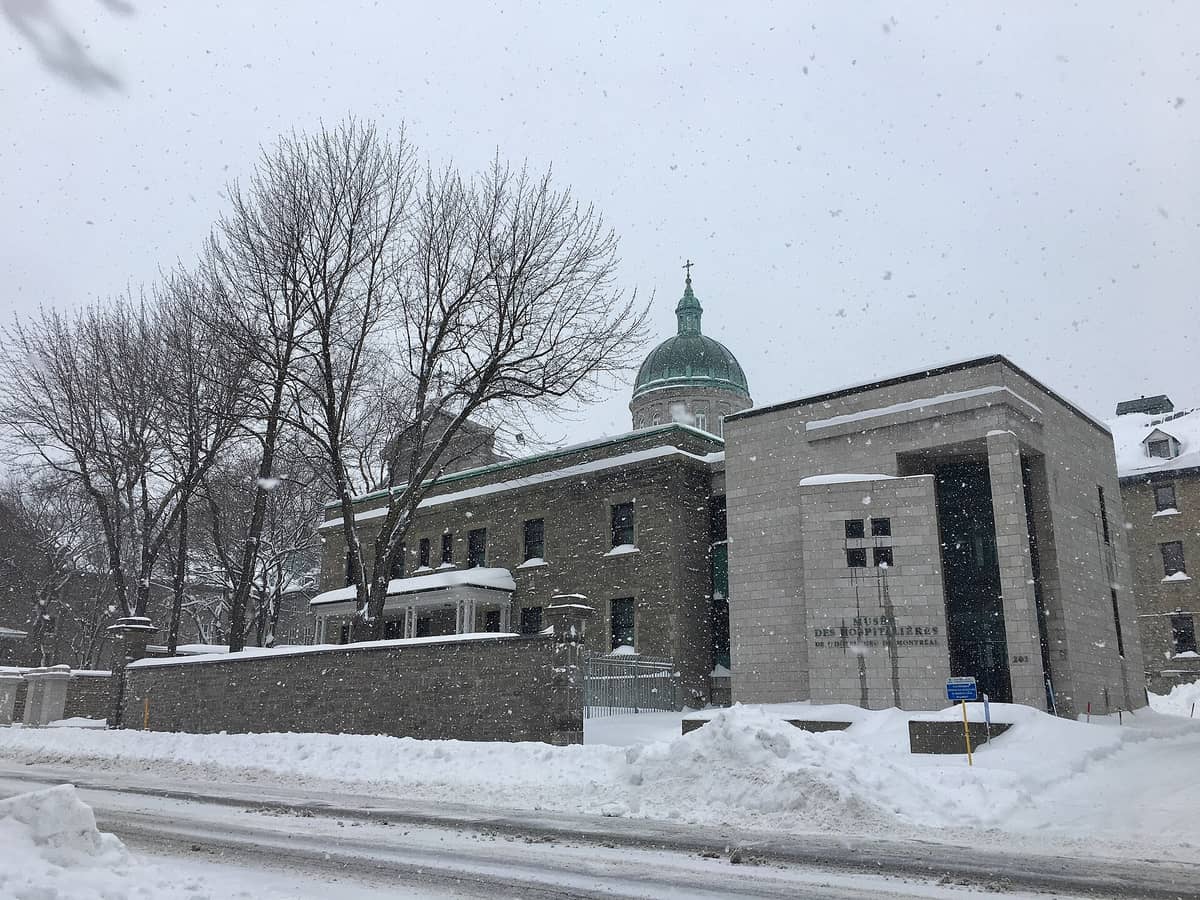
The Musée des Hospitalières de l'Hôtel-Dieu de Montréal sits inside a section of the convent complex adjoining the Hôtel-Dieu hospital at 201 Avenue des Pins Ouest. The hospital itself was founded in 1642 by Jeanne Mance, a lay French woman who arrived with Montreal's earliest colonists and established one of the earliest hospitals in New France, a few years after Hôtel-Dieu de Québec opened in 1639. The museum, which opened on May 18, 1992, occupies approximately 5,000 square feet across two floors and tells the story of those who built and sustained that institution: the Religieuses Hospitalières de Saint-Joseph, an order of nursing nuns who ran the Hôtel-Dieu for more than three centuries.
This is not a broad survey of Canadian history or a flashy interactive science exhibit. It is a focused, carefully curated collection covering medicine, religious life, colonial society, and the specific experiences of women in a city that is routinely underrepresented in mainstream historical narratives. The permanent collection spans over 375 years and includes surgical instruments, apothecary equipment, devotional objects, furniture, archival documents, and personal effects from both the sisters and their patients.
💡 Local tip
Admission is free on the first Sunday of each month, making this an easy addition to a budget-friendly weekend. Verify the museum’s current opening hours before visiting.
The Collection: What You Will Actually See
The ground floor introduces visitors to the founding of Montreal and the Hôtel-Dieu's origins. Display cases hold 17th-century medical and surgical instruments that look more like carpenter's tools than anything from a modern operating theatre: bone saws with wooden handles, bleeding lancets, crude forceps. The labels are bilingual in French and English and give enough context to understand what each object was used for without becoming a medical textbook.
One of the most striking spaces is the reconstructed apothecary, presented to reflect the appearance of a historical convent pharmacy. The wooden shelving holds ceramic and glass dispensing jars, distillation equipment, and botanical preparations. The smell in this section is faintly medicinal, a combination of old wood and the subtle residue of the building's long history, and it gives the room an atmosphere no theatrical reconstruction quite manages to fake. This is where the museum earns its credibility as a place worth visiting rather than merely reading about.
Upstairs, the exhibition shifts toward the lives of the Hospitallers themselves: their routines, their vows, their relationships with patients and with each other. Personal objects, letters, and photographs from the 19th and 20th centuries make the sisters concrete as individuals rather than abstract figures in habits. There are also exhibits covering the evolution of nursing practice and the gradual transition of the hospital from religious to secular administration.
Tickets & tours
Hand-picked options from our booking partner. Prices are indicative; availability and final rates are confirmed when you complete your booking.
Montreal evening cruise on the St. Lawrence River
From 54 €Instant confirmationFree cancellation3-hour e-bike guided tour in Montreal
From 68 €Instant confirmationFree cancellationWalking tour of Old Montreal
From 20 €Instant confirmationFree cancellationMontreal helicopter tour
From 156 €Instant confirmationFree cancellation
The Building and Its Setting
The museum is housed within a section of the convent complex that has been part of the Hôtel-Dieu campus for generations. The exterior is grey stone, restrained and institutional, consistent with the ecclesiastical architecture of 19th-century Montreal. It sits on Avenue des Pins Ouest, a street that runs along the lower slope of Mount Royal, and the surrounding streetscape includes mature trees, the hospital's main building, and the quiet residential streets that characterize this part of the city between the Plateau and the mountain.
The location is worth factoring into your itinerary. Mount Royal Park is a short walk north, and the Plateau-Mont-Royal neighborhood with its cafés and restaurants is nearby to the east. Combining the museum with a walk up to the Kondiaronk Belvedere and the mountain's lookout makes for a half-day that covers both cultural and outdoor experience without requiring transit between stops.
ℹ️ Good to know
Accessibility: The museum is certified by Kéroul and accessible to visitors with reduced mobility. The main entrance has an access ramp and an elevator serves both museum floors. Note that the convent-complex buildings and some guided tours are not fully accessible — confirm with the museum directly before your visit if this matters to your group.
When to Visit and What to Expect at Different Times
The museum is consistently quiet. This is part of its appeal: you can stand in front of a 17th-century surgical kit for as long as you like without a tour group moving in behind you. Weekday mornings are the emptiest, and the quality of light through the building's windows is good for reading labels and examining artifacts closely. Weekend afternoons bring slightly more visitors but rarely reach any level that feels crowded.
The third Thursday evening hours, until 21:00, offer a genuinely different atmosphere. The museum is lit primarily by the permanent display lighting after dark, and the combination of the historical content and the quieter evening setting gives the space a reflective quality that afternoon visits do not quite replicate. If you are spending an evening in the area and want something more considered than another restaurant or bar, this is worth knowing about.
Winter visits are entirely comfortable: the museum is fully heated and the subdued outdoor light of a Montreal January actually suits the collection's tone. Summer is equally fine indoors, though it makes the contrast with the bright green mountain just up the road more noticeable. Plan your visit to the museum either before or after time outdoors rather than treating it as a standalone trip.
Historical Context: Jeanne Mance and the Hospitallers
Jeanne Mance arrived in the settlement that would become Montreal in 1642 and founded the Hôtel-Dieu two years later in 1644, with financial backing from a French benefactress. She ran the hospital herself for years before the Religieuses Hospitalières de Saint-Joseph arrived from La Flèche, France, in 1659 to take over its operation. The order remained in charge of the Hôtel-Dieu for over three hundred years, eventually overseeing its expansion into one of the major hospitals in Quebec.
Mance is recognized as a co-founder of Montreal alongside Paul de Chomedey de Maisonneuve, yet she tends to receive less coverage in popular histories of the city. The museum addresses this imbalance directly. For more on the women who shaped early Montreal, the Maison Saint-Gabriel in Pointe-Saint-Charles covers a parallel story about Marguerite Bourgeoys and another generation of women who built institutional life in colonial New France.
The nursing order's influence extended well beyond medical care. The sisters maintained the apothecary, educated patients and staff, managed the hospital's finances, and served as a continuous institutional memory through wars, epidemics, and political upheavals. The museum's exhibits on their administrative and spiritual lives carry real weight precisely because the history is well documented rather than reconstructed.
Practical Notes for Your Visit
There is no café or food service inside the museum, so plan accordingly. The gift shop carries books on Quebec religious and medical history, a few reproductions, and modest souvenirs — quality over quantity. Photography is generally permitted in the permanent collection but confirm the rules at the front desk, particularly for temporary exhibitions.
The museum is closed on Mondays. If you are building a broader museum itinerary for Montreal, this pairs well with the McCord Stewart Museum downtown, which covers Quebec social history from a different angle. The best museums in Montreal guide can help you sequence visits efficiently if you have several in mind.
Getting here without a car takes some planning. The nearest metro stations are a walk away, and direct bus connections depend on your starting point. The STM trip planner is the most reliable tool for current routing. If you are already planning time on Mount Royal, it is simpler to walk down to the museum from the park than to make it a separate transit trip.
⚠️ What to skip
Some convent-complex sections and guided tour components are not accessible to visitors with reduced mobility. If accessibility matters for your group, contact the museum directly before visiting to confirm what is available.
Is It Worth Your Time?
For travellers with a genuine interest in history, this museum delivers more per square foot than most of Montreal's larger institutions. The collection is specific, the preservation standards are high, and the story it tells — of women navigating colonial, religious, and medical history over more than three centuries — is both locally important and broadly relevant.
Who should skip it: visitors who need constant interactivity, families with young children looking for hands-on engagement, or anyone whose Montreal time is limited to the major downtown highlights. The museum does not try to be something it is not. The text panels are informative but numerous, and the experience rewards reading rather than skimming. If you are moving quickly through the city and already prioritizing the Basilica, the Old Port, and the mountain, this will likely feel like one stop too many.
If you are on a tight budget, pair your visit with the free first-Sunday admission and combine it with a walk through the park afterward. Montreal has plenty of free things to do on any given day, and this museum fits naturally into a low-cost cultural weekend.
Insider Tips
- The third Thursday evening opening until 21:00 is barely publicized but offers one of the most atmospheric museum experiences in the city. The combination of dim period display lighting and a near-empty building suits the collection perfectly.
- First Sunday of the month admission is free and tends to draw a slightly larger local crowd, but the museum is small enough that it never feels packed. It is still quieter than almost any other Montreal museum on a free day.
- The apothecary reconstruction on the ground floor is the single most photographically interesting space in the collection. Position yourself at the end of the shelving and shoot along the length of the cabinet for the best composition.
- Wear comfortable shoes if you plan to walk up to Mount Royal after your visit. The route from Avenue des Pins to the Kondiaronk Belvedere is uphill but manageable in under 30 minutes, and the contrast between the museum's interior silence and the open mountain air is a satisfying way to close the morning.
- The museum's gift shop stocks several French-language academic titles on the history of the Hospitallers that are not easily found elsewhere in the city. Worth a look even if you do not buy.
Who Is Musée des Hospitalières de l'Hôtel-Dieu For?
- History and social history enthusiasts who want depth over spectacle
- Travellers interested in women's history, religious history, or the history of medicine
- Visitors combining a cultural stop with a walk through Mount Royal Park
- Those revisiting Montreal who have already seen the main attractions and want something less covered
- Anyone looking for a genuinely quiet museum experience away from the downtown crowds
Nearby Attractions
Other things to see while in Mount Royal:
- Beaver Lake
Beaver Lake, known in French as Lac aux Castors, is an artificial basin at the centre of Mount Royal Park. Free to access year-round, it draws picnickers in summer, skaters in winter, and anyone who needs a few quiet hours above the city's noise.
- Kondiaronk Belvedere
Perched above the Mount Royal Chalet at 233 metres, the Kondiaronk Belvedere delivers an unobstructed panorama of downtown Montreal and the Saint Lawrence River. Free to visit and open from 6 a.m. to midnight daily, it rewards visitors at every hour, from misty mornings to blazing sunsets.
- Mount Royal Cross
The Mount Royal Cross (Croix du mont Royal) is a 30-metre illuminated steel cross perched on the summit of Mount Royal, visible from much of Montreal. Free to visit year-round, it rewards the uphill walk with a sweeping view over the city and a surprisingly moving sense of scale when you stand beneath it.
- Mount Royal Park
Rising 233 metres above the city, Parc du Mont-Royal is free to enter, open daily from 6 a.m. to midnight, and rewards visitors year-round with panoramic lookouts, forested trails, and a pace of life that feels deliberately separate from the streets below. It is the park that Montrealers use, not just visit.