Kondiaronk Belvedere: Montreal's Most Iconic Viewpoint
Perched above the Mount Royal Chalet at 233 metres, the Kondiaronk Belvedere delivers an unobstructed panorama of downtown Montreal and the Saint Lawrence River. Free to visit and open from 6 a.m. to midnight daily, it rewards visitors at every hour, from misty mornings to blazing sunsets.
Quick Facts
- Location
- 1196 Voie Camillien-Houde, Mount Royal Park, Montréal, QC H3H 1A1
- Getting There
- Bus 11 (Mont-Royal) from Mont-Royal metro station (Orange Line); 30–40 min walk from Peel or Guy-Concordia stations
- Time Needed
- 20–45 minutes at the belvedere; allow 1–2 hours if walking up through the park
- Cost
- Free — no ticket required
- Best for
- City panoramas, sunset photography, first-time visitors, and autumn foliage
- Official website
- montreal.ca/en/places/kondiaronk-lookout
What Is the Kondiaronk Belvedere?
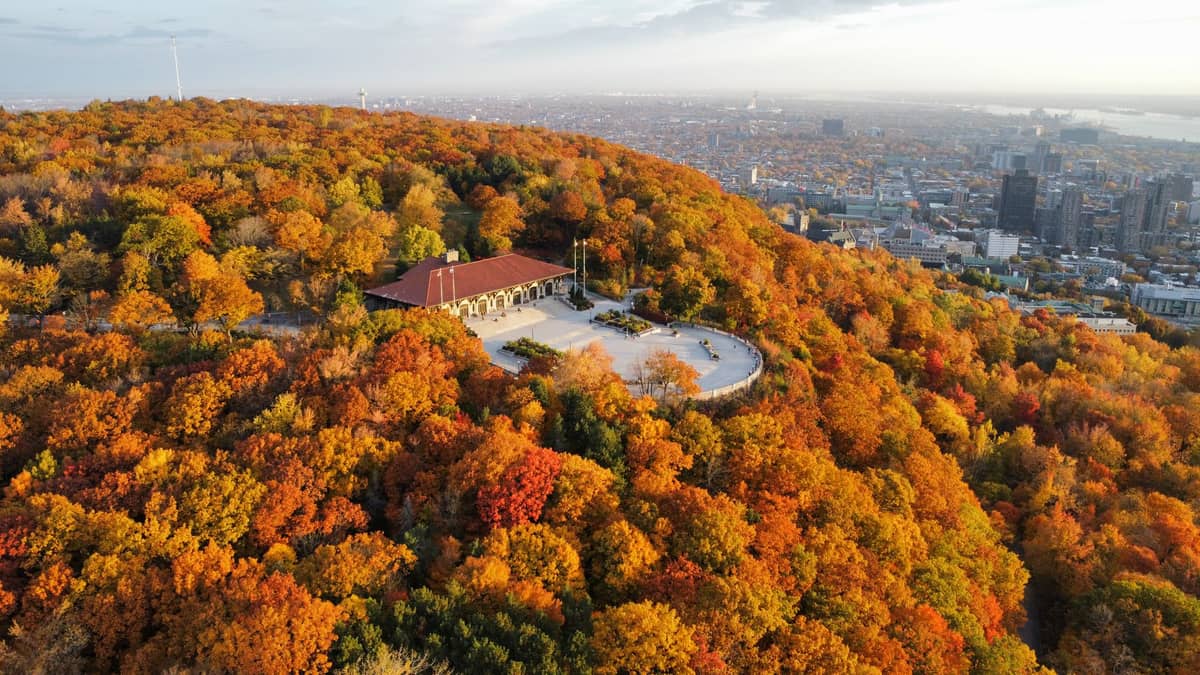
The Kondiaronk Belvedere is a wide stone terrace on the south slope of Mount Royal, positioned directly in front of the mountain's main chalet. From this platform, the entire downtown skyline of Montreal stretches out below you, anchored by the Saint Lawrence River glinting in the distance. On clear days, the view extends south toward the Monteregian Hills and, in winter, the white ridgeline of the Appalachians.
The belvedere sits within Mount Royal Park, the forested urban park that Frederick Law Olmsted — the landscape architect behind New York's Central Park — designed in the 1870s. That lineage matters: Olmsted shaped the paths deliberately so that walkers experience the view as a reward, revealed only after the final approach through the trees. The effect still works.
The lookout was formerly called Belvédère du Mont-Royal. Its current name was officially assigned in 1997, in anticipation of the 300th anniversary of the Great Peace of Montreal, a 1701 diplomatic accord between French colonists and representatives of dozens of Indigenous nations. Kondiaronk was the Wendat statesman and orator credited as a key architect of that peace. The name was formally recorded in 2002 by the Commission de toponymie du Québec. The belvedere's stone structure dates to 1906, according to the Quebec Cultural Heritage Directory, though the terrace's footprint and the adjacent chalet building underwent changes over the following decades.
💡 Local tip
The belvedere is open daily from 6:00 a.m. to midnight and is free. No booking, no ticket line. Just show up — but the time of day matters enormously for the experience. See the section on timing below.
The View: What You Actually See
Standing at the stone railing, the panorama spans roughly 180 degrees. Directly ahead, the glass towers of downtown Montreal rise in a tight cluster — the tallest is 1000 De La Gauchetière, distinguishable by its rounded copper-green roof. To the left, the Jacques Cartier Bridge arcs across the Saint Lawrence toward the South Shore. To the right, the cluster of towers thins out toward Westmount and beyond.
The river itself appears as a broad silver band, roughly 1.5 km wide at this stretch. On summer mornings, haze softens the scene into layers of blue. In winter, the ice breaks the river into jagged white slabs. Autumn is widely considered the strongest season visually: the canopy below the terrace ignites in orange, yellow and rust, so the skyline appears to float above a sea of colour.
For dedicated viewpoint-seekers, it helps to know that the Kondiaronk Belvedere is the most accessible of several elevated vantage points around the city. The Montreal Tower at Olympic Stadium and the observation points near the Mount Royal Cross offer different angles, but Kondiaronk gives the cleanest unobstructed forward view of the skyline without any ticket cost or enclosed glass between you and the city.
Tickets & tours
Hand-picked options from our booking partner. Prices are indicative; availability and final rates are confirmed when you complete your booking.
Montreal evening cruise on the St. Lawrence River
From 54 €Instant confirmationFree cancellation3-hour e-bike guided tour in Montreal
From 68 €Instant confirmationFree cancellationWalking tour of Old Montreal
From 20 €Instant confirmationFree cancellationMontreal helicopter tour
From 156 €Instant confirmationFree cancellation
How the Experience Changes by Time of Day
Early Morning (6:00–9:00 a.m.)
This is the quietest window. Joggers pass through, dog walkers pause briefly, and the light arrives low and golden from the southeast, raking across the building facades below. The air carries the smell of damp leaves or, in winter, cold stone. The city sounds that reach you here are mostly abstract — a distant hum, no individual sirens. If photography is your priority, the period just after sunrise in late September or early October gives soft directional light with near-empty terraces.
Midday and Afternoon
Between 11 a.m. and 3 p.m., especially on weekends and in summer, the belvedere fills significantly. Tour groups arrive, families spread out along the railing, and the adjacent chalet opens its doors. The crowd noise becomes part of the atmosphere rather than a distraction — there is something genuine about watching people from dozens of countries react to the same view. Parking on Voie Camillien-Houde can be completely full by 10 a.m. on a sunny Saturday.
Sunset and Evening (Until Midnight)
Sunset draws the most photogenic crowds. In summer, sunset in Montreal falls after 8 p.m., meaning the golden hour coincides with the after-dinner window. The skyline transitions from warm amber to deep blue and then full night, with the towers lighting up incrementally. By 10 p.m. on a weekday, the terrace is genuinely sparse, the temperature drops noticeably, and the city below becomes a map of moving light. Winter evenings here are cold and stunning — bring more layers than you think you need.
⚠️ What to skip
Wind at the belvedere is consistently stronger than at street level. Even on warm days, a light layer is useful. In winter, wind chill can make the exposed terrace feel 8–10 degrees colder than the city below.
Getting There: Your Practical Options
The belvedere is not directly on a metro line, which surprises some visitors. The most practical transit option is Bus 11 (Parc-du-Mont-Royal), which stops at Remembrance / du Chalet (Belvédère Kondiaronk). Check current STM schedules before you go, as service details can change.
Walking is entirely viable and many would argue preferable. From the Peel metro station (Green Line), the classic approach follows Avenue des Pins west and then takes the marked trail through the park — roughly 35 to 45 minutes at a moderate pace. The walk through the forest before the final reveal at the terrace is part of the attraction. From Mont-Royal metro, the trail ascends more steeply through the wooded east side of the park. Both routes are well-signed.
Cyclists can arrive via the dedicated cycling paths through the park, which connect to Montreal's broader bike network. The park is also part of popular weekend riding loops. For full details on cycling routes, see the Montreal cycling guide.
Driving to the belvedere is possible, and the address 1196 Voie Camillien-Houde brings you to the chalet parking area. However, this lot fills early on weekends and holidays. If it is full, there are secondary parking areas lower on the mountain, adding a short uphill walk.
The Chalet and the Surrounding Area
Directly behind the belvedere terrace stands the Mount Royal Chalet, a substantial stone building opened in 1932. Inside, the main hall features large murals depicting scenes from Canadian and Quebec history. The chalet functions as a warm-up space in winter and includes washrooms.
The immediate park surroundings reward those who extend their visit. Beaver Lake (Lac des Castors) is a ten-minute walk from the chalet and operates as a skating rink in winter and a peaceful pond the rest of the year. The Tam-Tams drum circle gathers at the George-Étienne Cartier Monument at the eastern base of the mountain every Sunday in summer — an entirely different, street-level experience of the same hill.
The park itself covers approximately 190 hectares of mixed forest. In spring, trilliums and trout lilies carpet the forest floor. In autumn, the canopy turns fast — peak foliage at this elevation typically arrives in the first two weeks of October, a week or so before the streets below peak. This time gap means the belvedere view includes coloured hillside foreground and still-green streets below, a layered effect that photographs well.
Accessibility and Who This Attraction Suits
The City of Montreal lists the belvedere as having an access ramp, an accessible path, and stroller-friendly access. The terrace surface is paved stone, level once you arrive at the platform. The challenge is getting there: the walking trails from street level involve sustained elevation gain, and not all are paved. The Bus 11 route provides the most practical option for visitors who cannot manage the hill on foot.
Families with young children find the belvedere straightforward. The open terrace has a railing along the full viewing edge, the chalet nearby provides facilities, and the flat platform gives children room to move. Strollers that have been pushed up the path tend to arrive somewhat muddy in wet weather; a compact, lightweight stroller is easier on the unpaved stretches than a large frame.
Visitors who find open-air panoramas underwhelming or who primarily seek enclosed cultural experiences may find the belvedere a brief stop rather than a destination. On an overcast day with low cloud cover, the skyline view is largely obscured and the experience is reduced to a forest walk to a foggy terrace. That said, low winter fog over the city from the belvedere has its own bleak appeal for a certain type of visitor.
Photography Notes
The classic compositional approach places the stone railing in the lower third of the frame with the skyline above. In summer, the canopy on either side of the terrace frames the view naturally. A wide-angle lens captures the full sweep; a short telephoto compresses the towers against the river. The best light for the skyline is sunset and the 20-minute period after, when the buildings reflect orange and the sky goes deep blue — photographers call this the blue hour.
Drone photography in Mount Royal Park requires permits from the City of Montreal. Do not assume it is permitted; regulations change and enforcement has increased in recent years. For handheld photography, there are no restrictions.
Insider Tips
- The chalet's interior murals are worth five minutes on their own. Most visitors walk straight through to the terrace and never look up at the painted walls inside — a significant oversight.
- If you visit on a clear winter evening after fresh snowfall, the rooftops below reflect the city lights in a way that is completely absent in summer. It is a different view from the same spot.
- Bus 11 runs less frequently on weekday mornings. If you plan an early arrival by transit, check the STM schedule the night before rather than assuming it runs on the same frequency as midday service.
- The stone terrace surface becomes slippery after rain or freezing rain. The City maintains the access ramp and main path, but the far corners of the terrace near the railing edges can be icy in winter. Wear shoes with grip.
- For autumn foliage, aim for the first two weeks of October and visit in morning light, which hits the hillside directly. By midday, the canopy is backlit and the colours flatten considerably in photographs.
Who Is Kondiaronk Belvedere For?
- First-time visitors who want to orient themselves spatially within Montreal before exploring at street level
- Photographers targeting the Montreal skyline, particularly at sunset or during the autumn foliage window
- Families looking for a free, accessible outdoor activity with a clear payoff at the top
- Travellers who enjoy combining a moderate uphill walk through a forested park with a dramatic final view
- Winter visitors willing to layer up for one of the most visually striking cold-weather vantage points in any Canadian city
Nearby Attractions
Other things to see while in Mount Royal:
- Beaver Lake
Beaver Lake, known in French as Lac aux Castors, is an artificial basin at the centre of Mount Royal Park. Free to access year-round, it draws picnickers in summer, skaters in winter, and anyone who needs a few quiet hours above the city's noise.
- Mount Royal Cross
The Mount Royal Cross (Croix du mont Royal) is a 30-metre illuminated steel cross perched on the summit of Mount Royal, visible from much of Montreal. Free to visit year-round, it rewards the uphill walk with a sweeping view over the city and a surprisingly moving sense of scale when you stand beneath it.
- Mount Royal Park
Rising 233 metres above the city, Parc du Mont-Royal is free to enter, open daily from 6 a.m. to midnight, and rewards visitors year-round with panoramic lookouts, forested trails, and a pace of life that feels deliberately separate from the streets below. It is the park that Montrealers use, not just visit.
- Musée des Hospitalières de l'Hôtel-Dieu
Tucked alongside one of Canada's oldest hospitals near the southern slope of Mount Royal, the Musée des Hospitalières de l'Hôtel-Dieu de Montréal documents more than three and a half centuries of healthcare, religious devotion, and colonial history. It is small, quiet, and genuinely rewarding for anyone willing to slow down.