Mount Royal Cross: History, Views, and What to Expect at the Top
The Mount Royal Cross (Croix du mont Royal) is a 30-metre illuminated steel cross perched on the summit of Mount Royal, visible from much of Montreal. Free to visit year-round, it rewards the uphill walk with a sweeping view over the city and a surprisingly moving sense of scale when you stand beneath it.
Quick Facts
- Location
- Mount Royal Park, Montréal, QC H2W 1S8
- Getting There
- Bus to Mount Royal Park, then uphill walk via marked trails
- Time Needed
- 1.5 to 3 hours including the walk up
- Cost
- Free — no ticket required
- Best for
- City views, history, outdoor walks, night photography
- Official website
- www.lemontroyal.qc.ca/en
What Is the Mount Royal Cross?
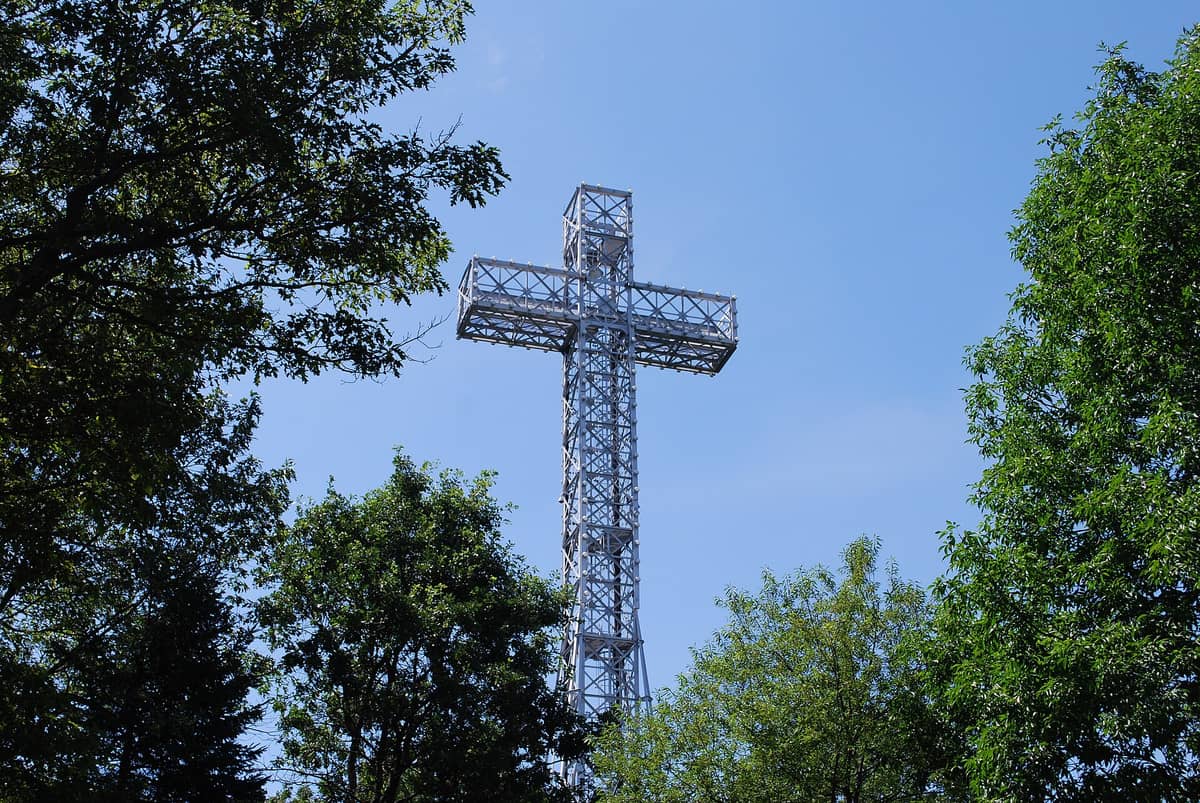
The Mount Royal Cross, known in French as the Croix du mont Royal, is a steel cross approximately 30 to 31 metres tall that stands near the summit of Mount Royal in Montreal. It is illuminated at night, making it one of the most recognized silhouettes in the city's skyline. From Plateau-Mont-Royal, from the waterfront, and on clear nights even from the South Shore across the St. Lawrence, the cross is a constant presence against the sky.
Up close, the scale of it catches most visitors off guard. From the city below it reads as a thin vertical element against the treeline, but standing at its base you realize you are looking at a structure nearly the height of a ten-storey building, made of riveted steel and anchored into the rock of the mountain. There are no fences or barriers around it, and no interpretive panels cluttering the space. It simply stands there, which is part of what makes it feel genuinely monumental rather than managed.
ℹ️ Good to know
The cross is free to visit and sits within Mount Royal Park, which is open daily from 6:00 a.m. to midnight. No ticket, booking, or registration is required.
The History Behind the Cross
The cross on Mount Royal has roots in the earliest days of the Montreal colony. On January 6, 1643, Paul Chomedey de Maisonneuve, the founder of Ville-Marie (the settlement that became Montreal), carried a wooden cross to the summit and planted it there as a gesture of thanks. The previous year, serious flooding had threatened to destroy the fledgling colony, and Maisonneuve had vowed to make the climb if the community survived. The colony did survive, and he kept his word.
That first cross was wooden and did not last. The present structure was erected in 1924, nearly three centuries after Maisonneuve's original vow. The steel cross was created through a major province-wide public fundraising campaign led by the Société Saint-Jean-Baptiste. It has since become something more complicated and more interesting: a piece of shared civic memory that is layered with debates about religious symbols in a secular public space, about French heritage, and about what it means for a city to carry history in its landscape.
These are not abstract arguments. Quebec's relationship with its Catholic heritage is a live political conversation, and the Mount Royal Cross is part of it. Visitors who want more context on how religion, culture, and public space intersect in Montreal will find that a visit to Notre-Dame Basilica adds a useful counterpoint — the interior there tells a complementary story about Montreal's Catholic identity, this time from the inside of the tradition rather than from above it.
Tickets & tours
Hand-picked options from our booking partner. Prices are indicative; availability and final rates are confirmed when you complete your booking.
Montreal evening cruise on the St. Lawrence River
From 54 €Instant confirmationFree cancellation3-hour e-bike guided tour in Montreal
From 68 €Instant confirmationFree cancellationWalking tour of Old Montreal
From 20 €Instant confirmationFree cancellationMontreal helicopter tour
From 156 €Instant confirmationFree cancellation
The Walk Up: What to Expect on the Trail
There is no elevator, no shuttle, and no shortcut to the cross. You walk. The most direct approach from the east side of the mountain follows a trail from the Mount Royal Chalet belvedere area, continuing uphill through mixed forest. The terrain is well-maintained but definitely uphill, with compacted dirt paths, some stone steps, and uneven sections. Budget at least 20 to 30 minutes from the chalet terrace, longer if you stop or take a slower pace.
In summer, the trail is shaded by a canopy of deciduous trees, and the smell of leaf litter and damp earth follows you up. In autumn, that same trail turns to a corridor of orange and red maples, and the light filtering through the canopy is genuinely striking. In winter, the path is compacted snow and ice, and traction devices for your boots are strongly advisable — the trail becomes significantly more demanding, and the exposed hilltop around the cross is exposed to wind that can make the temperature feel far colder than the forecast suggests.
For orientation before the climb, the Kondiaronk Belvedere at the Mount Royal Chalet gives you a panoramic view over the downtown skyline and is worth a stop on the way up or down. Most visitors combine both stops into a single loop.
⚠️ What to skip
The trail to the cross has limited wheelchair and stroller access. The principal park facilities, including the Mount Royal Chalet and Beaver Lake Pavilion, are more accessible — but the path to the cross itself involves significant elevation change over uneven ground.
The Experience at the Top: Morning, Afternoon, and After Dark
Morning is the quietest time. Early walkers arrive between 7:00 and 9:00 a.m., mostly locals doing their daily climb, a few joggers, and the occasional dog. The light at that hour comes in low and sideways through the trees, and the city below is just waking up — you can hear traffic starting to build on the streets far below, and sometimes birdsong from the forest is the loudest thing around you. This is the time to come if you want the cross largely to yourself.
Midday and early afternoon bring the highest foot traffic, particularly on weekends from May through September. The area around the cross becomes genuinely crowded between 11:00 a.m. and 2:00 p.m., with tour groups, families, couples, and solo walkers all arriving at roughly the same time. The views are excellent at any hour, but the solitude is gone.
The cross is illuminated every night from dusk until midnight. Visiting in the evening is a genuinely different experience: the mountain is quieter, the air cooler, and the lit cross against the dark sky has a clarity that photographs cannot quite capture. The city lights sprawl below in all directions, and on clear nights you can trace the St. Lawrence River by the darkness it cuts through the glittering grid. If you are photographing the cross from the mountain itself at night, a tripod is useful — the light falls sharply, and the surrounding forest is very dark.
💡 Local tip
For night photography of the cross from the city below, the lower slopes of Plateau-Mont-Royal and the viewpoints along the mountain's eastern edge offer clear sightlines. From street level in the neighborhood, the cross appears sharp against the dark sky on clear nights.
Getting There: Transit and Practical Logistics
Mount Royal Park is accessible by public transit, though the last section is always on foot. The STM bus network serves the park area — verify current routes and stops with the STM before your visit, as service can change seasonally. From the nearest bus stops, the walk into the park and up to the cross takes between 30 and 50 minutes depending on your pace and the route you choose.
Cycling is another option. Montreal has a well-developed bike path network, and the park is reachable by bicycle, though the mountain itself restricts cycling to designated paths and roads. Camillien-Houde is periodically closed to motor vehicles for scheduled cycling and pedestrian events.
If you are planning a broader day around Mount Royal, it is worth knowing that Beaver Lake is a short walk from the main chalet area and makes a natural second stop. The park as a whole is large enough to occupy a half-day without difficulty, and the cross is one point on a route rather than an isolated destination.
For context on how the park fits into the broader city, the Montreal neighborhoods guide explains how Mount Royal relates to the surrounding districts of Plateau-Mont-Royal, Outremont, and Côte-des-Neiges that fan out from its base.
Is the Cross Worth the Climb?
Honest answer: it depends what you are looking for. If your primary interest is the city view, you will get an excellent panorama from the Kondiaronk Belvedere, which is significantly easier to reach and widely considered the better vantage point for photographing downtown Montreal. The cross itself does not add dramatically to the view — it is above the treeline, but the sight lines are similar.
Where the cross delivers something different is in the experience of standing beneath it. It is larger than you expect, older in origin than most people realize, and it sits in a genuinely peaceful section of forest where the city noise fades away. The historical weight of Maisonneuve's 1643 vow — the idea that a person walked through a flooded colony and carried a wooden cross up this hill as an act of thanks — gives the place a particular quality that the belvedere, with its selfie crowds and tour buses, does not quite have.
Visitors with mobility limitations, young children in strollers, or a very tight itinerary may reasonably decide the belvedere gives them more return for the effort. But if you have the legs and the time, the extra climb to the cross is rarely regretted.
Photography Tips and Practical Notes
The best close-up photographs of the cross itself are taken from the base looking up, using a wide-angle lens. The riveted steel structure and the sky behind it make for a clean, graphic shot at any time of day, but the hour before sunset — when the light is warm and directional — produces the most interesting shadows and texture on the metal.
For photographs that show the cross within the Montreal skyline, you need to be off the mountain. The terrace of the Square Dorchester area, various rooftop vantage points downtown, and certain elevated positions on the South Shore all give a view where the cross is legible against the hill. At night from the city, a moderate telephoto (70-200mm equivalent) pulls the illuminated cross forward against the dark treeline.
Wear layers. Even in summer, the summit of Mount Royal can be noticeably cooler than the street level below, and the area around the cross is exposed. In spring and autumn, wind on the summit can make a light jacket or windbreaker worthwhile. Bring water, especially in summer — there are no refreshment services at the cross itself, though the chalet area has seasonal facilities.
Insider Tips
- The cross is illuminated from dusk until midnight every night of the year. Visiting on a weeknight in the off-season (October to April) means you will almost certainly have the area to yourself after dark — a very different atmosphere from the weekend day crowds.
- If you approach from the eastern trails rather than the main chalet route, you'll pass through a quieter section of forest and arrive at the cross from an angle that most visitors never see. The trail is less signed, so check a park map before heading up.
- The cross changes color on significant occasions — it has been lit in different colors to mark events, commemorations, and causes over the years. If you see an unusual color from the city and want to know why, Les amis de la montagne (the mountain's stewardship organization) typically posts the reason on their website.
- Combine your visit with the Sunday Tam-Tams gathering at the mountain's base near the George-Étienne Cartier monument, which runs on warm Sunday afternoons. It is one of Montreal's most distinctive informal traditions and adds a completely different energy to the day.
- In winter, the cross and the surrounding forest after a snowfall are genuinely beautiful, but the trail becomes icy. Lightweight microspike traction devices (available at most Montreal outdoor gear stores) make the difference between an enjoyable winter hike and a precarious one.
Who Is Mount Royal Cross For?
- History-minded travelers who want context behind a famous symbol
- Photographers looking for both daytime and nighttime compositions
- Hikers and walkers treating the mountain as a half-day outing
- Visitors who want a free, crowd-variable experience outside the main tourist circuit
- Autumn visitors during foliage season, when the trail itself is as rewarding as the destination
Nearby Attractions
Other things to see while in Mount Royal:
- Beaver Lake
Beaver Lake, known in French as Lac aux Castors, is an artificial basin at the centre of Mount Royal Park. Free to access year-round, it draws picnickers in summer, skaters in winter, and anyone who needs a few quiet hours above the city's noise.
- Kondiaronk Belvedere
Perched above the Mount Royal Chalet at 233 metres, the Kondiaronk Belvedere delivers an unobstructed panorama of downtown Montreal and the Saint Lawrence River. Free to visit and open from 6 a.m. to midnight daily, it rewards visitors at every hour, from misty mornings to blazing sunsets.
- Mount Royal Park
Rising 233 metres above the city, Parc du Mont-Royal is free to enter, open daily from 6 a.m. to midnight, and rewards visitors year-round with panoramic lookouts, forested trails, and a pace of life that feels deliberately separate from the streets below. It is the park that Montrealers use, not just visit.
- Musée des Hospitalières de l'Hôtel-Dieu
Tucked alongside one of Canada's oldest hospitals near the southern slope of Mount Royal, the Musée des Hospitalières de l'Hôtel-Dieu de Montréal documents more than three and a half centuries of healthcare, religious devotion, and colonial history. It is small, quiet, and genuinely rewarding for anyone willing to slow down.