Montreal Tower: The Audacious Leaning Landmark of Olympic Park
The Montreal Tower (Tour de Montréal) is the world's tallest inclined tower above the Olympic Stadium complex. Currently closed for major renovations, it is scheduled to reopen in spring 2027 with what promises to be an updated observation experience.
Quick Facts
- Location
- 4545 avenue Pierre-De Coubertin, Montréal, QC H1V 0B2 — within Olympic Park
- Getting There
- Viau metro station (Green Line, STM) — a short walk to the Olympic Park complex
- Time Needed
- 1 to 2 hours once open; combine with the Biodome or Olympic Stadium for a half-day
- Cost
- Currently closed for renovations until spring 2027. Check official site for updated pricing closer to reopening.
- Best for
- Architecture lovers, panoramic city views, visitors interested in Montreal's Olympic legacy
- Official website
- parcolympique.qc.ca/en/facilities/montreal-tower
What Is the Montreal Tower?
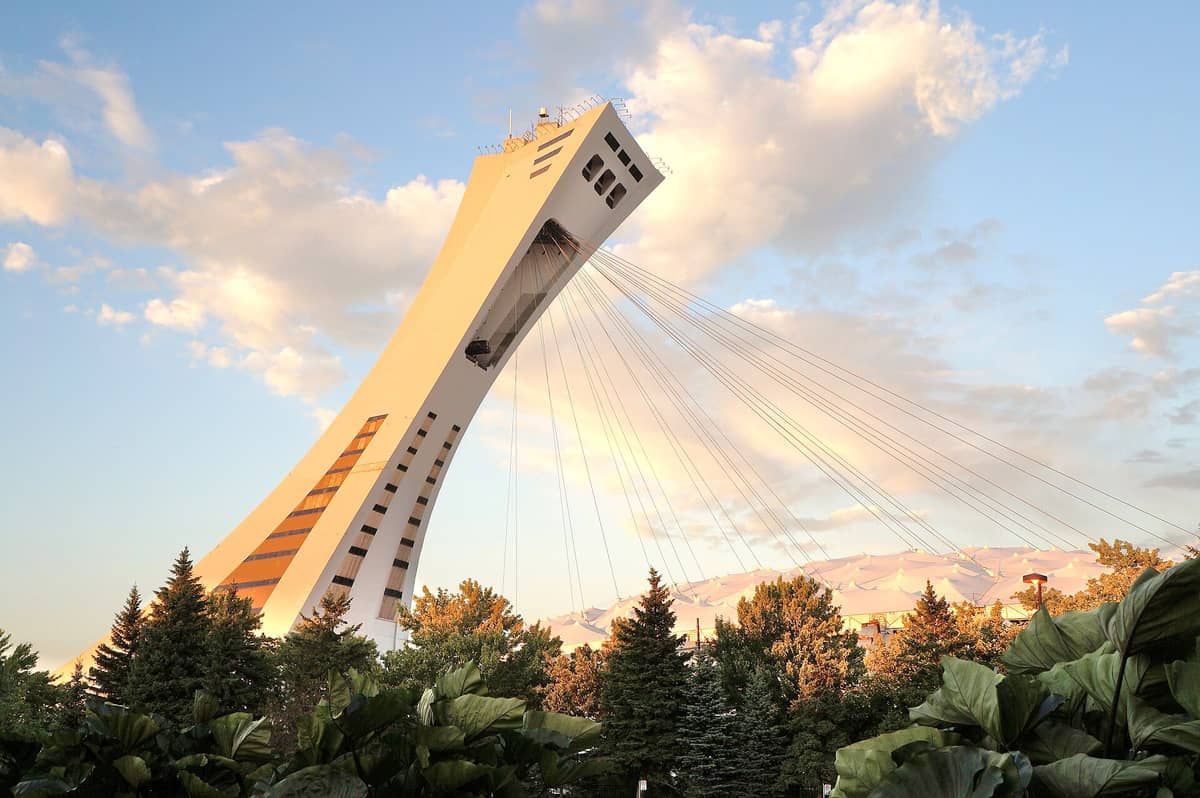
The Montreal Tower, known in French as the Tour de Montréal, is one of the most structurally eccentric buildings in North America. It is widely recognized as the world's tallest inclined tower above the Olympic Stadium complex. That fact sounds like trivia until you're standing at the base looking up at it: the tower does not taper toward a conventional point but angles away from you at a slope that seems to defy gravity at first glance.
The tower was designed by French architect Roger Taillibert, who also created the Olympic Stadium that it anchors. Taillibert's architecture throughout the Olympic Park complex is unapologetically bold, characterized by sweeping concrete forms and an almost sculptural disregard for the conventional. The tower was completed after the 1976 Montreal Summer Olympics for which the complex was built. It functioned for years as an observation deck, and it is now undergoing a major renovation that will introduce a new glass funicular and rooftop access.
⚠️ What to skip
Important: The Montreal Tower is currently closed to visitors while Olympic Park undergoes major renovations. The planned reopening is spring 2027. The renovated experience is expected to include rooftop access and a new glass funicular.[1]
The Architecture: Why This Building Matters
Even from a distance, the tower demands attention. From the Viau metro station, the inclined silhouette is already visible above the roofline, cutting a diagonal across the sky in a way that feels deliberately confrontational. Up close, the base is massive, and the cable systems that once connected the tower to the stadium's retractable roof are visible overhead, reinforcing the sense that this is a machine as much as a monument.
Taillibert's design language throughout Olympic Park belongs to a school of architecture sometimes described as organicist expressionism. The curved concrete, the absence of right angles, the integrated structural logic: all of it was controversial when built and has become progressively more appreciated as the buildings age and their singularity becomes clearer. Whether you find the tower beautiful or overwrought, it is impossible to argue that it resembles anything else in Montreal, or anywhere.
For context on how the tower fits into Montreal's broader architectural story, the Montreal architecture guide covers Taillibert's Olympic work alongside the city's other major architectural moments, from 19th-century religious buildings to Moshe Safdie's Habitat 67.
Tickets & tours
Hand-picked options from our booking partner. Prices are indicative; availability and final rates are confirmed when you complete your booking.
Montreal evening cruise on the St. Lawrence River
From 54 €Instant confirmationFree cancellation3-hour e-bike guided tour in Montreal
From 68 €Instant confirmationFree cancellationWalking tour of Old Montreal
From 20 €Instant confirmationFree cancellationMontreal helicopter tour
From 156 €Instant confirmationFree cancellation
The View from the Top: What You Could See
When the tower reopens, the renovated experience is planned to include a new glass funicular carrying visitors to redesigned visitor floors near the summit, as well as rooftop access. The official details of the final observation experience should be confirmed before visiting.[1]
From that height and position in the eastern part of the city, the view takes in the Olympic Stadium directly below, the green canopy of the Montreal Botanical Garden immediately adjacent, and the downtown skyline to the west with Mount Royal behind it. On a clear day, the Saint Lawrence River is visible to the south, and the flat agricultural plain extending toward the South Shore fills the horizon. The perspective is genuinely different from the view from Mount Royal, which gives a more compressed, central city panorama.
If comparing observation points around the city, the best views in Montreal guide helps contextualize what each vantage point offers and when the light conditions work best for each.
💡 Local tip
Photography tip for when the tower reopens: morning light from the east falls directly on the downtown skyline from the observation deck, making it ideal for photographers. Midday in summer can create harsh shadows on the stadium below; late afternoon is preferable for the Olympic Park grounds.
Olympic Park: The Broader Context
The tower does not exist in isolation. It is one component of a vast Olympic-era complex that includes the stadium, the Biodome, the Insectarium, the Montreal Botanical Garden, and the Rio Tinto Alcan Planetarium. This concentration of cultural and natural history attractions in a single area makes the Hochelaga-Maisonneuve district one of the most attraction-dense neighborhoods in the city outside of Old Montreal.
The Montreal Biodome is immediately adjacent to the tower base and houses four distinct ecosystems under a single roof, making it one of the more distinctive natural history attractions in Canada. The Montreal Botanical Garden sits across the street and is consistently ranked among the largest and most significant botanical collections in the world. A half-day visit that combines the tower with one or both of these institutions is more rewarding than the tower alone.
The Olympic Stadium itself has a complicated reputation. Built for the 1976 Games and plagued by construction overruns and technical problems for decades, it has nonetheless become a piece of Montreal's collective identity. Guided tours of the stadium run independently of the tower and continue during the renovation period, making the grounds worth visiting even while the tower is closed.
Getting There and Getting Around
The most straightforward transit route is the Green Line metro to Viau station, from which the Olympic Park complex is a few minutes on foot. Pie-IX station on the same line is an alternative entry point, useful for approaching from the botanical garden side. Both stations are accessible by elevator.
For visitors using a day pass or planning multiple metro trips, the getting around Montreal guide covers STM fares, the OPUS card system, and how to plan efficient routes between neighborhoods.
Driving is practical if arriving from outside the city, as Olympic Park has dedicated parking areas. The complex sits in the Hochelaga-Maisonneuve district, roughly 5 kilometres east of downtown. The area around the park is primarily residential and light commercial, with limited dining options directly adjacent; plan to eat inside the complex or bring food if visiting as part of a long day.
Planning Your Visit: What to Know Before 2027
The tower's visitor areas are closed through the renovation period, with a planned reopening in spring 2027. The renovated experience is planned to include rooftop access and a new glass funicular, while pricing, operating hours, and final visitor details should be confirmed on the official Olympic Park website closer to reopening.[1]
This renovation period is actually a practical opportunity to explore the Olympic Park complex without the tower crowds. The Biodome, Botanical Garden, Insectarium, and Planetarium are all operating. The stadium's exterior and grounds are freely accessible and give a complete sense of the scale and character of Taillibert's design. The tower's profile is fully visible from multiple angles without needing to ascend it.
Accessibility for the renovated experience has not yet been confirmed. Earlier versions of the attraction identified certain areas, including the main staircase and parts of the glass enclosure, as not wheelchair accessible. Visitors with mobility considerations should check directly with Olympic Park before planning a trip around the tower specifically.
ℹ️ Good to know
Who might want to skip this: travelers with no interest in architecture or city panoramas, or anyone visiting Montreal on a short trip focused on Old Montreal and the waterfront, may find the 20-minute metro ride to Olympic Park hard to justify for the tower alone. Pair it with the Botanical Garden or Biodome to make the trip worthwhile.
Insider Tips
- Even while the tower is closed, the walk around the base of the Olympic Stadium offers some of the most dramatic close-up architectural photography in the city. The concrete curvature of the stadium and the tower's angle create compositions unlike anything else in Montreal.
- The Montreal Botanical Garden across the street holds a Chinese Garden and Japanese Garden that are significantly undervisited compared to downtown attractions. Pair them with a tower visit after reopening for a half-day that covers both architecture and landscape.
- If you want a current elevated view over the eastern city, the Kondiaronk Belvedere on Mount Royal provides the most accessible alternative panorama, though the perspective differs substantially from what the tower offers.
- Transit timing matters at this end of the Green Line: trains can be less frequent during off-peak hours than at central stations. Check the STM schedule before heading out to avoid long waits at Viau or Pie-IX on your return.
- The tower is best understood as part of the Taillibert ensemble, not in isolation. Spending time looking at the stadium's exterior before or after ascending gives the architecture far more meaning than treating the tower as a standalone viewpoint.
Who Is Montreal Tower For?
- Architecture and engineering enthusiasts who want to see one of the world's most structurally unusual towers up close
- Visitors combining a half-day of Olympic Park attractions including the Biodome or Botanical Garden
- Photographers looking for panoramic views of Montreal from the east side of the city, with the downtown skyline and Saint Lawrence in frame
- Families already visiting the Biodome or Insectarium who want to extend the day with a unique ascent experience
- Anyone interested in Montreal's 1976 Olympic history and the complex legacy of that era's infrastructure
Nearby Attractions
Other things to see while in Olympic Park:
- Biodôme
The Biodôme is one of Montreal's most unusual attractions: a former Olympic velodrome converted into a living natural science museum where you walk through a tropical rainforest, a St. Lawrence marine ecosystem, a sub-polar environment, and a maple forest without stepping outside. It rewards curiosity at any age, but it helps to know what you're walking into.
- Château Dufresne
Built between 1915 and 1918 for two brothers at the peak of their industrial fortunes, Château Dufresne is a rare double mansion frozen in early 20th-century Montreal opulence. The interiors survive in remarkable condition, making it one of the city's most undervisited architectural treasures.
- Insectarium
The Montréal Insectarium is one of North America's most ambitious insect museums, housed in a striking new building that opened in 2022. With immersive galleries, living collections, and exhibits designed for curiosity rather than squeamishness, it rewards visitors of all ages who are willing to look closely at the world's most overlooked creatures.
- Montreal Botanical Garden
The Jardin botanique de Montréal is one of the largest botanical gardens in the world, covering 75 hectares with more than 22,000 plant species across dozens of thematic gardens. From the hushed indoor greenhouses in February to the blaze of the Chinese lantern festival in autumn, the garden rewards visitors in every season.