Montréal Insectarium: What to Expect Before You Go
The Montréal Insectarium is one of North America's most ambitious insect museums, housed in a striking new building that opened in 2022. With immersive galleries, living collections, and exhibits designed for curiosity rather than squeamishness, it rewards visitors of all ages who are willing to look closely at the world's most overlooked creatures.
Quick Facts
- Location
- 4581 rue Sherbrooke Est, Montréal, QC H1X 2B2 — Olympic Park area
- Getting There
- Viau or Pie-IX métro stations; bus 185 (Sherbrooke) stops nearby
- Time Needed
- 2 to 3 hours for a full visit; allow more if you linger in the immersive sections
- Cost
- Admission varies by age and category in CAD; verify current rates at espacepourlavie.ca before booking
- Best for
- Families with children, science enthusiasts, curious adults, rainy-day visits
- Official website
- espacepourlavie.ca/en/insectarium
What the Montréal Insectarium Actually Is
The Montréal Insectarium is not a zoo with insects as an afterthought. It is a dedicated natural history and science museum focused entirely on the world of arthropods: beetles, butterflies, ants, spiders, scorpions, and hundreds of other species that collectively make up the vast majority of animal life on Earth. Operated by Espace pour la vie, the same nonprofit network that runs the Botanical Garden, Biodôme, and Rio Tinto Alcan Planetarium, the Insectarium sits on rue Sherbrooke Est within the broader Olympic Park campus.
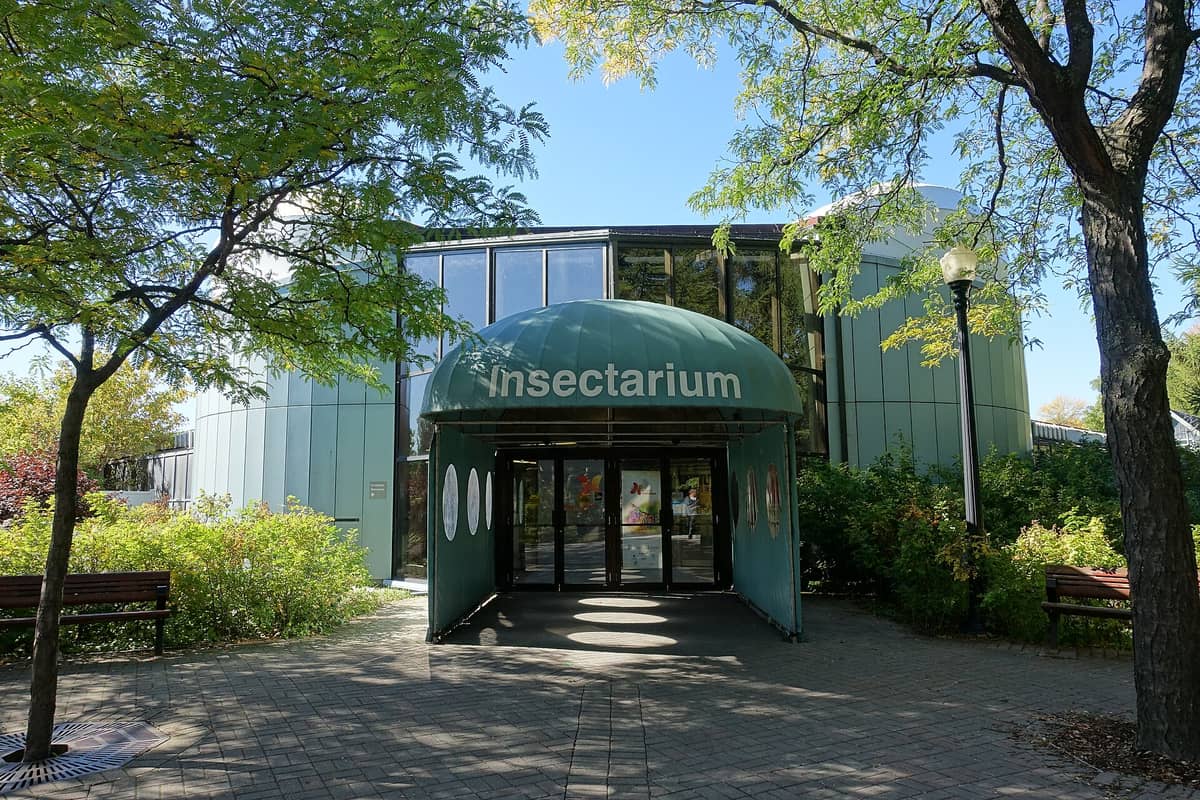
The museum's current form opened in 2022 after a multi-year reconstruction. The new building is a substantial architectural departure from the original 1990 structure: it integrates directly into the landscape, with a green roof planted with species that support pollinators, blurring the boundary between the building and the surrounding Botanical Garden next door. The design signals the museum's philosophy before you even step inside: insects are not curiosities to be kept at arm's length, they are part of every environment we inhabit.
💡 Local tip
The Insectarium and the Botanical Garden share an entry zone and are often combined in a single ticket. Confirm bundled options when booking — visiting both sites on the same day is very doable and significantly increases the value of the trip.
The Galleries: What You'll Actually See
The experience is organized into a sequence of environments rather than traditional display cases. Early sections move through dimly lit corridors where the sounds of a forest at night — faint clicks, rustling, high-pitched stridulation — create an immediate shift in atmosphere. The lighting is deliberate: many insects are most active in low-light conditions, and the exhibition design reflects that biological reality rather than optimizing for casual viewing comfort.
Living specimens are displayed throughout the permanent collection. You will see live arthropods in carefully maintained habitats: leaf-cutter ant colonies carrying fragments in organized lines, giant stick insects barely distinguishable from the branches they cling to, and beetles moving slowly across bark in a way that rewards patience. The smell in these zones is earthy and faintly humid, not unpleasant, but distinctive enough that you know you are somewhere that takes the biology seriously.
The museum's most discussed feature is its immersive experience, a sensory installation that puts visitors inside the perspective of an insect. This section involves close quarters, shifting visuals, and sound design intended to provoke a genuine sense of scale reversal. It is genuinely disorienting for some visitors. The official accessibility notes confirm this: the experience may cause feelings of tightness or disorientation. If you or someone in your group is prone to claustrophobia or sensory overload, it is worth knowing this before entering rather than after.
The pinned specimen collection provides a counterpoint to the living displays. Thousands of preserved insects from around the world are arranged by taxonomy and region, and this section functions more like a traditional natural history museum. It is here that you register the sheer scale of insect diversity: the iridescent blue of a Morpho butterfly pinned beside a dull brown relative, or the armored bulk of a tropical beetle next to something that would go unnoticed on a Montreal sidewalk.
Tickets & tours
Hand-picked options from our booking partner. Prices are indicative; availability and final rates are confirmed when you complete your booking.
Montreal evening cruise on the St. Lawrence River
From 54 €Instant confirmationFree cancellation3-hour e-bike guided tour in Montreal
From 68 €Instant confirmationFree cancellationWalking tour of Old Montreal
From 20 €Instant confirmationFree cancellationMontreal helicopter tour
From 156 €Instant confirmationFree cancellation
The Building and Its Relationship to the Botanical Garden
Understanding the Insectarium's setting makes the visit more coherent. The building was designed to sit at the edge of the Botanical Garden's grounds, and the two institutions share more than geography. The Botanical Garden's outdoor gardens actively support insect populations, and visitors who walk between the two sites during warmer months will see that relationship in practice: butterflies feeding on plantings, bees working through the herb garden, dragonflies around the lily ponds.
The green roof visible from certain vantage points in the Botanical Garden is planted with native wildflowers and grasses. This is not decorative: it is functioning habitat. The design choice reflects the museum's broader educational argument, that urban environments can support insect life if built and maintained with that goal in mind. For visitors interested in how cities and nature intersect, the combination of the Insectarium and the Botanical Garden tells a more complete story than either institution does alone.
Best Time to Visit and How Crowds Move
Weekday mornings are the quietest. School groups arrive frequently on weekday late mornings, so if you want to move through the galleries at your own pace, arriving when the museum opens gives you the best chance of doing so without navigating around a class of excited eight-year-olds. Weekend afternoons are the busiest periods, particularly during school holidays and summer months.
The Insectarium is an excellent rainy-day destination. Because almost everything is indoors, poor weather actually works in the museum's favor by concentrating visitors who might otherwise be at the Botanical Garden's outdoor sections. On gray, wet afternoons in shoulder season, the low lighting in the insect galleries feels appropriate rather than gloomy, and the crowds thin out compared to sunny summer days.
Seasonal programming varies. Check the official calendar at espacepourlavie.ca before visiting, as temporary exhibitions, guided tours, and special events rotate throughout the year. Opening hours also change by season, so confirming in advance prevents a wasted trip.
⚠️ What to skip
Opening hours and ticket prices vary by season and visitor category. Always verify the current schedule at espacepourlavie.ca before your visit. Do not rely on third-party booking platforms for the most accurate availability.
Getting There: Transit, Parking, and the Walk In
The Insectarium is reachable by two métro stations on the Green Line: Viau and Pie-IX. Both are within walking distance, and the walk along rue Sherbrooke Est passes through a stretch of the Olympic Park area that gives context to the scale of the 1976 infrastructure around it. Bus 185 (Sherbrooke) also serves the area directly. Most visitors coming from downtown will find the Viau station the slightly more convenient option, but the difference is minimal.
Paid parking is available at P2, located at 4581 Sherbrooke Street East. Driving is a reasonable option if you are combining the visit with other sites at Olympic Park, but the métro is straightforward and eliminates any parking cost or complexity. The Insectarium and Botanical Garden are adjacent, so if you plan to visit both, you do not need to repark or retake transit between them.
Accessibility and Practical Notes
The museum's main spaces are accessible to visitors using wheelchairs. A limited number of manual (non-electric) wheelchairs are available at no charge from the ticket counter, though availability is not guaranteed and cannot be pre-reserved. The outdoor parking area provides 12 designated accessible spaces near the main entrance.
One important exception: the exhibit hall called From Blade to Blade is not universally accessible. If accessibility is a priority concern, confirm the current layout with the museum before your visit, as exhibit configurations can change.
The immersive sensory experience described earlier is worth flagging again for accessibility purposes. Beyond the physical layout, the disorienting effects of that installation may be difficult for visitors with sensory sensitivities, vestibular conditions, or anxiety. Museum staff can advise on whether to skip or modify that section of the visit.
Combining the Insectarium with the Rest of Olympic Park
The Insectarium sits within one of Montreal's most information-dense visitor zones. A full day in the area can reasonably include the Insectarium, the Botanical Garden, and the Biodôme, which recreates five distinct ecosystems — tropical forest, sub-Arctic, Laurentian forest, Gulf of St. Lawrence, and Labrador Coast — inside the former velodrome from the 1976 Olympics. The Rio Tinto Alcan Planetarium and the Olympic Stadium with its tower are also on the same campus.
Espace pour la vie offers combination tickets covering multiple institutions. If you plan to visit more than one site, this is almost always the more economical option. Verify the current pricing and combinations on the official website, as packages are updated periodically.
For families treating this as part of a broader Montreal itinerary, the Olympic Park area is worth an overnight in the city's east end rather than treating it as a rushed half-day from downtown. See the guide to Montreal with kids for more on how to structure a family-oriented visit across the city.
Who Should Think Twice
Visitors with a strong aversion to insects will find the Insectarium difficult to enjoy, which is obvious but worth stating plainly. The museum is designed to reduce that aversion, and it does so thoughtfully, but if the goal is simply to check off a cultural institution, there are better options in Montreal for visitors who find the subject matter genuinely distressing.
Travelers with very limited time in Montreal should weigh the geographic trade-off. The Olympic Park area is east of downtown and not within easy walking distance of the historic center. If you have only a day or two in the city, the travel time required means you are committing a significant portion of your visit to this single neighborhood. That is a worthwhile trade for anyone with genuine interest in natural science or families with young children, but it is a real consideration for those prioritizing Old Montreal or the Plateau.
Insider Tips
- Arrive when the museum opens on a weekday if you want the living-insect displays to yourself. The leaf-cutter ant colony is especially active in the morning before foot traffic picks up.
- The green roof is visible from parts of the Botanical Garden path that runs along the museum's exterior. Walk around the building before entering to get a sense of the architecture from outside.
- Combination tickets covering the Insectarium and Botanical Garden offer significantly better value than separate admissions. Confirm the current bundle options at the ticket window or online before paying for just one site.
- The immersive sensory installation has a bypass route. If anyone in your group is sensitive to enclosed spaces or disorienting visuals, ask staff at the entrance to that section to point you toward the alternative path.
- Photography without flash is generally permitted in the permanent galleries. The pinned specimen collection with its metallic and iridescent specimens photographs well in the available gallery lighting, particularly with a phone camera's portrait mode.
Who Is Insectarium For?
- Families with school-age children who have developed an interest in animals or science
- Adults with a background or interest in natural history, entomology, or ecology
- Rainy-day visitors looking for a substantive indoor experience that takes at least half a day
- Travelers combining a full day at Olympic Park across multiple Espace pour la vie institutions
- Anyone willing to reconsider their relationship with a category of life they have spent most of their life ignoring
Nearby Attractions
Other things to see while in Olympic Park:
- Biodôme
The Biodôme is one of Montreal's most unusual attractions: a former Olympic velodrome converted into a living natural science museum where you walk through a tropical rainforest, a St. Lawrence marine ecosystem, a sub-polar environment, and a maple forest without stepping outside. It rewards curiosity at any age, but it helps to know what you're walking into.
- Château Dufresne
Built between 1915 and 1918 for two brothers at the peak of their industrial fortunes, Château Dufresne is a rare double mansion frozen in early 20th-century Montreal opulence. The interiors survive in remarkable condition, making it one of the city's most undervisited architectural treasures.
- Montreal Botanical Garden
The Jardin botanique de Montréal is one of the largest botanical gardens in the world, covering 75 hectares with more than 22,000 plant species across dozens of thematic gardens. From the hushed indoor greenhouses in February to the blaze of the Chinese lantern festival in autumn, the garden rewards visitors in every season.
- Montreal Tower
The Montreal Tower (Tour de Montréal) is the world's tallest inclined tower above the Olympic Stadium complex. Currently closed for major renovations, it is scheduled to reopen in spring 2027 with what promises to be an updated observation experience.