Montreal Biodôme: Five Ecosystems, One Extraordinary Building
The Biodôme is one of Montreal's most unusual attractions: a former Olympic velodrome converted into a living natural science museum where you walk through a tropical rainforest, a St. Lawrence marine ecosystem, a sub-polar environment, and a maple forest without stepping outside. It rewards curiosity at any age, but it helps to know what you're walking into.
Quick Facts
- Location
- 4777 avenue Pierre-De Coubertin, Olympic Park, Montréal, QC H1V 1B3
- Getting There
- Viau metro station (Green Line), approx. 5-min walk. Buses 34, 125, 136 also stop nearby.
- Time Needed
- 1.5 to 2.5 hours for a thorough visit
- Cost
- Adults $23.75 · Seniors 65+ $21.50 · Students (18+ with ID) $17.50 · Ages 5–17 $12.25 · Family (2 adults + 3 children) $65.75 · Under 4 free. Verify current prices before purchase.
- Best for
- Families with children, wildlife enthusiasts, rainy-day visitors, anyone curious about ecosystems
- Official website
- espacepourlavie.ca/biodome
What the Biodôme Actually Is
The Biodôme de Montréal is an indoor nature museum unlike any conventional zoo or aquarium. Housed inside the shell of the velodrome built for the 1976 Summer Olympics, it contains four distinct ecosystems replicated with genuine living plants and animals: the Tropical Rainforest, the Laurentian Maple Forest, the Gulf of St. Lawrence marine environment, and the Sub-polar Worlds. Visitors walk through each in sequence, with the temperature, humidity, light levels, and even the soundscape changing as you cross from one zone to the next.
It is part of Espace pour la vie, the cluster of science and nature institutions around Olympic Park that also includes the Montreal Botanical Garden, the Insectarium, and the Rio Tinto Alcan Planetarium. A single-museum ticket covers only the Biodôme; combination tickets covering multiple Espace pour la vie institutions are also available and generally offer better value if you plan to visit more than one.
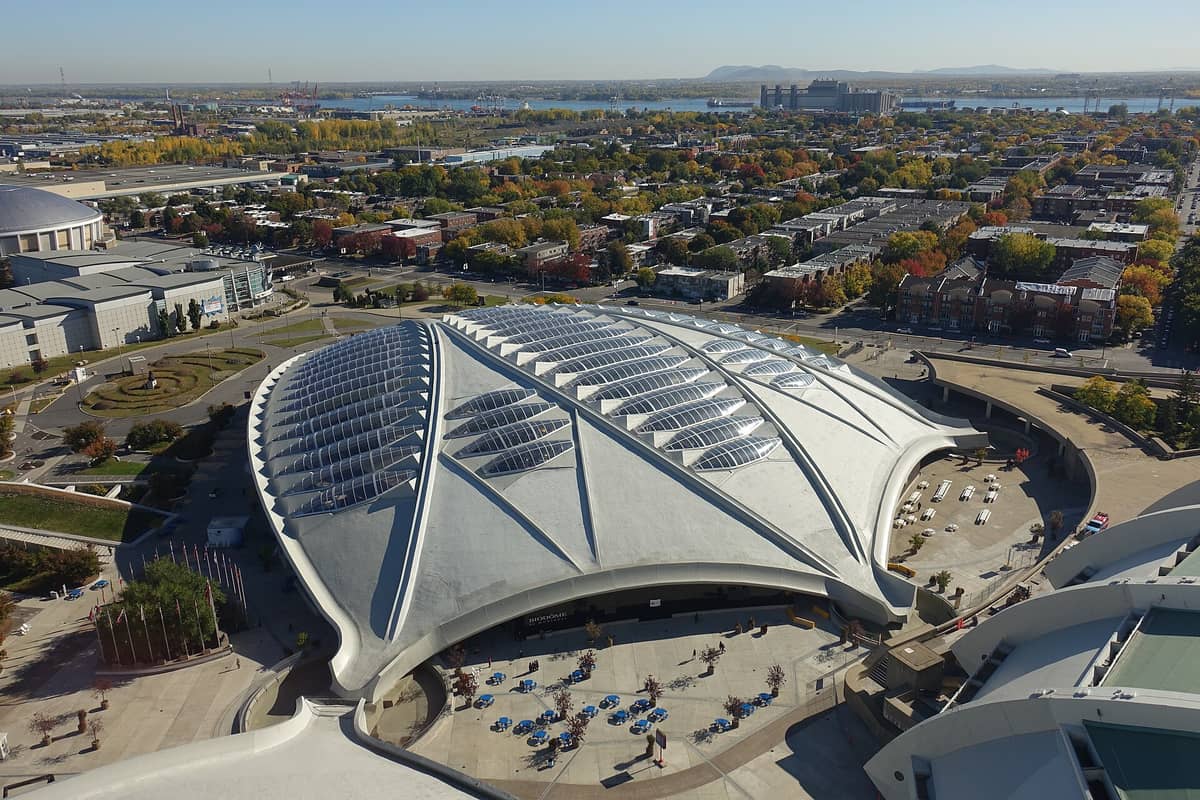
The surrounding Olympic Park complex gives the Biodôme an architectural context worth appreciating even before you enter. The velodrome's curved concrete form, designed by Roger Taillibert, is distinctive from the outside. The conversion to a nature museum was completed in 1992, and a major renovation finished around 2020 modernized the exhibits significantly without losing the spatial drama of the original structure.
💡 Local tip
Opening hours vary by season, with extended hours typically running around 9:00 a.m.–6:00 p.m. in summer and approximately 9:00 a.m.–5:00 p.m. at other times. Always confirm the current schedule at espacepourlavie.ca before you go, as holiday hours differ.
Walking Through the Five Ecosystems
Tropical Rainforest
The route begins in the Tropical Rainforest, and the shift is immediate and physical. The air becomes warm and noticeably humid, carrying the faint green smell of damp vegetation. Light filters down through a canopy of tall palms and broad-leafed tropical plants. Capybaras move unhurriedly along the ground; golden lion tamarins leap between branches close enough that you can study their faces without any barrier blocking the view. Scarlet ibises stand in groups, their color almost implausibly vivid against the foliage.
This zone tends to attract the most attention from younger visitors, partly because the animals are conspicuous and partly because the environment feels genuinely dramatic. On busy weekend mornings, the narrow pathways can become congested near popular viewing spots, so moving through at a steady pace rather than clustering works better for everyone.
Laurentian Maple Forest
The transition into the Laurentian Maple Forest brings a cooler, drier air. The lighting shifts to suggest a Quebec woodland in different seasons, cycling through the amber tones of autumn and the muted light of winter. Beavers, river otters, and lynx are among the resident animals here. The otter exhibit in particular tends to stop visitors in their tracks: the animals swim in looping patterns through the glass-fronted tank, covering the same route repeatedly with apparent enthusiasm.
Gulf of St. Lawrence
The Gulf of St. Lawrence zone is darker and cooler, built around a large aquatic exhibit representing the cold Atlantic marine environment off Quebec's coast. Puffins, razorbills, and common murres occupy a rocky shoreline above the water while fish and invertebrates fill the tank below. The combination of seabirds and marine life in a single space is one of the more distinctive exhibits in the Biodôme, and it is difficult to replicate in a conventional aquarium setting.
Sub-polar Worlds
The final zone covers both the Arctic and Antarctic, and it is noticeably cold. Penguins are the centerpiece here, and the exhibit is designed so that you can observe them both above and below the waterline. Little blue penguins and king penguins share the space, and the contrast in size is striking when they're visible side by side. The temperature drop makes a light layer useful if you tend to feel cold quickly.
Tickets & tours
Hand-picked options from our booking partner. Prices are indicative; availability and final rates are confirmed when you complete your booking.
Montreal evening cruise on the St. Lawrence River
From 54 €Instant confirmationFree cancellation3-hour e-bike guided tour in Montreal
From 68 €Instant confirmationFree cancellationWalking tour of Old Montreal
From 20 €Instant confirmationFree cancellationMontreal helicopter tour
From 156 €Instant confirmationFree cancellation
The Building Itself: A Brief History
The velodrome that became the Biodôme was purpose-built for track cycling at the 1976 Montreal Olympics. After the Games, the building sat underused for years before the City of Montreal and provincial stakeholders decided to transform it into a living ecosystem museum, which opened in 1992. The choice to repurpose a sports facility rather than demolish it was partly pragmatic and partly forward-looking: the building's sweeping roof, originally designed to shelter cycling spectators, happened to be well-suited to maintaining the large, climate-controlled volumes needed for tropical and sub-polar exhibits.
The renovation completed around 2020 updated the visitor experience considerably, improving sightlines, refreshing exhibits, and reworking interpretive materials. The Olympic Stadium stands just across the park, and together they make the Olympic Park complex one of the more architecturally coherent sports-to-culture conversions in North America.
When to Visit and What to Expect
The Biodôme is a fully indoor experience, which makes it genuinely useful on days when Montreal's weather is uncooperative. It draws heavily on weekends and during school holidays, especially in summer. Arriving at or close to opening time on weekdays tends to produce a quieter experience: the pathways are less congested, the animals are often more active in the morning, and you can linger at exhibits without negotiating around tour groups.
Summer afternoons are the peak crowd period, particularly during July and August when the attraction draws families on school break. If you're visiting in winter, the Biodôme is an especially comfortable choice: stepping from sub-zero outdoor temperatures into the tropical zone produces an almost theatrical contrast, and attendance tends to be lower than in the summer peak.
ℹ️ Good to know
Photography is permitted throughout the Biodôme without flash. The tropical and marine zones offer the best light for handheld shots. The sub-polar zone is dimly lit and benefits from a lens with a wider aperture or a phone camera with good low-light performance.
The Biodôme does not require significant physical effort: the entire route is flat and paved, with no stairs on the main circuit. Wheelchairs and strollers can be borrowed free of charge at the entrance, which is a practical detail worth knowing if you're travelling with young children or visitors with mobility considerations. The institution's accessibility documentation confirms that the full ecosystem visit is navigable for all visitors.
Getting There
The most straightforward route from central Montreal is the Green Line metro to Viau station, which puts you about a five-minute walk from the Biodôme entrance. Bus routes 34, 125, and 136 serve the area as well. BIXI bike-share stations are located near the intersection of Pierre-De Coubertin and Bennett, and bicycle racks are available at the site. If you are combining the Biodôme with the Montreal Botanical Garden or the Rio Tinto Alcan Planetarium, all three are within easy walking distance of each other in the Olympic Park cluster, making a half-day itinerary across two or three institutions genuinely practical.
Is It Worth Your Time? An Honest Assessment
For travelers with children, the Biodôme is one of the stronger options in Montreal. The animals are accessible, the route is easy, the spaces are engaging without being overwhelming, and the hour or two it requires fits naturally into a family day at Olympic Park. Adults without children will also find it worthwhile if they have genuine interest in wildlife or ecology, particularly given the unusual architectural setting.
It is worth being clear about what it is not. The Biodôme is not a large zoo and does not house a wide variety of megafauna. The species present are carefully chosen to represent specific ecosystems rather than to impress through sheer volume. If you're expecting the scale of a major zoo or the depth of a specialist aquarium, the experience may feel compact. The admission price is also not trivial, and visitors who are indifferent to wildlife or ecosystems are unlikely to feel it was worth the cost.
For a fuller picture of what else Olympic Park offers, the Montreal Tower provides one of the city's better elevated views and can be combined with a Biodôme visit on the same day. The Montreal with kids guide covers the broader family options across the city if you are planning multiple days.
Insider Tips
- Buy your ticket online before arrival. The entrance queue on busy summer weekends can be slow, and pre-purchased tickets let you bypass the ticket window entirely.
- The penguins in the Sub-polar Worlds zone are fed at scheduled times during the day. Check the posted schedule at the entrance and time your visit to the zone accordingly; feeding sessions draw noticeably more activity from the birds.
- If you plan to visit more than one Espace pour la vie institution on the same trip, the combination ticket across multiple institutions costs substantially less than buying single-museum admissions separately. The Botanical Garden next door is an easy pairing.
- Bring a light layer or a zip-up for the Sub-polar Worlds zone. The temperature drop from the tropical section is sharp, and the zone is cold enough to be uncomfortable in a t-shirt after you've been warm for twenty minutes.
- Weekday mornings, especially Tuesday through Thursday, are the quietest times to visit. School group visits are generally booked for mid-morning, so arriving right at opening gives you the best chance of moving through the ecosystems without congestion.
Who Is Biodôme For?
- Families with children aged 3 and up
- Rainy or cold days when outdoor sightseeing is unpleasant
- Wildlife and ecology enthusiasts of any age
- Visitors already spending time at Olympic Park
- Travelers who appreciate architecture with an interesting history
Nearby Attractions
Other things to see while in Olympic Park:
- Château Dufresne
Built between 1915 and 1918 for two brothers at the peak of their industrial fortunes, Château Dufresne is a rare double mansion frozen in early 20th-century Montreal opulence. The interiors survive in remarkable condition, making it one of the city's most undervisited architectural treasures.
- Insectarium
The Montréal Insectarium is one of North America's most ambitious insect museums, housed in a striking new building that opened in 2022. With immersive galleries, living collections, and exhibits designed for curiosity rather than squeamishness, it rewards visitors of all ages who are willing to look closely at the world's most overlooked creatures.
- Montreal Botanical Garden
The Jardin botanique de Montréal is one of the largest botanical gardens in the world, covering 75 hectares with more than 22,000 plant species across dozens of thematic gardens. From the hushed indoor greenhouses in February to the blaze of the Chinese lantern festival in autumn, the garden rewards visitors in every season.
- Montreal Tower
The Montreal Tower (Tour de Montréal) is the world's tallest inclined tower above the Olympic Stadium complex. Currently closed for major renovations, it is scheduled to reopen in spring 2027 with what promises to be an updated observation experience.