Château Dufresne: Montreal's Forgotten Beaux-Arts Mansion
Built between 1915 and 1918 for two brothers at the peak of their industrial fortunes, Château Dufresne is a rare double mansion frozen in early 20th-century Montreal opulence. The interiors survive in remarkable condition, making it one of the city's most undervisited architectural treasures.
Quick Facts
- Location
- 2929 Jeanne-d'Arc Avenue, Montréal, QC H1W 3W2
- Getting There
- Pie-IX metro station (Green Line), western exit
- Time Needed
- 1.5 to 2.5 hours
- Cost
- Adults C$14 · Seniors 65+ C$13 · Full‑time students 18–30 C$13 · Ages 6–17 C$7 · Under 5 free · Family C$30
- Best for
- Architecture enthusiasts, history lovers, quiet cultural afternoons
- Official website
- chateaudufresne.com/en/home
What Is Château Dufresne?
Château Dufresne is a double Beaux-Arts mansion built between 1915 and 1918 on the eastern edge of Montreal, designed to house two brothers side by side under one shared roof. Marius Dufresne, the engineer and entrepreneur, occupied one half; his brother Oscar, a shoe manufacturer, the other. The result is not a single grand house but two mirror-image residences connected at the centre, each with its own entrance, reception rooms, and private quarters. That duality is visible in the architecture and even more striking once you are inside.
The building sits just north of the Olympic Park complex, at the foot of what was then the grandest stretch of eastern Montreal. In its day, this location signalled ambition: the Dufresne brothers were positioning themselves among the city's francophone elite at a time when wealth in Montreal was largely concentrated among English-speaking industrialists. The house was a statement as much as a residence.
ℹ️ Good to know
Open Wednesday through Sunday, 9:30 a.m. to 5 p.m. Last admission is at 4 p.m. The museum is closed Mondays, Tuesdays, and public holidays. Admission prices are tax-inclusive: adults C$14, seniors 65+ and full-time students 18–30 C$13, ages 6–17 C$7, under 5 free, family C$30.
The Architecture: Beaux-Arts in Montreal's East End
The Beaux-Arts style, imported from the École des Beaux-Arts in Paris, was the prestige language of public and civic buildings in North America between roughly 1880 and 1930. Applied to a private residence, it produced something relatively unusual: a house with the proportions and decorative vocabulary of a small institution. The symmetrical limestone facade, the carved classical ornament, the projecting central pavilion — all of it reads as formal and deliberate rather than domestic.
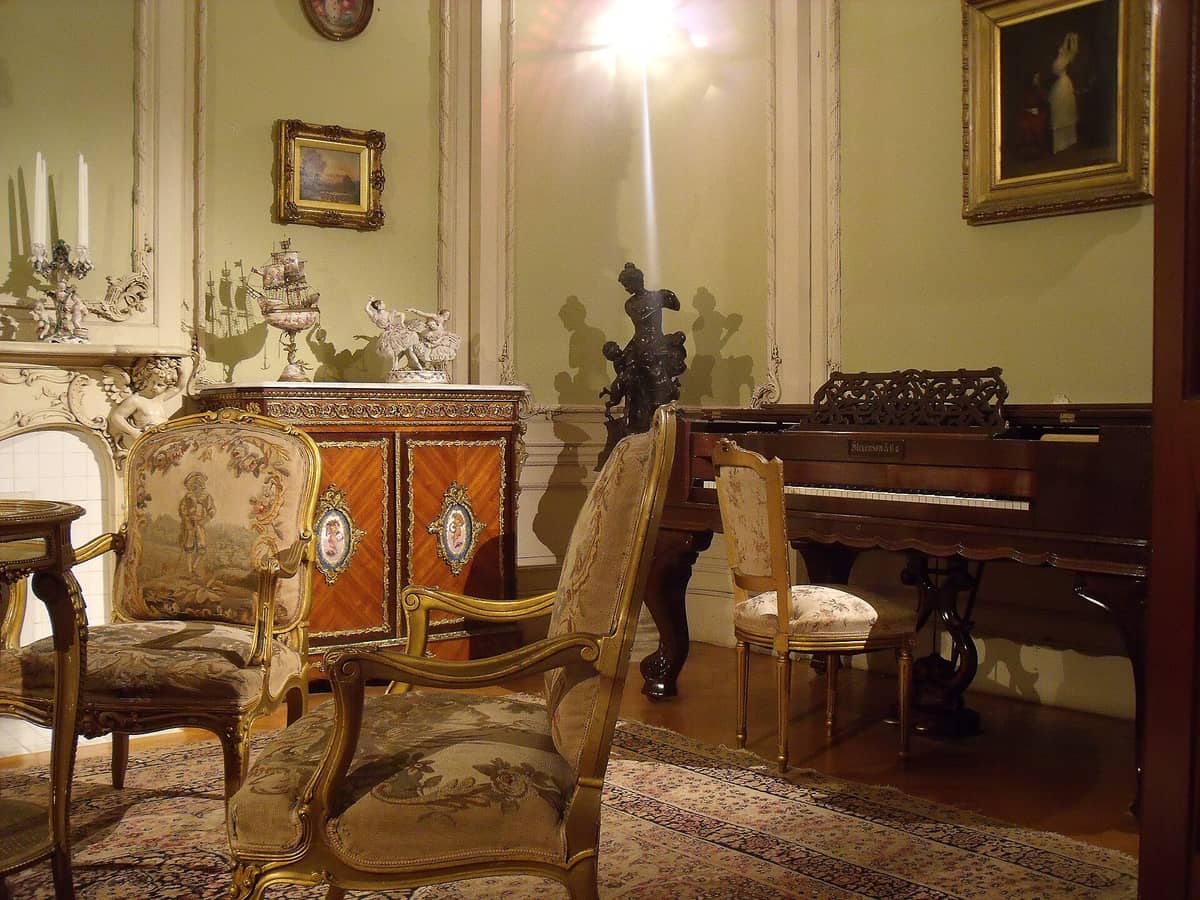
Inside, the rooms are finished with painted ceilings, gilded plasterwork, imported marble, and period furniture selected to convey European cultural sophistication. The decorative programs in each half of the house differ subtly, reflecting the individual tastes of the two brothers, and those differences become one of the more interesting threads to follow as you move through the building. Some of the painted ceiling panels were executed by Guido Nincheri, the Italian-born artist responsible for some of Montreal's most elaborate church interiors.
The mansion's architectural context matters as much as the building itself. This is not Old Montreal or downtown, where grand buildings are routine. The area around Olympic Park developed as a working and middle-class district, which makes a Beaux-Arts double mansion of this scale genuinely surprising. For visitors interested in Montreal's wider architectural story, the contrast between the building and its surroundings is part of what makes the visit worth making.
Tickets & tours
Hand-picked options from our booking partner. Prices are indicative; availability and final rates are confirmed when you complete your booking.
Montreal evening cruise on the St. Lawrence River
From 54 €Instant confirmationFree cancellation3-hour e-bike guided tour in Montreal
From 68 €Instant confirmationFree cancellationWalking tour of Old Montreal
From 20 €Instant confirmationFree cancellationMontreal helicopter tour
From 156 €Instant confirmationFree cancellation
What the Visit Actually Looks Like
The entrance sits on Jeanne-d'Arc Avenue, though the garden gate on Boulevard Pie-IX also leads to the ticket office. The reception area is modest and the staff tend to be attentive without being overbearing, which sets the tone for an experience that feels more like a house visit than a conventional museum.
Guided tours are available and worth taking if your schedule allows: the painted ceilings and decorative details accumulate meaning when someone can explain who commissioned them and why. Self-guided visits are also possible, and the rooms are labelled. Plan for at least 90 minutes if you want to move through both halves of the house without rushing. Visitors who stop to read the interpretive materials and look carefully at the ceiling paintings will find two hours disappears quickly.
The building is not enormous, but the level of finish is dense. Every room has something worth examining closely, whether the texture of a wallcovering, the carving on a fireplace surround, or the geometry of an inlaid floor. This is a place that rewards slow attention rather than quick circuits.
💡 Local tip
Photography is generally permitted in the public rooms. Natural light from the tall windows is best in the morning hours. If you are visiting primarily for the painted ceilings, ask staff which rooms have the most significant work by Guido Nincheri before you begin.
Time of Day and Crowd Patterns
Château Dufresne attracts a notably smaller crowd than Montreal's flagship museums. On weekday mornings, the house can feel almost private: footsteps echo in the parquet corridors and you may move through several rooms without encountering another visitor. Weekend afternoons bring families and architecture students, but even then the volume rarely becomes uncomfortable. This is not the kind of place where you queue at the door.
Morning visits take advantage of the best light in the east-facing rooms, where winter sun angles sharply through tall windows and catches the gold leaf on plasterwork details. Afternoon visits are quieter in those same rooms but brighter in the west-facing spaces. If ceiling paintings are your priority, a weekday morning between 10 a.m. and noon offers the most useful combination of light and solitude.
⚠️ What to skip
The museum is closed Mondays and Tuesdays, which catches visitors who assume it follows a standard five-day schedule. Check opening hours before making a trip, especially around public holidays.
Getting There and Practical Logistics
The most straightforward route is the Green Line metro to Pie-IX station. Use the exit toward Boulevard Pie-IX and walk south; the facade of Château Dufresne is visible almost immediately on Jeanne-d'Arc Avenue. The walk from the station takes about five minutes. Bus routes on Pie-IX also stop nearby for those coming from other directions.
If you are combining the visit with other sites in the area, Olympic Stadium and the Biodôme are within walking distance, and the Montreal Botanical Garden is directly across Pie-IX Boulevard. A half-day itinerary that starts at Château Dufresne and crosses the street to the botanical garden is one of the better-paced culture days available in this part of the city.
The building has an access ramp and elevator, making it wheelchair accessible. A wheelchair is available to borrow on arrival at no charge, though it cannot be reserved in advance. Strollers are also permitted inside. Seeing-eye dogs are accepted.
There is no dedicated parking lot attached to the museum, but street parking is generally available in the surrounding residential grid. Cyclists will find the area manageable, and the nearby cycling infrastructure connects to broader Montreal routes.
Historical and Cultural Context
The Dufresne brothers completed their mansion just as the First World War was ending, at a moment when Montreal's francophone entrepreneurial class was asserting itself with new confidence. The scale and style of the building were deliberate choices: Beaux-Arts was the architecture of prestige institutions, and bringing it to a private home in the east end sent a clear message about where the brothers saw themselves in the city's social order.
After the brothers' deaths, the building passed through various hands and uses, including a period as a boarding school for boys. Decades of institutional occupation took a toll on some sections while, paradoxically, preserving others by limiting alterations. The restoration effort that transformed the building into a museum was careful and ongoing; the interpretive programming has grown more sophisticated over time and now places the house clearly within the broader story of Montreal's francophone bourgeoisie in the early 20th century.
Visitors with a broader interest in Montreal's architectural heritage may find it worth reading the Montreal architecture guide before or after the visit, which places buildings like Château Dufresne within the city's wider built environment.
Who Should Think Twice
Visitors looking for a large or action-packed museum will find Château Dufresne too quiet and too focused. The building has no rotating blockbuster exhibitions, no interactive children's areas, and no gift shop with broad appeal. Families with very young children may find the formal interiors limiting, though the building is stroller-accessible and the staff are generally accommodating.
Travellers with only a single day in Montreal and a long list of major sites should weigh priorities carefully. Château Dufresne is not the kind of place that generates strong reactions from people who visit without any particular interest in decorative arts or architectural history. For those audiences, the time might be better spent elsewhere. For everyone else, it is one of the most genuinely distinctive buildings open to visitors in the city.
Insider Tips
- Ask at the ticket desk whether a guided tour is running during your visit. The interpretive content on the ceiling paintings, particularly the Nincheri panels, is significantly richer with a guide than from the printed labels alone.
- The garden gate entrance on Boulevard Pie-IX is useful if you are arriving by foot from the Botanical Garden side of the street. It leads directly to the ticket office and avoids doubling back around the block.
- Visit on a weekday morning if the painted ceilings are your main draw. The east-facing rooms receive direct morning light that catches gilded plasterwork in a way that afternoon visits simply do not replicate.
- Admission prices are already tax-inclusive, so the price on the sign is the price you pay. Groups of at least 15 adults, seniors, or students visiting together can qualify for the reduced group rate of C$12 per person with a prior reservation; it is worth asking at the desk rather than assuming the standard rate applies.
- Pair the visit with the Montreal Botanical Garden directly across Pie-IX Boulevard. The two together make a full and well-paced half-day in the Olympic Park area without any transit required between them.
Who Is Château Dufresne For?
- Architecture and decorative arts enthusiasts who want to see Beaux-Arts residential design up close
- History-minded travellers interested in early 20th-century francophone Montreal
- Visitors seeking a calm, unhurried museum experience away from major tourist crowds
- Photographers drawn to ornate interiors and painted ceilings
- Travellers combining a half-day itinerary in the Olympic Park neighbourhood
Nearby Attractions
Other things to see while in Olympic Park:
- Biodôme
The Biodôme is one of Montreal's most unusual attractions: a former Olympic velodrome converted into a living natural science museum where you walk through a tropical rainforest, a St. Lawrence marine ecosystem, a sub-polar environment, and a maple forest without stepping outside. It rewards curiosity at any age, but it helps to know what you're walking into.
- Insectarium
The Montréal Insectarium is one of North America's most ambitious insect museums, housed in a striking new building that opened in 2022. With immersive galleries, living collections, and exhibits designed for curiosity rather than squeamishness, it rewards visitors of all ages who are willing to look closely at the world's most overlooked creatures.
- Montreal Botanical Garden
The Jardin botanique de Montréal is one of the largest botanical gardens in the world, covering 75 hectares with more than 22,000 plant species across dozens of thematic gardens. From the hushed indoor greenhouses in February to the blaze of the Chinese lantern festival in autumn, the garden rewards visitors in every season.
- Montreal Tower
The Montreal Tower (Tour de Montréal) is the world's tallest inclined tower above the Olympic Stadium complex. Currently closed for major renovations, it is scheduled to reopen in spring 2027 with what promises to be an updated observation experience.