Montréal Botanical Garden: What to See, When to Go, and How to Plan Your Visit
The Jardin botanique de Montréal is one of the largest botanical gardens in the world, covering 75 hectares with more than 22,000 plant species across dozens of thematic gardens. From the hushed indoor greenhouses in February to the blaze of the Chinese lantern festival in autumn, the garden rewards visitors in every season.
Quick Facts
- Location
- 4101 rue Sherbrooke Est, Montréal, QC — adjacent to the Olympic Park precinct
- Getting There
- Pie-IX station (Metro Green Line); STM buses 185 and 139
- Time Needed
- 2–5 hours depending on season and interests
- Cost
- C$23.75 adults / C$12.25 ages 5–17 / C$65.75 family (prices as of 2026; verify before visiting)
- Best for
- Families, garden enthusiasts, photographers, autumn visitors
- Official website
- espacepourlavie.ca/en/botanical-garden
What Is the Montréal Botanical Garden?
The Jardin botanique de Montréal, officially the Montréal Botanical Garden, is one of the largest botanical gardens in the world by area and collection size. Founded in 1931 under the direction of botanist Brother Marie-Victorin, it now covers roughly 75 hectares and holds more than 22,000 plant species and cultivars across The Jardin botanique de Montréal, officially the Montréal Botanical Garden, is one of the largest botanical gardens in the world by area and collection size. Founded in 1931 under the direction of botanist Brother Marie-Victorin, it now covers roughly 75 hectares and holds more than 22,000 plant species and cultivars across its outdoor thematic gardens and exhibition greenhouses. The scale is genuinely surprising: first-time visitors who set aside a casual 90 minutes often find themselves still wandering two hours later.. The scale is genuinely surprising: first-time visitors who set aside a casual 90 minutes often find themselves still wandering two hours later.
The garden sits at the eastern edge of the Olympic Park complex on rue Sherbrooke Est, sharing a block with the Biodôme, the Insectarium, and the Rio Tinto Alcan Planetarium, all of which operate under the Espace pour la vie science network. This concentration makes the area one of the densest clusters of natural-science attractions anywhere in Canada.
If you are planning a full day in the area, check the Biodôme and the Insectarium in advance — combination tickets are available and can reduce the per-attraction cost considerably.
💡 Local tip
Admission prices are set by Espace pour la vie and updated periodically. Always confirm current rates at espacepourlavie.ca before visiting, as prices listed here reflect 2026 information.
The Outdoor Gardens: Where to Focus Your Time
The outdoor section is vast enough that trying to cover every corner in a single visit feels more like a march than a walk. The two most celebrated areas are the Chinese Garden and the Japanese Garden, and they deserve the most attention.
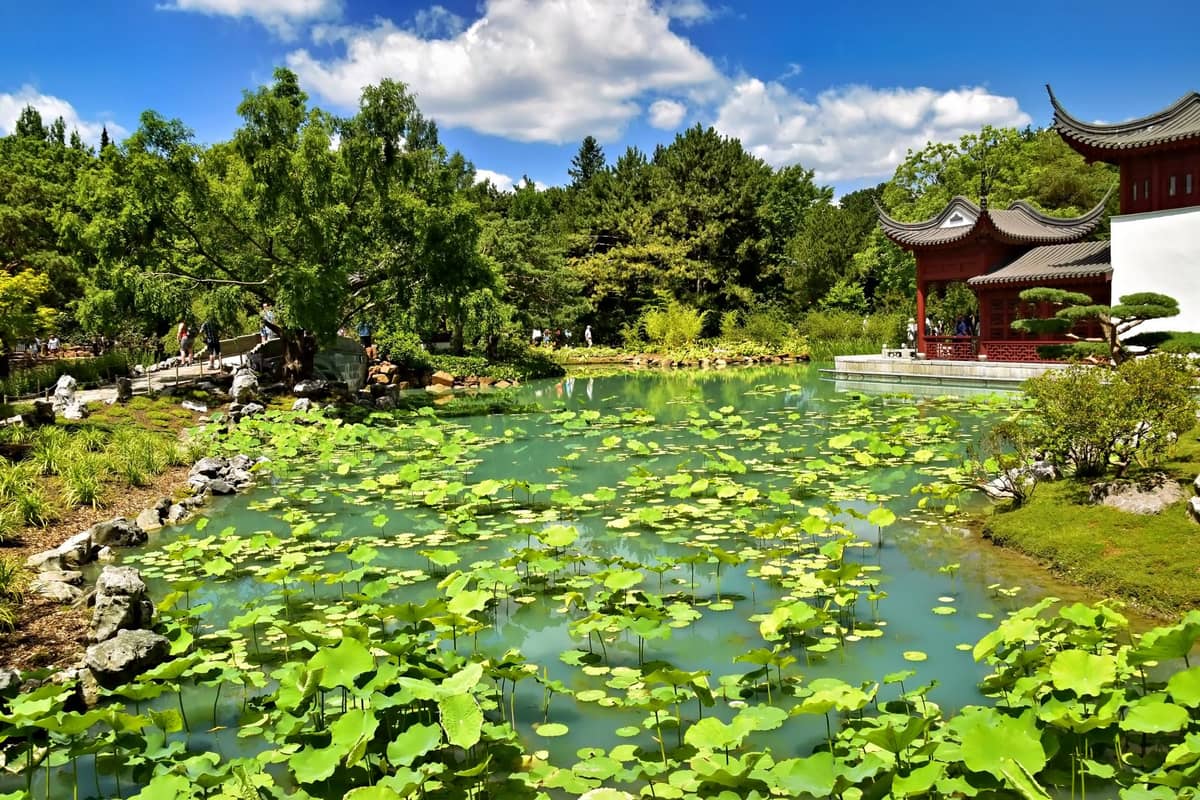
The Chinese Garden, built in 1991 as a joint project between Montreal and Shanghai, is among the largest of its kind outside of Asia. Its pavilions, moon gates, and scholar's rocks are arranged according to Ming dynasty garden principles: the view is meant to shift with every step, revealing a new framing of water, stone, and plant. In late September and October, the garden hosts the famous Gardens of Light festival, when hundreds of silk lanterns illuminate the paths after dark. The crowd thins noticeably after the first hour of opening on weekday mornings; by Saturday afternoon in October, lines can stretch back toward the ticket gates.
The Japanese Garden takes a quieter approach. Its raked gravel sections and clipped pine specimens require a slower pace to appreciate, and the traditional pavilion at its centre is a working teahouse used for cultural programming. Early mornings here, when the light is low and the garden is largely empty, produce a quality of stillness that is difficult to find anywhere else in Montreal.
Beyond these two showpieces, the First Nations Garden is worth more time than most visitors give it. The First Nations Garden is worth more time than most visitors give it. It presents plants significant to Indigenous nations of northeastern North America, organized by ecological zone rather than alphabetical taxonomy. Interpretive panels are detailed and avoid the generic framing that weakens many ethnobotanical displays.
Tickets & tours
Hand-picked options from our booking partner. Prices are indicative; availability and final rates are confirmed when you complete your booking.
Montreal evening cruise on the St. Lawrence River
From 54 €Instant confirmationFree cancellation3-hour e-bike guided tour in Montreal
From 68 €Instant confirmationFree cancellationWalking tour of Old Montreal
From 20 €Instant confirmationFree cancellationMontreal helicopter tour
From 156 €Instant confirmationFree cancellation
The Greenhouses: A Garden That Works Year-Round
Montreal winters are long and cold, with average daily temperatures well below freezing from December through February. The Botanical Garden's ten indoor greenhouses make it one of the few large outdoor attractions that genuinely justifies a visit in the depths of winter. The Tropical Rainforest greenhouse is warm and humid even on the coldest days, filled with the smell of wet earth and the drip of condensation from broad-leafed canopy plants. After walking in from minus-fifteen, the shift in temperature is immediate and physical.
The Orchid collection, housed in a dedicated greenhouse, peaks in late winter and early spring when most of the outdoor gardens are dormant. The succulent and cactus greenhouse holds specimens that have been growing in place for decades, some reaching dimensions that make the usual houseplant versions look trivial. Winter visiting hours may differ from summer schedules, so confirm the current timetable before making the trip.
ℹ️ Good to know
During high season, outdoor-garden access for Accès Montréal cardholders is free and runs 9:00 a.m.–6:00 p.m. from May 1, and 9:00 a.m.–5:00 p.m. from August 30 to October 31. Seasonal hours vary; check the official site before visiting.
When to Visit: Season by Season
Spring arrival, typically late April to mid-May, brings the flowering cherry and crabapple trees near the Japanese Garden into bloom. The effect is brief, often lasting only ten days to two weeks depending on the year's temperatures, but the density of blossoms against the garden's wooden structures is striking. This period coincides with rising visitor numbers, though crowds are still manageable compared to midsummer.
Summer, from June through August, sees the rose garden and the perennial borders at their fullest. The Ballade electric train that circles the outdoor gardens is useful on hot days, though walking the full loop is preferable for anyone wanting to linger. Heat and humidity peak in July, Montreal's warmest month, so an early morning start before 10:00 a.m. makes a real difference in comfort.
Autumn is widely considered the most rewarding season. The Japanese maples turn from mid-September, and the Gardens of Light lantern festival in the Chinese Garden runs evenings from late September through late October. Ticket demand for evening sessions is high; book online well in advance if you want a specific date. Daytime visits in October combine foliage colour with festival installations, making for an unusually photogenic combination.
Winter reduces the outdoor gardens to bare structure and mulched beds, but the greenhouse programme continues. The annual Christmas exhibition in the main exhibition greenhouse typically features tropical plants decorated to highlight their cultural uses across different traditions. It attracts families with young children and tends to sell out weekend slots.
⚠️ What to skip
The Gardens of Light evening festival in autumn is one of Montreal's most popular ticketed events. Do not show up without a reservation on weekends in October — sellouts are common and walk-up entry is not guaranteed.
Getting There and Getting Around
The most straightforward route from downtown is the Metro Green Line (Line 1) to Pie-IX station. From the station exit, the garden's main entrance on rue Sherbrooke Est is a short walk east. STM buses 185 (Sherbrooke) and 139 (Pie-IX) also serve the area and provide useful connections from neighborhoods not directly on the Green Line.
Cycling is a practical option in warmer months. The garden sits near several of Montreal's cycling corridors, and the Lachine Canal cycling path is within reach by bike from the city centre. Montreal's BIXI bike-share network has docking stations near the garden entrance.
Parking is available on site for visitors arriving by car, though it fills quickly on festival weekends and sunny summer Saturdays. Transit is the more reliable option on peak days. The garden is fully stroller-accessible, and wheelchairs and strollers can be borrowed at no charge subject to availability. One companion per visitor with a disability is admitted free.
Photography, Practical Details, and Who Should Think Twice
Photography is permitted throughout the garden for personal and non-commercial use. The Japanese Garden rewards a wide-angle lens for its landscape views and a macro for the moss and stone details. The Chinese Garden during the lantern festival is almost exclusively a night-photography context: bring a fast prime lens or accept that phone cameras will struggle with moving lanterns in low light. The greenhouse windows require patience with reflections; a circular polarising filter eliminates most of the problem.
Food options inside the garden are seasonal. A café operates during peak months, but it closes in lower-traffic periods. Bringing your own water and snacks is advisable for longer visits or off-season outings. There are picnic areas in the outdoor sections.
Visitors focused purely on Montreal's historical core may find the journey east of downtown less compelling if their time is limited. In that case, the Mount Royal Park or the museums along Sherbrooke Ouest offer nature and culture without leaving the central districts. The Botanical Garden, however, is not replicated elsewhere in the city: nothing in Montreal's centre comes close to this scale or botanical depth.
Visitors with very limited mobility should note that the full outdoor circuit covers several kilometres of paths, some of which are gravel or have gentle slopes. The Ballade train covers a portion of the outdoor route and provides a seated alternative. The greenhouses are all fully accessible.
For a broader look at what the Olympic Park precinct offers, the Olympic Stadium and its observation tower are immediately adjacent. The combined site is worth planning as a half-day or full-day excursion rather than a brief stop. See our three-day Montreal itinerary for one approach to combining these attractions.
Insider Tips
- Weekday mornings before 10:30 a.m. in the Chinese Garden are noticeably quieter than afternoons, and the light is better for photography with the sun still at a low angle from the east.
- The First Nations Garden has its own interpretive trail map available at the entrance kiosk — pick one up before entering rather than relying on in-garden signage alone.
- The Ballade electric train is included in admission, not separately ticketed. In summer heat, it is useful for getting from the main entrance greenhouses to the far end of the Japanese Garden without a 20-minute walk in the sun.
- For the Gardens of Light festival, the Tuesday-to-Thursday evening sessions typically have 30–40% fewer visitors than Friday-to-Sunday, with no difference in the installations themselves.
- Lockers are available near the main entrance for a small deposit. Bringing a backpack into the greenhouses in summer is uncomfortable because of the heat and humidity — leave coats and bags at the lockers before entering the tropical section.
Who Is Montreal Botanical Garden For?
- Families with children looking for a full half-day outdoors without a specific agenda
- Photographers, particularly during autumn foliage and the evening lantern festival
- Garden and horticulture enthusiasts who want serious botanical depth beyond a decorative park
- Winter visitors looking for green, living spaces during Montreal's coldest months
- Travellers combining the Botanical Garden with the Biodôme and Insectarium into a science-and-nature day
Nearby Attractions
Other things to see while in Olympic Park:
- Biodôme
The Biodôme is one of Montreal's most unusual attractions: a former Olympic velodrome converted into a living natural science museum where you walk through a tropical rainforest, a St. Lawrence marine ecosystem, a sub-polar environment, and a maple forest without stepping outside. It rewards curiosity at any age, but it helps to know what you're walking into.
- Château Dufresne
Built between 1915 and 1918 for two brothers at the peak of their industrial fortunes, Château Dufresne is a rare double mansion frozen in early 20th-century Montreal opulence. The interiors survive in remarkable condition, making it one of the city's most undervisited architectural treasures.
- Insectarium
The Montréal Insectarium is one of North America's most ambitious insect museums, housed in a striking new building that opened in 2022. With immersive galleries, living collections, and exhibits designed for curiosity rather than squeamishness, it rewards visitors of all ages who are willing to look closely at the world's most overlooked creatures.
- Montreal Tower
The Montreal Tower (Tour de Montréal) is the world's tallest inclined tower above the Olympic Stadium complex. Currently closed for major renovations, it is scheduled to reopen in spring 2027 with what promises to be an updated observation experience.