Lachine Canal: Montreal's Waterfront Path Through Industrial History
The Lachine Canal National Historic Site stretches 14.5 km from Montreal's Old Port to the historic town of Lachine, tracing a corridor that once powered Canada's industrial revolution. Today the canal is free to visit, open daily from sunrise to 11 p.m., and best explored on foot or by bicycle along its well-maintained waterfront path.
Quick Facts
- Location
- Old Port to Lachine, Montreal, QC — canal path starts at Lock No. 1 in the Old Port
- Getting There
- Closest metro stations: Square-Victoria–OACI or Lionel-Groulx (Orange/Green lines). Car parking available at Peel Basin on Mill Street beneath the Bonaventure Autoroute (paid lot).
- Time Needed
- 1–2 hours for a partial walk; 3–4 hours to cycle the full 14.5 km length and back
- Cost
- Free for walking and cycling. Boating fees apply: single lock C$1.50; one-day full transit C$2.25; seasonal non-motorized watercraft permit C$25.00 (prices listed as of September 8, 2026 — verify with Parks Canada before visiting)
- Best for
- Cyclists, joggers, history enthusiasts, families, picnickers
- Official website
- parks.canada.ca/lhn-nhs/qc/canallachine
What the Lachine Canal Actually Is
The Lachine Canal National Historic Site is a 14.5-kilometre waterway that begins at Lock No. 1 in Montreal's Old Port and ends at Lock No. 5 in Lachine, on the southwestern tip of the island. Parks Canada manages the site, and walking or cycling the canal path costs nothing. The canal is open daily from sunrise to 11 p.m., with the maintained path accessible from April 15 to November 15 and the navigation season running roughly mid-May to mid-October.
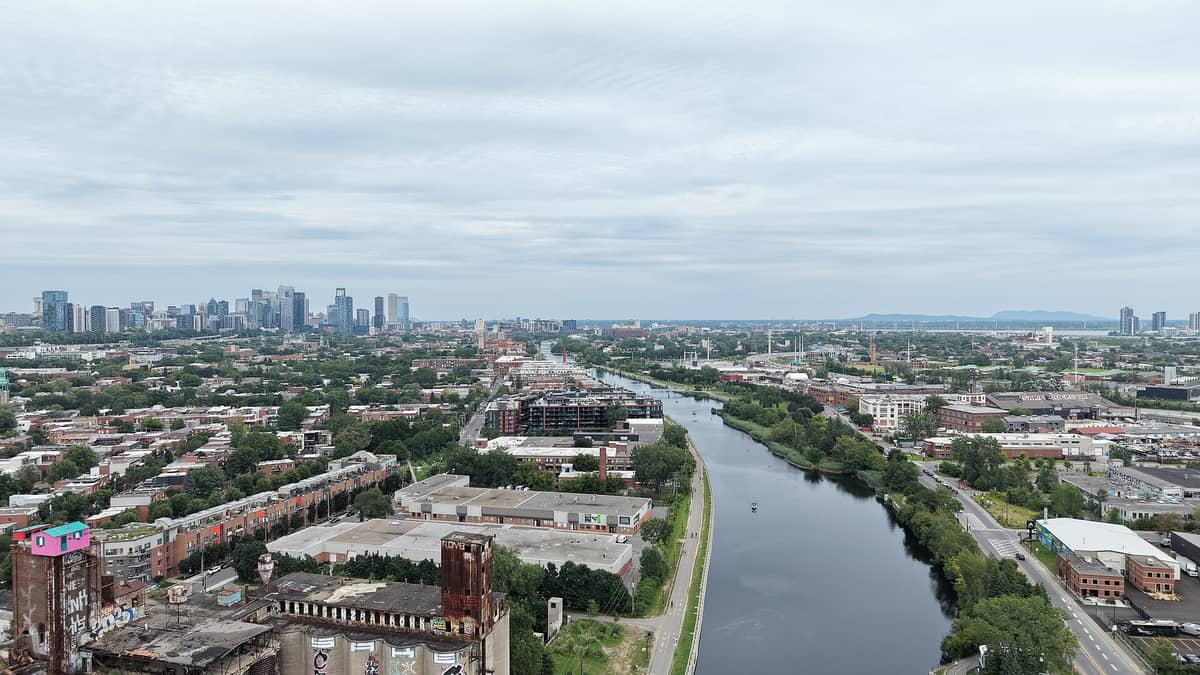
The canal itself is calm and narrow, flanked on both sides by a flat, paved multi-use path. What you experience depends almost entirely on how far along the canal you travel: the Old Port end is more polished and tourist-facing, the middle stretch passes through converted industrial buildings and newer residential developments in Griffintown, and the outer sections near Lachine grow quieter, greener, and more residential in character.
💡 Local tip
If you only have two hours, walk or cycle from Lock No. 1 to the Atwater Market and back. That stretch covers roughly 3 km each way, includes the most photogenic lock scenery, and ends with one of the best food markets in the city — a natural turnaround point.
A Canal That Built a Country (Then Was Forgotten)
The Lachine Canal was inaugurated in 1825, making it one of Canada's earliest major engineering projects. Its purpose was practical and urgent: the Lachine Rapids just upstream made the St. Lawrence River impassable for commercial vessels. The canal created a navigable bypass, allowing goods to move between the Great Lakes and the Atlantic coast without the dangerous portage around the rapids.
The effect on Montreal was transformational. Mills, foundries, and factories lined the canal banks throughout the 19th century, making this corridor the engine of Canadian industrial output. The canal was deepened and widened multiple times to accommodate larger vessels. By the early 20th century, it was one of the most heavily trafficked waterways in North America.
The canal closed to commercial navigation in 1970 after the St. Lawrence Seaway made it redundant. For more than a decade it sat largely abandoned, the surrounding factories idle and the water polluted. Parks Canada began restoration in the 1990s, and the canal reopened to recreational watercraft in 2002. The designation as a National Historic Site acknowledges both its engineering significance and its role in shaping Montreal's working-class heritage.
Tickets & tours
Hand-picked options from our booking partner. Prices are indicative; availability and final rates are confirmed when you complete your booking.
Montreal Canadiens ice hockey game tickets at Bell Center
From 48 €Instant confirmationMontreal evening cruise on the St. Lawrence River
From 54 €Instant confirmationFree cancellation3-hour e-bike guided tour in Montreal
From 68 €Instant confirmationFree cancellationWalking tour of Old Montreal
From 20 €Instant confirmationFree cancellation
Walking the Canal: What You'll Actually See
The path is paved and flat for its entire length, which makes it accessible to most visitors regardless of fitness level. The surface is shared between pedestrians and cyclists, so expect faster-moving bike traffic, especially on weekends between May and September. Keep to the right and look both ways before stepping off the path.
Starting from the Old Port end, the first thing you notice is the water itself: dark greenish, slow-moving, reflecting the old stone lock infrastructure and the underside of footbridges. The locks are functional, not decorative. During navigation season you may see leisure boats waiting to pass through, the lock gates closing with a low mechanical groan as water levels equalize. It takes about 20 minutes per boat, and watching the process once is genuinely interesting — a piece of working engineering that has changed very little in principle since 1825.
Moving southwest, the path passes through what is now Griffintown, a former industrial district undergoing significant redevelopment. Here the canal banks alternate between restored red-brick mill buildings converted into condominiums and glass-and-steel residential towers. The contrast is stark and worth pausing to observe. Old loading docks still project into the water in places, their iron rings rusted but intact.
Around the midpoint of the route, the Atwater Market sits directly on the canal's north bank. The market building dates from 1933 and is worth a stop regardless of appetite — the produce stalls, butchers, and cheese vendors make it one of the better food stops on any walking route in Montreal. In summer, vendors spill out onto the terrasse beside the water.
Beyond Atwater, the path grows noticeably quieter. Warehouses give way to parks and low-rise neighbourhoods. The water widens slightly and the reflections on the surface change with the light. By the time you reach the Lachine end, the industrial atmosphere has dissolved entirely into something closer to a lakeside promenade. Lac Saint-Louis opens up ahead — the terminus of the canal — and on clear days the view across the water is long and uninterrupted.
How the Canal Changes by Time of Day
Early mornings, especially on weekdays, are the quietest the canal path gets. Between 7 and 9 a.m. you share the path mostly with commuter cyclists and joggers. The light at that hour hits the water at a low angle and the stone lock structures take on a warm tone that disappears once the sun climbs. If photography is a priority, early morning is the answer.
Midday on weekends from June through August is peak congestion. Rental cyclists, families with strollers, rollerbladers, and tourists all converge on the same path. It remains pleasant, but the contemplative quality is largely gone. If you are cycling the full length, starting before 10 a.m. or after 4 p.m. avoids the worst of it.
Late afternoon and evening bring a different atmosphere entirely. Montrealers use the canal banks as an outdoor living room in summer: groups spread out on the grass, small speakers play music at low volume, people fish from the banks. The path stays open until 11 p.m., and the hour before sunset produces some of the softer, more atmospheric light along the water. Bring a layer if you're staying past 8 p.m., as the canal corridor tends to hold cool air from the water.
⚠️ What to skip
The canal path is not maintained through winter. From mid-November to mid-April, sections may be snow-covered, icy, or closed for maintenance. Do not assume the full path is accessible outside the April 15 to November 15 window.
Getting There and Cycling Options
The canal's eastern entrance at Lock No. 1 is a short walk from the Old Port and accessible on foot from the Square-Victoria–OACI or Lionel-Groulx metro stations. For full route details on Montreal's transit network, the STM operates the metro and bus services across the island — see the guide to getting around Montreal for practical transit advice.
Cycling is by far the most efficient way to experience the full canal. Bike rental is available in the Old Port area from multiple operators, including Montreal's BIXI bike-share network, which has docking stations near the canal entrance. BIXI works well for casual riders doing the first few kilometres, but for the full 14.5 km the fixed 45-minute BIXI window is limiting unless you upgrade to a longer rental. Dedicated bike rental shops in the Old Port offer hourly and half-day options, which provide more flexibility.
Car access is limited and not recommended if you are doing the path end-to-end. The only paid parking lot managed by Parks Canada is at the Peel Basin on Mill Street, beneath the Bonaventure Autoroute. Street parking near the canal is limited and subject to Montreal's neighbourhood parking regulations, which vary by block.
ℹ️ Good to know
Accessibility note: The paved canal path is flat and continuous, making it suitable for wheelchairs and mobility aids for most of its length. Seasonal facilities including restrooms are available at specific points along the route during operating hours only. Check Parks Canada's website for current facility locations before visiting.
Honest Assessment: Who This Is For and Who Might Be Disappointed
The Lachine Canal delivers something specific: a long, linear outdoor route with industrial heritage framing and genuine water views. It rewards people who enjoy slow, purposeful movement through a city, whether on foot or by bike. It pairs naturally with a visit to the Old Port or a stop at the Atwater Market, and it fits comfortably into a broader exploration of Montreal's cycling network, which extends well beyond the canal itself.
That said, the canal is not a condensed highlight reel. There is no single dramatic moment, no landmark that makes the visit feel complete in 20 minutes. Visitors expecting a quick scenic stop may find the canal path underwhelming without the context of a longer walk or ride. The industrial remnants along the route are interesting if you engage with them, but they require some imagination — most of the original factories are either demolished or converted beyond recognition.
Visitors with very limited time in Montreal who are weighing major landmarks against outdoor routes should consider the canal as a complement to, not a replacement for, sites like the Notre-Dame Basilica or Pointe-à-Callière Museum. The canal works best as part of a half-day itinerary rather than a standalone destination.
People who dislike unshaded paths should know that sun exposure on the canal is significant in summer, especially between 10 a.m. and 3 p.m. Tree cover is sparse for long stretches. Sunscreen, water, and a hat are practical necessities, not optional accessories, on a full-length summer ride.
Insider Tips
- The lock closest to the Old Port is the most photogenic and also the easiest to watch in action during navigation season. Arrive just before a boat is scheduled to pass through and you will have a front-row view of the locking process — ask the lock operator when the next boat is expected.
- Cycling to the Lachine end takes you directly to the edge of Lac Saint-Louis. Most visitors turn around before reaching it, but if you arrive at the lake on a clear afternoon, the open water view is a distinct reward for completing the route.
- The Atwater Market is a legitimate reason to plan your route around it. Arrive between 10 a.m. and noon to find the full selection of vendors open before the lunchtime rush thins the displays.
- On summer weekends, the grassy banks between the locks near the Old Port fill with locals in the late afternoon. Bringing a blanket and joining them — rather than treating the canal as a throughway — gives you a more accurate sense of how Montrealers actually use the space.
- The canal path connects directly to other cycling routes on the island. If you bring your own bike or rent for a full day, the canal can serve as a spine from which to branch into surrounding neighbourhoods rather than simply an out-and-back route.
Who Is Lachine Canal For?
- Cyclists who want a flat, clearly marked urban route with food stops en route
- Visitors interested in Canadian industrial and engineering history in an accessible outdoor format
- Families with children in strollers or on small bikes, given the flat paved surface
- Photographers working with early morning light and water reflections
- Travellers combining an Old Port visit with a half-day outdoor itinerary
Nearby Attractions
Other things to see while in Old Port of Montreal:
- Atwater Market
Open since 1933 in a landmark Art Deco building, Atwater Market is where Montreal's serious food culture lives. From Quebec cheeses and heritage-breed butchers to seasonal produce and local bakeries, it rewards both quick stops and slow morning visits. Free to enter, easy to reach by metro, and positioned at the edge of the Lachine Canal, it belongs on almost any Montreal itinerary.
- Clock Tower
Standing at the eastern tip of the Old Port, the Montreal Clock Tower is an emblematic monument that has stood at the end of Clock Tower Quay since 1922.
- Grande Roue de Montréal
La Grande Roue de Montréal is a 60-metre (200-foot) observation wheel on the Old Port waterfront, offering rotating views of the Saint Lawrence River, Old Montreal's historic skyline, and Mount Royal. Here is what the experience actually delivers, when to go, and whether the ticket price is justified.
- Habitat 67
Designed by Moshe Safdie for Expo 67, Habitat 67 is a stacked concrete puzzle of 354 prefabricated modules that has fascinated architects and tourists alike for nearly six decades. Guided tours run seasonally through November, offering rare access to the interior of this private residential complex on the Saint Lawrence waterfront.