Habitat 67: Montreal's Most Radical Building, Explained
Designed by Moshe Safdie for Expo 67, Habitat 67 is a stacked concrete puzzle of 354 prefabricated modules that has fascinated architects and tourists alike for nearly six decades. Guided tours run seasonally through November, offering rare access to the interior of this private residential complex on the Saint Lawrence waterfront.
Quick Facts
- Location
- 2600 Pierre-Dupuy Avenue, Cité-du-Havre, near the Concorde Bridge
- Getting There
- No direct metro stop; take bus or taxi from Old Port. Tour meeting point is the main entrance near the Concorde Bridge.
- Time Needed
- Allow 1.5 to 2 hours including travel from Old Montreal
- Cost
- CAD $58 per adult (2026, taxes included). Children under 12 free with a parent or guardian. Advance booking required online — no on-site ticket sales.
- Best for
- Architecture enthusiasts, design students, photographers, and anyone curious about utopian urban planning
- Official website
- www.habitat67.com
What Habitat 67 Actually Is
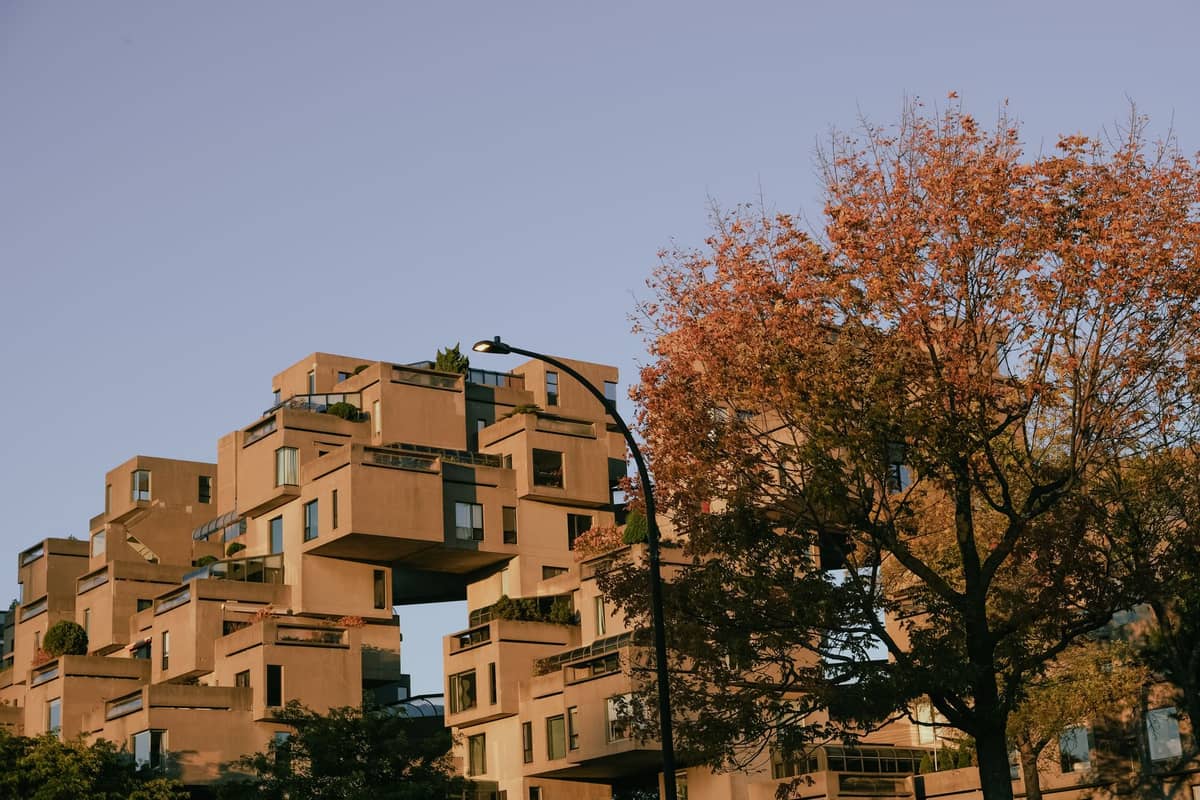
Habitat 67 is a privately owned residential complex on the Cité-du-Havre peninsula, overlooking the Saint Lawrence River and the Montreal skyline. It was designed by Israeli-Canadian architect Moshe Safdie and built between 1964 and 1967 as his master's thesis project at McGill University, then realized at full scale for Expo 67. The building consists of 354 prefabricated concrete modules stacked and interconnected in a configuration that gives each unit its own private rooftop terrace, borrowed from the module below. People still live here. That is the detail that tends to stop visitors short.
The complex covers approximately 22,160 square metres and contains 146 residential units of varying sizes, ranging from one to eight modules each. The staggered, pyramid-like silhouette is unlike anything else in Montreal's skyline and unlike almost anything built anywhere in the world at that scale. It was a serious attempt to prove that high-density urban housing could feel like a private home with outdoor space, natural light, and cross-ventilation — the kinds of qualities usually reserved for low-rise suburban development.
ℹ️ Good to know
Habitat 67 is a working residential building, not a museum. The only official way inside is through a scheduled guided tour, which runs seasonally through November. Tickets are CAD $58 per adult (2026 price, taxes included) and must be booked in advance at habitat67.com. Tickets are not sold at the door.
The Architecture: What Safdie Was Actually Trying to Do
Safdie's central argument was spatial and social. Mid-century apartment towers were efficient but they sacrificed the things that make urban life tolerable: private outdoor space, varying sightlines, the feeling of inhabiting rather than stacking. His solution was modular prefabrication. Each concrete box was cast off-site to identical dimensions, then craned into position and post-tensioned together. The result is a building that reads as chaotic from a distance but is rigidly geometric up close.
The rooftop terraces are the structural key to the whole system. Because each unit steps back from the one below, the roof of your neighbor's apartment becomes your garden. The modules are oriented to maximize views across the river and minimize direct overlooking between units. Safdie achieved genuine privacy in a building where 146 families share walls, floors, and ceilings with multiple neighbors.
The building's influence on architectural theory has been significant, even though the economic model never scaled as Safdie intended. The prefabrication costs turned out to be far higher per unit than conventional construction at that time, which is why no direct successor was ever built. You can read more about how Habitat 67 fits into Montreal's broader built environment in the Montreal architecture guide.
Tickets & tours
Hand-picked options from our booking partner. Prices are indicative; availability and final rates are confirmed when you complete your booking.
Montreal evening cruise on the St. Lawrence River
From 54 €Instant confirmationFree cancellation3-hour e-bike guided tour in Montreal
From 68 €Instant confirmationFree cancellationWalking tour of Old Montreal
From 20 €Instant confirmationFree cancellationMontreal helicopter tour
From 156 €Instant confirmationFree cancellation
The Guided Tour: What to Expect Inside
Tours depart from the main entrance at 2600 Pierre-Dupuy Avenue, near the Concorde Bridge. The tour involves moving through the building's network of pedestrian streets — indoor corridors and open-air walkways suspended several storeys above ground — that Safdie called 'streets in the sky.' These circulation routes connect the modules and were intended to recreate the social logic of a traditional urban street within a vertical structure.
During the tour, guides explain the structural system, the history of the building's construction and its reception at Expo 67, and the ways residents have adapted their units over the decades. The exposed concrete surfaces are everywhere: raw, textured, slightly rough to the touch, with the bolt holes from formwork still visible. The scale is surprisingly human. Individual units are not enormous, but the terraces, the varying ceiling heights, and the irregular plan shapes make them feel less constricted than equivalent square footage in a conventional apartment.
⚠️ What to skip
The tour is not accessible to visitors with limited mobility. The route involves multiple staircases in both directions, with no lift access between levels. There are also no public washrooms inside Habitat 67 itself. The nearest facilities are at Dieppe Park, approximately 450 metres from the entrance. Plan accordingly.
Children under 12 can join the tour free with a paying parent or legal guardian, but a free ticket still needs to be reserved in advance through the website. The tour covers a fair amount of ground and involves some physically demanding stair sections, so it is worth considering whether young children in the group will manage comfortably.
Viewing the Building Without a Tour
If a guided tour does not fit your schedule or budget, Habitat 67 is still worth a visit from the outside. The building is visible from several points around the Old Port and the Saint Lawrence River, and the perspective shifts dramatically depending on where you stand.
From the Concorde Bridge, you can walk along the sidewalk beside the building and look directly up into the stacked modules and overhanging terraces. This is the closest external view available to the public and where the building's structural logic becomes most legible. The concrete surfaces up close show their age without apology: staining, moss in the joints, satellite dishes and plant pots on the terraces. It looks like a place people live in, which is the point.
The building also reads well from across the river, and from the Clock Tower area in the Old Port. From a distance, the modules stack and cascade toward the water in a way that resembles a Cubist painting more than a housing block. Early morning light hits the west-facing facades directly; evening light from the east gives the terraces longer shadows and more texture. Either moment is better for photography than midday.
Getting There and When to Go
Cité-du-Havre is a peninsula connected to the mainland by the Concorde Bridge, and it sits between the Old Port and the Île Notre-Dame. It is not served directly by the Montreal metro. The most practical approach for most visitors is by taxi or ride-hailing app from Old Montreal, which takes under ten minutes. Some visitors walk from the Old Port along the waterfront path, which adds roughly 20 to 30 minutes each way but gives a continuous riverfront view of the building as you approach.
Tours run from May through November. The summer months bring warm weather and the open terraces are at their most photogenic with greenery on them, but tour groups tend to be larger. September and October offer cooler temperatures, smaller groups, and arguably better light for photography. If you are combining the visit with other Old Port sites, the Grande Roue de Montréal observation wheel and the Montreal Science Centre are both within walking distance of the Old Port departure point.
💡 Local tip
Book your tour well in advance, especially for July and August. Tour capacity is limited and popular dates sell out. Check habitat67.com directly for the current schedule and availability.
Who Might Not Enjoy This
Habitat 67 is a specific kind of attraction. If architecture is not your primary interest, the guided tour may feel long for what you get to see. The building's interiors are not staged for visitors: this is not a museum with exhibits or a restored period property. What you are getting is access to a living building, an explanation of an architectural idea, and views from unusual vantage points. That is genuinely compelling if the subject interests you. It is less obviously entertaining if it does not.
Visitors who have difficulty with stairs should not attempt the tour. The route is explicitly described by the building as inaccessible to people with limited mobility. Anyone expecting a polished, air-conditioned museum experience will find the raw concrete corridors and exposed utilities a surprise. That roughness is part of the building's honesty, but it is worth knowing in advance.
Insider Tips
- Walk along the Concorde Bridge sidewalk before or after your tour. The view looking directly up into the stacked modules from ground level is one of the best angles on the building and costs nothing.
- Photograph the building from the Old Port side in the early morning, before the tour crowds arrive. The building reads most clearly against a clear sky before the midday haze builds up in summer.
- The terraces are planted by individual residents, so the building looks different in spring versus late autumn. If greenery matters to your photography, aim for June through early September.
- Wear comfortable, flat-soled shoes. The tour covers outdoor walkways and staircases in multiple directions, and some surfaces are uneven concrete. Heels or slippery soles are a genuine inconvenience.
- Guided tour groups are capped in size, which means the experience rarely feels crowded inside the building. Weekday tours in May, June, and October tend to have the smallest groups and the most time for questions.
Who Is Habitat 67 For?
- Architecture and design enthusiasts who want to understand one of the twentieth century's most ambitious housing experiments
- Photographers looking for an unusual structural subject with strong geometric lines and changing light
- Travelers combining Old Port sightseeing with a deeper look at Montreal's Expo 67 legacy
- Students of urban planning, engineering, or prefabrication construction
- Couples or solo visitors who want a focused, intellectually engaging two-hour experience rather than a passive attraction
Nearby Attractions
Other things to see while in Old Port of Montreal:
- Atwater Market
Open since 1933 in a landmark Art Deco building, Atwater Market is where Montreal's serious food culture lives. From Quebec cheeses and heritage-breed butchers to seasonal produce and local bakeries, it rewards both quick stops and slow morning visits. Free to enter, easy to reach by metro, and positioned at the edge of the Lachine Canal, it belongs on almost any Montreal itinerary.
- Clock Tower
Standing at the eastern tip of the Old Port, the Montreal Clock Tower is an emblematic monument that has stood at the end of Clock Tower Quay since 1922.
- Grande Roue de Montréal
La Grande Roue de Montréal is a 60-metre (200-foot) observation wheel on the Old Port waterfront, offering rotating views of the Saint Lawrence River, Old Montreal's historic skyline, and Mount Royal. Here is what the experience actually delivers, when to go, and whether the ticket price is justified.
- Lachine Canal
The Lachine Canal National Historic Site stretches 14.5 km from Montreal's Old Port to the historic town of Lachine, tracing a corridor that once powered Canada's industrial revolution. Today the canal is free to visit, open daily from sunrise to 11 p.m., and best explored on foot or by bicycle along its well-maintained waterfront path.