Grande Roue de Montréal: The Old Port Observation Wheel, Honestly Assessed
La Grande Roue de Montréal is a 60-metre (200-foot) observation wheel on the Old Port waterfront, offering rotating views of the Saint Lawrence River, Old Montreal's historic skyline, and Mount Royal. Here is what the experience actually delivers, when to go, and whether the ticket price is justified.
Quick Facts
- Location
- 362 de la Commune Street East, Old Port, Montréal, QC H2Y 0B4
- Getting There
- Champ-de-Mars (Orange Line); paid parking at Quai de l'Horloge
- Time Needed
- 45–75 minutes including queuing and one full rotation
- Cost
- Adults CAD $29.50 | Students CAD $24 | Ages 5–12 CAD $16.50 | Under 5 free (taxes added at checkout; verify before visiting)
- Best for
- Families with children, couples at sunset, first-time visitors wanting a spatial overview of Montreal
- Official website
- lagranderouedemontreal.com
What La Grande Roue de Montréal Actually Is
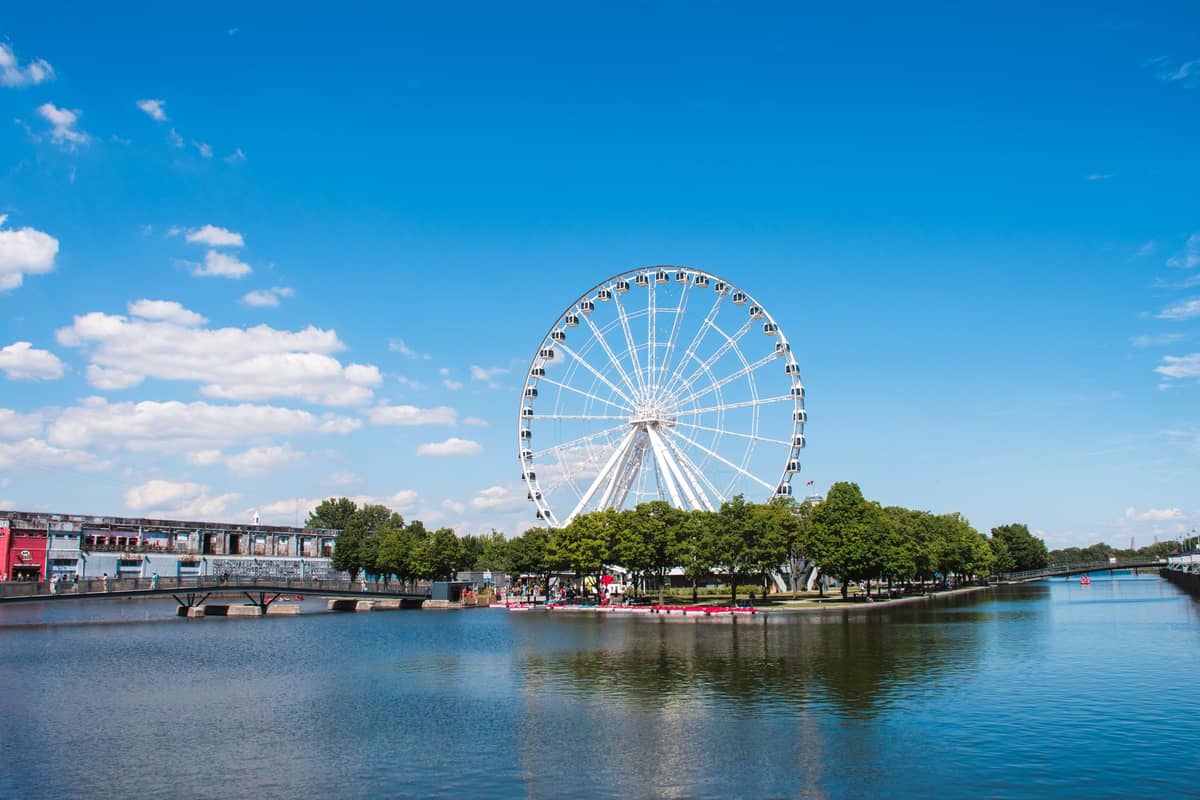
La Grande Roue de Montréal is a permanent, climate-controlled observation wheel that opened in 2017 at the edge of the Old Port's waterfront. Standing approximately 60 metres (200 feet) tall and fitted with 42 enclosed gondola cabins, it is a major observation wheel in Canada. The wheel sits at 362 de la Commune Street East, directly on the Saint Lawrence riverfront, meaning the view from the top is wide and largely unobstructed in three directions. For a city-overview perspective, it delivers more than most ground-level viewpoints in the Old Port.
Each enclosed cabin seats up to eight people and is climate-controlled for year-round comfort. The gondolas rotate continuously, allowing you to enjoy the views and photograph the city from changing perspectives during your visit.
💡 Local tip
Book tickets online in advance, especially on summer weekends and during festival season. Walk-up queues can stretch 30 to 45 minutes on busy evenings, and online booking typically allows you to select a boarding window.
The View: What You Can See and What You Cannot
At the summit, the panorama spans the Saint Lawrence River to the south and east, the dense roofline of Old Montreal's 17th and 18th-century stone buildings to the west, and Mount Royal's wooded ridge to the north. On clear days the Montérégie plain spreads out beyond the South Shore bridges, and the Jacques Cartier Bridge appears as a steel arc cutting across the river. The view is genuinely useful for understanding how the city is organized: you can see at a glance how the old town hugs the river, how the financial towers of downtown step back from the historic core, and how much green space Mount Royal holds.
There are limits. The cabin windows are glass panels framed in metal, which creates reflection challenges for photographers unless the interior is dark relative to the outside. Bring a lens cloth. Condensation can appear in shoulder seasons when temperatures shift. And while the panorama is broad, it is not dramatically elevated the way a rooftop tower would be — 60 metres gives you a meaningful height above the waterfront, but details within Old Montreal are too far below to make out clearly. Think of it as a wide-angle overview, not a zoom lens.
Tickets & tours
Hand-picked options from our booking partner. Prices are indicative; availability and final rates are confirmed when you complete your booking.
Montreal evening cruise on the St. Lawrence River
From 54 €Instant confirmationFree cancellation3-hour e-bike guided tour in Montreal
From 68 €Instant confirmationFree cancellationWalking tour of Old Montreal
From 20 €Instant confirmationFree cancellationMontreal helicopter tour
From 156 €Instant confirmationFree cancellation
How the Experience Changes by Time of Day
Midday rides offer the most visibility in terms of raw clarity, but the light is flat and the Old Port is at its most crowded. The wheel runs from 10:00 a.m. to 11:00 p.m. daily, although hours may vary during holidays and special events, which gives you genuine flexibility. The most consistently rewarding time to ride is the hour before sunset. As the sun drops toward the west, it catches the copper and limestone facades of Old Montreal's buildings at a warm angle, the river surface picks up color, and Mount Royal's cross begins to glow faintly in the distance. The cabin interior is dim enough at this hour that window reflections are manageable.
After dark, the wheel itself is illuminated with LED displays, and the ride becomes more about Montreal's lit skyline than its geography. The city's towers reflect on the river, and Place Jacques-Cartier's terraces are visible below as lit strips of activity. This is the most atmospheric option for couples, though families with young children may find the wait and evening timing less practical.
Winter rides deserve a specific mention. The enclosed, heated cabins make cold-weather riding genuinely comfortable, and the snow-covered riverbanks and ice formations on the Saint Lawrence add a stark beauty that summer riders miss entirely. January and February queues are also shorter. If you are visiting Montreal in winter and looking for a view experience that does not require layering up on an exposed rooftop, this is one of the few options available.
ℹ️ Good to know
Hours are listed as 10:00 a.m. to 11:00 p.m. daily, but may vary on holidays and during major events at the Old Port. Check the official website before visiting, particularly during Montreal's busy summer festival season.
Getting There and Getting On
The closest metro station is Champ-de-Mars on the Orange Line, about a 10-minute walk through Old Montreal to the waterfront. The route takes you past Place Jacques-Cartier and down toward the river, which is a pleasant approach. The Orange Line's Place-d'Armes station is a slightly longer walk but useful if you are coming from downtown. If you are cycling, the Lachine Canal bike path connects to the Old Port waterfront and there are BIXI stations nearby.
Paid parking is available at Quai de l'Horloge, accessible via Quai de l'Horloge Street. Driving to the Old Port on summer weekends is possible but slow — the area draws large crowds for events, festivals, and weekend leisure. Public transit or cycling is reliably faster from most parts of the island.
The boarding area is level and accessible for wheelchairs and strollers. The attraction is explicitly designed to accommodate visitors with reduced mobility, and the cabin entry does not require steps. Accessible washrooms are available on site. The cabins themselves are spacious enough for a wheelchair and accompanying passengers without feeling cramped.
Historical and Urban Context
The Old Port of Montreal was a working commercial port for most of the city's post-colonial history, handling grain, timber, and general cargo along the Saint Lawrence. Its transformation into a public recreational and cultural zone began in the 1990s, and the area has since added cycling paths, outdoor events, the Montreal Science Centre, and a range of seasonal attractions. La Grande Roue de Montréal arrived in 2017 as the most visible addition to the site in years, its steel structure becoming immediately recognizable on the waterfront skyline. It sits near the Clock Tower, another Old Port landmark that you can also climb for a different, more historically layered perspective.
The wheel's positioning along the Saint Lawrence is significant: this river was the arterial route through which French colonial settlers, fur traders, and missionaries first accessed the interior of the continent. Riding the wheel with that in mind reframes the view. The same water you are looking down at from 60 metres was the highway that shaped Montreal's founding. The Pointe-à-Callière Museum, just a short walk west along the waterfront, tells that history in detail and makes for a natural pairing with a wheel visit.
Photography: Getting the Most Out of the Gondola
The glass panels in the cabins are the main obstacle for photographers. Smartphone cameras handle reflections better than DSLRs in some situations because you can press the phone against the glass to eliminate the gap where reflections form. If you are using a mirrorless or DSLR camera, a flexible polarizing filter helps cut glare, though it is not a complete solution. Position yourself on the river-facing side of the cabin during the ascent if the sun is behind you, and shift to the city-facing side as you crest the top.
For wide-angle shots of the full skyline, a focal length between 24mm and 35mm (full-frame equivalent) captures both the river and the city without requiring you to move around the small cabin. At sunset, bracket your exposures — the sky and the buildings below have a significant exposure difference that a single shot may not handle cleanly. Shoot in RAW format if your camera supports it.
Who Should Think Twice
The ticket price (CAD $29.50 for adults) is significant for a 20-minute ride. If you are traveling on a tight budget, the view from the top of Mount Royal's Kondiaronk Belvedere is free and arguably more sweeping, with the full downtown skyline in the foreground. The wheel's view is different in character — lower, closer to the river, and oriented more toward the water — but it is not obviously superior for every traveler.
Visitors with significant fear of heights should know that the slow, enclosed rotation and solid cabin construction makes this gentler than most amusement rides, but the gondola does sway slightly in wind and reaches a height where the people below look genuinely small. If you want a comparison: it is much less intense than most roller coasters, but it is not a flat experience. For free views that still impress, see our guide to the best views in Montreal.
Those visiting primarily to photograph the wheel itself, rather than to ride it, get the best shots from the waterfront boardwalk below, particularly at night when the LED facade is active. You do not need a ticket to appreciate the structure from ground level.
Insider Tips
- The cabin assigned to your group is semi-random, but if you ask nicely at boarding, staff sometimes accommodate requests for a specific side of the wheel at departure — which determines your first view on the ascent.
- On summer evenings during major Old Port events or festivals, the surrounding area fills quickly and transit can slow down. Arrive via metro at Champ-de-Mars rather than driving, and build in extra time for the walk through the crowds.
- Shoulder-season visits (late September through October, and March through April) offer shorter queues, lower ambient noise on the waterfront, and autumn or early spring light that is often softer and more photogenic than midsummer sun.
- The LED display on the wheel's exterior changes patterns and can be seen from the Jacques Cartier Bridge and the South Shore on clear nights. If you want to photograph the wheel lit up from the outside, the boardwalk directly in front of the Bonsecours Market gives a clean sightline.
- Children aged four and under ride free, which makes this genuinely accessible for families with toddlers — the enclosed cabins mean there is no safety barrier anxiety that open-air rides create.
Who Is Grande Roue de Montréal For?
- First-time visitors to Montreal who want a spatial overview of how the city and the river relate to each other
- Families with children who want an activity that is weather-proof, accessible, and manageable for younger kids
- Couples looking for a sunset or evening activity with atmosphere on the Old Port waterfront
- Winter visitors who want a view experience that does not expose them to prolonged cold
- Photographers targeting the combination of the Saint Lawrence River, Old Montreal's roofline, and Mount Royal in a single frame
Nearby Attractions
Other things to see while in Old Port of Montreal:
- Atwater Market
Open since 1933 in a landmark Art Deco building, Atwater Market is where Montreal's serious food culture lives. From Quebec cheeses and heritage-breed butchers to seasonal produce and local bakeries, it rewards both quick stops and slow morning visits. Free to enter, easy to reach by metro, and positioned at the edge of the Lachine Canal, it belongs on almost any Montreal itinerary.
- Clock Tower
Standing at the eastern tip of the Old Port, the Montreal Clock Tower is an emblematic monument that has stood at the end of Clock Tower Quay since 1922.
- Habitat 67
Designed by Moshe Safdie for Expo 67, Habitat 67 is a stacked concrete puzzle of 354 prefabricated modules that has fascinated architects and tourists alike for nearly six decades. Guided tours run seasonally through November, offering rare access to the interior of this private residential complex on the Saint Lawrence waterfront.
- Lachine Canal
The Lachine Canal National Historic Site stretches 14.5 km from Montreal's Old Port to the historic town of Lachine, tracing a corridor that once powered Canada's industrial revolution. Today the canal is free to visit, open daily from sunrise to 11 p.m., and best explored on foot or by bicycle along its well-maintained waterfront path.