Olympic Stadium Montreal: The Colossus of the East End
Built for the 1976 Summer Olympics, Montreal's Olympic Stadium is one of the most architecturally audacious structures in North America. Whether you're drawn by the engineering spectacle, the adjoining Montreal Tower, or the broader Olympic Park campus, knowing what to expect will help you make the most of the visit.
Quick Facts
- Location
- 4545 avenue Pierre-De Coubertin, Montreal, QC H1V 0B2
- Getting There
- Viau station, Blue Line (STM Metro)
- Time Needed
- 1.5 to 3 hours for the stadium and tower; half a day if combining with Biodome and Botanical Garden
- Cost
- No general admission to the stadium itself; event tickets and guided-visit fees vary. Check parcolympique.qc.ca for current pricing before visiting.
- Best for
- Architecture lovers, sports history fans, families, photographers seeking panoramic views
- Official website
- parcolympique.qc.ca/en
What You're Actually Looking At
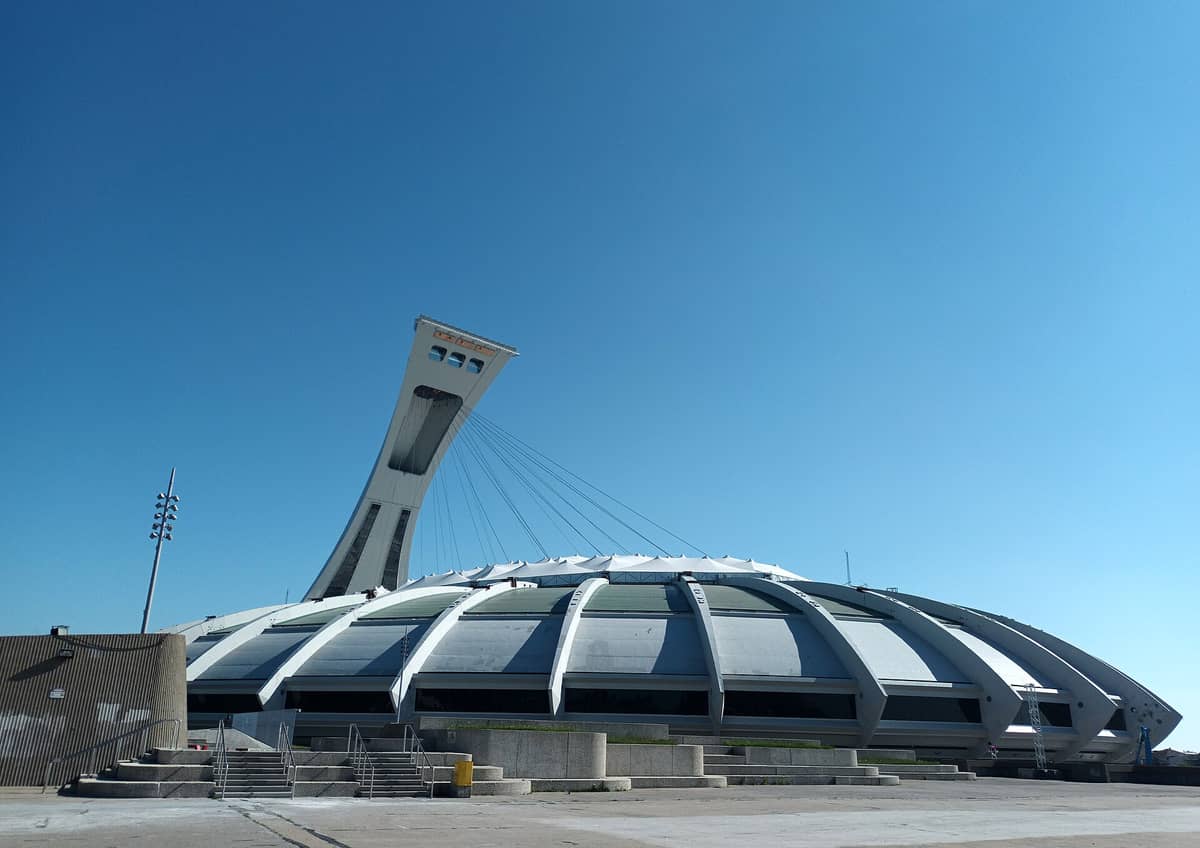
Olympic Stadium — the Stade olympique in French — is the physical centerpiece of Montreal's Olympic Park, a campus of facilities purpose-built for the 1976 Summer Olympics. The stadium's elliptical concrete shell stretches approximately 284 metres long, with its technical ring's major ellipse measuring about 175 metres across. Its most striking feature is the Montreal Tower, an inclined concrete tower that leans at a 45-degree angle and reaches 165 metres at its highest point, making it the tallest inclined tower in the world. From a distance, the whole complex reads as one unified object rather than a collection of buildings.
The design came from French architect Roger Taillibert, whose vision was organic, almost skeletal: the ribbed concrete forms were meant to suggest bones or a living structure. Whether you find it beautiful or brutal, it is unmistakably distinct. There is nothing else like it in Canada, and very little like it anywhere.
ℹ️ Good to know
The stadium's interior height at the covered centre reaches 61 metres of clear space. When the retractable roof is installed, the scale is difficult to fully register until you're standing on the playing surface looking up.
How It Feels to Arrive
Viau metro station on the Blue Line deposits you on the Esplanade Viau, the wide pedestrian approach that faces the stadium's main facade. The walk from the metro exit is short, and the scale of the building registers almost immediately. On weekday mornings, the esplanade is quiet enough that you can study the exterior without distraction. Pigeons, the occasional jogger, a few families consulting the campus map. The concrete looks weathered in places but the bones of the structure feel permanent.
On event days, the tone shifts entirely. The esplanade fills with food trucks, banners, and crowds moving in waves toward the gates. The stadium holds tens of thousands of people and the acoustics of that concrete bowl, when full, are unlike anything in Montreal's more intimate venues. If you're visiting for a concert or a sporting event, arrive early enough to walk the concourse and appreciate the structure rather than just finding your seat.
Winter visits are underrated. The surrounding Olympic Park grounds are emptier, the tower reads sharply against grey sky, and the Biodome next door becomes particularly appealing as a warm counterpoint. Cold weather sharpens the geometry of the place.
Tickets & tours
Hand-picked options from our booking partner. Prices are indicative; availability and final rates are confirmed when you complete your booking.
Montreal evening cruise on the St. Lawrence River
From 54 €Instant confirmationFree cancellation3-hour e-bike guided tour in Montreal
From 68 €Instant confirmationFree cancellationWalking tour of Old Montreal
From 20 €Instant confirmationFree cancellationMontreal helicopter tour
From 156 €Instant confirmationFree cancellation
The Montreal Tower: The Real Reason to Come on a Clear Day
The Montreal Tower observation deck is currently unavailable while the tower undergoes renovation; check Olympic Park announcements for its planned reopening and future access arrangements.
The views are expansive rather than intimate. You are looking at Montreal from the east end, which means the city's downtown skyline appears at a distance to the west, with Mount Royal visible behind it. On the clearest days in autumn, this perspective is genuinely striking. If panoramic views are a priority, comparing it with Kondiaronk Belvedere on Mount Royal is useful: the Belvedere sits lower but places you directly above downtown, while the Tower offers more geographic breadth.
💡 Local tip
Check the weather before committing to a tower visit. Overcast days with low cloud dramatically reduce visibility from the observation level. A clear autumn day will give you far more than a hazy July afternoon.
History and the Weight of 1976
The 1976 Montreal Olympics were supposed to be a triumph of civic ambition. They became famous instead for cost overruns so severe that the remaining construction debt was not resolved until 2006. Construction on the tower and retractable roof was not even complete by the time the Games opened. The roof, a Kevlar structure, was never fully functional and was eventually replaced. The stadium itself hosted athletics, football, equestrian team-jumping finals, and the opening and closing ceremonies.
The complex became home to the Montreal Expos baseball team, who played there from 1977 until the franchise relocated to Washington in 2004. The absence of the Expos left an obvious gap in the stadium's identity, and for a period the facility struggled to find its footing as primarily a concert and event venue. That transitional awkwardness is part of the honest story of the place.
The broader Olympic Park campus gives the history real texture. The Biodome occupies the former Olympic velodrome, converted in 1992 into an ecological museum. The Rio Tinto Alcan Planetarium and the Montreal Botanical Garden are a short walk away, making this corner of the city far richer than a visit to the stadium alone would suggest.
Practical Walkthrough: What to Do Without an Event
Visitors arriving outside an event need a plan. The stadium interior is not a permanent open-access attraction. Guided visits have been offered in past seasons, allowing access to the playing field and interior spaces; these are ticketed separately and run on scheduled times. Confirm current guided-visit availability and hours directly with the Olympic Park before making this the sole purpose of a trip.
The Montreal Tower funicular and observation deck are currently unavailable during renovation; check the official Olympic Park website for reopening information and future ticket prices and hours. Accessibility information should likewise be confirmed for the reopened facility.
- Check parcolympique.qc.ca for current guided-visit schedules and the Montreal Tower's reopening information before your visit
- When the tower reopens, allow about 45 minutes for the observatory experience, plus any queueing time
- Combine with the Biodome on the same visit — both are on the Olympic Park campus
- Parking is available on-site but Viau metro is the most straightforward approach
- Photography is generally permitted in public areas; confirm restrictions for any specific ticketed event
Who This Suits and Who Should Skip It
Architecture enthusiasts and anyone drawn to 20th-century infrastructure at scale will find genuine material here. The stadium is a serious piece of design history, and even a circuit of the exterior takes you through concrete detailing and structural forms that architecture students still study. Sports history travelers, particularly those with any connection to the 1976 Olympics or the Montreal Expos era, will feel the weight of the place in a way casual visitors may not.
Families with children get the most value from a half-day that combines the tower with the Biodome. The Biodome's four ecological zones hold children's attention far longer than the stadium exterior, and together they make a coherent east-end itinerary without requiring a car.
Travelers on a short visit to Montreal — two days or fewer — should think carefully about priorities. The Olympic Park is in the east end of the city, roughly 20 minutes by metro from Old Montreal. If your list already includes Notre-Dame Basilica, Mount Royal, and the Old Port, adding the stadium means a meaningful transit investment. For those already exploring the Olympic Park neighborhood, it's a straightforward addition. For those tight on time, the exterior can be admired without purchasing any ticket at all.
Travelers expecting an active, crowd-filled experience similar to visiting a major European stadium on non-event days may be disappointed. Without a guided visit or a specific event, the accessible public areas are primarily the esplanade, the tower, and the common spaces of the Olympic Park. The stadium's value scales significantly with context: knowing the history of the 1976 Games, the Expos, and Taillibert's design transforms what might otherwise feel like a very large empty building into something with genuine resonance.
Getting There and Getting Around the Campus
The Blue Line of the STM Metro runs directly to Viau station, which opens onto the Esplanade Viau facing the stadium. The metro is the simplest option from downtown or from anywhere else on the Blue Line. For transit planning and fare information, the STM's official site and the guide to getting around Montreal are both useful starting points.
The Olympic Park campus is walkable in itself. From the stadium, the Biodome is adjacent, and the Botanical Garden and Insectarium are a short walk further. The Rio Tinto Alcan Planetarium is nearby. Wearing comfortable walking shoes is worthwhile if you plan to cover multiple sites. The esplanade and interior pedestrian areas are paved and level, with good accessibility throughout.
⚠️ What to skip
Do not assume the stadium interior is open for walk-in visits. Hours, pricing, and public access all depend on events and seasonal programming. Always check parcolympique.qc.ca before arriving.
Insider Tips
- The best exterior photographs of the stadium come from the Esplanade Viau in the early morning, when low light catches the ribbed concrete and there's no crowd obscuring the foreground. A wide-angle lens helps capture the full curve of the facade.
- If you want to visit the Biodome, Montreal Botanical Garden, and the tower after its reopening, check whether the Olympic Park offers combination tickets for multiple attractions — it can reduce the per-site cost. Confirm availability at parcolympique.qc.ca.
- After the funicular observation deck reopens, a clear autumn day between late September and mid-October may give you the added bonus of fall colour in the Saint Lawrence valley below. Check parcolympique.qc.ca for reopening information.
- Guided tours of the stadium floor give you access to spaces that are otherwise off-limits, including the playing surface and interior concourses. If this format is available when you visit, it provides context that the exterior alone does not.
- The Olympic Park's accessible facilities should be confirmed before visiting; the Montreal Tower funicular is unavailable during the current renovation. Visitors with mobility considerations should confirm specific needs in advance with the Olympic Park.
Who Is Olympic Stadium For?
- Architecture and design travelers with an interest in brutalist or organic concrete structures
- Olympic Games history enthusiasts and anyone curious about the legacy of Montreal 1976
- Families combining a campus day across the Biodome, Botanical Garden, and tower
- Photographers seeking a distinctive urban panorama from an unusual vantage point
- Sports history fans, particularly those with a connection to the Montreal Expos era
Nearby Attractions
Other things to see while in Olympic Park:
- Biodôme
The Biodôme is one of Montreal's most unusual attractions: a former Olympic velodrome converted into a living natural science museum where you walk through a tropical rainforest, a St. Lawrence marine ecosystem, a sub-polar environment, and a maple forest without stepping outside. It rewards curiosity at any age, but it helps to know what you're walking into.
- Château Dufresne
Built between 1915 and 1918 for two brothers at the peak of their industrial fortunes, Château Dufresne is a rare double mansion frozen in early 20th-century Montreal opulence. The interiors survive in remarkable condition, making it one of the city's most undervisited architectural treasures.
- Insectarium
The Montréal Insectarium is one of North America's most ambitious insect museums, housed in a striking new building that opened in 2022. With immersive galleries, living collections, and exhibits designed for curiosity rather than squeamishness, it rewards visitors of all ages who are willing to look closely at the world's most overlooked creatures.
- Montreal Botanical Garden
The Jardin botanique de Montréal is one of the largest botanical gardens in the world, covering 75 hectares with more than 22,000 plant species across dozens of thematic gardens. From the hushed indoor greenhouses in February to the blaze of the Chinese lantern festival in autumn, the garden rewards visitors in every season.