Canadian Centre for Architecture: Montreal's Temple to the Built World
The Canadian Centre for Architecture (CCA) is both a museum and an international research centre devoted to architecture and urbanism. Located on René-Lévesque Boulevard in downtown Montreal, it holds one of the world's most significant architecture collections and stages exhibitions that challenge how we think about cities, design, and space.
Quick Facts
- Location
- 1920 rue Baile, downtown Montreal (near Atwater metro station & René-Lévesque Blvd)
- Getting There
- Atwater metro station (Green Line), approx. 10-min walk
- Time Needed
- 1.5 to 3 hours
- Cost
- CAD $15 adults / $10 seniors & students / Free under 18 / Free admission Thursdays after 17:00
- Best for
- Architecture lovers, design students, curious urbanists, serious readers
- Official website
- www.cca.qc.ca/en
What the CCA Actually Is
The Canadian Centre for Architecture is not a conventional museum in the sense of permanent rooms filled with objects behind glass. It is an active research institution that also opens its exhibitions and collections to the public. The CCA holds an internationally significant archive of architectural drawings, models, photographs, prints, and books, and it uses that collection to build exhibitions that ask pointed questions about urban design, environmental responsibility, and the history of how cities are shaped. A visit here is closer to an intellectual provocation than a leisurely gallery stroll.
The institution was founded by architect Phyllis Lambert, who served as its director from 1979 to 1989. Lambert is widely known for her role in commissioning Mies van der Rohe's Seagram Building in New York, and her vision for the CCA was correspondingly rigorous: a place where architecture would be taken seriously as a cultural force, not merely as a construction discipline. That seriousness pervades the building, the programming, and the bookshop.
💡 Local tip
Thursday evenings (after 17:00) offer free admission for everyone, making this one of downtown Montreal's best value cultural outings. The building is quieter at that hour and the light through the skylights softens considerably.
The Building Itself: Architecture Worth Examining
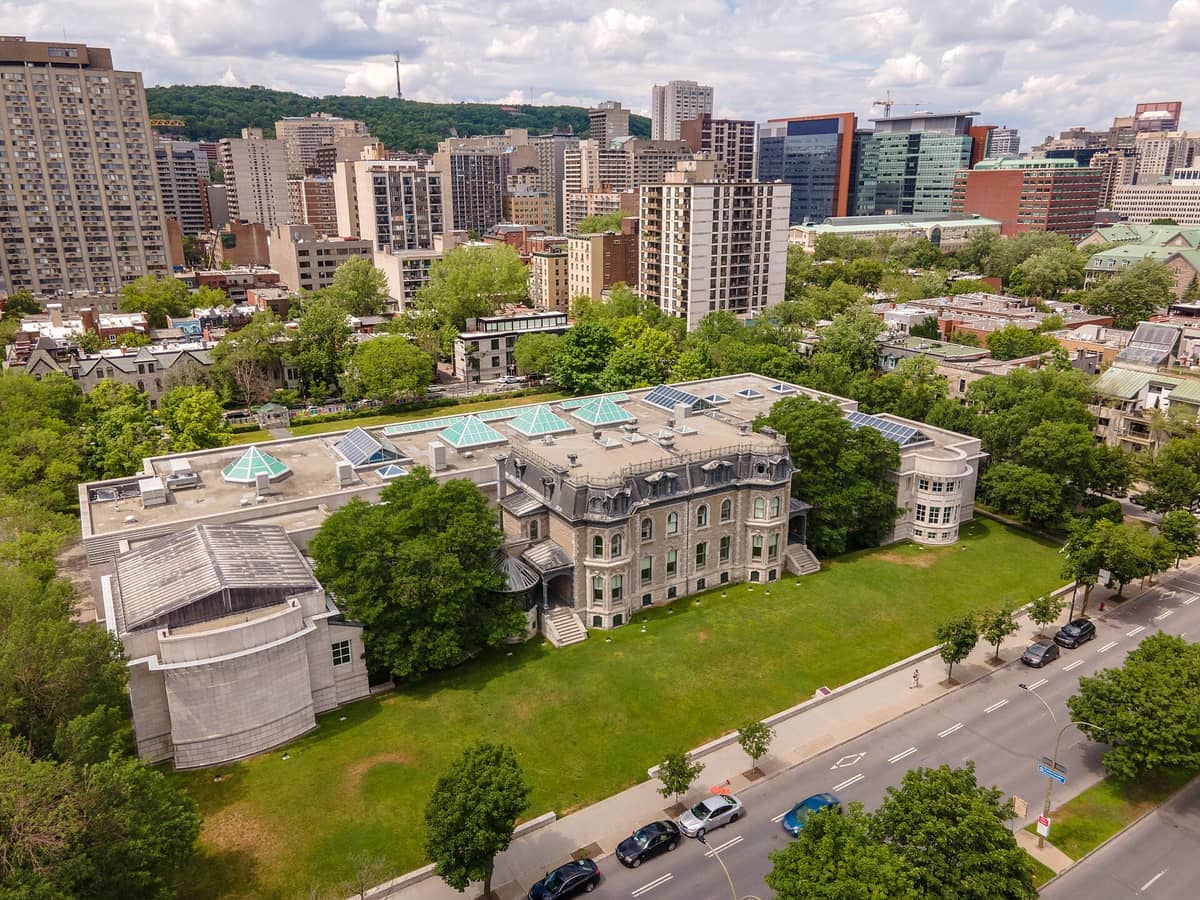
Completed in 1989 and designed by Peter Rose with Phyllis Lambert, the CCA building covers roughly 135,000 square feet and performs an unusual architectural act: it wraps around and preserves the Shaughnessy House, a grey limestone Victorian mansion built in 1874. The contrast between the neo-Baroque mansion and the severe modernist wings that surround it is not accidental. It is a design argument about heritage, continuity, and how new institutions can coexist with older urban fabric.
From rue Baile, the facade reads as restrained and even austere: long horizontal bands of pale limestone, narrow windows, almost no ornamentation. Step inside and the spatial sequence changes the mood. The entrance hall is calm and precise; materials are cool to the touch; light enters through carefully placed skylights rather than street-facing windows. There is an intentional sense of separation from the noise of the city, designed to focus attention inward.
Across René-Lévesque Boulevard, the CCA's Sculpture Garden occupies a terrace that overlooks the surrounding neighbourhood. Designed by artist Melvin Charney in 1987, the garden incorporates architectural follies, columns, and fragments that reference the history of the street and the buildings that once stood there. It is freely accessible to the public and tends to be overlooked by visitors, which means you will often have it nearly to yourself. This counts as one of the more unusual outdoor spaces in downtown Montreal, and it connects loosely to the broader conversation about Montreal's architectural identity.
Tickets & tours
Hand-picked options from our booking partner. Prices are indicative; availability and final rates are confirmed when you complete your booking.
Vista architecture bike tour in Montreal
From 54 €Instant confirmationFree cancellation3-hour electric bike vista architecture guided tour
From 68 €Instant confirmationFree cancellationMontreal evening cruise on the St. Lawrence River
From 54 €Instant confirmationFree cancellation3-hour e-bike guided tour in Montreal
From 68 €Instant confirmationFree cancellation
The Exhibitions: Challenging and Rewards-Based
The CCA rotates its exhibitions regularly, and they are rarely decorative. Past exhibitions have examined the architecture of informal settlements, the design of nuclear waste storage facilities, the urban consequences of car infrastructure, and the spatial experience of exile. Topics are chosen for their intellectual weight, not their crowd appeal.
This means the experience varies substantially depending on when you visit. Some exhibitions are visually dense and primarily text-driven, with dense wall labels that reward patience. Others incorporate models, archival drawings, film projections, or interactive elements that make the content more immediate. It is worth checking the current programme on the CCA website before you go, not because any exhibition is likely to disappoint, but because knowing the subject matter helps you decide how much time to allocate.
The gallery spaces themselves are generous and uncluttered. Natural light from skylights does the heavy lifting in the main corridors. The Shaughnessy House rooms, where some exhibitions spill into the Victorian interior, create an odd and effective counterpoint: elaborate plasterwork ceilings above contemporary display cases. That layering of historical periods feels deliberate and works well.
ℹ️ Good to know
Opening hours vary by season. June to September: Wed 11:00–18:00, Thu 11:00–21:00, Fri–Sat 11:00–18:00, Sun 11:00–17:00. October to May: Thu 11:00–21:00, Fri–Sat 11:00–18:00, Sun 11:00–17:00. Closed Monday and Tuesday year-round; also closed Wednesday from October to May. Verify hours on the official site before visiting.
The Bookshop and Study Centre
The CCA bookshop operates on a different level of seriousness than a typical museum gift shop. It stocks a carefully curated selection of architecture monographs, urbanist theory, design history, and the CCA's own publications, which are produced to unusually high editorial standards. If you have any interest in the field, budget both time and money here. The shop is open during regular museum hours and may also be accessible by appointment on days when the galleries are closed.
The institution's study centre and library serve researchers by appointment and are not part of the standard visitor experience. This is not a place where you will wander into rooms of archival drawings on a casual visit, but the awareness that such a collection exists beneath the public surface adds a certain gravity to the experience.
How the Experience Changes by Time of Day
Wednesday and Friday mornings, shortly after opening, the CCA receives the smallest crowds. The main galleries feel quiet enough that you can hear the ventilation system and the faint sound of footsteps on stone floors. This is the optimal time for visitors who want to read exhibition texts carefully without feeling self-conscious about lingering.
Thursday evenings from 17:00 to 21:00 bring a different energy. Admission is free for everyone, and the visitor profile shifts to include architecture students, young professionals, and people who have come directly from work nearby. The galleries stay open late, the natural light fades and the artificial lighting takes over, which actually suits some of the more dramatically lit installations. The building's atmosphere during these hours is more social without becoming loud.
Weekend afternoons are busiest, particularly Saturday. Families and general tourists make up a larger share of visitors at those times, which is not a problem but does mean the galleries are less contemplative. If a particular exhibition requires concentration, a weekday visit is preferable.
Getting There and Practical Notes
The most straightforward route from central Montreal is the Green Line metro to Atwater station, followed by roughly a 10-minute walk west along rue Sainte-Catherine or along René-Lévesque Boulevard. The walk passes through a part of downtown that is neither tourist-heavy nor particularly scenic, mostly residential blocks and low-rise commercial buildings. Cyclists will find the area accessible via the city's cycling network; the Montreal cycling guide covers the main routes through this part of the city.
Wheelchairs are available at reception on request, and an elevator behind the front desk connects the entrance level to the upper gallery. Guide dogs are permitted throughout the public spaces. The building's design prioritises clear sightlines and unobstructed floor plans, which makes navigation straightforward regardless of mobility.
There is no dedicated café inside the CCA, though the neighbourhood has several options within a few blocks. Plan accordingly if you are visiting for a long stretch, particularly during summer when the surrounding streets have outdoor seating.
⚠️ What to skip
Photography policies vary by exhibition at the CCA. Some shows restrict photography entirely due to copyright or loan agreements on the works displayed. Check signage at the gallery entrance rather than assuming phones are welcome throughout.
Honest Assessment: Who This Is For
The CCA is one of the few places in Montreal that genuinely rewards intellectual preparation. Visitors who arrive knowing something about architecture, urban planning, or the history of the built environment will get considerably more from the exhibitions than those who wander in without context. That said, the physical building itself, particularly the integration of the Shaughnessy House and the Sculpture Garden, offers things to appreciate even without prior knowledge. For a broader look at how architecture shapes Montreal as a city, the Montreal architecture guide provides useful context before a visit.
Travellers looking for a quick photo opportunity or a broad overview of Canadian culture would be better served elsewhere. The McCord Stewart Museum covers Montreal's social and cultural history in a more accessible format, and the Montreal Museum of Fine Arts offers more varied visual appeal for visitors with general interests. The CCA is for people who want to think about buildings, not just look at them.
Insider Tips
- Free Thursday evenings (17:00–21:00) are the best time for budget-conscious visitors, but also attract a knowledgeable crowd, so it is a genuinely good time to visit, not just a discount.
- The Sculpture Garden on René-Lévesque is freely accessible to the public, even when the museum is closed. It is worth a detour even if you are not going inside.
- Pick up the CCA's current exhibition catalogue in the bookshop rather than the general publications table. The institution produces its own books with high editorial standards and they are frequently out of print quickly.
- Ask at reception about any programming happening during your visit. The CCA regularly hosts talks, screenings, and guided tours that are not prominently advertised outside its own channels.
- The integration of the Victorian Shaughnessy House into the modern building is most readable from the interior corridors where old and new facades face each other directly. Take a moment to locate yourself on both sides of that junction.
Who Is Canadian Centre for Architecture For?
- Architecture students and design professionals looking for serious intellectual content
- Curious travellers who want to understand how cities are shaped and designed
- Solo visitors who appreciate unhurried, quiet cultural spaces
- Budget travellers who can plan a Thursday evening visit for free admission
- Anyone interested in Montreal's own architectural identity and urban history
Nearby Attractions
Other things to see while in Downtown Montreal:
- Bell Centre
The Bell Centre is Montreal's premier indoor arena, home to the storied Montreal Canadiens and one of North America's highest-capacity NHL venues. Whether you're coming for hockey, a concert, or just to soak up the atmosphere outside, this guide covers everything you need to make the most of your visit.
- Mary Queen of the World Cathedral
Standing at the heart of downtown Montreal, Mary Queen of the World Cathedral is a one-fifth-scale replica of St. Peter's Basilica in Rome, completed in 1894. Free to enter daily, it offers one of the most striking architectural contrasts in the city: solemn stone and gilded interiors set directly against glass towers and commuter traffic.
- McCord Stewart Museum
The McCord Stewart Museum on Sherbrooke Street West holds one of Canada's richest collections of photographs, clothing, Indigenous artifacts, and everyday objects tracing over 350 years of Montreal and Canadian life. Serious in scope but accessible in presentation, it rewards curious visitors who want more than architecture tours.
- McGill University
Founded by royal charter in 1821, McGill University sits at the foot of Mount Royal in downtown Montreal, offering free public access to one of Canada's most architecturally striking campuses. Whether you're a prospective student, a history enthusiast, or simply looking for a quiet green space in the middle of the city, the campus rewards a slow, unhurried visit.