Mirador del Balcón: Gran Canaria's Most Dramatic Clifftop Viewpoint
Perched above the volcanic cliffs of the Andén Verde coast on Gran Canaria's remote west side, Mirador del Balcón delivers some of the island's most arresting Atlantic panoramas from a glass-floored platform. Entry is free, the site is open around the clock, and the drive there is half the experience.
Quick Facts
- Location
- GC-200 (Andén Verde road), near La Aldea de San Nicolás, west coast of Gran Canaria
- Getting There
- Global bus line 101 (Gáldar–La Aldea via Agaete and Puerto de las Nieves); alight at the nearest stop in the Andén Verde / El Risco section of GC-200 and walk to the viewpoint. Car strongly recommended.
- Time Needed
- 20–45 minutes at the viewpoint; allow extra time for the scenic drive
- Cost
- Free. No ticket or reservation required.
- Best for
- Sunset photography, road-trippers, geology enthusiasts, solo travellers
What Is Mirador del Balcón?
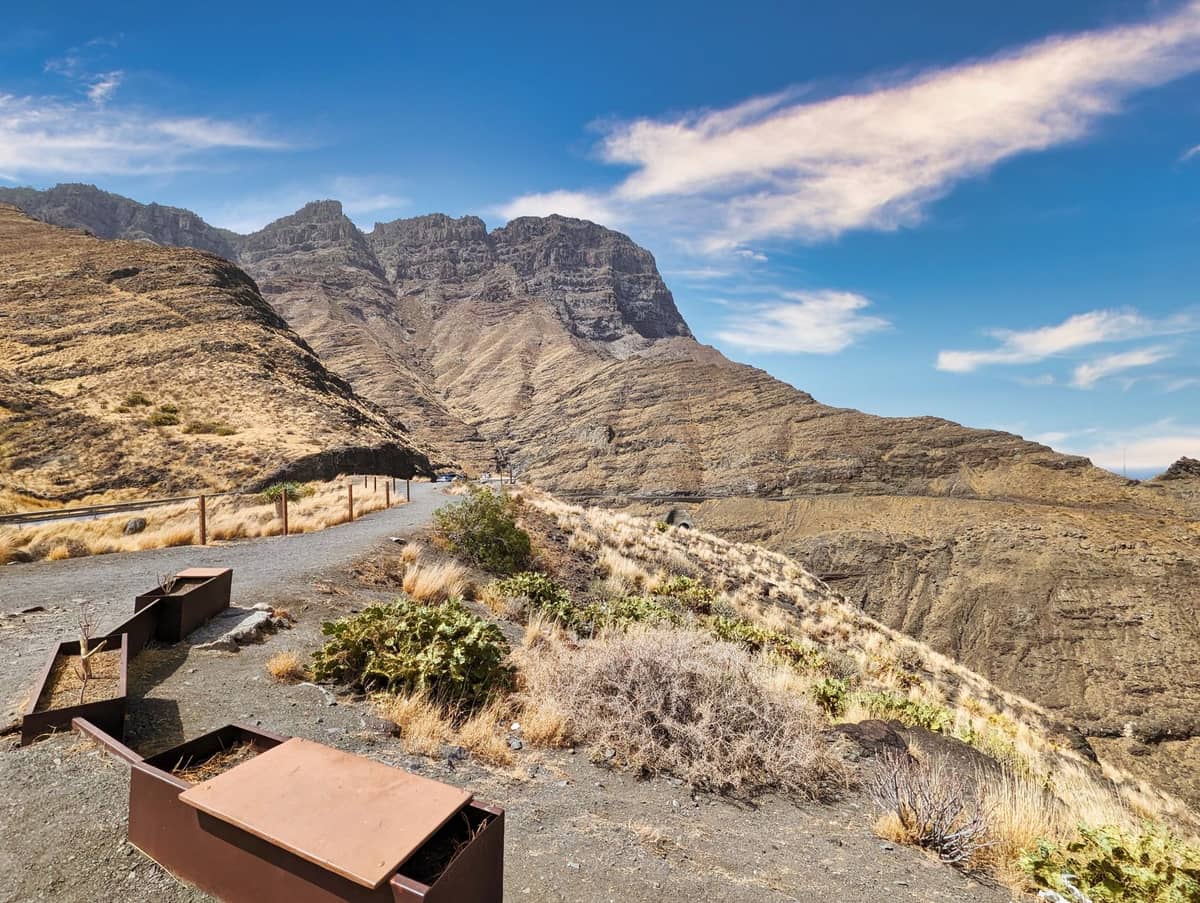
Mirador del Balcón is a public viewpoint on the GC-200 coastal road, officially designated Mirador Astronómico El Balcón by the island's tourism board. It sits above the Andén Verde cliffs on the island's north-western flank, just a short drive from La Aldea de San Nicolás and near the boundary of Tamadaba Natural Park. The setting is genuinely stark: sheer dark basalt drops straight to the Atlantic, with no beach, no village, and no visual clutter below.
The centrepiece is a glass-floored platform cantilevered over the cliff edge. Standing on it, you look down through transparent panels to the ocean swell breaking against rocks far below. Some visitors find this exhilarating; others prefer to stay on the solid stone terrace beside it. Either way, the horizontal view across the deep blue of the Atlantic is what most people remember.
ℹ️ Good to know
The site is freely accessible at all hours, every day of the year, with no admission fee. The small car park holds roughly 5–6 vehicles, so arriving early or late in the day dramatically improves your chances of a peaceful visit.
The Experience: What You'll Actually See and Feel
The moment you step out of the car, the wind hits you. Even on calm days, the Andén Verde coast channels Atlantic air along the cliff face, and the sound of it — a low, persistent rush interrupted by the distant percussion of surf below — sets this place apart from more sheltered viewpoints on the island. The air smells of salt and, faintly, of the dry rock vegetation clinging to the slopes.
The cliffs here are composed of dark volcanic basalt, layered and fractured in geological strata that read like a slow-motion record of eruptions over millions of years. The rock face catches different colours depending on the light: charcoal grey in cloud, warm amber at golden hour, and almost purple in the flat midday sun. On clear days, the outline of Tenerife is visible to the north-west, with the white cone of Mount Teide rising above any haze on the horizon.
Below the platform, a gorge path known historically as Paso Marinero ('Seamen's Pass') descends toward isolated coves. This route was once used by local shepherds and by sailors who collected orchilla, a lichen harvested from the cliff walls and traded as a valuable natural dye for fabric. None of that commercial activity survives, but the path still exists for those willing to explore further on foot.
Morning, Midday, and Sunset: How the Light Changes Everything
Timing your visit makes a significant difference. In the morning, the west-facing cliffs are in partial shade, which keeps colours cool and photographs slightly flat, but the light on the ocean surface is clean and the car park is almost certainly empty. If you are driving the GC-200 loop as a day trip from Las Palmas or Agaete, stopping here first thing means you will have the platform to yourself.
Midday brings the clearest visibility — ideal for spotting Tenerife on the horizon — but also the harshest light and the highest chance of other visitors. The small parking area fills quickly when tour buses or cycling groups pass through, and the platform can feel crowded with a dozen people on it.
Late afternoon is widely considered the best time to visit. The sun drops toward the ocean on this westward-facing cliff, turning the basalt from grey to gold and casting long shadows into every geological fold in the rock face. The Atlantic picks up a deep, metallic blue at this hour, and the light on the distant silhouette of Tenerife can be extraordinary. Arriving about 45 minutes before sunset gives you time to settle before the colours peak.
💡 Local tip
Photography tip: For sunset shots, position yourself toward the southern end of the stone terrace to frame the glass platform against the orange sky and ocean. A wide-angle lens captures the full cliff scale; a telephoto brings in the Tenerife silhouette.
Getting There: The Drive Is Part of the Attraction
Mirador del Balcón is located on the GC-200, the road known as Andén Verde, which runs between La Aldea de San Nicolás and Agaete along the north-west coast. From La Aldea, take the GC-2 toward Agaete and Gáldar, then exit onto the short open section of the GC-200. The viewpoint is approximately 8 minutes from La Aldea by car.
A word of warning about the road: the GC-200 is narrow, winds sharply along cliff edges, and has sections with minimal barriers between the tarmac and a very long drop. Driving it in a standard rental car is entirely manageable at a careful pace, but it demands full attention. Larger vehicles and motorhomes will find it genuinely difficult in places. Avoid driving it after dark if you are unfamiliar with it.
If you don't have a car, Global bus line 101 runs between Gáldar and La Aldea de San Nicolás via Agaete and Puerto de las Nieves, passing along the GC-200 section. The closest stop is on the same road, from which the viewpoint is reachable on foot. That said, bus frequency on this route is limited, so check current timetables before relying on it. Most visitors combine Mirador del Balcón with the wider Tamadaba Natural Park circuit or with a stop at Puerto de las Nieves in Agaete, making a full west-coast day trip the logical approach.
Practical Details: Parking, Accessibility, and What to Bring
The car park at the viewpoint is small — space for around five or six cars — and it sits directly beside the main road. In peak hours or when a tour group stops, overflow vehicles park on the roadside verge. Arriving early morning or in the last two hours before sunset usually means space is available. There are no facilities at the site: no toilets, no café, no shelter. Fill up on water and use facilities in La Aldea or Agaete before you come.
Accessing the glass platform requires descending a staircase from the road level. This means the platform is not suitable for wheelchair users or visitors with significant mobility difficulties. The stone terrace beside the stairs does offer an open-air view without requiring the descent, but the glass floor experience is limited to those who can manage the steps.
Wear shoes with grip. The stone surfaces can be slippery when wet, and the wind at the cliff edge is strong enough to unbalance you if you are carrying a large camera bag or a child. A light windproof layer is worth packing even in summer, as the cliff-top temperature regularly feels several degrees cooler than inland or coastal resort areas.
⚠️ What to skip
The glass platform has a physical barrier, but the surrounding cliff is unfenced in places. Keep children close to you at all times. The drop below the viewing area is severe.
Context: Where Mirador del Balcón Fits in Gran Canaria's Landscape
Gran Canaria has a well-developed network of official miradores across the island, but most are inland, overlooking volcanic calderas or pine forest ridges. Mirador del Balcón is one of the few that faces the open ocean directly, making its character fundamentally different from viewpoints like Roque Nublo or Cruz de Tejeda in the central highlands. Those interior viewpoints offer mountain scale; this one offers oceanic exposure.
The Andén Verde coast as a whole is one of the least-developed stretches of Gran Canaria's coastline. There are no resort hotels here, no beach clubs, and no tourist infrastructure beyond the road and the viewpoint itself. That is precisely why it attracts visitors who have already seen the island's south. If you are planning more than three days on the island, the west coast loop — incorporating the viewpoint, Tamadaba forest, and the village of Agaete — is one of the more rewarding full-day drives Gran Canaria offers.
The site also carries official designation as an astronomical viewpoint. The west coast's distance from light pollution makes it genuinely dark at night, and on a clear evening, the star visibility above the Atlantic horizon is exceptional. This is a niche use of the mirador, but for travellers interested in stargazing, it is worth considering as part of a broader look at Gran Canaria's quieter corners.
Who Might Want to Skip It
Mirador del Balcón rewards visitors who are willing to drive a winding cliff road to reach a single viewpoint with no additional services. If you are travelling without a car, reaching it independently is difficult enough that it may not be worth the effort relative to other accessible viewpoints. If you are nervous on narrow mountain roads, the GC-200 will be stressful rather than scenic. And if dramatic ocean cliff views simply do not interest you as much as beaches or historical sites, the logistical effort is hard to justify.
Families with very young children or visitors with mobility restrictions will also find the site limiting, given the staircase descent and the absence of any facilities. For families looking for more structured outdoor experiences on the island, options like Jardín Botánico Viera y Clavijo or the kid-friendly attractions across Gran Canaria are better suited.
Insider Tips
- The car park fills within minutes when a tour group arrives. If you see a coach parked on the road verge as you approach, continue driving a few hundred metres and wait — groups rarely stay longer than 20 minutes.
- The astronomical viewpoint designation is not just ceremonial. On clear, moonless nights, the west coast darkness produces exceptional star visibility, and the westward orientation gives an unobstructed view of celestial objects setting over the ocean.
- Combine the stop with Puerto de las Nieves in Agaete, roughly 20 minutes north along the GC-200. The village has restaurants and a small harbour where you can decompress after the cliff road.
- If clouds are sitting low on the inland peaks — a common pattern in autumn and winter — the coastal GC-200 is often clear. This makes Mirador del Balcón a reliable choice when the interior viewpoints are socked in.
- The Paso Marinero path descending below the viewpoint is navigable with appropriate footwear and a head for heights. It leads to isolated rock platforms above the sea. Go early, tell someone your plans, and do not attempt it in wet conditions.
Who Is Mirador del Balcón For?
- Road-trippers doing the west coast loop of Gran Canaria
- Photographers chasing Atlantic sunset compositions
- Geology and volcanic landscape enthusiasts
- Stargazers and dark-sky seekers
- Travellers who have already covered the island's main sites and want something off the standard itinerary
Nearby Attractions
Combine your visit with:
- Arteara Necropolis
The Arteara Necropolis is the most extensive aboriginal cemetery on Gran Canaria, with 809 stone burial mounds spread across 13 hectares inside the dramatic Barranco de Fataga gorge. It offers a rare, unhurried encounter with the island's pre-Hispanic Canarii people, well away from the resort crowds of the south.
- Bandama Caldera & Crater Viewpoint
Rising 574 metres above sea level, the Pico de Bandama offers the most striking volcanic panorama on Gran Canaria. Below stretches the Caldera de Bandama, a crater around 200 metres deep and about 1,000 metres across, formed by one of the island's most recent volcanic episodes. It is free to visit, takes under an hour from Las Palmas, and rewards visitors with views that stretch from the island's green interior to the Atlantic coastline.
- Barranco de los Cernícalos
Barranco de los Cernícalos is a 7 km round-trip ravine hike in central-eastern Gran Canaria where a year-round stream cuts through laurel forest, fern-draped cliffs, and small waterfalls. It is free to enter, requires no booking, and remains genuinely quiet compared to the island's more promoted highland routes.
- Cactualdea Park
Cactualdea Park sits in the remote western municipality of La Aldea de San Nicolás, where an extraordinary collection of cacti and succulents grows against a backdrop of volcanic rock and Atlantic light. It rewards visitors who make the journey with something genuinely unusual: a curated desert landscape that feels nothing like the resort south of the island.