Cruz de Tejeda: The Stone Cross at the Heart of Gran Canaria
Cruz de Tejeda is the symbolic centrepoint of Gran Canaria, a small mountain hamlet at 1,514 metres where a centuries-old stone cross marks the convergence of the island's main interior roads. The views stretch across volcanic peaks, pine-forested ridges, and ancient calderas — and it costs nothing to visit.
Quick Facts
- Location
- Cruz de Tejeda, s/n, 35328 Tejeda, Gran Canaria, Spain — at the junction of roads GC-15 and GC-150
- Getting There
- By car via GC-15 from Las Palmas or GC-150 from the south. Public buses serve the area from Las Palmas with limited frequency — check timetables in advance.
- Time Needed
- 1–2 hours for the viewpoint and hamlet; half a day if you add a hike
- Cost
- Free. The viewpoint and stone cross are open public spaces. Dining at the Parador or local cafés is extra.
- Best for
- Hikers, scenic drivers, photographers, and anyone wanting to see Gran Canaria's mountainous interior
- Official website
- paradores.es/en/parador-de-cruz-de-tejeda
What Cruz de Tejeda Actually Is
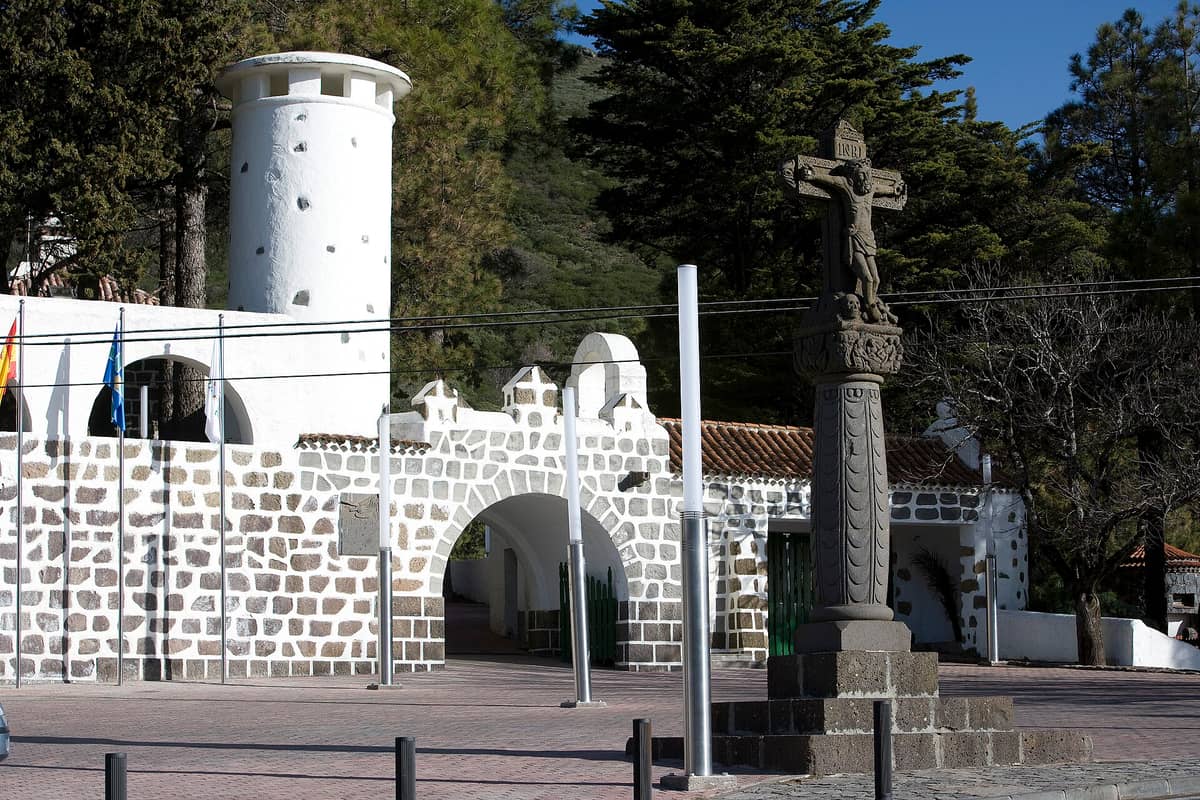
Cruz de Tejeda is not a town in any conventional sense. It is a high-altitude hamlet, barely more than a crossroads, sitting at approximately 1,514 metres above sea level at the geographic heart of Gran Canaria. The name refers both to the stone cross that stands at the entrance of the Parador Nacional and to the wider viewpoint area around it. A few souvenir stalls, a handful of vendors selling local almonds and marzipan, and the renovated Parador hotel and restaurant make up most of what you will find here.
What draws people is not the hamlet itself but what surrounds it. Standing at the cross, the landscape opens in every direction across an interior Gran Canaria that most coastal tourists never see: volcanic rock formations, terraced ravines, pine forests at altitude, and on clear days, the unmistakable silhouettes of Roque Nublo and Roque Bentayga rising from the ridgeline to the southwest.
ℹ️ Good to know
Cruz de Tejeda is a free, open-air public area accessible at any hour. No ticket, no booking, no queue. The Parador hotel restaurant and on-site cafés have their own hours and prices — check directly with them if you plan to eat.
The View: What You Are Looking At and Why It Matters
Gran Canaria is often described as a continent in miniature, and Cruz de Tejeda is where that claim makes most sense. The island's terrain was shaped by millions of years of volcanic activity, and the central caldera region you see from here represents some of the oldest exposed rock on Gran Canaria. The peaks in the distance are not simply photogenic — they are archaeologically and culturally significant landmarks that the indigenous Canarii people considered sacred.
The twin formations visible from the viewpoint, Roque Nublo and Roque Bentayga, are both protected natural monuments. Roque Nublo, at around 1,813 metres, is the eroded plug of an ancient volcano and one of the most recognisable shapes on the island. Roque Bentayga was a major ceremonial site for the Guanche people before the Spanish conquest in the 15th century. Seeing both from Cruz de Tejeda in a single glance gives a sense of scale that no postcard quite captures.
On days with high humidity or calima (dust-laden wind from the Sahara), the view can be partially obscured and the light turns a flat, yellowish-grey. This is worth knowing before you drive an hour into the mountains. The clearest conditions tend to follow rain in winter or occur in early morning during spring and autumn.
How the Experience Changes Through the Day
Arriving early — before 9am if you can manage it — gives you Cruz de Tejeda at its quietest and often its most dramatic. Mist frequently sits in the valleys below the pass, and the peaks emerge from it slowly as the sun climbs. The air at this altitude carries a sharp, resinous smell from the Canarian pine forests on the surrounding slopes. In winter months, you may need a proper jacket; temperatures at 1,514 metres can be 8 to 10 degrees cooler than at the coast.
By late morning, especially on weekends, the parking areas fill up and the souvenir vendors set out their stalls. The atmosphere becomes more social — families arriving for a Sunday drive, hikers returning from Roque Nublo with muddy boots, and tourists stopping briefly on organised excursions. The Parador's terrace becomes a good place to sit with coffee and watch the light change across the caldera.
Late afternoon, roughly from 4pm onwards, sees the day-tripper crowds thin out. The colour of the rock changes considerably in low evening light, shifting from grey-brown to amber and orange. If you have a car and flexibility, this is when the drive back down through Tejeda village is at its most scenic.
💡 Local tip
The two free car parks along GC-150 fill quickly on weekends and public holidays, often by 10am in peak season. Arriving before 9am or after 4pm solves the parking problem almost entirely.
Getting There: Practical Routes
The most practical way to reach Cruz de Tejeda is by car. The GC-15 road from Las Palmas de Gran Canaria winds up through Vega de San Mateo and into the mountains — a drive of around 40 to 50 minutes depending on traffic and how often you stop. From the south, the GC-60 followed by the GC-150 connects the coast to Cruz de Tejeda via the Tejeda valley, passing views of Roque Bentayga along the way. Both routes are paved and manageable in a standard rental car, though they involve continuous sharp bends at altitude.
Public buses do serve Cruz de Tejeda from Las Palmas, operated by the island's Global interurban bus network, but frequency is limited and schedules on weekends and holidays are reduced significantly. If you are relying on public transport, check current timetables before setting out. For anyone planning to combine Cruz de Tejeda with other interior stops, the island's Gran Canaria road trip guide outlines logical routes through the central highlands.
The road surface at Cruz de Tejeda itself, near the cross and the Parador, is level enough, but the surrounding paths are uneven mountain terrain. Visitors with limited mobility can comfortably reach the stone cross and take in the view without leaving the road area, but any walking beyond that point involves rocky, irregular ground.
Hiking Beyond the Viewpoint
Cruz de Tejeda is one of the main trailheads for hiking in Gran Canaria's interior. The most popular route from here leads to Roque Nublo, a walk of roughly 3 to 4 kilometres each way with moderate elevation gain. The trail passes through pine woodland and offers continuous views across the central caldera. Most walkers complete the round trip in 2 to 3 hours. Wear proper footwear — the path is stony and can be slippery after rain.
For those wanting a longer day out, trails also connect Cruz de Tejeda to Pico de las Nieves, the island's highest accessible summit at around 1,949 metres. The terrain up here is genuine mountain walking, and the weather can shift quickly, so layers and water are essential regardless of how warm it felt at the coast.
The wider hiking network around Tejeda is extensive. Gran Canaria's interior is criss-crossed with waymarked trails, and Cruz de Tejeda sits at their hub. The hiking guide for Gran Canaria covers the best routes for different fitness levels, including several that start or end here.
⚠️ What to skip
Weather at 1,514 metres can change fast. Cloud cover rolls in within minutes, reducing visibility and dropping temperatures sharply. Even in summer, bring a windproof layer if you plan to hike beyond the viewpoint.
The Parador and Local Food
The Parador de Cruz de Tejeda is a state-run hotel sitting directly at the cross. It was completely renovated and reopened as a modern property, and its restaurant is open to non-guests. Sitting on the Parador's terrace with a coffee or a plate of local food while looking out across the caldera is, straightforwardly, one of the more satisfying experiences you can have in Gran Canaria's interior. The menu leans toward Canarian cuisine, including the almond-based dishes for which Tejeda municipality is known.
Tejeda is the almond capital of Gran Canaria. The municipality produces almonds and the local marzipan (called bienmesabe when in liquid form) is sold at roadside stalls near the cross. It is sticky-sweet, made with ground almonds and honey, and far better than anything sold in the resort souvenir shops at the coast. Buying directly from vendors here means the product is local.
Photography at Cruz de Tejeda
The composition from the main viewpoint area puts the stone cross in the foreground with Roque Nublo on the horizon — this is the classic shot, and almost everyone takes it. To make something more interesting, try shooting from the parking area below the cross level, where you get the cross against sky rather than against the hillside behind it. Early morning mist in the valleys below creates natural depth in wide shots.
If you have a telephoto lens, the rock formations in the distance reward it. Roque Nublo's profile changes dramatically depending on the angle you shoot from, and at Cruz de Tejeda you are seeing it from the northeast, which shows its vertical mass clearly. Golden hour in late afternoon lights the west-facing slopes of the caldera in a way that midday light completely flattens.
Insider Tips
- The marzipan and bienmesabe sold by vendors directly at the cross are locally made Tejeda products. They are meaningfully better than the packaged versions found in resort shops — worth buying here rather than anywhere else.
- If the main viewpoint parking is full, drive 300 metres back down GC-150 toward Tejeda village. There is a second parking area that most visitors miss, and it is nearly always less crowded.
- The calima — dusty Saharan wind that periodically affects the Canary Islands — makes the mountain views hazy and flat. Check the local forecast for 'calima' conditions before making a dedicated trip up here in summer.
- Cruz de Tejeda sits at the intersection of several long-distance hiking routes. If you plan to walk to Roque Nublo and back, the trailhead is clearly signposted from the main road junction — start early to get the clearest views before afternoon cloud builds.
- The Parador restaurant is open to non-guests and is a legitimate option for lunch, not just a tourist trap. The Canarian stew and almond desserts are worth the price. Booking ahead on weekends is sensible.
Who Is Cruz de Tejeda For?
- Hikers using Cruz de Tejeda as a base for trails to Roque Nublo or Pico de las Nieves
- Scenic drivers doing a circuit of Gran Canaria's interior
- Photographers after the island's most iconic mountain composition
- Travellers who want to see the real geographic and cultural heart of the island
- Anyone who has spent time on the southern beaches and wants a complete contrast in landscape and atmosphere
Nearby Attractions
Other things to see while in Tejeda & the Mountain Interior:
- Pico de las Nieves
At 1,949 metres, Pico de las Nieves is traditionally considered the highest point on Gran Canaria, though recent measurements place nearby Morro de la Agujereada slightly higher. It sits on the border between Tejeda and San Bartolomé de Tirajana. The public viewpoint is free, open around the clock, and offers sweeping mountain panoramas that stretch, on clear days, all the way to the Atlantic horizon and neighbouring islands. Getting there requires a car or a combination of mountain buses, but the reward is a perspective on the island that the beach resorts cannot offer.
- Roque Bentayga
Rising to 1,404 metres in the volcanic heart of Gran Canaria, Roque Bentayga is a basaltic rock tower surrounded by pre-Hispanic ceremonial sites and sweeping caldera views. The free interpretation centre and trail to the summit plateau make it one of the island's most rewarding inland excursions within the Risco Caído and the Sacred Mountains of Gran Canaria UNESCO cultural landscape.
- Roque Nublo
Roque Nublo is a volcanic basalt monolith rising from the central highlands of Gran Canaria, one of the most recognizable natural landmarks in the Canary Islands. Visiting the summit via the regulated S-70 trail currently requires advance reservation and a mountain hike, but the panoramic views over the island's interior reward the effort considerably.
- Tamadaba Natural Park
Parque Natural de Tamadaba is Gran Canaria's most significant forested wilderness, a 7,538-hectare protected pine forest draped across the island's rugged northwest. Expect dramatic ridge-top panoramas, silent conifer tracks, and some of the clearest air on the island — all free to enter.