Roque Nublo: Gran Canaria's Ancient Rock in the Clouds
Roque Nublo is a volcanic basalt monolith rising from the central highlands of Gran Canaria, one of the most recognizable natural landmarks in the Canary Islands. Visiting the summit via the regulated S-70 trail currently requires advance reservation and a mountain hike, but the panoramic views over the island's interior reward the effort considerably.
Quick Facts
- Location
- Roque Nublo Natural Monument, Tejeda municipality, central Gran Canaria
- Getting There
- On foot via trail S-70 from Degollada de La Goleta; roadside parking is available at the trailhead, with access regulated for the final stretch to the monolith.
- Time Needed
- 2.5 to 4 hours including the hike up and back
- Cost
- Advance reservation required (mandatory) for access to the regulated S-70 trail; current individual reservations are free of charge, but verify conditions before visiting.
- Best for
- Hikers, landscape photographers, and anyone wanting Gran Canaria's most dramatic interior views
- Official website
- www.grancanaria.com/turismo/en/nature/virtual-routes/roque-nublo
What Is Roque Nublo, and Why Does It Matter?
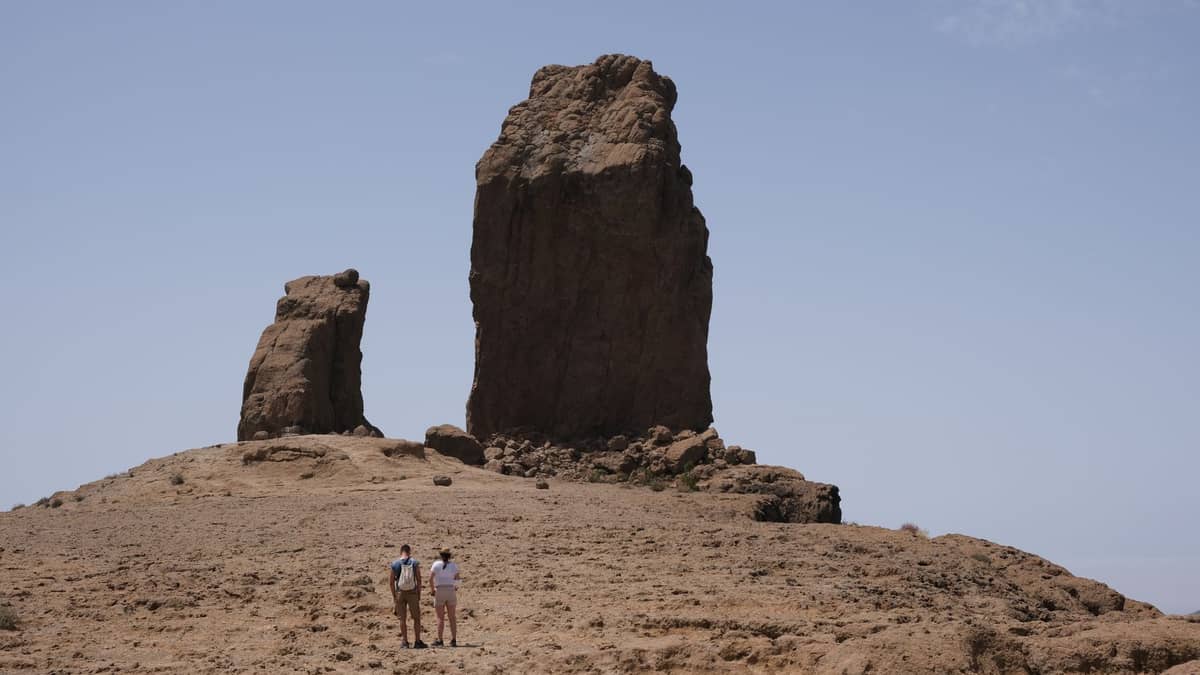
Roque Nublo is a volcanic basalt monolith standing in the central highlands of Gran Canaria, within the protected Roque Nublo Natural Monument. It is widely considered the island's most iconic natural feature, visible from much of the island on clear days and deeply embedded in Canarian cultural identity. The rock formation rises above the Tejeda caldera and has long been associated with the indigenous Canarii people, who inhabited the island before the Spanish conquest in the 15th century, making this not just a geological landmark but a site of genuine historical weight.
At roughly 1,813 metres above sea level, Roque Nublo sits in the mountainous interior that defines the character of Gran Canaria's centre. The island's varied microclimates mean the summit area can be wrapped in low cloud even when the coast basks in sun, which explains the name: Rock in the Clouds. On clear days, the views extend to Teide on Tenerife to the west, and the contrast between the bare rock and the layered valleys below is genuinely striking.
⚠️ What to skip
Reservation is mandatory before visiting via the Degollada de La Goleta access to the S-70 trail. Access to trail S-70 is controlled with a QR code, and entry is capped at 60 people per hour. Book in advance at the official reservation site (grancanariasenderos.com) to avoid being turned away.
The Hike: What the Trail Actually Feels Like
The regulated trail begins at Degollada de La Goleta, the designated access point for trail S-70. From the trailhead, the path climbs steadily through pine-scented scrubland and rocky terrain. The surface is uneven in places, with loose volcanic stone underfoot on the upper sections, so grip matters more than stamina here. The route is not technical, but it is a real mountain hike, not a paved promenade.
As you gain elevation, the landscape opens up dramatically. The smell of resin from Canarian pine drifts across the path, and the sound drops to almost nothing except wind across the ridge. When you round the final approach and the monolith comes fully into view, the scale of it tends to stop people in their tracks. Roque Nublo towers above the surrounding plateau, flanked by a smaller companion formation called El Fraile. Most visitors spend 20 to 40 minutes at the base of the rock before beginning the descent.
The round trip takes between 2.5 and 4 hours depending on pace and how long you linger at the top. Bring more water than you think you need; the altitude and wind can mask how much you are exerting. The trail has limited shade in the upper sections.
💡 Local tip
Wear proper walking shoes or hiking boots with ankle support. Trainers are manageable but the loose stone on the upper trail makes grip footwear worth it. A wind layer is essential even in summer — the ridge can be significantly colder than coastal temperatures.
Access Rules and Reservations: What You Need to Know
Access to the Roque Nublo trail via Degollada de La Goleta is currently regulated daily from 09:00 to 17:00. The authorities introduced this system to protect the fragile highland ecosystem and manage overcrowding, which had become a real problem. Entry is controlled via a QR code linked to your advance reservation, and the limit of 60 people per hour is enforced at the access point. There are special regulations for school groups and commercial active tourism companies, so if you are visiting with an organised hiking group, check the rules for operators before booking.
Access to the Roque Nublo trail is typically by private vehicle to the roadside parking at Degollada de La Goleta or on foot via adjacent trails, with the final stretch to the monolith regulated by reservation. Check the official reservation platform and Gran Canaria Turismo before your visit, as access regimes on protected natural sites in the Canary Islands are subject to revision. Times and conditions listed here reflect publicly available official information but should be verified close to your visit date.
Best Time to Visit: Light, Weather, and Crowd Patterns
The central highlands of Gran Canaria have a different rhythm to the coast. Mornings tend to offer the clearest conditions, before Atlantic clouds build up over the interior in the early afternoon. Booking a slot close to the 09:00 opening gives you the best chance of arriving at the summit in clear air. By early afternoon, the rock is frequently inside cloud, which has its own atmosphere but eliminates the long-range views.
For hiking conditions, the cooler months from November through April are generally more comfortable, with lower temperatures and clearer air. Summer visits are feasible but the sun is more intense on the exposed upper trail. The island's interior can receive occasional rain between November and January, so check the forecast before heading up. A morning visit in spring or autumn, when the coastal resorts are quieter and the mountain light is particularly clean, tends to be the most rewarding combination.
Planning your wider trip around the best conditions? The best time to visit Gran Canaria guide covers seasonal patterns across the whole island, including how the interior differs from the coast.
Photography at Roque Nublo
The main photographic challenge is that Roque Nublo is most dramatic when shot with something to give it scale, not in isolation. Position yourself on the plateau below the monolith with other visitors or the rocky landscape in the foreground, and the sheer height of the formation becomes apparent. The light in the first hour of access (around 09:00 to 10:30) hits the rock face from the east with warm, directional quality. Midday light is harsher and tends to flatten the texture of the basalt.
When cloud is drifting across at summit level, the monolith appearing and disappearing through mist creates genuinely dramatic images, but the wide panoramic shots will not work. Bring a wide-angle option if your lens kit allows. The views toward Tejeda village far below and the caldera beyond are worth framing carefully on the descent, where the angle back toward the monolith also works well.
Roque Nublo in Context: The Tejeda Area and What Surrounds It
Roque Nublo sits within the municipality of Tejeda, one of the most scenic areas of Gran Canaria's interior. The village of Tejeda itself, visible in the caldera below the trail, is worth combining with the hike for a full day in the mountains. From Tejeda, you can orient yourself toward other significant landmarks in the central highlands, including the Roque Bentayga, another sacred formation with Guanche archaeological significance, and the Cruz de Tejeda viewpoint, the traditional crossroads of the island's mountain routes.
The broader landscape is part of what makes the hike meaningful. Gran Canaria's interior is a world apart from the resort coast, and Roque Nublo is at the heart of it. If you are considering spending more time exploring the island's interior and natural spaces, the hiking in Gran Canaria guide covers the wider trail network and what conditions to expect across different zones.
For a full day combining Roque Nublo with the surrounding area, the day trips in Gran Canaria guide includes practical itineraries for the central highlands that pair well with this hike.
Who This Attraction Is and Is Not For
Roque Nublo rewards visitors who come prepared for a genuine mountain hike. If you are comfortable with uneven terrain, happy to walk for two to four hours at altitude, and willing to plan ahead with a reservation, it delivers some of the most memorable scenery on the island. Landscape photographers, hikers, and anyone with an interest in pre-Hispanic Canarian culture will find real depth here.
It is not suitable for visitors expecting a short, easy walk from a car park. The access restrictions mean spontaneous visits are not possible. Families with very young children or anyone with significant mobility limitations will find the terrain genuinely difficult. The altitude and wind also catch some visitors off-guard, particularly in winter when conditions on the ridge can feel considerably more demanding than the coastal forecast suggests.
Insider Tips
- Book your reservation slot for the first available entry time (09:00) rather than later in the day. The cloud builds over the interior reliably from mid-morning onward, and the panoramic views are far more likely to be clear in the first two hours of access.
- If you are not renting a car, check current public transport or excursion options to reach Degollada de La Goleta, as access to the regulated trail itself is on foot from the roadside parking area. Confirm current logistics via the official reservation platform before your visit.
- Tejeda village is only a short drive below the access point and has a small selection of local restaurants serving traditional Canarian food. Combining lunch in the village with the morning hike makes a well-structured full day without requiring any additional long drives.
- The formation called El Fraile (The Friar), a smaller pillar beside Roque Nublo, is visible from the plateau and is easy to miss if you are focused entirely on the main monolith. Look for it to the side as you approach the base.
- Mobile signal on the upper trail is unreliable. Download your QR reservation code and any offline maps before leaving the access point. Do not rely on loading anything fresh once you are above the treeline.
Who Is Roque Nublo For?
- Hikers looking for Gran Canaria's most rewarding half-day trail
- Landscape and nature photographers chasing dramatic volcanic scenery
- Travellers interested in the indigenous Guanche cultural heritage of the Canary Islands
- Visitors who want to experience the island's interior rather than only the coast
- Those combining a wider Tejeda area day trip with mountain scenery
Nearby Attractions
Other things to see while in Tejeda & the Mountain Interior:
- Cruz de Tejeda
Cruz de Tejeda is the symbolic centrepoint of Gran Canaria, a small mountain hamlet at 1,514 metres where a centuries-old stone cross marks the convergence of the island's main interior roads. The views stretch across volcanic peaks, pine-forested ridges, and ancient calderas — and it costs nothing to visit.
- Pico de las Nieves
At 1,949 metres, Pico de las Nieves is traditionally considered the highest point on Gran Canaria, though recent measurements place nearby Morro de la Agujereada slightly higher. It sits on the border between Tejeda and San Bartolomé de Tirajana. The public viewpoint is free, open around the clock, and offers sweeping mountain panoramas that stretch, on clear days, all the way to the Atlantic horizon and neighbouring islands. Getting there requires a car or a combination of mountain buses, but the reward is a perspective on the island that the beach resorts cannot offer.
- Roque Bentayga
Rising to 1,404 metres in the volcanic heart of Gran Canaria, Roque Bentayga is a basaltic rock tower surrounded by pre-Hispanic ceremonial sites and sweeping caldera views. The free interpretation centre and trail to the summit plateau make it one of the island's most rewarding inland excursions within the Risco Caído and the Sacred Mountains of Gran Canaria UNESCO cultural landscape.
- Tamadaba Natural Park
Parque Natural de Tamadaba is Gran Canaria's most significant forested wilderness, a 7,538-hectare protected pine forest draped across the island's rugged northwest. Expect dramatic ridge-top panoramas, silent conifer tracks, and some of the clearest air on the island — all free to enter.