Arteara Necropolis: Gran Canaria's Largest Pre-Hispanic Burial Ground
The Arteara Necropolis is the most extensive aboriginal cemetery on Gran Canaria, with 809 stone burial mounds spread across 13 hectares inside the dramatic Barranco de Fataga gorge. It offers a rare, unhurried encounter with the island's pre-Hispanic Canarii people, well away from the resort crowds of the south.
Quick Facts
- Location
- Barranco de Fataga, San Bartolomé de Tirajana, Gran Canaria — off GC-60 road
- Getting There
- Best reached by car via GC-60 from Maspalomas or Playa del Inglés; signposted turn-off to Arteara hamlet. Organized excursions also available.
- Time Needed
- 1.5 to 2.5 hours
- Cost
- General: €4. Reduced (students, seniors 65+, groups 10+): €2. Under-10s free. Verify current rates before visiting.
- Best for
- History enthusiasts, archaeology lovers, road-trippers, photography in dramatic canyon light
- Official website
- http://www.necropolisdearteara.com
What Is the Arteara Necropolis?
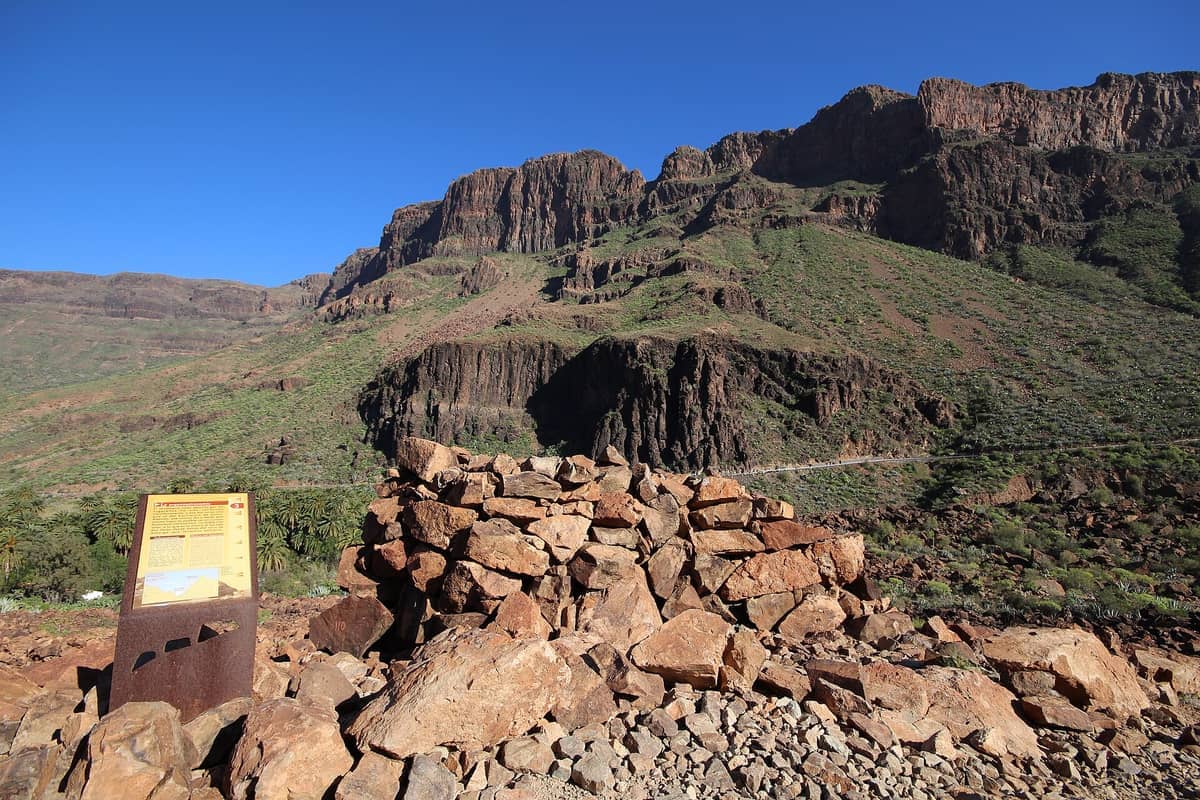
The Arteara Necropolis, or Necrópolis de Arteara, is the largest known aboriginal burial ground on Gran Canaria and one of the most significant pre-Hispanic archaeological sites in the entire Canary Islands. Spread across roughly 14 hectares (about 138,000 m²) inside the lower reaches of Barranco de Fataga, the site contains hundreds of individual and collective tumular structures: stone-built burial mounds that once held the dead of the island's original Canarii inhabitants. The cemetery occupies the rocky right bank of the barranco in a landscape of volcanic boulders, sparse scrub, and towering canyon walls.
The site was declared a Bien de Interés Cultural (BIC) in 1973, placing it under the highest category of Spanish heritage protection. That designation has kept large-scale development at arm's length, and the result is an archaeological zone that still feels genuinely remote — even though Maspalomas and Playa del Inglés are only a short drive away down the valley.
⚠️ What to skip
The official tourism channels currently list the site as temporarily closed at times. Always verify current opening status via the official website or Gran Canaria tourism channels before making the trip.
The Landscape: Where the Necropolis Sits
Barranco de Fataga is one of the most photogenic ravines in Gran Canaria: a narrow, winding gorge cut through dark volcanic rock, with palm groves clinging to the lower reaches and pale ridgelines rising above. The necropolis occupies a section of this canyon where the valley floor widens slightly and the rock breaks into fields of loose boulders — exactly the kind of terrain where the Canarii built their tumuli, using whatever stone was to hand.
The visual effect of 800-plus stone mounds arranged across this landscape is striking in a quiet, cumulative way. This is not a single monument you photograph and move on from; it is a field of dozens of low stone circles and cairns that rewards slow walking. For context on the broader gorge environment, see the Fataga village guide, which sits further up the same barranco and pairs well with a visit here.
The GC-60 road that passes the site also forms part of one of the island's most rewarding inland drives. Morning light enters the canyon from the east, throwing the mounds into sharp relief against the canyon floor — the best conditions for photography. By midday in summer, the sun is directly overhead and the pale boulders reflect heat intensely; there is almost no shade on the main archaeological area.
Historical Context: Who Built These Mounds?
The Canarii, Gran Canaria's pre-Hispanic population, are believed to have descended from Berber groups who arrived on the island from North Africa, possibly during the first millennium BCE or earlier. They were a settled, agricultural society with a complex social hierarchy, cave-dwelling traditions, and, as Arteara demonstrates, sophisticated funerary practices. The tumuli here are stone-ring structures that enclosed individual or group burials, often accompanied by grave goods. Some mounds cluster together in groups that may indicate family or clan affiliations; others stand isolated on rocky outcrops.
What makes Arteara particularly significant is scale. No other Canarii burial site on the island comes close to this in either number of structures or total area. Archaeologists interpret the necropolis as a long-used communal cemetery, probably serving a wide valley population over many generations before the Spanish conquest of the island, which was completed in 1483.
Visitors who want deeper context on the island's pre-Hispanic culture should also consider the Cueva Pintada in Gáldar, which preserves the only painted cave interior of the Canarii, and the Museo Canario in Las Palmas, which holds one of the most complete collections of Canarii artefacts in existence.
Visiting in Practice: What the Experience Is Actually Like
When operating, the site opens Tuesday through Sunday, with the Interpretation Centre on-site providing contextual information about the first inhabitants of Gran Canaria. Standard opening hours run from 10:00 to 17:00 between October and March, and 10:00 to 18:00 from April through September. The site is closed Mondays and on specific public holidays including 1 January, 6 January, 1 May, and 24, 25, and 31 December.
Arriving by car is the most practical option. From Maspalomas or Playa del Inglés, follow the GC-60 north into Barranco de Fataga; the turn-off to Arteara is signposted before you reach the village of Fataga itself. The road into the hamlet is narrow but manageable for standard vehicles. There is a small parking area near the site entrance.
💡 Local tip
Arrive within the first hour of opening. The necropolis sits in an open canyon with minimal shade. By 11:30 in summer, the heat on the exposed boulder field becomes uncomfortable, and the light is too harsh for good photography.
The terrain across the main archaeological area is uneven: loose volcanic rock, rough stone paths, and undulating ground between the tumuli. Solid footwear with ankle support is strongly recommended. The site is not well-suited to visitors with significant mobility limitations, as there are no paved paths across the main cemetery area. If mobility is a concern, contact the site in advance via the official website to understand what is accessible near the Interpretation Centre.
Visitor numbers at Arteara are low compared to the island's coastal attractions. On most mornings, particularly on weekdays outside peak summer weeks, you can walk among the mounds in near-silence, with only the sound of wind through the canyon. That quiet is a large part of what the site offers. Groups do occasionally arrive by excursion coach, concentrated in mid-morning slots, so genuinely independent visitors can avoid overlap by arriving at opening time or after 15:00.
Photography and Sensory Notes
The canyon walls above the necropolis are a deep, dark basalt streaked with lighter rock, and the sky above them is almost always an intense blue on clear days. Early morning casts long shadows across the tumuli that define their circular forms clearly. Late afternoon, when the western canyon wall catches oblique light, also produces good conditions. Midday light flattens everything and makes the grey stone mounds difficult to distinguish from the surrounding terrain.
The smell of the site is desert-dry: hot stone, a faint trace of herbs from low scrub vegetation, and occasionally the dust kicked up from the unpaved access track. The silence is notable — there is no background noise from resort areas, and the canyon walls dampen wind. It is genuinely still, in a way that makes the scale of the cemetery register differently than it would in a busier landscape.
Combining Arteara with the Surrounding Area
Arteara fits naturally into a half-day drive through the interior of southern Gran Canaria. The most logical extension is continuing up the GC-60 to Fataga village, a small hamlet with a date palm grove, a couple of restaurants, and sweeping views back down the barranco. From Fataga, the road continues toward Cruz de Tejeda at the island's geographic centre if you want a full interior circuit.
Drivers heading back south can reach Maspalomas or Playa del Inglés in under 20 minutes, making Arteara a manageable cultural detour from a resort-based holiday without requiring a long day out.
ℹ️ Good to know
Bring water. There are no cafes or vending points at the necropolis itself, and the canyon heat in summer can be deceptive. A minimum of one litre per person for a standard visit is sensible, more if you plan to spend time exploring the full extent of the site.
Who Will Not Enjoy This Site
Arteara is not for everyone. If you need clear, well-captioned exhibits to engage with a site, the Interpretation Centre helps, but the outdoor cemetery itself offers no in-situ explanatory panels at each mound. Without background knowledge or a guided tour, walking among the tumuli can feel like walking across a field of old rock piles. That's not a criticism of the site — it's an honest description of what undisturbed archaeological terrain looks like. Visitors expecting a museum-standard experience throughout will be disappointed.
Families with young children should assess carefully. The terrain is rough, there are no visitor amenities on-site beyond the Interpretation Centre, and the site offers nothing interactive for children under around ten. In summer heat, a morning here can become tiring quickly for small kids. The nearby southern beaches are a far better fit for family days.
Insider Tips
- Visit on a Tuesday or Wednesday morning when excursion coaches are least likely to overlap with your visit. Weekend mornings see the highest independent visitor traffic.
- The Interpretation Centre near the entrance is worth 20–30 minutes before you walk the grounds. It reframes what you're seeing: the mounds read differently when you understand Canarii burial practices.
- If you're combining with Fataga village, go to Arteara first while the light is still low and the temperature manageable, then drive up to Fataga for a late morning coffee before the heat peaks.
- Photography of the tumuli is most effective from slightly elevated positions looking down into the circular stone rings. The rocky terrain has natural high points that give you this angle without climbing on the mounds themselves — which you should not do.
- The official website (necropolisdearteara.com) is the most reliable place to check current opening status before visiting, as the site has had temporary closure periods. Don't rely solely on third-party booking platforms for this information.
Who Is Arteara Necropolis For?
- Travellers with a genuine interest in pre-Hispanic Canary Islands history and archaeology
- Photographers looking for dramatic canyon light and ancient landscape compositions
- Road-trippers on an interior Gran Canaria circuit combining Fataga, Cruz de Tejeda, and the southern valleys
- Visitors seeking a quiet, uncrowded counterpoint to the busy resort beaches of the south
- Anyone pairing cultural sites with hiking in the Barranco de Fataga area
Nearby Attractions
Combine your visit with:
- Bandama Caldera & Crater Viewpoint
Rising 574 metres above sea level, the Pico de Bandama offers the most striking volcanic panorama on Gran Canaria. Below stretches the Caldera de Bandama, a crater around 200 metres deep and about 1,000 metres across, formed by one of the island's most recent volcanic episodes. It is free to visit, takes under an hour from Las Palmas, and rewards visitors with views that stretch from the island's green interior to the Atlantic coastline.
- Barranco de los Cernícalos
Barranco de los Cernícalos is a 7 km round-trip ravine hike in central-eastern Gran Canaria where a year-round stream cuts through laurel forest, fern-draped cliffs, and small waterfalls. It is free to enter, requires no booking, and remains genuinely quiet compared to the island's more promoted highland routes.
- Cactualdea Park
Cactualdea Park sits in the remote western municipality of La Aldea de San Nicolás, where an extraordinary collection of cacti and succulents grows against a backdrop of volcanic rock and Atlantic light. It rewards visitors who make the journey with something genuinely unusual: a curated desert landscape that feels nothing like the resort south of the island.
- Fataga Village
Tucked into the dramatic Barranco de Fataga canyon in southern Gran Canaria, the whitewashed village of Fataga is a free, unhurried stop with real Canarian character. Expect palm-lined lanes, a modest stone church, and views that few visitors from the coastal resorts ever bother to seek out.