Cueva Pintada Archaeological Park: Gran Canaria's Most Remarkable Pre-Hispanic Site
Hidden in the northern town of Gáldar, the Cueva Pintada Museum and Archaeological Park preserves an extraordinary painted cave and the remains of a Canario aboriginal settlement that predates the Spanish conquest. With a well-designed modern museum wrapped around a genuine ancient site, it is one of the most rewarding cultural stops on the island.
Quick Facts
- Location
- C/Audiencia nº 2, Gáldar, northwest Gran Canaria
- Getting There
- By car via GC-2 highway to Gáldar town centre; public buses from Las Palmas serve Gáldar (verify current lines before travel)
- Time Needed
- 1.5 to 2.5 hours
- Cost
- General €6 / Reduced €3 (students, seniors, unemployed). €4 for groups and large families. Some free-entry days offered periodically.
- Best for
- History enthusiasts, families with older children, slow travellers interested in pre-Hispanic culture
- Official website
- www.cuevapintada.com
What Is Cueva Pintada?
The Cueva Pintada Museum and Archaeological Park, located in the historic centre of Gáldar in the north of Gran Canaria, is the island's most significant pre-Hispanic site open to the public. At its heart is a painted cave whose walls bear geometric polychrome designs created by the Canario people, the aboriginal inhabitants of Gran Canaria, before the Castilian conquest of the late 15th century. The cave is not a lone curiosity: it sits within a large excavated housing and ceremonial complex that once formed part of a functioning indigenous settlement.
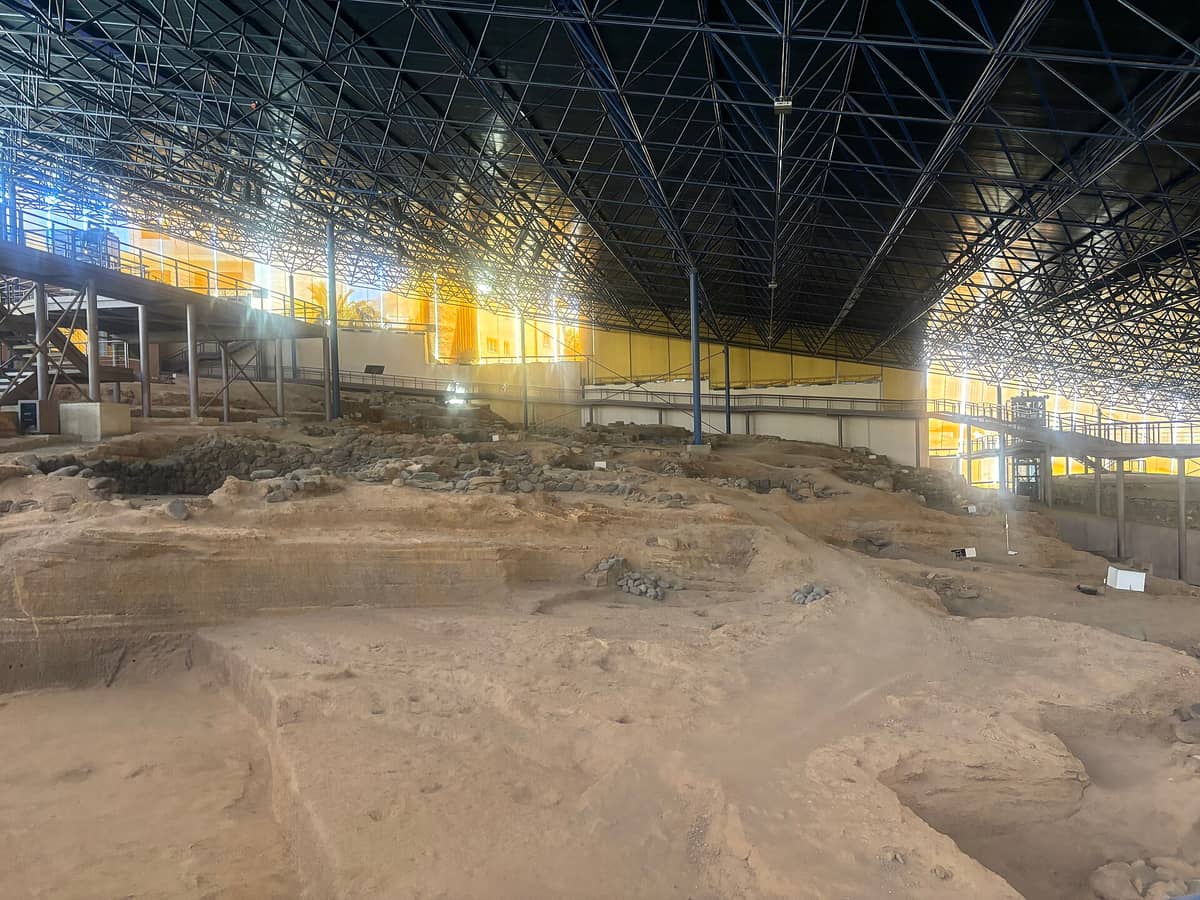
The park is operated by the Cabildo de Gran Canaria, the island's governing council, and the investment in how the site is presented shows. Rather than roping off some ruins in a field, the architects and curators have built a contemporary museum structure directly over the excavation. Visitors move through exhibition rooms that explain the Canario world, then descend into the archaeological zone itself, walking paths that weave between reconstructed grain stores, burial spaces, and the dwellings of people who lived here over a thousand years ago.
💡 Local tip
Access to the painted cave itself is carefully managed to protect humidity and temperature conditions. Entry is in small, timed groups. Book in advance if possible, especially on weekends and during school holidays when guided visit slots fill quickly.
The Cave and Its Paintings: What You Are Actually Looking At
The painted cave is modest in physical scale but extraordinary in detail. The interior walls are covered in geometric patterns: concentric rectangles, triangles, checkerboard fields, and circular motifs rendered in red, black, and white pigments. No figurative images of animals or humans appear; the art is purely geometric and repeating, creating an almost rhythmic visual texture across the rock surface. Whether the designs carried religious, calendrical, or territorial meaning is still debated among researchers, which adds an honest layer of mystery to the visit.
The cave's controlled microclimate means you will feel a noticeable drop in temperature and a slight dampness the moment you step inside. The lighting is low and directed to protect the pigments from degradation. This is not a place to rush through. The guide will point out specific sections of the decoration and explain the pigment chemistry and preservation challenges. It takes perhaps ten minutes inside, but those ten minutes tend to stay with visitors for a long time.
To understand what you are seeing in context, plan to spend time in the museum galleries before entering the cave. The displays cover Canario daily life, burial customs, ceramics, and the social structure of Gáldar, which was one of the island's most important political centres before conquest. If you are building a deeper picture of Gran Canaria's indigenous past, a visit to the Museo Canario in Las Palmas makes a strong companion trip, as its collections cover the broader archipelago-wide Canarian archaeological record.
The Archaeological Zone: Walking the Settlement
Beyond the cave, the outdoor archaeological zone gives the visit its physical scale. The excavated area reveals the foundations and partial reconstructions of round and rectangular structures: storage silos cut into the ground, circular habitation units, and pathways between them. The settlement extends across a considerable area, and walking through it gives a genuine sense of how densely populated this place once was.
The pathways are well-maintained and largely level, making movement through the site accessible for most visitors. Information panels are placed throughout in Spanish and English. Early morning light hits the stonework at a low angle that makes the textures particularly readable; by midday the site is bright and exposed, and the pale rock reflects heat in summer months. Wear comfortable shoes with grip, as some surfaces are uneven.
Gáldar itself was the capital of one of Gran Canaria's two pre-conquest kingdoms, the Guanartemato of Gáldar, ruled by a hereditary leader known as the Guanarteme. The town sits near the island's northwest coast, and the surrounding landscape of banana plantations and volcanic terrain gives the visit a geographic context that a trip to, say, the Cenobio de Valerón granary complex nearby reinforces well. Both sites speak to the sophistication of pre-Hispanic Canarian society in this part of the island.
Visiting in Practice: Hours, Seasons, and What Changes
The park operates on a seasonal schedule. From October to May, it opens Tuesday to Saturday from 10:00 to 18:00, with the last guided cave visit at 16:30. Sundays and public holidays run from 11:00 to 18:00. From June to September, hours extend slightly: Tuesday to Saturday from 10:30 to 19:30, last guided cave visit at 17:30; Sundays and holidays from 11:00 to 19:00, last visit at 17:30. The park is closed on Mondays and on 1, 5, and 6 January; 1 May; and 24, 25, and 31 December. Verify current times at the official site before travelling.
The visit experience changes meaningfully by season. In winter months, the light outside is soft and the air cool enough that the cave's chill feels gentle rather than sharp. Crowds are thinner on weekday mornings from November through February. Summer visits are entirely manageable but the outdoor zone gets warm by 11:00; arriving when the doors open and completing the outdoor walk before the cave tour avoids the worst of the midday heat.
⚠️ What to skip
The park is closed every Monday. This catches out many visitors who combine a trip to Gáldar with a drive along the north coast. Check your day of travel carefully before making the journey from Las Palmas, which takes around 30 to 40 minutes by road.
Getting to Gáldar
Most visitors arrive by car via the GC-2 motorway, which links Las Palmas de Gran Canaria to the northwest coast. Gáldar is well signposted from the main road. Parking in the town centre is available but limited in the immediate vicinity of the museum; arriving before 10:30 almost always means finding a space within a few minutes' walk. The drive itself is pleasant, running through the coastal cliffs and agricultural interior of the north.
Public buses from Las Palmas serve Gáldar town, operated by Global (Guaguas Global). Specific route numbers and timetables change periodically, so check the current schedule at the Global website before relying on this option. Gáldar is also a natural stop on a self-guided north coast loop; for route ideas, the Gran Canaria road trip guide covers the northwest coastal circuit in detail.
Accessibility and Practical Notes
The museum states that it is designed to be accessible to all visitors, with content intended to be understandable across different ages and backgrounds. The modern museum building has accessible routes, and the archaeological zone's main paths are navigable for most mobility levels, though some surface variation exists. For detailed information on specific accessibility features, including tactile or audiovisual resources, the park's official accessibility page provides the most current information, or visitors can contact the museum directly before their visit.
Photography is generally permitted in the museum and archaeological zone, but the painted cave requires attention: flash photography is almost certainly restricted to protect the pigments, and low-light conditions inside the cave make smartphone images difficult. A camera that handles low light reasonably well is worth bringing. Do not expect dramatic cave photography; the value here is in witnessing the paintings, not documenting them.
ℹ️ Good to know
Admission is €6 general, €3 reduced (students, seniors, unemployed) and €4 for groups and large families. Periodic free-entry days are offered; check the official website or social media channels before your visit for current promotions. Paying by card is generally possible, but carrying a small amount of cash is sensible in smaller Canarian towns.
Is It Worth the Journey from Las Palmas or the South?
For anyone with a genuine interest in history or archaeology, the answer is clearly yes. The Cueva Pintada is the kind of site that is difficult to convey through photographs: the scale is intimate, the detail is remarkable, and the guided structure of the visit means you leave with actual understanding rather than impressions. It does not compete with its own marketing image, which is relatively restrained. What you get is exactly what is described, and that honesty is refreshing.
Visitors looking purely for beaches or dramatic scenery will not get much from this stop. For those, the island's natural draws sit elsewhere. But if you are making a broader loop of Gran Canaria's cultural and natural sites, Cueva Pintada pairs naturally with a stop at the nearby coast at Puerto de las Nieves, or with a drive inland toward the volcanic landscapes of the centre. The day trips guide for Gran Canaria outlines how to structure a north coast circuit that takes in the museum alongside the coast and the agricultural towns nearby.
Travellers who struggle with limited mobility on uneven outdoor terrain may find the outdoor archaeological zone tiring, though the museum building itself is comfortable. Those who find guided tour formats restrictive should be aware that the cave portion of the visit is always accompanied by a guide: you cannot enter independently. The museum galleries and outdoor zone can be explored freely.
Insider Tips
- Arrive when the museum opens rather than around midday. The morning light in the outdoor archaeological zone is better for observing the stonework, and you will have a better chance of joining a smaller guided cave group.
- The guided cave visit is conducted in Spanish by default; ask when booking or on arrival whether an English-language guide is available that day. English-guided sessions do run but scheduling varies.
- Combine Cueva Pintada with a visit to Cenobio de Valerón, approximately 8 kilometres away near Santa María de Guía. Together they form a coherent picture of the scale and organisation of pre-Hispanic society in the northwest of the island, and neither requires more than half a day.
- The town of Gáldar itself has a handsome neoclassical church, the Iglesia de Santiago de los Caballeros, and a modest Plaza de Santiago where locals gather in the mornings. Spending 30 minutes walking the square after the museum adds texture to the visit without requiring any extra effort.
- Check the official website for occasional free-entry promotions, particularly around cultural heritage dates in May and specific local festivals. These are not heavily advertised outside the Canary Islands but can represent a useful saving.
Who Is Cueva Pintada Archaeological Park For?
- History and archaeology enthusiasts who want substance beyond a scenic photo
- Families with older children (10 and above) who can engage with guided interpretation
- Slow travellers building a picture of the Canary Islands before Spanish colonisation
- Road-trippers covering Gran Canaria's north coast circuit
- Visitors already planning a trip to Gáldar or the northwest corner of the island
Nearby Attractions
Other things to see while in Northern Villages: Teror, Arucas & Gáldar:
- Arucas Church (Iglesia de San Juan Bautista)
Rising dramatically above the banana plantations and rum distilleries of Arucas, the Iglesia de San Juan Bautista is Gran Canaria's most architecturally ambitious church. Built from local dark basalt stone and completed in neo-Gothic style, it dominates the town's skyline with a presence that belies its parish status. This guide tells you exactly what to expect inside, when to go, and how to get there.
- Basílica de Nuestra Señora del Pino
Standing at the heart of Teror's colonial square, the Basílica de Nuestra Señora del Pino is the spiritual centre of Gran Canaria. Home to the island's patron saint, it draws pilgrims and curious travellers alike with its ornate façade, incense-scented interior, and one of the most atmospheric town squares in the Canary Islands.
- Cenobio de Valerón
Cenobio de Valerón is one of the most remarkable archaeological sites in the Canary Islands: around 350 cavities carved into a volcanic cliff face by the island's aboriginal inhabitants to store grain. Set above the GC-2 road in the north of Gran Canaria, it rewards visitors with both history and sweeping coastal views.