Arucas Church (Iglesia de San Juan Bautista): The North's Most Striking Building
Rising dramatically above the banana plantations and rum distilleries of Arucas, the Iglesia de San Juan Bautista is Gran Canaria's most architecturally ambitious church. Built from local dark basalt stone and completed in neo-Gothic style, it dominates the town's skyline with a presence that belies its parish status. This guide tells you exactly what to expect inside, when to go, and how to get there.
Quick Facts
- Location
- Calle Párroco Morales, Arucas, Gran Canaria, Spain
- Getting There
- Global Bus Line 210 from Estación San Telmo (Las Palmas) to Puente de Arucas; ~10-min walk to church
- Time Needed
- 45–90 minutes inside; allow half a day if exploring Arucas town
- Cost
- €5 per person for tourist visits (since January 2024); free to attend Mass
- Best for
- Architecture lovers, photography, cultural day trips from Las Palmas
- Official website
- turismoarucas.com
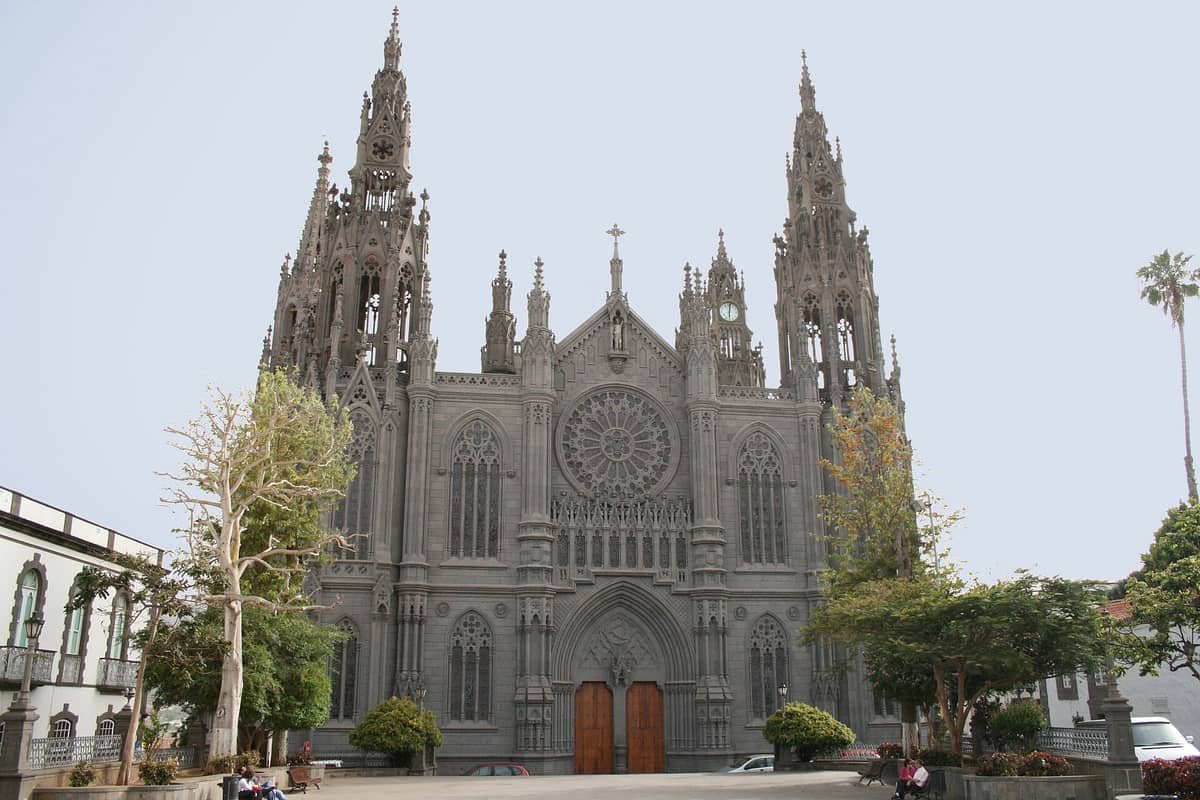
First Impressions: A Cathedral That Is Not a Cathedral
The Iglesia de San Juan Bautista announces itself long before you reach it. Approaching Arucas from Las Palmas along the GC-3, the twin towers emerge above the rooftops with the self-assurance of a proper cathedral. That comparison is intentional: locals have called it the 'Cathedral of Arucas' for generations, even though it functions as a parish church. No bishop is seated here, no diocese is governed from these walls. What you get instead is something rarer: genuine civic ambition, executed in stone over decades, and still used every week for ordinary parish life.
The building is constructed almost entirely from dark blue-grey basalt quarried locally in Arucas. On overcast mornings, that stone absorbs the flat Atlantic light and gives the church a brooding, almost northern European character that feels distinctly out of place among palm trees. On bright afternoons, the façade catches the sun differently, and the same stone warms to a deep charcoal with faint violet undertones. The effect shifts hour to hour in a way that rewards a second look.
ℹ️ Good to know
Since January 2024, a €5 per-person contribution is required for tourist visits to the interior. Attending Mass remains free. Confirm opening hours with the parish before arriving: recent local information lists Monday to Saturday 10:00–13:30 and 16:00–17:30, with Sundays and public holidays typically closed to tourist visits.
History and Construction: A Project That Took a Century
The current church building dates formally from 1909, when construction began in earnest on the neo-Gothic structure that stands today. But the story of a church on this site is much older: Arucas has had a religious building at its center since the early colonial period following the Spanish conquest of Gran Canaria in the late 15th century. What makes the current structure remarkable is not age but ambition. The people of Arucas, a prosperous town built on sugar cane and later banana cultivation and rum production, decided at the turn of the 20th century to build something proportionally extraordinary for a town this size.
Construction proceeded slowly across the 20th century, financed in part by local donations and civic pride. The neo-Gothic idiom chosen by the architects placed Arucas in direct dialogue with the great ecclesiastical building tradition of northern Spain and France, at a time when the Canary Islands were experiencing genuine economic growth from the export trade. The result is a building that reads architecturally as transplanted from Catalonia or the Basque Country, yet made entirely from Canarian rock by Canarian hands.
The stained-glass windows inside were produced by the French atelier a tradition shared with Gran Canaria's Cathedral of Santa Ana — specifically by the celebrated Maumejean et Frères firm, whose work appears in major European churches and basilicas. This is not a minor detail. The Maumejean windows bring a quality of light to the interior that elevates the building well beyond regional curiosity into something genuinely worth the detour.
Inside the Church: What You Actually See
The interior is cool, dim, and tall in the way that neo-Gothic architecture intends. Your eyes take a moment to adjust coming in from the Canarian sun. The nave stretches ahead with pointed arches marching toward the apse, and the ribbed vaulting overhead creates the sensation of being inside an upturned hull. The proportions are serious. This is not a prettified Baroque interior with gilded excess; it is spare, vertical, and deliberate.
The Maumejean stained glass is the centrepiece. Positioned in the nave and apse, the windows handle the Atlantic light well, filtering it into blues, golds, and deep reds that shift across the stone floor as the sun moves. Arrive in the late morning, around 11:00, and the light through the south-facing windows reaches its most dramatic angle. In the early afternoon, the apse windows glow directly. Photography is possible but the contrast between shadowed stonework and bright glass is challenging; bring patience and adjust your exposure manually if you can.
Alongside the windows, the church contains artworks by Canarian artists, including sculpture and devotional paintings that reflect the island's own religious traditions. A carved figure of San Juan Bautista occupies a position of prominence. The overall atmosphere is one of active parish life rather than museum stillness: flowers are sometimes fresh, candles are lit, and the smell of incense from a recent Mass may linger in the stone.
💡 Local tip
Late morning on a weekday is the quietest time for a tourist visit. Weekends see more local worshippers arriving for Mass and tour groups in the early afternoon. Arrive before 11:00 for the best light and the most peaceful experience.
Opening Hours, Tickets, and Practicalities
Tourist visiting hours have been reported as daily 09:30 to 17:30 by some sources, while others – including recent local information – specify Monday to Saturday 10:00 to 13:30 and 16:00 to 17:30, with Sundays and public holidays closed to tourist visits. The church remains open for Mass regardless. Given these discrepancies, confirming hours directly with the parish or the local tourism office before making a dedicated trip is strongly advised, particularly on Sundays and public holidays.
Mass is held Monday to Saturday at 18:30, and on Sundays and holidays at 08:30, 11:30, and 18:30. If you are visiting on a Sunday, arriving before the 11:30 Mass begins will give you a chance to see the church with worshippers present, which has its own atmospheric quality, though tourist movement inside is understandably limited during services. The parish phone number is 928 600 092 for direct queries, including accessibility needs.
The €5 visitor contribution introduced in January 2024 goes toward heritage conservation and maintenance. Some older travel resources still list the church as free to enter; those references predate the current policy. Dress modestly: shoulders covered, no beachwear. The stone floors are uneven in places, and the interior has no climate control, which means it is noticeably cool year-round and a welcome refuge in summer.
Getting to Arucas from Las Palmas
Arucas is approximately 18 kilometres from Las Palmas de Gran Canaria, making it a straightforward half-day trip from the capital. By public bus, take Global Bus Line 210 from Estación de San Telmo in Las Palmas. The journey takes around 30 to 40 minutes depending on traffic, and the fare is modest. Alight at Puente de Arucas and walk approximately 10 minutes into the town centre, where the church towers are visible as a navigation aid.
If you are coming from the south of the island, take a bus to Estación San Telmo in Las Palmas first, then connect to lines 205, 206, 210, or 234 to Arucas. By car from Las Palmas, the GC-3 is the most direct route, with the GC-20 offering an alternative through the interior. Parking in Arucas town centre exists but can be limited on weekend mornings when the local market brings additional visitors. The church itself sits on a central square and is easily located on foot.
💡 Local tip
Combine Arucas with the town's rum distillery (Destilerías Arehucas), which offers guided tours and tastings. The distillery is a short walk from the church and together they make a complete half-day without needing a car.
The Surrounding Town: Worth the Extra Hour
Arucas is not a place most visitors spend the night, but the town itself rewards an unhurried walk. The central square in front of the church has café terraces that face the façade directly, useful for sitting with a coffee and watching the stone change colour as clouds move over. The municipal garden nearby is well-maintained and quiet on weekday mornings. If you are building a broader northern itinerary, a day trip through the north of Gran Canaria can link Arucas with the agricultural valleys and coastal villages that define this part of the island.
The north of Gran Canaria has a different character from the southern resorts: greener, wetter, with banana plantations on terraced hillsides and a pace of life oriented around local agriculture and civic tradition rather than tourism. Arucas is one of the more prosperous and well-maintained towns in this zone. If the church sparks interest in the region, the Cenobio de Valerón — a remarkable pre-Hispanic granary carved into a cliff face — lies further west along the northern route and makes a logical continuation.
Photography Notes and Honest Caveats
The exterior of the church photographs best in the early morning, when the low eastern light catches the texture of the basalt and the square in front is mostly empty. By mid-morning, tour groups and local foot traffic fill the plaza, and the church is harder to photograph cleanly. The west-facing towers catch warm late-afternoon light well in summer, which can produce strong golden-hour shots, but the square becomes busier again as people return from work.
Inside, a wide-angle lens is helpful given the narrow nave width relative to the height. Tripods are unlikely to be permitted during visitor hours; steady your camera against a pew or column. Flash photography during services is not appropriate and should be avoided. The stained glass photographs most vividly when the sun is on the relevant side of the building, so time your visit accordingly.
One honest caveat: if you have visited the great Gothic cathedrals of mainland Spain or northern Europe, Arucas Church will feel modest in scale. The nave is comparatively short, and the overall footprint is that of a large parish church, not a metropolitan cathedral. The interest here lies in the ambition behind the building, the quality of specific elements like the Maumejean glass, and the architectural incongruity of seeing this style rise from a Canarian hillside town. Adjust expectations accordingly and you will not be disappointed.
Insider Tips
- The church's exterior reads completely differently in morning light versus afternoon. If you can only visit once, early morning gives you the dramatic dark basalt without the washed-out flatness of midday light, and the square is nearly empty before 10:00.
- Sitting at one of the café terraces on the plaza and ordering a coffee before entering gives you the best orientation. You can study the façade, identify the decorative details at the upper levels, and arrive inside already knowing what you are looking at.
- The Maumejean stained glass in the apse is best seen from the nave, not from directly underneath. Walk about two-thirds of the way back toward the entrance and look toward the altar: the full arrangement of the windows becomes readable from that distance.
- If you want to attend Mass rather than pay the visitor contribution, the Saturday evening Mass at 18:30 is typically the least crowded and gives you time in the interior with good late-afternoon light still coming through the west-facing windows.
- Combine the visit with Destilerías Arehucas nearby. The rum distillery tours run most mornings and the combination of Gothic church and functioning 19th-century distillery in the same hour captures something authentic about Arucas that no single attraction alone provides.
Who Is Arucas Church (Iglesia de San Juan Bautista) For?
- Architecture and design enthusiasts who appreciate the craft of Gothic stone building
- Photographers looking for a dramatic exterior subject away from the southern resort crowds
- Visitors based in Las Palmas seeking a culturally substantial half-day trip that does not require a car
- Travellers interested in Canarian history and the island's economic and social development in the early 20th century
- Anyone building a northern Gran Canaria day route who wants an anchor attraction with real visual impact
Nearby Attractions
Other things to see while in Northern Villages: Teror, Arucas & Gáldar:
- Basílica de Nuestra Señora del Pino
Standing at the heart of Teror's colonial square, the Basílica de Nuestra Señora del Pino is the spiritual centre of Gran Canaria. Home to the island's patron saint, it draws pilgrims and curious travellers alike with its ornate façade, incense-scented interior, and one of the most atmospheric town squares in the Canary Islands.
- Cenobio de Valerón
Cenobio de Valerón is one of the most remarkable archaeological sites in the Canary Islands: around 350 cavities carved into a volcanic cliff face by the island's aboriginal inhabitants to store grain. Set above the GC-2 road in the north of Gran Canaria, it rewards visitors with both history and sweeping coastal views.
- Cueva Pintada Archaeological Park
Hidden in the northern town of Gáldar, the Cueva Pintada Museum and Archaeological Park preserves an extraordinary painted cave and the remains of a Canario aboriginal settlement that predates the Spanish conquest. With a well-designed modern museum wrapped around a genuine ancient site, it is one of the most rewarding cultural stops on the island.