Cenobio de Valerón: Inside Gran Canaria's Ancient Cave Granary
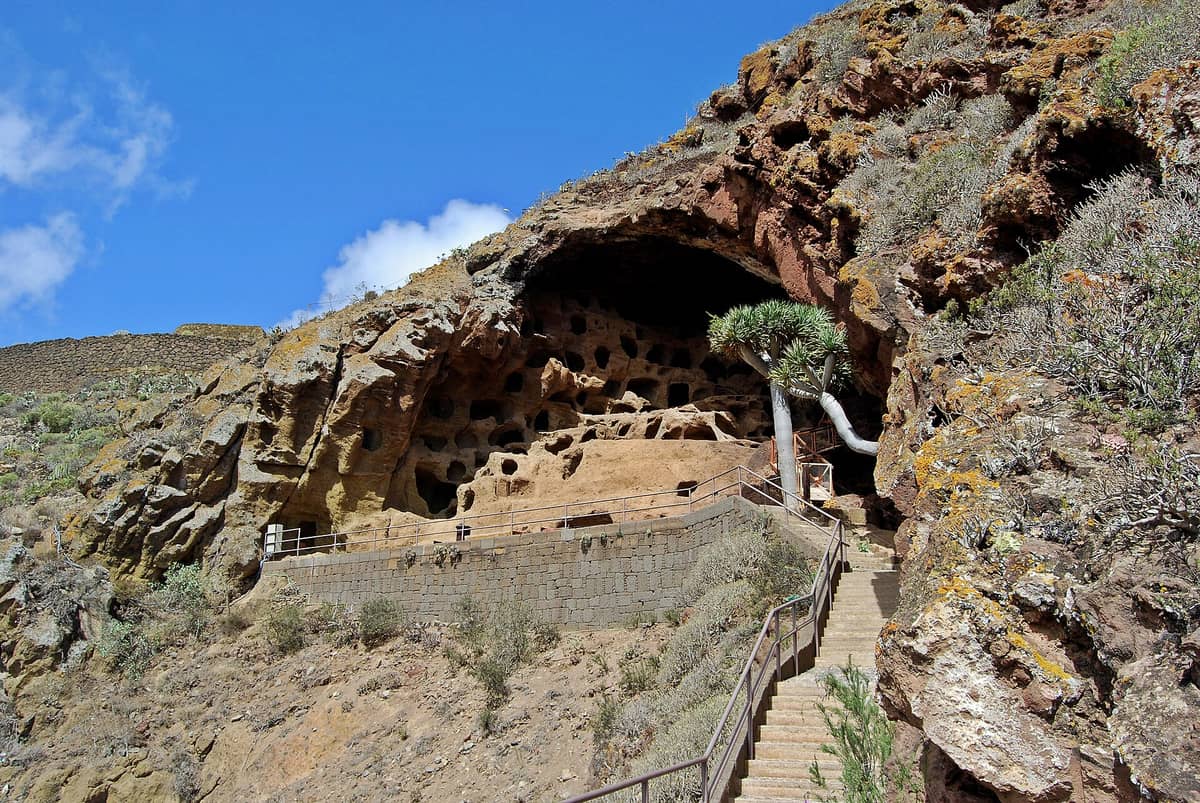
Cenobio de Valerón is one of the most remarkable archaeological sites in the Canary Islands: around 350 cavities carved into a volcanic cliff face by the island's aboriginal inhabitants to store grain. Set above the GC-2 road in the north of Gran Canaria, it rewards visitors with both history and sweeping coastal views.
Quick Facts
- Location
- Cuesta de Silva s/n, Santa María de Guía, northern Gran Canaria
- Getting There
- Global bus to Santa María de Guía, then taxi or car to the site; own transport strongly recommended
- Time Needed
- 45–90 minutes
- Cost
- €3 adults / €2 reduced (under 10 and people with disabilities free)
- Best for
- History lovers, archaeology fans, road-trippers exploring the north coast
- Official website
- http://www.cenobiodevaleron.com
What Is Cenobio de Valerón?
Cenobio de Valerón is a pre-Hispanic archaeological site on the north coast of Gran Canaria, consisting of roughly 350 cavities carved directly into a volcanic rock face. The site sits above the GC-2 coastal road in the municipality of Santa María de Guía, and from the road below you can already spot the honeycomb cliff face that makes this place instantly recognizable.
Despite the name 'cenobio' (which typically refers to a monastic community), the site was not a convent or religious retreat. It was a communal granary, built and used by the Canarii, the indigenous inhabitants of Gran Canaria before the Spanish conquest in the 15th century. The cavities were carved to store grain, likely protected by a governing social structure that controlled access. Early Spanish colonizers, impressed by its scale and apparent organization, misread it as a nunnery, and the name stuck.
ℹ️ Good to know
Opening hours vary by season. October to March: Tuesday–Sunday, 10:00–17:00. April to September: Tuesday–Sunday, 10:00–18:00. Closed Mondays and on 1 and 5–6 January, 1 May, and 24, 25, and 31 December.
The Physical Experience: Approaching and Entering the Site
The approach to Cenobio de Valerón is part of the experience. A short path climbs the hillside through scrubby vegetation, the air carrying the faint mineral smell of warm volcanic rock. As you ascend, the scale of the carved cliff becomes clearer: row upon row of openings at different depths, some shallow and open to the sky, others reaching back into darkness. The texture of the rock is rough and irregular, and the cavities are not uniform, each one slightly different in shape and size depending on the natural fissures the builders exploited.
Viewing platforms and prepared pathways make the site accessible without entering the cave complex directly. You circle around and above the granary rather than walking through it, which gives you a better overall sense of the architecture as a whole. The vantage points also open out to the northern coast and the banana plantations below, a combination of ancient and agricultural landscape that is distinctly Canarian.
Flash photography is not permitted inside or near the caves, both to protect the fragile rock surfaces and any remaining cultural residues. A standard camera or smartphone will work fine in good natural light, but the interior of deeper cavities can be dim, especially on overcast mornings.
Time of Day and Seasonal Considerations
The cliff face at Cenobio de Valerón faces roughly north and west, which means direct sunlight hits it for much of the morning and early afternoon. Visiting between 10:00 and 12:00 gives the best light for photography, with the sun illuminating the individual cave openings and casting clear shadows that define the texture of the rock. By mid-afternoon in summer, the light can become flat and harsh.
In the winter months (October to March), when closing time is 17:00, arriving before 15:00 gives you a comfortable window to explore without rushing. Summer visitors have until 18:00, which allows for a late afternoon visit after the midday heat has eased. The north of Gran Canaria tends to be cooler and more overcast than the south, particularly from late autumn through spring, so check the forecast before you go: a foggy morning on the north coast means poor visibility and flat photographs.
💡 Local tip
Weekday mornings in spring or autumn offer the quietest visit. School groups occasionally book visits, particularly mid-week during term time, so if silence matters to you, aim for Tuesday or Wednesday before 11:00 outside the local school calendar.
Historical and Cultural Context
The Canarii, Gran Canaria's pre-Hispanic population, developed a sophisticated society well before European contact. They were primarily pastoralists and agriculturalists who stored surplus grain in collective facilities, and Cenobio de Valerón represents one of the largest and most elaborately constructed examples of this practice on the island. The cavities were sealed and controlled, suggesting that access was managed and that the granary served a broader community rather than individual households.
The site sits within the broader archaeological landscape of the north of Gran Canaria, a region that contains numerous pre-Hispanic remains. If Cenobio de Valerón sparks your interest in indigenous Canarian culture, the Museo Canario in Las Palmas holds one of the most significant collections of Canarii artefacts in existence, including mummies, ceramics, and tools that help fill out the picture of daily life before the conquest.
The volcanic tuff rock used here is soft enough to carve with basic tools but durable enough to survive centuries of exposure. Looking closely at the interior surfaces, you can sometimes make out the marks left by stone implements. This is not a reconstructed or restored site in the conventional sense: what you are looking at is genuinely ancient, which makes the scale of the complex all the more striking.
Getting There and Practical Logistics
Cenobio de Valerón is located on the Cuesta de Silva road in Santa María de Guía, a municipality in the north of Gran Canaria. The site is signed from the GC-2, the main coastal road running through the north. If you are driving, there is a small parking area at the base of the site, though it fills quickly during peak periods.
Without a car, the journey is workable but requires planning. Global interurban buses connect Las Palmas de Gran Canaria with Santa María de Guía, but the final stretch to the site itself involves a road not served by regular buses, so you would need a taxi from the town centre. For most visitors, Cenobio de Valerón makes more sense as part of a self-drive road trip around the north coast, combined with other stops in the area.
The north of Gran Canaria is genuinely worth exploring beyond this single site. The nearby town of Agaete and the Valle de Agaete offer lush scenery and excellent local produce, while the neo-Gothic church of Arucas is a short drive east and makes for a logical pairing on the same day out.
⚠️ What to skip
The access road to the site is narrow and can get busy on weekends. If you are arriving by car, go early or on a weekday to avoid parking frustration.
Is It Worth the Trip?
At €3 for adults, Cenobio de Valerón is one of the most affordable and genuinely distinctive archaeological experiences in the Canary Islands. The combination of raw visual impact, clear historical significance, and coastal views makes it more rewarding than many higher-profile sites. The visit itself is short: most people spend between 45 minutes and 90 minutes here, including time on the viewing platforms and the walk up and back.
That said, visitors who are not interested in pre-Hispanic history and who are primarily visiting Gran Canaria for beach time or the south coast resorts may find the detour to the north coast adds more travel time than the site can justify on its own. If that is you, consider whether a broader day trip through the north would give the journey more value.
People with limited mobility should be aware that the path to the viewing platforms involves an uphill climb on uneven terrain. The site provides free entry for visitors with functional diversity, but detailed wheelchair access information is not confirmed in official sources, so it is worth contacting the site directly before visiting if this is a concern.
Insider Tips
- Visit on a clear morning after overnight rain: the north coast air is sharp, the rock colour deepens when damp, and the banana plantation below has a vivid green that makes the whole scene more photogenic.
- The small car park fills fast on summer weekends. Arriving at opening time (10:00) almost guarantees a space and a quiet first look before coach groups from Las Palmas arrive.
- Bring a small torch or use your phone light to look into the deeper cavities from the platform edge. You cannot enter them, but the light picks out tool marks on the back walls that are invisible from a distance.
- Combine the visit with a stop at Santa María de Guía town for the local cheese, Queso de Guía. It is one of the most distinctive cheeses produced on the island and the town's market is a few minutes' drive from the site.
- If you plan to visit multiple archaeological sites on the island, Cenobio de Valerón pairs well with the Cueva Pintada museum in nearby Gáldar, which covers a different but complementary aspect of Canarii culture with its painted cave and on-site museum.
Who Is Cenobio de Valerón For?
- History and archaeology enthusiasts who want to understand Gran Canaria beyond its beaches
- Road-trippers combining a north coast circuit with Agaete, Gáldar, and Arucas
- Photographers interested in ancient rock architecture and coastal landscape
- Families with older children (10+) curious about pre-Hispanic island culture
- Budget-conscious travellers looking for high-impact, low-cost cultural experiences
Nearby Attractions
Other things to see while in Northern Villages: Teror, Arucas & Gáldar:
- Arucas Church (Iglesia de San Juan Bautista)
Rising dramatically above the banana plantations and rum distilleries of Arucas, the Iglesia de San Juan Bautista is Gran Canaria's most architecturally ambitious church. Built from local dark basalt stone and completed in neo-Gothic style, it dominates the town's skyline with a presence that belies its parish status. This guide tells you exactly what to expect inside, when to go, and how to get there.
- Basílica de Nuestra Señora del Pino
Standing at the heart of Teror's colonial square, the Basílica de Nuestra Señora del Pino is the spiritual centre of Gran Canaria. Home to the island's patron saint, it draws pilgrims and curious travellers alike with its ornate façade, incense-scented interior, and one of the most atmospheric town squares in the Canary Islands.
- Cueva Pintada Archaeological Park
Hidden in the northern town of Gáldar, the Cueva Pintada Museum and Archaeological Park preserves an extraordinary painted cave and the remains of a Canario aboriginal settlement that predates the Spanish conquest. With a well-designed modern museum wrapped around a genuine ancient site, it is one of the most rewarding cultural stops on the island.