El Museo Canario: Inside Gran Canaria's Most Important Archaeological Museum
El Museo Canario in Vegueta, Las Palmas, holds the definitive collection of pre-Hispanic Canarian artifacts, including one of the largest assemblages of ancient skulls in Europe. For anyone serious about understanding the islands' indigenous Guanche culture, this is the most important building on Gran Canaria.
Quick Facts
- Location
- Calle Doctor Verneau, 2, Vegueta, Las Palmas de Gran Canaria
- Getting There
- Urban guagua (city bus) to Vegueta; walkable from the historic centre
- Time Needed
- 1.5 to 2.5 hours
- Cost
- €6 (non-residents); €5 (residents); €3 reduced; free for under-12s, members, and visitors with a recognized disability of 33% or higher
- Best for
- History lovers, archaeology enthusiasts, culture-focused travellers
- Official website
- www.elmuseocanario.com
What Is El Museo Canario?
El Museo Canario, formally the Sociedad Científica El Museo Canario, is a scientific institution dedicated to the archaeological and ethnographic study of the pre-Hispanic Canary Islands. Its collection focuses almost entirely on the pre-Hispanic inhabitants of the Canary Islands, the indigenous people commonly referred to as the Guanches, though on Gran Canaria they were known as the Canarii. This is not a generalist regional museum with a bit of everything. It is a focused scientific institution with serious scholarly depth.
The museum sits on Calle Doctor Verneau, 2, in the Vegueta quarter, Las Palmas de Gran Canaria's oldest neighbourhood. The surrounding streets are lined with colonial-era buildings, carved wooden balconies, and stone cobbles worn smooth by centuries of foot traffic. Even before you step inside, the neighbourhood tells a story about how layers of history accumulate on a small island.
Vegueta itself is worth at least half a day of exploration. The Catedral de Santa Ana and the Casa de Colón are both within a few minutes' walk, making it straightforward to combine El Museo Canario with a broader morning in the historic quarter.
The Collection: What You Will Actually See
The museum's permanent collection is organized around the material culture of the Canarii, the indigenous people who inhabited Gran Canaria before Spanish conquest in the 15th century. The rooms move through archaeology, physical anthropology, and daily life in a sequence that rewards slow, attentive visitors.
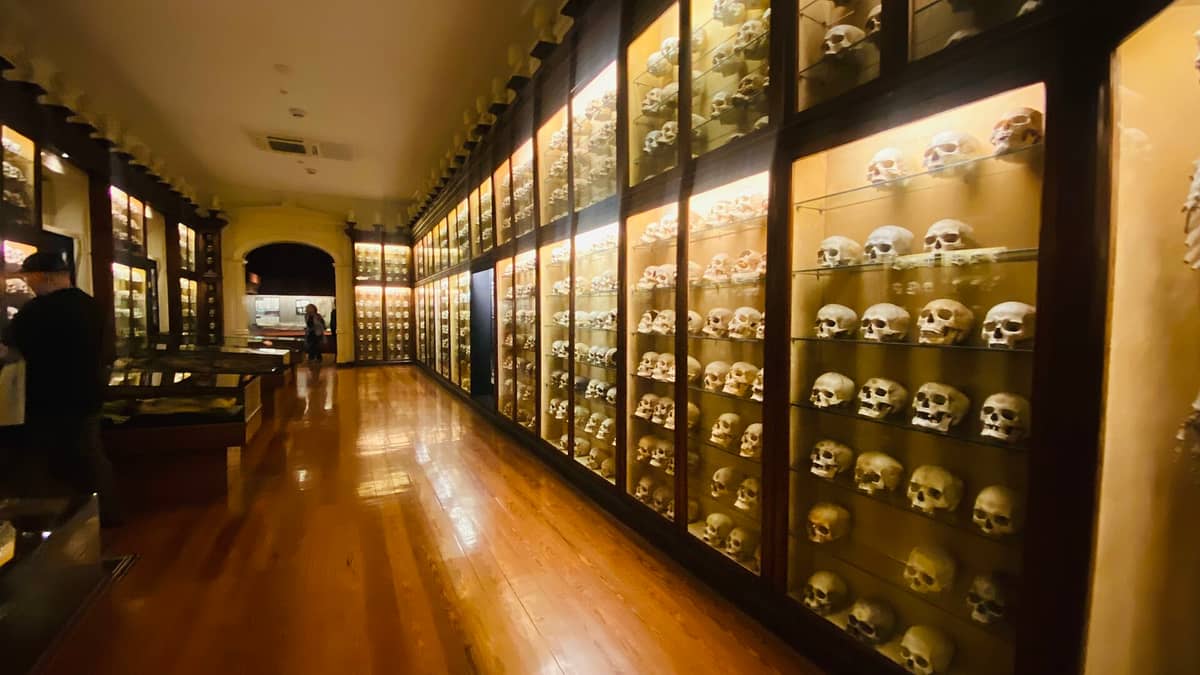
The most immediately striking section is the ossuary, a room containing hundreds of ancient skulls arranged in dense rows behind glass. It is one of the largest osteological collections of pre-Hispanic Canarian remains and has a genuinely arresting quality. This is not gratuitous spectacle. The display is accompanied by scientific context explaining what skeletal analysis has revealed about diet, disease, social structure, and the genetic origins of the island's first inhabitants.
Ceramics, mummified remains, stone tools, personal ornaments, and grain storage vessels round out the collection. The pottery is particularly notable: Canarii ceramics were made without a wheel, hand-built using techniques that researchers have traced back to Berber populations in present-day Morocco. The forms are elegant despite their simplicity, and the museum displays enough intact pieces to give a real sense of material sophistication.
💡 Local tip
Pick up an audio guide or tablet guide at reception. The English-language labels throughout the museum are adequate, but the supplementary guides add significant context to the physical anthropology rooms, which can otherwise feel dense without background knowledge.
The Building and Its Atmosphere
The museum occupies a handsome 19th-century building arranged around a central courtyard, a form typical of Canarian civic architecture. The courtyard provides a useful moment of orientation between the denser exhibit rooms.
Natural light filters into the ground-floor rooms unevenly. Some sections are well-lit and easy to photograph; others are deliberately dim to protect organic materials. If you plan to photograph the ceramics or smaller artifacts, the morning hours before midday tend to offer the clearest light in the upper rooms.
Opening Hours, Prices, and Practical Access
The museum is open Monday to Friday from 10:00 to 20:00. On Saturday, Sunday, and public holidays the hours shorten significantly to 10:00 to 14:00 only. The museum is closed on 1 January and 25 December. The Documentation Centre, a research library attached to the institution, operates Monday to Friday from 10:00 to 17:00.
Admission is €6 for non-residents and €5 for residents of the Canary Islands. A reduced rate of €3 applies to students, unemployed visitors, large families, and pensioners who can show qualifying documentation. Children aged 12 and under enter free, as do current museum members. Visitors with an officially recognized disability of 33% or higher also enter free.
⚠️ What to skip
Accessibility note: The museum's own documentation states that its facilities are not yet fully adapted for visitors with reduced mobility, pending extension works. Adapted resources including audio guides, tablets with a sign-language guide, and an easy-reading guide are available on request at reception. Visitors with specific mobility needs should contact the museum in advance.
To reach the museum by public transport, city guaguas connect the central areas of Las Palmas with Vegueta. The museum is also comfortably walkable from other Vegueta landmarks. Verify current fares before travel, as these change periodically.
Best Time to Visit and Crowd Patterns
Weekday mornings between 10:00 and 12:00 are consistently the quietest window. The museum attracts a mix of academic visitors, school groups, and culturally curious tourists, but it never reaches the saturation levels of more famous European museums. Even on a busy Saturday morning, the rooms rarely feel crowded. The short weekend hours, closing at 14:00, mean late risers may feel rushed. Arriving by 10:30 on a Saturday gives a comfortable two hours before closing.
Gran Canaria's year-round mild climate means there is no dramatically better or worse season for visiting an indoor museum. That said, pairing a museum visit with a Vegueta walking morning works best from October through April, when outdoor temperatures are comfortable for extended walking. Summer visits in July and August are perfectly fine inside the museum, but the midday heat outside can make the surrounding street exploration tiring.
If you are building a wider itinerary around the island's pre-Hispanic history, the Cueva Pintada in Gáldar and the Cenobio de Valerón grain silos in the north are the logical follow-ups to what El Museo Canario explains in archaeological context. The museum makes those outdoor sites significantly more legible.
Cultural Significance: Why This Museum Matters
The Canarii arrived on Gran Canaria thousands of years before the Spanish conquest, almost certainly from North Africa. They developed a complex society with social hierarchies, agricultural systems based on barley and goat herding, and sophisticated cave architecture. The Spanish conquest of Gran Canaria, completed in 1483, effectively ended this culture as a living tradition within a generation.
El Museo Canario is the primary institution charged with preserving and interpreting what survives of that world. Its collection has grown since the museum was founded in the 19th century through the work of the Sociedad Científica El Museo Canario, a scientific society that predates the current building. The institution occupies an unusual position, being both a public-facing museum and an active research body with its own documentation centre and academic publications.
For travellers exploring Gran Canaria's inland mountain towns, understanding the pre-Hispanic population adds texture to places like Tejeda and sites like Roque Bentayga, which held significant ritual importance for the Canarii.
Who Should Skip This Museum
Visitors looking primarily for dramatic interactive displays, children's activity zones, or contemporary art will find little to hold their attention here. El Museo Canario is a traditional archaeological museum with a scholarly orientation. The exhibits are well-presented but not theatrical. Young children under around ten are unlikely to engage meaningfully unless they have a specific interest or an adult willing to interpret each display actively.
Travellers on very short trips who are prioritizing beaches and outdoor scenery can reasonably skip this. It is not a casual drop-in attraction. The museum rewards visitors who arrive with at least a baseline curiosity about archaeology or Canarian history, and who are willing to spend 90 minutes to two and a half hours inside.
Insider Tips
- The weekday late afternoon slot, around 17:00 to 19:00, is almost entirely tourist-free. You get the ossuary room essentially to yourself, which changes the experience considerably.
- The museum's Documentation Centre holds a research library that is open to the public on weekdays until 17:00. If you have a specific academic interest in Canarian prehistory, reception staff can advise on access.
- Combine your visit with the Vegueta market on Sunday mornings, but note the museum only opens until 14:00 on Sundays, so plan the museum first and the market afterwards.
- The courtyard is quiet and shaded. It makes a good five-minute pause between the ground and upper floor rooms, especially on warmer days.
- Photography of the permanent collection is generally permitted without flash. The ceramic rooms on the upper floor photograph well in the morning light. Always confirm photography rules at the ticket desk on arrival, as policies can vary.
Who Is Museo Canario For?
- Travellers with a genuine interest in pre-Hispanic cultures and Canarian archaeology
- History-focused visitors building a thematic itinerary around the island's indigenous heritage
- Those spending a day in Vegueta who want to anchor the neighbourhood's history with deeper context
- Slow travellers and cultural tourists who prefer museums over beach resorts
- Students and researchers with access to the museum's Documentation Centre
Nearby Attractions
Other things to see while in Vegueta:
- CAAM – Centro Atlántico de Arte Moderno
Housed in restored colonial buildings on one of Vegueta's most atmospheric streets, the Centro Atlántico de Arte Moderno (CAAM) is Las Palmas de Gran Canaria's leading contemporary art institution. Admission is free, the programming is genuinely ambitious, and the setting alone justifies the detour.
- Casa de Colón
Housed in one of the finest colonial buildings in the Canary Islands, Casa de Colón traces the voyages of Christopher Columbus and the founding history of Las Palmas de Gran Canaria. Located in the Vegueta old quarter, it is one of the most rewarding indoor attractions in the city, and entry is free every Sunday.
- Casa-Museo Pérez Galdós
The Casa-Museo Pérez Galdós preserves the Triana townhouse where Benito Pérez Galdós was born in 1843, offering intimate guided tours through period rooms, original manuscripts, and personal belongings. Admission is free, and the house gives real texture to the literary history of the Canary Islands.
- Catedral de Santa Ana
Standing on Plaza de Santa Ana since the late 15th century, the Catedral-Basílica de Santa Ana is the oldest cathedral in the Canary Islands and the architectural anchor of Vegueta, Las Palmas's historic quarter. Its layered Gothic and Neoclassical facade tells five centuries of island history in stone, while the tower rewards those who climb it with some of the best rooftop views in the city.