CAAM – Centro Atlántico de Arte Moderno: Modern Art in the Heart of Vegueta
Housed in restored colonial buildings on one of Vegueta's most atmospheric streets, the Centro Atlántico de Arte Moderno (CAAM) is Las Palmas de Gran Canaria's leading contemporary art institution. Admission is free, the programming is genuinely ambitious, and the setting alone justifies the detour.
Quick Facts
- Location
- Los Balcones 11–13, Vegueta, Las Palmas de Gran Canaria
- Getting There
- Walkable from central Vegueta; city guagua bus lines serve the district
- Time Needed
- 1 to 2 hours depending on current exhibitions
- Cost
- Free admission to all exhibitions
- Best for
- Art lovers, architecture enthusiasts, culture-focused travelers, free-attraction seekers
- Official website
- caam.net
What Is CAAM and Why Does It Matter
The Centro Atlántico de Arte Moderno, universally known by its acronym CAAM, is Gran Canaria's most serious contemporary art institution. It occupies a row of carefully restored historic buildings on Calle de los Balcones in Vegueta, the colonial old town of Las Palmas de Gran Canaria. The address alone tells you something about the institution's ambitions: this is one of the most architecturally significant streets in the Canary Islands, lined with the ornate wooden balconies that define the region's urban heritage.
CAAM's programming is built around a specific curatorial idea: the Atlantic as a meeting point for European, African, and American cultures. That tricontinental focus sets it apart from mainstream European art museums and explains why its exhibitions often feature artists and movements that larger institutions on the continent overlook. If you arrive expecting a conventional survey of Western modernism, you will find something more interesting and less predictable.
Free admission to all exhibitions means there is no financial barrier to entry, which is unusual for an institution of this calibre. It also means the museum draws a genuinely mixed crowd: art students, local families on Sunday mornings, international visitors weaving CAAM into a broader tour of Vegueta, and the occasional traveler who stumbled in from the street and stayed longer than planned.
ℹ️ Good to know
Opening hours: Tuesday–Saturday 10:00–21:00, Sunday 10:00–14:00. Closed Mondays, public holidays, and 24 & 31 December. Access to exhibition halls ends 30 minutes before closing. Admission is free. Verify hours at caam.net before visiting, as summer schedules for the library differ.
The Building: Architecture as Part of the Experience
The CAAM building complex is not a purpose-built white cube. It is a sequence of colonial-era structures that have been sensitively adapted to display contemporary work. The integration of old masonry, internal courtyards, and modern interventions creates a spatial rhythm that few purpose-built museums can replicate. Moving between rooms, you shift between centuries without any sense of awkwardness.
Calle de los Balcones, where the main entrance sits, is one of those streets that stops pedestrians mid-stride. The carved timber balconies overhead are characteristic of Canarian urban architecture, a style that blends Andalusian, Portuguese, and colonial influences developed over several centuries. Standing outside the entrance and looking up at the facade, before you have even entered, is a worthwhile moment.
The surrounding block is itself a reason to linger. A short walk in any direction puts you near the Cathedral of Santa Ana, the Plaza de Santa Ana, and a cluster of historic institutions that make Vegueta one of the most coherent historic districts in the entire Atlantic archipelago. CAAM fits naturally into that landscape rather than interrupting it.
What to Expect Inside: Exhibitions and Atmosphere
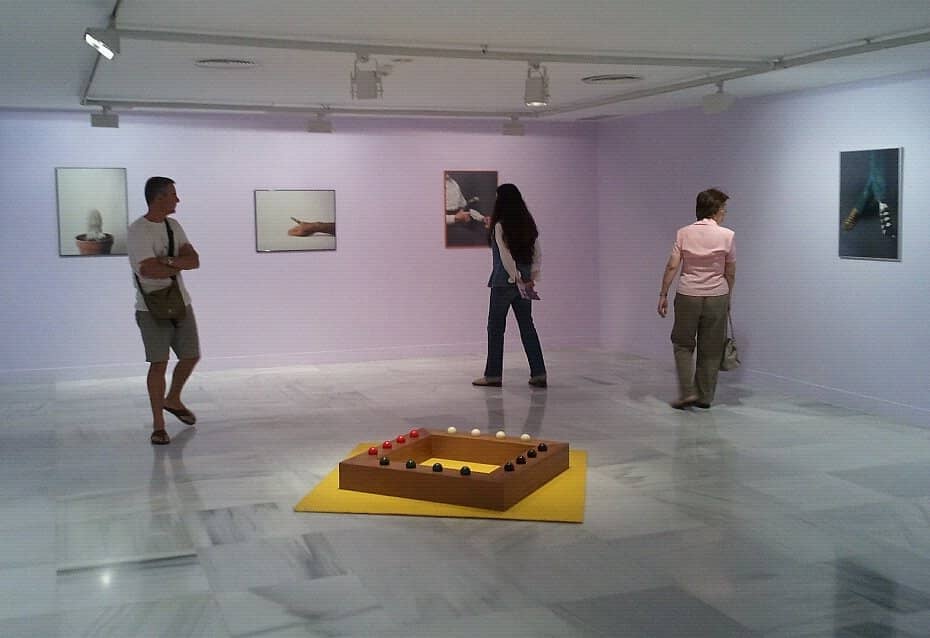
CAAM runs a changing programme of temporary exhibitions across its gallery spaces, supplemented by a permanent collection focused on modern and contemporary Atlantic art. The work on display at any given time ranges from painting and sculpture to installation, video art, and photography. Because the programme rotates, no two visits are identical, and repeat visitors from Las Palmas treat the museum as an ongoing resource rather than a one-time destination.
The atmosphere inside is calm without feeling sterile. Lighting is careful throughout, and the gallery rooms vary enough in scale that large-format works and intimate pieces both have appropriate settings. The acoustic texture shifts as you move through the building: the internal courtyard, if accessible, offers a quieter pause between exhibition rooms, with ambient city sound filtered down to something low and steady.
The library and documentation centre is open to the public on weekdays, providing access to specialist art publications, catalogues, and reference materials. This is not a tourist amenity in the conventional sense; it is a working research resource, but one that is genuinely open to curious visitors who want to go deeper into the collection or the themes it addresses.
💡 Local tip
Check the current exhibition listings on caam.net before your visit. The museum's programme is theme-driven and contextually rich; reading a short summary of what is on display will significantly deepen the experience inside.
Best Time to Visit and How the Experience Changes
Tuesday through Saturday evenings are the most rewarding time to visit from a practical standpoint. The museum stays open until 21:00, which means you can arrive after the midday heat of summer, spend the cooler late afternoon in the galleries, and walk out into Vegueta as the light turns golden and the neighbourhood's cafe terraces fill up. This evening window is one of CAAM's underused advantages.
Sunday mornings attract a noticeable local crowd, particularly families. The galleries are busier than on weekday afternoons, but the mood is relaxed rather than crowded. Sunday hours cut off at 14:00, so arrive well before noon to give yourself enough time without feeling rushed. Monday closures are firm, and public holiday closures apply as well, so always confirm before making a specific trip.
Because CAAM is located in Vegueta, a morning visit pairs naturally with the weekly market at Vegueta Market and a walk through the district's historic streets before the afternoon sun makes outdoor exploration less comfortable. This combination makes for a full, varied half-day without requiring any transport.
Getting There and Practical Logistics
CAAM's address is Los Balcones 11–13, in the Vegueta district of Las Palmas de Gran Canaria. The museum is walkable from the surrounding historic streets and easily reachable by city bus. Las Palmas operates an urban guagua network, and several lines serve the Vegueta area; check current routes and stops with the municipal operator before travelling, as schedules and stop locations are subject to change.
If you are staying in the Santa Catalina area or near Las Canteras beach, the walk to Vegueta takes around 30 to 40 minutes on foot through the Triana shopping district, which is itself worth exploring. A bus is a faster alternative.
Parking in Vegueta is limited and the streets are narrow, so arriving by car is not recommended if you have alternatives. Visitors with mobility considerations should note that CAAM publishes dedicated accessibility information on its website, including adapted access and support services. Guide dogs are explicitly permitted; other animals are not. All visitors pass through a standard security check on entry.
⚠️ What to skip
Note that access to exhibition spaces ends 30 minutes before closing time. If you arrive at 20:40 on a Saturday, you will not be admitted to the galleries. Plan accordingly, especially for evening visits.
CAAM in the Context of Vegueta's Cultural Offer
CAAM is one of several serious cultural institutions in Vegueta, and the district rewards a full day rather than a single-stop visit. The Museo Canario sits close by and holds an extensive archaeological collection documenting the pre-Hispanic Guanche civilisation of the Canary Islands. The contrast between the two museums, one focused on deep pre-colonial history, the other on contemporary Atlantic dialogue, is a striking illustration of how much intellectual range this compact neighbourhood contains.
The Casa de Colón, a beautifully preserved colonial mansion associated with Christopher Columbus's Atlantic voyages, is also within easy walking distance. Together, these three institutions form one of the most culturally concentrated clusters in the Canary Islands, all free or low-cost, all within a ten-minute walk of each other.
For travelers building an itinerary around the city, the Las Palmas cultural guide covers how to sequence Vegueta's attractions effectively, including timing recommendations that account for opening hours and pedestrian flow through the historic streets.
Photography and What to Know Before You Shoot
Photography rules inside CAAM depend on the specific exhibitions in place, as some works are subject to artist or rights-holder restrictions. Check with staff at the entrance about what is permitted before raising your camera in the galleries. As a general principle, flash photography and tripods are typically prohibited in contemporary art museums, and CAAM follows standard institutional practice.
Outside the building, the Calle de los Balcones facade is one of the more photogenic stretches in Vegueta. Early morning light hits the carved timber balconies from a low angle that brings out the texture of the woodwork. If you want the street quiet and the architecture unobstructed by pedestrians and parked vehicles, arrive before 10:00 on a weekday.
Honest Assessment: Who Will Love It and Who Might Not
CAAM is a genuinely good museum for its category. The curatorial focus is distinctive, the building is interesting, and the free admission removes any sense of obligation to get your money's worth. For travelers with a serious interest in contemporary art, particularly work that sits outside the mainstream European canon, it is one of the more rewarding museum visits available in the Canary Islands.
Travelers with no particular interest in contemporary art are unlikely to find the experience revelatory. The museum does not have a permanent blockbuster collection that functions as a guaranteed draw regardless of taste. If you are looking for a quick cultural checkbox on a beach-focused itinerary, thirty minutes inside is probably enough to satisfy curiosity. But if modern art is genuinely your thing, plan for longer and time your visit to overlap with whatever temporary exhibition is current.
Young children may find the visit short on interactive elements. CAAM is a contemplative space with a predominantly adult audience. That said, the building's architecture and the courtyard areas provide enough visual interest for older children with a degree of curiosity.
Insider Tips
- The museum stays open until 21:00 Tuesday through Saturday. A late-afternoon arrival lets you miss the midday heat, spend the golden hour in the galleries, and walk out into Vegueta at its most atmospheric.
- The building complex contains internal courtyards that most visitors pass through without stopping. Take a moment to stand still in the courtyard space between rooms. The ambient acoustics and the architectural framing of the sky above are worth pausing for.
- The on-site library and documentation centre is open to the public on weekday mornings. If you have a research interest in Atlantic art or the Canarian cultural context, this is a genuinely useful resource that almost no visitor mentions.
- CAAM's programme often includes artist talks, guided visits, and educational events, some of which are free and open to the public. Check the events calendar on caam.net a few days before your visit, as these are rarely advertised through tourist channels.
- Combine your visit with a walk down Calle de los Balcones early in the morning, before the museum opens, when the timber balconies catch the low sun and the street is quiet. The architectural setting is as much a reason to come here as the art inside.
Who Is CAAM – Centro Atlántico de Arte Moderno For?
- Contemporary art enthusiasts looking for programming beyond the mainstream European canon
- Architecture lovers interested in Canarian colonial heritage adapted for modern use
- Budget-conscious cultural travelers, since admission is entirely free
- Visitors building a full-day itinerary around Vegueta's historic district
- Digital nomads and longer-stay visitors in Las Palmas who want a recurring cultural resource
Nearby Attractions
Other things to see while in Vegueta:
- Casa de Colón
Housed in one of the finest colonial buildings in the Canary Islands, Casa de Colón traces the voyages of Christopher Columbus and the founding history of Las Palmas de Gran Canaria. Located in the Vegueta old quarter, it is one of the most rewarding indoor attractions in the city, and entry is free every Sunday.
- Casa-Museo Pérez Galdós
The Casa-Museo Pérez Galdós preserves the Triana townhouse where Benito Pérez Galdós was born in 1843, offering intimate guided tours through period rooms, original manuscripts, and personal belongings. Admission is free, and the house gives real texture to the literary history of the Canary Islands.
- Catedral de Santa Ana
Standing on Plaza de Santa Ana since the late 15th century, the Catedral-Basílica de Santa Ana is the oldest cathedral in the Canary Islands and the architectural anchor of Vegueta, Las Palmas's historic quarter. Its layered Gothic and Neoclassical facade tells five centuries of island history in stone, while the tower rewards those who climb it with some of the best rooftop views in the city.
- Museo Canario
El Museo Canario in Vegueta, Las Palmas, holds the definitive collection of pre-Hispanic Canarian artifacts, including one of the largest assemblages of ancient skulls in Europe. For anyone serious about understanding the islands' indigenous Guanche culture, this is the most important building on Gran Canaria.