Casa-Museo Pérez Galdós: Inside the Birthplace of Spain's Greatest Novelist
The Casa-Museo Pérez Galdós preserves the Triana townhouse where Benito Pérez Galdós was born in 1843, offering intimate guided tours through period rooms, original manuscripts, and personal belongings. Admission is free, and the house gives real texture to the literary history of the Canary Islands.
Quick Facts
- Location
- Calle Cano 2 y 6, Triana district, Las Palmas de Gran Canaria
- Getting There
- Urban bus to Triana; short walk from Vegueta historic centre
- Time Needed
- 1 to 1.5 hours (guided tour, starting on the hour, last access 17:00)
- Cost
- Free admission for all visitors
- Best for
- Literature lovers, Spanish history enthusiasts, quiet cultural mornings
- Official website
- perezgaldos.grancanaria.com/en/visita
What Is the Casa-Museo Pérez Galdós?
The Casa-Museo Pérez Galdós is the preserved birthplace and childhood home of Benito Pérez Galdós, widely regarded as the greatest Spanish novelist since Cervantes. Located on Calle Cano in Las Palmas de Gran Canaria's Triana district, the house now functions as a museum and has become one of the most carefully maintained literary museums in Spain. Entry is completely free, which makes it one of the most accessible cultural stops in the Canary Islands.
Galdós was born here in 1843 and grew up in this compact, mid-19th-century Canarian townhouse before leaving for Madrid, where he would produce an extraordinary body of work: 31 major contemporary novels, 46 historical novels in the Episodios Nacionales series, 23 plays, and thousands of pages of journalism. His Episodios Nacionales series alone covers nearly a century of Spanish history across 46 volumes. The museum gives visitors a rare opportunity to understand the domestic and cultural world that shaped that ambition.
ℹ️ Good to know
Tours are guided only and begin on the hour. The last entry is at 17:00, even though the museum is open until 18:00. Arrive a few minutes early to join the next tour without waiting.
The House Itself: What You Will See
The building occupies two adjacent properties on Calle Cano, numbers 2 and 6, connected internally. The architecture is typical of prosperous 19th-century Canarian urban construction: solid stone walls, shaded interior courtyards, and high-ceilinged rooms that stay noticeably cool even in summer. The ground floor courtyard, with its worn stone paving and potted plants, sets a quiet tone the moment you step inside. Street noise from the nearby commercial strip of Calle Triana fades almost immediately.
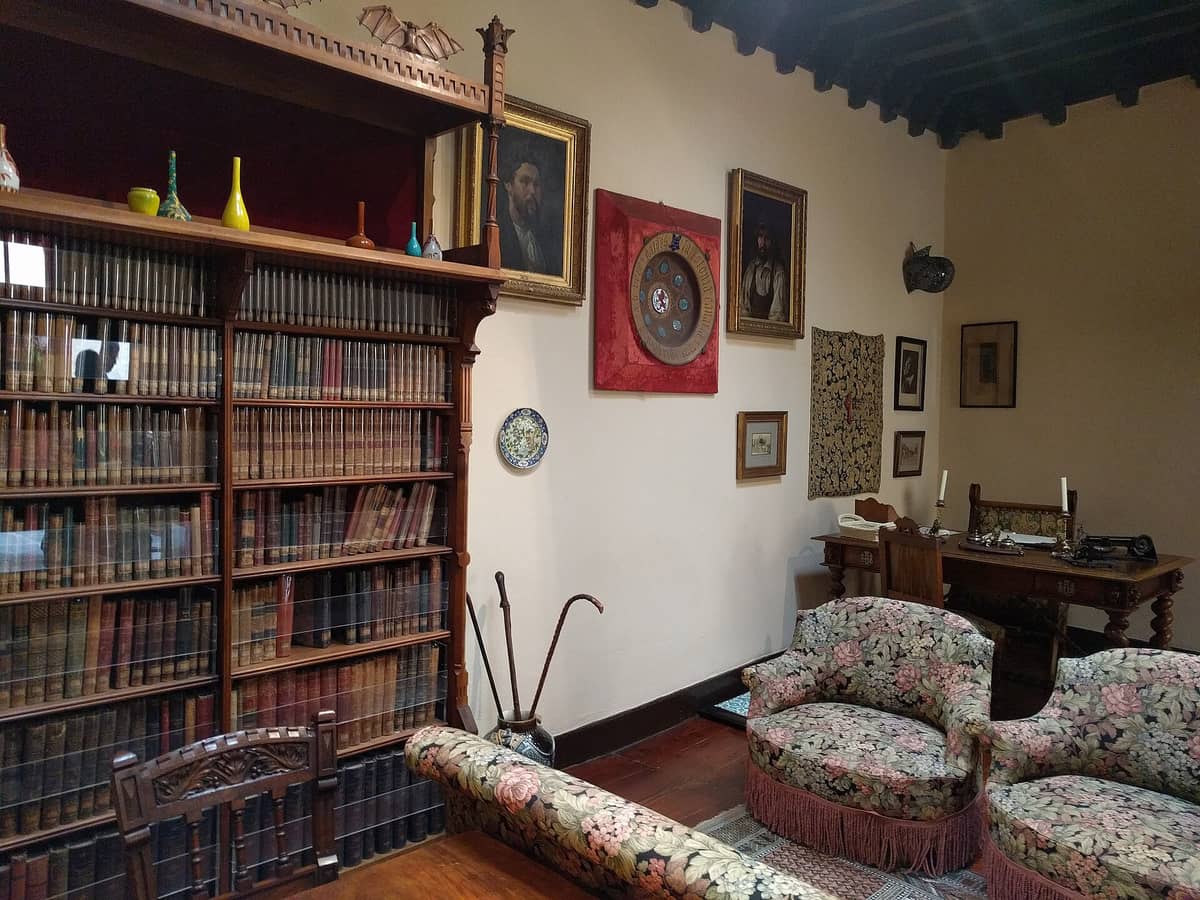
The rooms are arranged to reflect the house as it would have appeared during the Galdós family's occupation. Period furniture, family portraits, and personal objects are displayed in context rather than in glass cases, which gives the visit an intimacy that larger, more institutional museums rarely achieve. You see the writer's actual desk, correspondence, and first editions alongside the kind of everyday domestic objects, ceramic bowls, folded linen, a shaving mirror, that make the biography feel grounded rather than mythologized.
A dedicated section of the museum focuses on the literary archive: manuscripts, annotated proofs, and letters that reveal the working methods of a writer who was extraordinarily prolific while also deeply embedded in the political debates of his era. For visitors who have read Galdós, this section tends to be the most absorbing. For those who have not, it still provides a compelling portrait of creative labor in 19th-century Spain.
How the Experience Changes by Time of Day
The museum opens at 10:00, and the first tour of the day is reliably the quietest. Tour groups from cruise ships and larger organized parties tend to arrive mid-morning, so the 10:00 and 11:00 slots are the best choice for anyone who prefers to move through the rooms at their own pace while the guide speaks. The house is small enough that a large group can make the experience feel crowded, particularly in the narrower corridor rooms.
By early afternoon, Triana is at its most active as a commercial district. Arriving around 13:00 or 14:00 means the surrounding streets are lively, which is pleasant if you plan to combine the visit with lunch in the neighborhood, but the museum itself remains calm regardless of outside activity. Light through the interior courtyard is at its warmest in the early afternoon, which matters if you intend to photograph the architectural details.
💡 Local tip
If you are visiting Las Palmas with limited time, pair the Casa-Museo with the nearby Vegueta historic quarter on the same morning. The walk between Calle Cano and the cathedral square takes under ten minutes.
Galdós, the Canaries, and Why This Museum Matters
Outside Spain, Pérez Galdós is underappreciated. He was nominated multiple times for the Nobel Prize in Literature but never received it, partly due to political opposition within Spain's Royal Academy. His rehabilitation as a canonical figure in Spanish literature has been ongoing, and the museum plays an active role in that project, hosting cultural events, school programs, and occasional temporary exhibitions that connect his themes to contemporary issues.
What makes the museum particularly interesting from a Canarian perspective is the tension it represents: Galdós left these islands young and set almost all of his major work on the Spanish mainland and in Madrid. The Canaries gave him his early formation but rarely appear directly in his fiction. That biographical tension, between island origin and continental ambition, is present throughout the collection and gives the visit a layer of meaning beyond the standard birthplace-of-a-famous-person format. For more on the cultural depth of this part of the city, the Vegueta historic district rewards a longer walk with several significant institutions concentrated within a few blocks.
Getting There and Practical Planning
The museum is in Triana, the commercial district immediately north of Vegueta, in central Las Palmas de Gran Canaria. Calle Cano runs parallel to Calle Triana, which is the main pedestrian shopping street. From Vegueta's Plaza de Santa Ana, the walk to the museum takes roughly ten minutes on foot. Urban bus lines serving the city centre stop within a short walk. If you are using the TransGC rechargeable card, fares are reduced compared to single tickets; verify current prices before travel as these are subject to change.
Parking in central Las Palmas is difficult and not recommended for a museum visit of this scale. Public transport or walking from nearby accommodation in Triana or Vegueta is more practical.
The museum sits naturally at the junction of two worthwhile cultural areas. Immediately south is Vegueta, where the Cathedral of Santa Ana and the Museo Canario are both within walking distance. Combining these three stops makes for a full and rewarding cultural day in the city without needing transport between them.
Accessibility
The Casa-Museo Pérez Galdós has made accessibility a stated institutional priority. The entrance from street level is accessible, and the building includes ramps or other adaptations in public areas where possible. Adapted and clearly signed toilets are available. Visitors with visual impairments can access audio resources or QR audio guides with audio description when offered. Guide dogs and recognized assistance animals are welcome with appropriate accreditation. Free admission applies to visitors with disabilities; documentation may be required at the entrance.
Who Should Consider Skipping This
The museum works best for visitors with some prior interest in Spanish literature, 19th-century history, or period domestic architecture. If you have no familiarity with Galdós and limited patience for guided, text-heavy presentations in a relatively small space, you may find the experience too narrowly focused to justify the time. Families with very young children may also find the guided-only format restrictive, as the tours require a level of sustained attention that young children often find difficult. The museum is not the wrong choice for curious adults who know nothing about Galdós, but it rewards some background reading in advance.
Visitors looking for a broader, more interactive cultural experience in Las Palmas might prefer the ELDER Museum of Science and Technology or the Casa de Colón, which covers the city's connection to Christopher Columbus with more visual and spatial variety.
Opening Hours and Key Rules
- Open Tuesday to Sunday, including most public holidays, from 10:00 to 18:00
- Closed every Monday
- Closed on: 1 and 6 January, Carnival Tuesday, 1 May, 24, 25 and 31 December
- All visits are guided, starting on the hour
- Last admission is at 17:00
- Admission is free for all visitors
- Photography policies: check with staff on arrival, as rules on flash and tripods in historic house museums can vary
Insider Tips
- The 10:00 opening tour is consistently the least crowded. Cruise ship groups and school parties typically arrive from 11:00 onward, so arriving right at opening makes a real difference to how much space you have in the smaller rooms.
- If you read Spanish, pick up any edition of the Episodios Nacionales before your visit. Even reading the first volume gives the archive section of the museum an entirely different level of meaning. English translations exist but are harder to find.
- Calle Triana, one street over, has several good cafés for a coffee before or after the tour. The street is a genuine local shopping district, not a tourist strip, so prices and quality are both better than you might expect near a museum.
- The interior courtyard is the best architectural feature of the building. If your guided group moves through it quickly, ask your guide if you can pause there at the end. The light and proportions are worth a few quiet minutes.
- The museum occasionally hosts evening cultural events and literary readings tied to Galdós anniversaries. Checking the institutional calendar at perezgaldos.grancanaria.com before your trip may reveal programming that is not listed in standard travel resources.
Who Is Casa-Museo Pérez Galdós For?
- Readers and literature enthusiasts interested in Spanish fiction and 19th-century culture
- History travelers wanting to understand Spain's intellectual and political history through a personal lens
- Architecture visitors drawn to preserved Canarian urban domestic buildings
- Travelers combining a full cultural day in Vegueta and Triana on a single itinerary
- Anyone looking for a free, unhurried, and genuinely substantive museum in central Las Palmas
Nearby Attractions
Other things to see while in Vegueta:
- CAAM – Centro Atlántico de Arte Moderno
Housed in restored colonial buildings on one of Vegueta's most atmospheric streets, the Centro Atlántico de Arte Moderno (CAAM) is Las Palmas de Gran Canaria's leading contemporary art institution. Admission is free, the programming is genuinely ambitious, and the setting alone justifies the detour.
- Casa de Colón
Housed in one of the finest colonial buildings in the Canary Islands, Casa de Colón traces the voyages of Christopher Columbus and the founding history of Las Palmas de Gran Canaria. Located in the Vegueta old quarter, it is one of the most rewarding indoor attractions in the city, and entry is free every Sunday.
- Catedral de Santa Ana
Standing on Plaza de Santa Ana since the late 15th century, the Catedral-Basílica de Santa Ana is the oldest cathedral in the Canary Islands and the architectural anchor of Vegueta, Las Palmas's historic quarter. Its layered Gothic and Neoclassical facade tells five centuries of island history in stone, while the tower rewards those who climb it with some of the best rooftop views in the city.
- Museo Canario
El Museo Canario in Vegueta, Las Palmas, holds the definitive collection of pre-Hispanic Canarian artifacts, including one of the largest assemblages of ancient skulls in Europe. For anyone serious about understanding the islands' indigenous Guanche culture, this is the most important building on Gran Canaria.