Casa de Colón: Gran Canaria's Window into the Age of Atlantic Exploration
Housed in one of the finest colonial buildings in the Canary Islands, Casa de Colón traces the voyages of Christopher Columbus and the founding history of Las Palmas de Gran Canaria. Located in the Vegueta old quarter, it is one of the most rewarding indoor attractions in the city, and entry is free every Sunday.
Quick Facts
- Location
- Calle Colón 1, Vegueta, Las Palmas de Gran Canaria
- Getting There
- City buses serve the Vegueta area; the museum is walkable from central Las Palmas
- Time Needed
- 1.5 to 2.5 hours
- Cost
- €4 general / €2 reduced / Free under 18s, disabled visitors (plus necessary companion), unemployed visitors, school groups, teachers, official guides, ICOM cardholders, and all Sundays
- Best for
- History lovers, architecture admirers, rainy-day visits, solo travellers
- Official website
- casadecolon.grancanaria.com
What Is Casa de Colón?
Casa de Colón is a history museum dedicated to Christopher Columbus, the Atlantic voyages of exploration, and the early colonial development of Las Palmas de Gran Canaria. It sits at Calle Colón 1, in the heart of the Vegueta district, surrounded by the same cobblestone streets and whitewashed walls that would have framed the city at its founding in 1478.
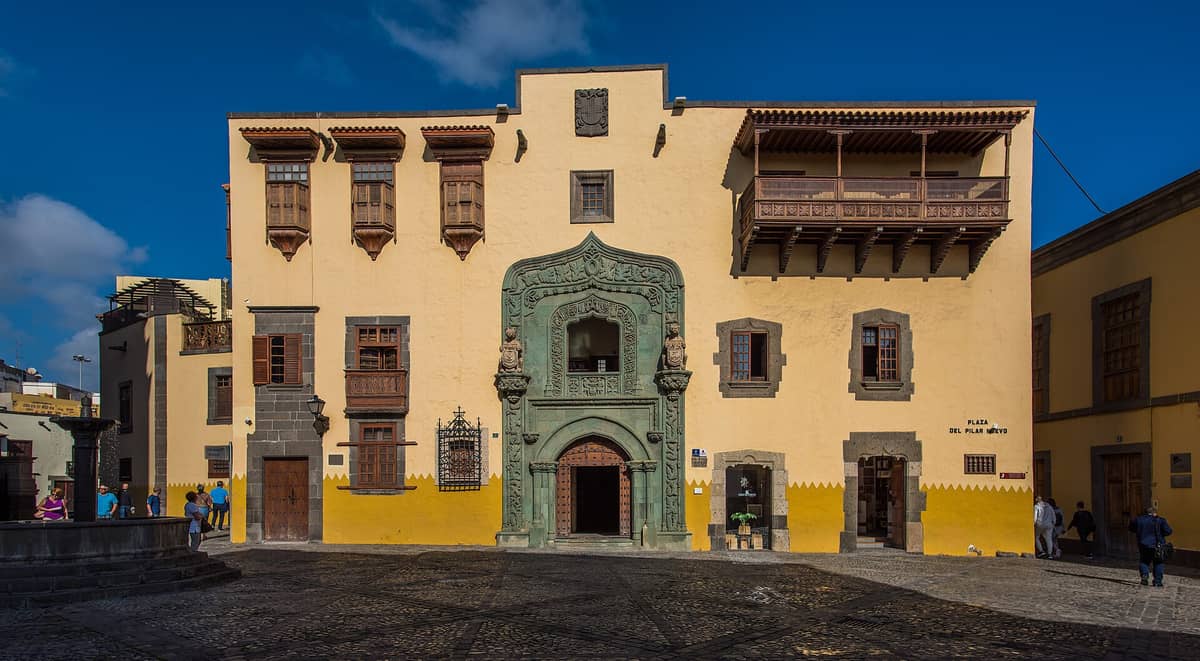
The building itself is the first thing that stops visitors in their tracks. Its facade is one of the most photographed in Las Palmas: a late Gothic and early Renaissance structure with carved wooden balconies, ornate stone portals, and two interior courtyards linked by arched colonnades. It was built as the residence of the island's first governor, and the architectural quality signals how strategically important Gran Canaria was to the Spanish Crown during the era of Atlantic expansion.
Columbus is believed to have stopped at Gran Canaria during his first and subsequent voyages to the Americas, and the museum uses this connection as its anchor. Whether or not the explorer actually stayed in this precise building is a matter historians debate, but the island's documented role as a staging post for Atlantic crossings is well established. For the full historical neighbourhood context, see our guide to Vegueta, the old town of Las Palmas.
The Building: Architecture Worth Studying Before You Enter
Spend a few minutes outside before going in. The main portal on Calle Colón uses carved basalt stone in a style that blends Canarian Gothic with early Renaissance detailing, unusual for a civic building of this scale outside the Iberian Peninsula. The dark volcanic stone contrasts with the whitewashed plaster walls in a way that photographs well in morning light, when shadows are long and there is little foot traffic.
Once inside, the two linked patios are the architectural highlight of the visit. The first is smaller and more intimate, with a central well and potted plants that make it feel like a private courtyard still in use. The second patio is grander, its arched galleries running on two levels, the upper walkway framed by carved wooden railings. At midday, the light falls directly into the courtyard and the stone takes on a warm golden tone. On overcast days, the space feels quieter and more contemplative, which suits the museum's tone well.
💡 Local tip
Visit on a weekday morning if you want the courtyards largely to yourself. Cruise ship arrivals in Vegueta tend to peak between 10:30 and 13:00, so arriving at opening time (10:00) gives you a noticeably quieter experience.
What the Exhibitions Cover
The permanent collection spans several rooms arranged across two floors and is organised thematically rather than strictly chronologically. The early sections deal with pre-Columbian navigation and the geography of the Atlantic as understood in the late 15th century, including period maps and reproductions of navigational instruments. The cartography displays alone justify the visit for anyone with an interest in exploration history: some of the maps shown illustrate the conceptual shift from Mediterranean-centric views of the world to a genuinely Atlantic perspective.
A section dedicated to Columbus's voyages examines the logistics of the crossings: crew numbers, provisions, the types of vessels used, and the specific role Gran Canaria played as a resupply and repair stop. The island's position at roughly 28 degrees north latitude made it an ideal departure point for ships using the northeast trade winds to cross to the Caribbean. This is not dramatised for tourism purposes; the displays are measured and informative.
Upper-floor rooms shift focus to the history of Las Palmas de Gran Canaria itself, covering the founding of the city, its development as a colonial port, and the cultural exchanges that shaped the Canary Islands over subsequent centuries. There is also a small rotating exhibition space, which has hosted art and photography shows in the past. Content changes, so check the official site before visiting if temporary exhibitions influence your decision.
ℹ️ Good to know
Exhibition text is primarily in Spanish, with English summaries available on panels and in printed guides at the entrance. Audio guides may be available; confirm at the ticket desk on arrival.
Practical Information: Hours, Tickets, and Getting There
Casa de Colón is open Monday to Saturday from 10:00 to 18:00, and on Sundays and public holidays from 10:00 to 15:00. It is closed on 1 and 6 January, 1 May, and 24, 25, and 31 December. General admission is €4, with a reduced rate of €2 for visitors over 65, students aged 18 to 23, large families, and groups of seven or more. Entry is free for under-18s, people with disabilities and a necessary accompanying person, unemployed visitors, school groups, teachers, official guides, and ICOM cardholders.
Entry is also free on every Sunday, making it one of the better-value options in the city for weekend visitors. Free entry also applies on several commemorative dates: 18 April, 18 May, 30 May, 24 June, 27 September, and 12 October. If you are visiting specifically for the free Sunday entry, arrive shortly after 10:00, as the museum closes at 15:00 on Sundays and the rooms fill up faster than on weekdays.
Vegueta is reachable from central Las Palmas by city bus (guagua), with stops within a short walk of the museum. The neighbourhood is compact and best explored on foot once you arrive. If you are combining the visit with other Vegueta landmarks, the Cathedral of Santa Ana is a two-minute walk north, and the Museo Canario, which holds the island's pre-Hispanic archaeological collection, is around the corner on Calle Doctor Verneau.
On accessibility: visitors with disabilities receive free admission, including one necessary companion. As a historic building with multiple levels, some areas may present challenges for wheelchair users. The official museum contact number is +34 928 312 373; calling ahead is recommended if mobility access is a concern.
How the Visit Changes by Time of Day
Morning visits, particularly between 10:00 and 11:30 on weekdays, are the quietest. The patios feel almost private, the light in the first courtyard is soft and lateral, and you can take your time reading the cartography panels without crowds pressing around you. By late morning, particularly if a cruise ship has docked, organised tour groups begin moving through the rooms in clusters, which can make the upper floor feel congested.
Early afternoon, roughly 13:00 to 15:00, sees a lull as locals take lunch and many tour groups move on. This is a reasonable window if morning timing is not possible. The building stays cool even in summer, the thick stone walls doing the work that air conditioning does elsewhere, which makes it a genuinely pleasant midday refuge when temperatures outside push past 27 degrees Celsius.
Late afternoon light enters the second patio from the west and creates good conditions for photography of the arcaded galleries. By 16:30 on weekdays, visitor numbers drop noticeably and the museum takes on a calmer character. The gift shop near the entrance stocks a selection of books on Canarian history and Atlantic exploration, as well as reproduction maps, which are worth browsing on the way out.
Combining Casa de Colón with the Rest of Vegueta
Vegueta is compact enough that Casa de Colón sits naturally at the centre of a two to three hour neighbourhood walk. From the museum, the covered market at Mercado de Vegueta is a five-minute walk and gives a strong contrast to the museum's formality: fresh produce, local cheeses, and mojo sauces sold from stalls under a 19th-century iron-framed roof.
The literary museum dedicated to Benito Pérez Galdós, one of Spain's most significant 19th-century novelists, is also nearby at Casa Museo Pérez Galdós. Galdós was born in Las Palmas and the house-museum offers an intimate look at the city's intellectual history, a useful complement to the broader colonial narrative at Casa de Colón.
For a broader picture of how to spend time in the capital, the guide to things to do in Las Palmas de Gran Canaria covers the full range of options across the city's neighbourhoods.
⚠️ What to skip
The museum is closed on Christmas Eve, Christmas Day, New Year's Eve, New Year's Day, and Three Kings Day (6 January). If your trip falls around these dates, check the official site for any additional closure days before planning your visit.
Is It Worth Your Time? An Honest Assessment
For visitors with a genuine interest in exploration history, cartography, or Spanish colonial architecture, Casa de Colón is one of the strongest museum experiences in the Canary Islands. The building alone delivers value, and the permanent collection is coherent and well-curated rather than simply assembled for tourist traffic.
For visitors who prefer kinetic or outdoor experiences, the museum will feel slow. The content is text-heavy and the displays are traditional in format: wall panels, glass cases, reproductions. There are no interactive screens or immersive installations as of the last available information. Children under about ten years old are unlikely to find much to hold their attention beyond the courtyard architecture.
At €4 general admission, or free on Sundays, the price is low enough that it does not need to be the centrepiece of a visit to justify itself. It works best as part of a morning in Vegueta, not as a standalone half-day trip from the southern resorts.
Insider Tips
- Free entry every Sunday makes it easy to absorb into a morning already spent in Vegueta without needing to budget for it. Arrive by 10:15 to beat the midday crowds and still have time for the full collection before the 15:00 Sunday closing.
- The second interior courtyard is one of the most photogenic spots in Las Palmas. Shoot upward from the ground floor toward the wooden balustrades and upper arcade for the best architectural framing. A wide-angle lens or phone shot in portrait mode works well in the space.
- If you are visiting in October, free admission on 12 October (Día de la Hispanidad, Spain's National Day) coincides with a date that carries particular resonance at a Columbus museum. The museum sometimes holds special programming around this date.
- The printed visitor guide available at the entrance is more detailed than the wall panel summaries and is free of charge. Pick one up before entering rather than relying solely on the display texts if your Spanish is limited.
- Combine the museum with the Mercado de Vegueta for a well-rounded morning. The market is at its busiest and best-stocked between 08:00 and 12:00, so visit the market first, then cross to Casa de Colón as your second stop.
Who Is Casa de Colón For?
- History and exploration enthusiasts who want context beyond beach tourism
- Architecture lovers drawn to Canarian Gothic and early Renaissance civic buildings
- Travellers seeking a cool, quiet retreat from midday heat in Las Palmas
- Solo travellers and couples looking for a thoughtful half-morning in Vegueta
- Budget-conscious visitors: free every Sunday and inexpensive on all other days
Nearby Attractions
Other things to see while in Vegueta:
- CAAM – Centro Atlántico de Arte Moderno
Housed in restored colonial buildings on one of Vegueta's most atmospheric streets, the Centro Atlántico de Arte Moderno (CAAM) is Las Palmas de Gran Canaria's leading contemporary art institution. Admission is free, the programming is genuinely ambitious, and the setting alone justifies the detour.
- Casa-Museo Pérez Galdós
The Casa-Museo Pérez Galdós preserves the Triana townhouse where Benito Pérez Galdós was born in 1843, offering intimate guided tours through period rooms, original manuscripts, and personal belongings. Admission is free, and the house gives real texture to the literary history of the Canary Islands.
- Catedral de Santa Ana
Standing on Plaza de Santa Ana since the late 15th century, the Catedral-Basílica de Santa Ana is the oldest cathedral in the Canary Islands and the architectural anchor of Vegueta, Las Palmas's historic quarter. Its layered Gothic and Neoclassical facade tells five centuries of island history in stone, while the tower rewards those who climb it with some of the best rooftop views in the city.
- Museo Canario
El Museo Canario in Vegueta, Las Palmas, holds the definitive collection of pre-Hispanic Canarian artifacts, including one of the largest assemblages of ancient skulls in Europe. For anyone serious about understanding the islands' indigenous Guanche culture, this is the most important building on Gran Canaria.