Jardín Botánico Viera y Clavijo: Gran Canaria's Living Atlas of Canarian Flora
Perched above the Guiniguada ravine in Tafira Alta, the Jardín Botánico Canario 'Viera y Clavijo' is the largest botanical garden in Spain and home to the world's most comprehensive collection of Canarian endemic plants. Entry is free, the setting is dramatic, and a weekday morning visit feels nothing like a tourist attraction.
Quick Facts
- Location
- Camino del Palmeral 15, Tafira Alta, Las Palmas de Gran Canaria
- Getting There
- Global bus network from Las Palmas city centre; check current routes to Tafira Alta before visiting
- Time Needed
- 2 to 3 hours for a thorough visit; 1 hour covers the main terraces
- Cost
- Free admission
- Best for
- Nature lovers, botanists, photographers, and anyone wanting a quiet escape from the coast
- Official website
- http://www.jardincanario.org
What the Jardín Botánico Viera y Clavijo Actually Is
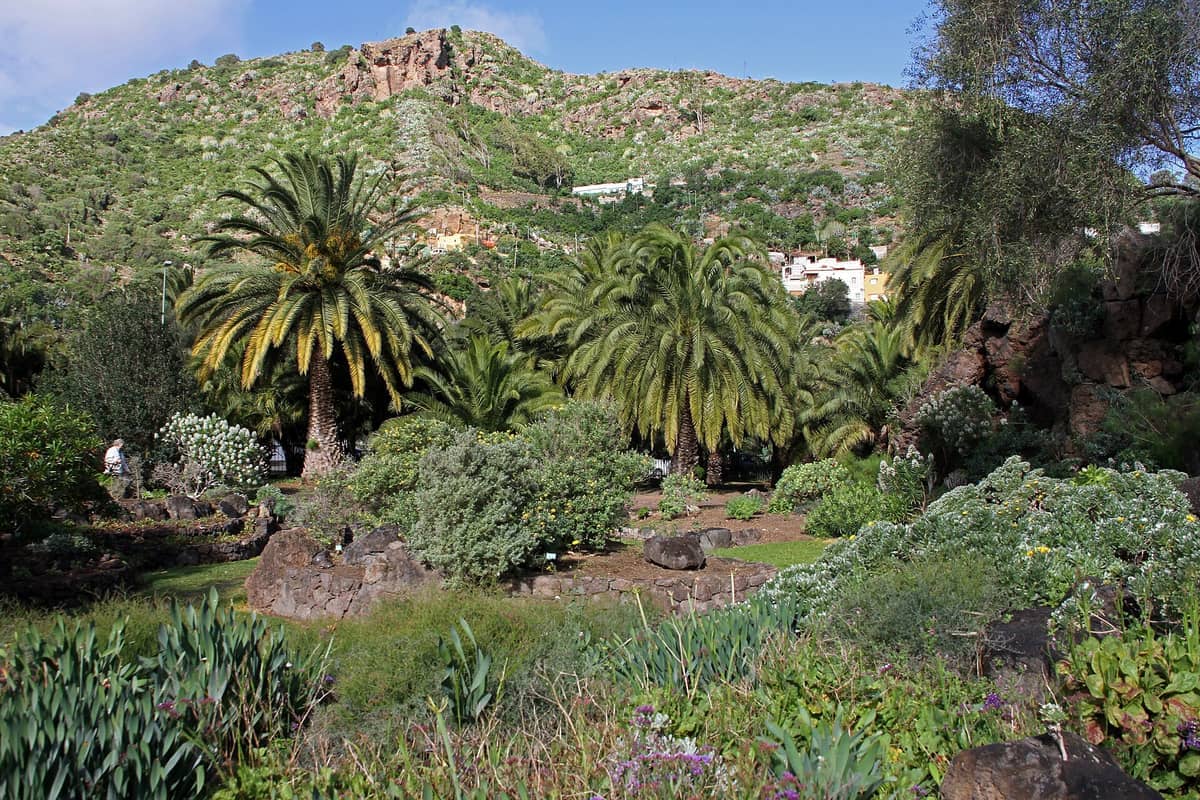
The Jardín Botánico Canario 'Viera y Clavijo' is the largest botanical garden in Spain, set across a series of terraced hillsides and ravine slopes in Tafira Alta, a quiet residential area on the outskirts of Las Palmas de Gran Canaria. Its primary purpose is scientific: this is a living repository of the Canarian flora, with a particular focus on endemic species, plants found nowhere else on Earth. For a general visitor, that translates into an experience that feels genuinely different from any garden on the Spanish mainland or elsewhere in Europe.
The garden is named after José Viera y Clavijo, an 18th-century Canarian priest, historian, and naturalist who produced the first systematic study of Canarian flora. That scholarly tradition runs through the whole place. Where most botanical gardens feel like curated parks, this one feels more like fieldwork made accessible: the terrain is steep in places, the planting naturalistic rather than ornamental, and the plant labels carry enough scientific detail to keep a serious botanist busy.
ℹ️ Good to know
Opening hours: Monday to Friday 07:30–19:00 (April–September) or 07:30–18:00 (October–March). Weekends and public holidays 10:00–18:00. Last entry is one hour before closing. Closed 24, 25, and 31 December and 1 January. Admission is free.
The Setting: Ravine, Terraces, and Microclimates
The garden occupies a section of the Guiniguada ravine, one of the deep barranco systems that cut through the interior of Gran Canaria from the central mountains toward the coast. This is not incidental geography. The ravine creates its own microclimate: cooler and more humid than the city below, which allows species from the laurisilva cloud forests of the Canarian highlands to grow here at a lower altitude than they would naturally occupy.
From the upper entrance, the terrain drops away sharply in stepped terraces, each one planted to represent a different ecological zone of the Canary Islands. Dragon trees (Dracaena draco), some of considerable age, punctuate the upper slopes. Lower down, the density increases: tree-sized euphorbias, Canarian palms, giant Echium species with flower spikes taller than a person, and the silver-grey rosettes of Aeonium in dozens of varieties cling to rock faces alongside the paths.
On a clear morning, which is common between May and September, the upper terraces offer views across the ravine to the opposite hillside and, on the clearest days, toward the coast. The quality of light in the garden is particularly good in the first two hours after opening on weekdays: soft, directional, and free of the flat glare that builds up by midday.
💡 Local tip
Wear comfortable shoes with grip. Several paths descend steeply through the ravine section and can be slippery after rain. A lightweight layer is useful even in summer, as the ravine floor is noticeably cooler than the upper terraces.
What You Actually See: A Practical Walkthrough
The main entrance from Camino del Palmeral brings you into the upper section of the garden, where the collections of succulent plants, including some of the most architecturally striking Canarian cacti-like euphorbias, are concentrated. This zone is the easiest to navigate and the most immediately dramatic, with large specimen plants spaced across open terraces.
Moving down through the ravine, the vegetation thickens and the atmosphere shifts. The path narrows, the canopy closes overhead, and the sound of the city disappears almost entirely. In its place: birdsong, the occasional sound of water if the ravine has seen recent rain, and the dry, slightly resinous scent of Canarian pine and laurel. This lower section contains the endemic forest species and is the botanical heart of the garden, though it requires some physical effort to reach and return from.
There is also a dedicated section for the flora of each of the major Canary Islands, organized geographically. For anyone already familiar with the islands, comparing the plant communities side by side is genuinely instructive. For a first-time visitor, it gives useful context about just how different the ecology of Tenerife, La Palma, or Lanzarote is from Gran Canaria, despite the islands being part of the same archipelago.
The garden sits at an altitude that places it within Gran Canaria's layered system of microclimates, something explored in more depth in a guide to hiking in Gran Canaria. Understanding that system helps explain why the garden's plant geography is so compressed and varied.
When to Visit and How the Experience Changes
Weekday mornings before 10:00 are the quietest window. The garden opens at 07:30 Monday to Friday, and in the first hour or two you may share the upper terraces with almost nobody. This is the best time for photography and for engaging with the labelling on plants without navigating around groups.
Weekend visits from 10:00 onward, particularly on Sunday mornings, attract more local families and some organized tour groups. The experience is still pleasant but noticeably less meditative. School groups from the island visit on weekday mornings during term time, so if total quiet is the priority, mid-week late-morning in summer is reliably calm.
Seasonally, spring (March to May) brings the garden to its most visually dense peak: many Echium species flower in this period, producing columns of blue and purple that are genuinely spectacular. The succulent collections look their best after the mild winter rains have encouraged new growth. Summer is lush and green. Autumn and early winter are the least colorful months, though the garden's overall structure remains impressive year-round.
Gran Canaria's subtropical climate means the garden is accessible and enjoyable throughout the year. For an overview of how seasons affect the island generally, see the guide to the best time to visit Gran Canaria.
⚠️ What to skip
The garden is closed on 24, 25, and 31 December and 1 January. If you are visiting in late December, plan around these closures. Arriving after the last entry time (one hour before closing) means you will be turned away regardless of how much time you intended to spend.
Getting There from Las Palmas
Tafira Alta is a residential suburb roughly 10 kilometres southwest of central Las Palmas, at a higher elevation. The Global interurban bus network serves the area, though bus route numbers and schedules on this island change periodically. Verify the current route number for Tafira Alta with the Global network (globalsu.net) or at the Santa Catalina bus interchange before your visit.
Taxis from the city centre are a straightforward alternative and the journey takes around 15 to 20 minutes depending on traffic. If you are renting a car, there is parking near the entrance on Camino del Palmeral, though spaces fill up quickly on weekend mornings.
The garden pairs well with a broader day in Las Palmas. From Tafira Alta you can return to the city and continue to the historic Vegueta district, or head to the Las Canteras beach for the afternoon.
Photography, Accessibility, and Honest Limitations
Photography conditions here are excellent for plant macro work and landscape compositions. The combination of dramatic terrain, textured bark on mature dragon trees, and the geometric rosettes of Aeonium gives a photographer working with natural light plenty to engage with across the full day. Morning light from the east hits the upper terraces; by early afternoon the ravine section is in partial shade, which is ideal for shooting foliage detail without harsh contrast.
On accessibility: the upper terraces have some paved paths and are manageable for most visitors, but the ravine descent involves uneven, steep, and sometimes narrow tracks. Visitors with mobility limitations will find significant portions of the lower garden difficult or inaccessible. Official accessibility information is limited, so if this is a concern, contacting the garden directly via its official website before visiting is advisable.
Who might not enjoy this: visitors who need constant narrative (there is no audio guide and English-language signage is partial), very young children who would find the uneven terrain frustrating after the first 20 minutes, and anyone expecting a manicured park with formal beds and lawns. This is a scientific institution with aesthetics to match. It is serious about plants in a way that rewards curiosity and penalizes indifference.
If you want a broader sense of what nature-based attractions look like across the island, the guide to things to do in Gran Canaria covers the range well.
Insider Tips
- Enter on a weekday before 09:00 for near-total solitude. The 07:30 opening is rarely used by tourists and the quality of light on the upper terraces at that hour is excellent for photography.
- The ravine floor section is significantly cooler than the entrance terrace, sometimes by several degrees. If you are visiting in winter or on a cloudy day, bring a layer you can add when you descend.
- The island-by-island plant sections in the mid-garden are underused by casual visitors but are among the most interesting parts of the collection, particularly the contrast between the arid flora of Lanzarote and the cloud-forest species of La Palma, displayed side by side.
- The dragon trees in the upper section include some large, mature specimens. The Dracaena draco grows extremely slowly, making old individuals genuinely rare; take time with these rather than rushing past to the ravine.
- There are no cafes or food options inside the garden. Bring water, particularly in summer, as the terraces in the upper section can feel warm by midday even at Tafira Alta's elevation.
Who Is Jardín Botánico Viera y Clavijo For?
- Botanists and naturalists wanting first-hand access to the world's most complete collection of Canarian endemic flora
- Photographers seeking dramatic natural light, textured plant forms, and ravine landscapes without crowds
- Travellers who want a genuine half-day break from the beach without leaving the island's natural environment
- Families with older children who can manage uneven terrain and have some curiosity about natural history
- Anyone spending more than a few days in Las Palmas who wants to understand the island's ecological variety beyond the coastline
Nearby Attractions
Combine your visit with:
- Arteara Necropolis
The Arteara Necropolis is the most extensive aboriginal cemetery on Gran Canaria, with 809 stone burial mounds spread across 13 hectares inside the dramatic Barranco de Fataga gorge. It offers a rare, unhurried encounter with the island's pre-Hispanic Canarii people, well away from the resort crowds of the south.
- Bandama Caldera & Crater Viewpoint
Rising 574 metres above sea level, the Pico de Bandama offers the most striking volcanic panorama on Gran Canaria. Below stretches the Caldera de Bandama, a crater around 200 metres deep and about 1,000 metres across, formed by one of the island's most recent volcanic episodes. It is free to visit, takes under an hour from Las Palmas, and rewards visitors with views that stretch from the island's green interior to the Atlantic coastline.
- Barranco de los Cernícalos
Barranco de los Cernícalos is a 7 km round-trip ravine hike in central-eastern Gran Canaria where a year-round stream cuts through laurel forest, fern-draped cliffs, and small waterfalls. It is free to enter, requires no booking, and remains genuinely quiet compared to the island's more promoted highland routes.
- Cactualdea Park
Cactualdea Park sits in the remote western municipality of La Aldea de San Nicolás, where an extraordinary collection of cacti and succulents grows against a backdrop of volcanic rock and Atlantic light. It rewards visitors who make the journey with something genuinely unusual: a curated desert landscape that feels nothing like the resort south of the island.