Mercat de Santa Caterina: Barcelona's Most Underrated Market
Mercat de Santa Caterina is Barcelona's first covered market, rebuilt in 2005 beneath a spectacular undulating mosaic roof designed by architects Enric Miralles and Benedetta Tagliabue. Unlike its famous rival La Boqueria, this market in El Born still functions primarily as a neighborhood food market, where locals outnumber tourists and the produce is genuinely fresh.
Quick Facts
- Location
- Av. Francesc Cambó, 16, El Born (Sant Pere, Santa Caterina i la Ribera), Barcelona
- Getting There
- Metro L4 – Jaume I station (5-min walk); Urquinaona (L1/L4) also walkable
- Time Needed
- 30–60 minutes for a browse; 90 minutes if you stop to eat
- Cost
- Free entry; spend what you choose at stalls
- Best for
- Food lovers, architecture enthusiasts, photographers, and anyone tired of tourist-trap markets
- Official website
- mercatdesantacaterina.com/en
What Is Mercat de Santa Caterina?
Mercat de Santa Caterina sits on Avinguda Francesc Cambó in the heart of El Born, sandwiched between the Gothic Quarter and the Ribera district. It holds the distinction of being Barcelona's first covered market, originally constructed in 1848 on the ruins of the Convent of Santa Caterina, a Dominican monastery demolished during the anti-clerical riots of 1835. That layered history, medieval foundations beneath a 19th-century market, beneath a 21st-century architectural icon, gives the place a depth that most casual visitors don't fully register.
The market's current appearance is the result of a sweeping renovation completed in 2005 (works 1997-2004), designed by the late Catalan architect Enric Miralles and his partner Benedetta Tagliabue. Their practice, EMBT, created one of Barcelona's most photographed rooflines: a 4,200-square-meter undulating ceramic mosaic made from 325,000 hexagonal tiles in 67 colors, designed to evoke a landscape of fruit and vegetables seen from above. It is a genuinely striking piece of architecture, and it earns comparison with the tile work of Gaudí without copying it. For a broader look at Barcelona's modernist architecture heritage, the Gaudí Barcelona guide provides useful context on how this era of design has shaped the city.
ℹ️ Good to know
Entry to the market is completely free. There is no ticket booth and no timed entry system. Simply walk in during opening hours.
Opening Hours and When to Go
The market keeps hours that reflect its role as a working food market, not a tourist attraction. Monday 7:30am to 2pm. Tuesday, Wednesday, Thursday, Friday, and Saturday extend to 3:30pm or later (Thurs/Fri until 8:30pm), making them the best option for visitors whose schedules don't allow a morning trip.
Mornings between 8:30am and 10:30am are when the market is at its most alive. Fishmongers arrange their ice displays, the fruit and vegetable vendors are restocking, and the smell of fresh herbs and citrus is genuinely sharp. Local residents do their weekly shopping here, and the pace is purposeful rather than leisurely. This is the window where the market feels least like a tourist stop.
By midday, especially on weekends, foot traffic picks up and the prepared food counters see queues. If you plan to eat at one of the sit-down bar counters inside, aim to arrive before noon or after 1:30pm to avoid the lunch rush. The market empties noticeably after 2pm on weekdays as stalls begin to close.
💡 Local tip
Thursday and Friday evenings offer an unexpectedly quiet visit window. Many stalls remain open until 8:30pm, but tourist foot traffic drops sharply after 6pm, leaving you largely with local shoppers.
Tickets & tours
Live prices and dates from our booking partner. If you book, we may earn a commission at no extra cost to you.
Boqueria and Santa Caterina Markets tour with food and tapas
From 89 €Instant confirmationFree cancellationSanta Maria del Mar Guided Tour Through the Interior and Terraces
From 19 €Instant confirmationFree cancellationGirona and Costa Brava small-group tour from Barcelona
From 95 €Instant confirmationFree cancellationIdelfonso Falcones's Santa Maria del Mar guided tour
From 12 €Instant confirmationFree cancellation
The Architecture: Reading the Roof
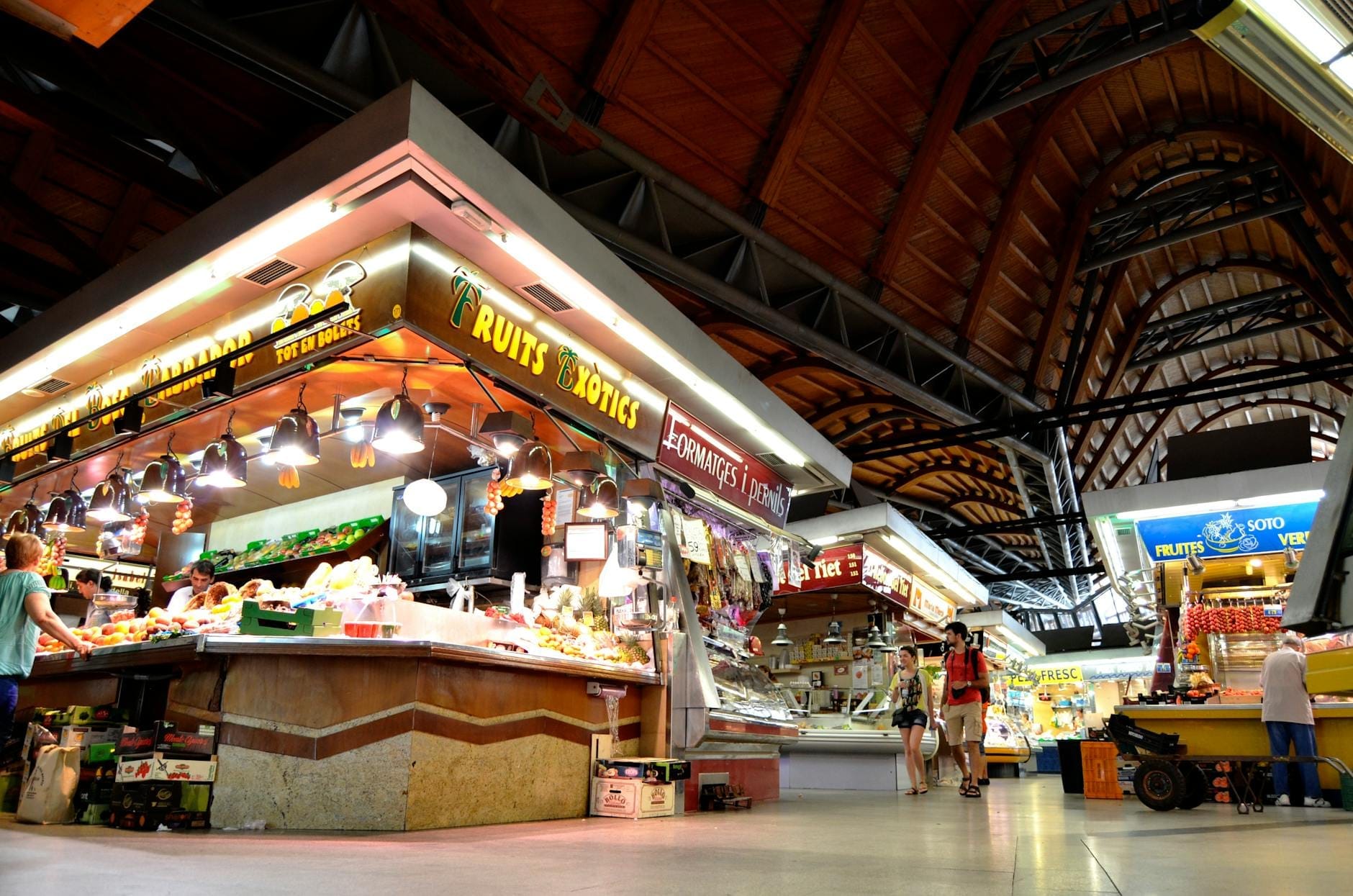
Most visitors photograph the roof from the street outside before going in. That is worth doing, but the view from inside is equally interesting. The undulating wooden structure that supports the mosaic creates a cave-like ceiling above the market floor, with natural light filtering through skylights at irregular intervals. The effect is warmer and more intimate than the photograph suggests.
The renovation deliberately preserved fragments of the original 19th-century market walls, and during construction archaeologists uncovered significant remains of the medieval convent beneath the floor. Some of these excavations are still visible in a small exhibition space integrated into the market's lower level, offering a cross-section of the site's 700-year history. It is easy to walk past this without noticing it; look for the glazed floor panels near the market's perimeter.
The structural approach Miralles and Tagliabue used, a self-supporting timber lattice beneath the ceramic skin, was considered technically ambitious at the time of construction. The roof covers the entire market floor without internal columns interrupting the space, which gives the vendors unusual flexibility in their layout. If the architecture here interests you, the nearby Palau de la Música Catalana is another landmark of Catalan architectural ambition, though it predates this renovation by nearly a century.
What You'll Find Inside
The stall mix is what separates Santa Caterina from La Boqueria. Fresh produce, meat, and fish counters make up the backbone of the market, and they serve a neighborhood clientele that actually cooks. You will find excellent seasonal vegetables at competitive prices, good quality whole fish laid on crushed ice, and a butcher section that includes cuts and preparations less common in supermarkets.
There are also several prepared food bars inside the market itself. These are genuine counters where you sit on a stool and order from a short menu: pa amb tomàquet (bread rubbed with tomato and oil), cured meats, local cheeses, and simple cooked dishes. The quality is consistent and the prices are honest. One or two counters have developed a following beyond the neighborhood, so they do see some deliberate tourist traffic, but nothing close to the gridlock that defines La Boqueria's prepared food section.
Santa Caterina sits at the edge of El Born, a neighborhood worth spending additional time in. The Basilica de Santa Maria del Mar is a five-minute walk south, and the El Born Centre de Cultura i Memòria is equally close to the east. The market makes a natural starting point for a half-day route through the district.
Santa Caterina vs. La Boqueria: An Honest Comparison
This comparison will come up if you are planning your visit. Mercat de la Boqueria on La Rambla is far more famous and far more overcrowded. Its prepared food counters are significantly more expensive, and the stall mix has shifted substantially toward tourist-facing products over the past decade. Local shoppers have largely abandoned it.
Santa Caterina has not replaced La Boqueria in terms of spectacle. The individual stalls are less theatrical, the fruit pyramids less photogenic, and the overall atmosphere is quieter. What it offers instead is a market that still works as a market. If you want to understand how Barcelona residents actually shop and eat, Santa Caterina is the more honest answer.
⚠️ What to skip
If you are looking for a high-energy, photo-opportunity-packed market experience with lots of vendors selling cut fruit and jamón directly to tourists, Santa Caterina may feel underwhelming. It is not designed for that kind of visit.
Getting There and Practical Notes
The most direct metro access is Line 4 (yellow line) to Jaume I, a five-minute walk from the market. Urquinaona station on Lines 1 and 4 is slightly further but useful if you are arriving from the Eixample or Gràcia. The market sits just off Via Laietana, the main road dividing the Gothic Quarter from El Born, which helps with orientation.
The surrounding streets are narrow and cobbled, typical of El Born. Comfortable flat shoes are more practical than anything else. There is no dedicated car parking at or near the market; arriving by foot, metro, or bicycle is straightforward and strongly preferable.
Accessibility inside the market is generally good at the main floor level, though some of the surrounding streets in El Born have uneven surfaces. The market interior is wide-aisle and wheelchair-accessible. If you have specific accessibility requirements, contacting the market directly through their official website before visiting is advisable.
Santa Caterina fits naturally into a broader exploration of the area. A visit pairs well with a walk through El Born, one of Barcelona's most architecturally and culturally layered neighborhoods, or a stop at the nearby Museu Picasso Barcelona on Carrer de Montcada.
Photography Tips
The roof is best photographed from the street along the eastern and northern sides of the market building. Morning light hits the mosaic tiles from the east and brings out the color contrast most effectively. The internal ceiling structure, with its wooden lattice and filtered skylights, photographs well in the mid-morning when natural light penetrates without harsh contrast.
Inside the market, the fishmonger and produce displays are photogenic in a low-key way. Ask before photographing vendors directly; most are accommodating if you make eye contact and gesture first. The archaeological glazed floor panels require a wide angle to capture in context, since the space around them is narrow.
Insider Tips
- The Thursday and Friday evening hours (until 8:30pm) are genuinely underused by visitors. The market has a different, quieter atmosphere in the late afternoon that rewards a slower pace.
- Look for the glazed floor panels near the market perimeter that reveal the medieval convent foundations discovered during construction. Most visitors walk right past them.
- The prepared food bars inside the market serve proper sit-down meals, not just snacks. Arriving just before noon gives you a seat without a wait and lets you watch the market at full operational pace before the lunch rush closes in.
- The mosaic roof contains 325,000 individual ceramic tiles in 67 different colors. The design was intended to evoke a bird's-eye view of fruit and vegetables: stand across the street on Avinguda Francesc Cambó and look up to get the full effect.
- Wednesday mornings tend to be the quietest mid-week slot for a genuinely unhurried visit. Monday is also quiet, though the shorter hours (closing at 2pm) limit your window.
Who Is Mercat de Santa Caterina For?
- Food travelers who want to see how Barcelona residents actually shop, not how they perform shopping for tourists
- Architecture enthusiasts interested in contemporary Catalan design and the EMBT practice's approach to adaptive reuse
- Photographers seeking interesting structural and mosaic tile subjects with manageable crowd levels
- Travelers building a half-day route through El Born who need a practical, atmospheric starting point
- Anyone on a budget who wants to assemble a high-quality picnic with fresh local produce at neighborhood prices
Nearby Attractions
Other things to see while in El Born (Sant Pere):
- Arc de Triomf
Built as the ceremonial entrance to Barcelona's 1888 Universal Exhibition, the Arc de Triomf stands at the top of a wide pedestrian promenade leading to Parc de la Ciutadella. It's free, always accessible, and one of the few grand monuments in the city where you can simply stop and look without queuing or paying.
- Barcelona Zoo
Occupying over 14 hectares inside the historic Parc de la Ciutadella, Barcelona Zoo is one of Europe's oldest urban zoos, open since 1892. It balances conservation work with family-friendly programming, though the setting inside a 19th-century park gives it a character quite different from modern safari-style zoos.
- Basilica of Santa Maria del Mar
Built entirely between 1329 and 1383, the Basílica de Santa Maria del Mar stands as the finest example of Catalan Gothic architecture in existence. Funded and constructed by the waterfront workers of the Ribera district, it carries a human story that its stone geometry quietly amplifies. Fewer crowds, better proportions, and a profound atmosphere make it one of the most rewarding stops in Barcelona.
- Cascada Monumental
The Cascada Monumental is a sweeping neoclassical waterfall fountain inside Parc de la Ciutadella, designed in 1875 by Josep Fontserè and partially shaped by a young Antoni Gaudí. Free to visit and open daily, it rewards early morning visitors with calm light and empty paths, and makes for a striking photography subject at any hour.
Planning a trip? Discover personalized activities with the Nomado app.