Cascada Monumental: Barcelona's Grand Fountain with a Gaudí Connection
The Cascada Monumental is a sweeping neoclassical waterfall fountain inside Parc de la Ciutadella, designed in 1875 by Josep Fontserè and partially shaped by a young Antoni Gaudí. Free to visit and open daily, it rewards early morning visitors with calm light and empty paths, and makes for a striking photography subject at any hour.
Quick Facts
- Location
- Parc de la Ciutadella, Passeig de Picasso 21, 08003 Barcelona
- Getting There
- Metro L1 Arc de Triomf (10-min walk) or L4 Ciutadella-Vila Olímpica (5-min walk)
- Time Needed
- 20–45 minutes at the fountain; 1–2 hours if exploring the full park
- Cost
- Free. Park open daily 10:00–20:00 (seasonal variations apply)
- Best for
- Architecture lovers, Gaudí trail visitors, families, photographers, morning walkers
What Is the Cascada Monumental?
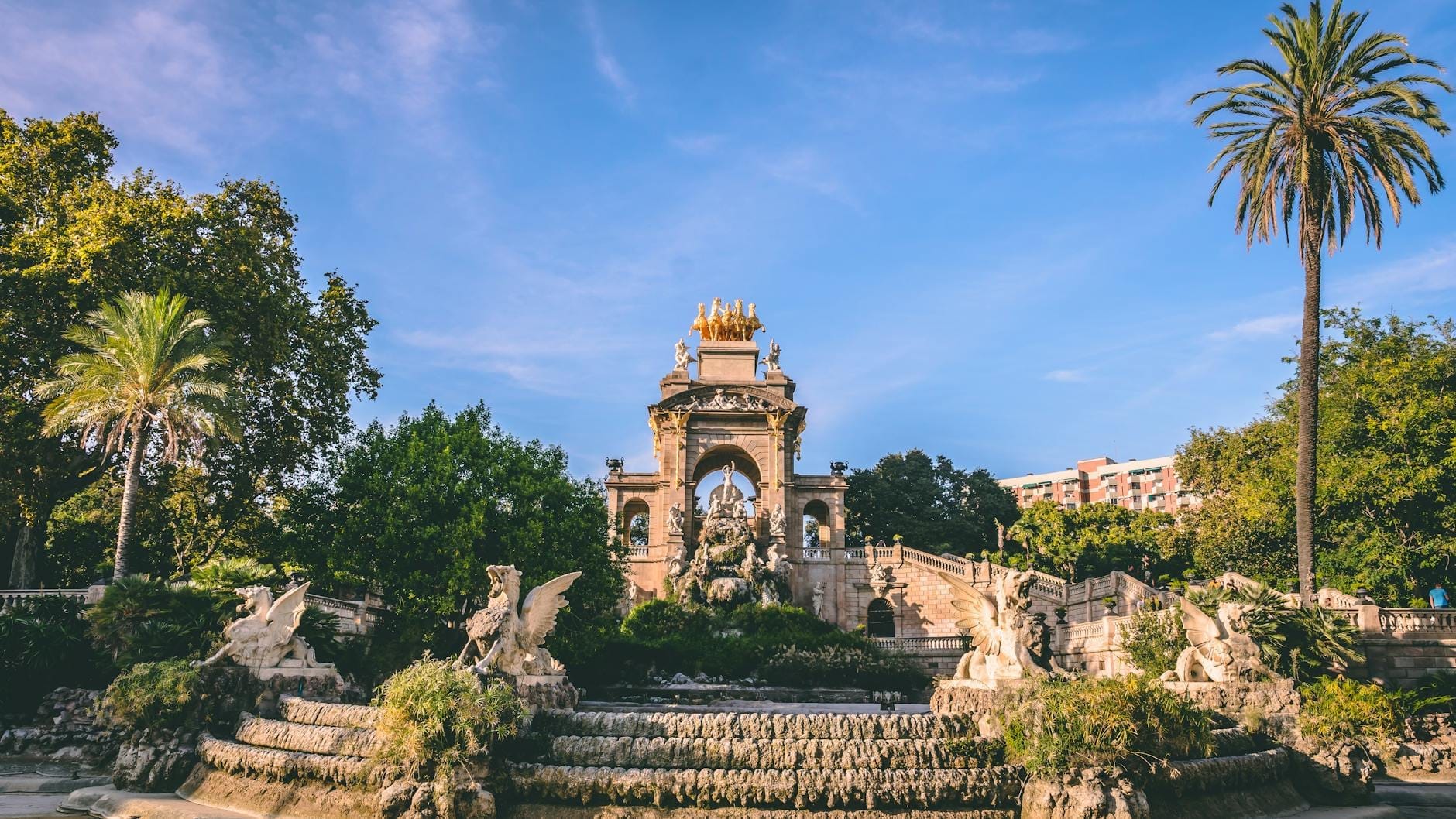
The Cascada Monumental, formally known as the Font de la Cascada del Parc de la Ciutadella, is a monumental waterfall fountain occupying the northeastern corner of Parc de la Ciutadella. It is one of Barcelona's most architecturally complex public monuments, yet most visitors walking through the park are surprised to stumble upon it. The scale is genuinely unexpected: a tiered stone facade roughly four stories tall, crowned with sculptures, dragon figures, and cascading water channels that empty into a wide reflective pond at the base.
It was designed by architect Josep Fontserè, who won the commission to landscape the park after the old Bourbon citadel was demolished in 1869. Construction began in 1875 and the fountain was inaugurated in 1881, later enhanced further ahead of Barcelona's 1888 Universal Exhibition. The design drew clear inspiration from Rome's Trevi Fountain, adopting its theatrical combination of triumphal arch structure, allegorical sculpture, and rushing water.
ℹ️ Good to know
The Cascada Monumental is free to visit and sits inside a public park. No tickets, no queues, no reservations needed. Just walk in during park hours (10:00–20:00 daily, seasonal).
The Gaudí Connection: More Significant Than Most Guides Suggest
A young Antoni Gaudí, still a student at Barcelona's School of Architecture, assisted Fontserè with the hydraulic engineering of the fountain and contributed to the design of certain decorative elements, including medallions on the structure. Gaudí was in his early twenties at the time, years before he would begin work on the Sagrada Família or the Park Güell. This makes the Cascada Monumental one of the earliest places in Barcelona where Gaudí's involvement can be traced, and that gives it a specific kind of historical interest for anyone following his career.
For context on how Gaudí's style evolved from projects like this one to his fully mature work, the Gaudí Barcelona guide covers his key buildings chronologically and is worth reading before your visit.
It would be misleading to call this a Gaudí work in the way that Casa Batlló or the Sagrada Família are. Fontserè designed it, and Fontserè gets the architectural credit. But the detail of Gaudí's early involvement is not a marketing invention, it is documented, and it adds a layer of meaning to what would otherwise be a remarkable but anonymous 19th-century fountain.
Tickets & tours
Live prices and dates from our booking partner. If you book, we may earn a commission at no extra cost to you.
Picasso Museum guided tour
From 30 €Instant confirmationFree cancellationOlympic and Sports Museum Juan Antonio Samaranch tickets
From 6 €Instant confirmationFree cancellationCasa Vicens skip-the-line tickets and guided visit in small groups
From 21 €Instant confirmationSunset Sailing Experience with Spanish Tapas and Premium Open Bar
From 69 €Instant confirmationFree cancellation
What You Actually See Up Close
Standing at the pond's edge, the fountain fills your entire field of view. The central arch frames a large sculptural group, the figure of Venus rising from water, carved by sculptor Venanci Vallmitjana. Flanking her are allegorical figures representing the rivers and seas. Above, at the very summit, winged horses rear up dramatically against the sky. The stonework is heavily ornamented in a style that sits somewhere between Baroque and eclectic Historicism.
The water itself runs in multiple channels: thin streams glide down polished stone ramps into the main cascade, which then fans out across a broad stepped apron before spilling into the pond. On sunny days, the mist from the falling water catches the light and produces a faint rainbow at certain angles. The pond is populated by ducks year-round, which gives the base of this grand monument an unexpectedly domestic quality.
The immediate surroundings include benches, shade trees, and a gravel path that loops the pond. Families often gather here, particularly on weekend mornings, with children feeding the ducks while adults photograph the fountain. It is a functioning piece of public space, not a roped-off monument.
How the Experience Changes by Time of Day
Morning visits, particularly between 10:00 and 11:30, offer the clearest view of the stonework detail with soft northern light falling across the facade. The park is quieter at this hour, with joggers, dog walkers, and the occasional painter rather than tour groups. The water sounds carry clearly across the empty paths.
By midday in summer, direct sunlight hits the fountain from above, which flattens shadows and makes photography difficult. The park fills significantly between 12:00 and 14:00 on weekends. Afternoons from around 16:00 onward bring a warmer, more golden light from the west, and the crowds begin to thin after 17:00. The fountain is lit in the evenings but the lighting is modest, not a dramatic light show. Evening visits are pleasant for the atmosphere of the park rather than close inspection of the sculpture.
💡 Local tip
For photography, arrive early on a weekday. The soft morning light and near-empty foreground make a significant difference compared to a midday weekend visit when the pond area is crowded.
The Wider Park: How It Fits In
The Cascada Monumental sits inside the 31-hectare Parc de la Ciutadella, Barcelona's main urban green space in the central city. The park also contains a boating lake, the city's zoo, a geology museum, and the Catalan Parliament building. A single visit to the park can reasonably include the fountain, a loop of the lake, and a walk along the tree-lined central paths. Budget 1.5 to 2 hours if you want to take it slowly.
The park's main pedestrian entrance on Passeig de Picasso brings you within a short walk of the fountain. If you're approaching from the Arc de Triomf, which sits just north of the park on the Passeig de Lluís Companys, the walk through the tree-lined promenade and into the park takes about ten minutes and is pleasant in its own right.
The neighborhood surrounding the park, the El Born district to the west and the Barceloneta area to the south, means that the Cascada Monumental can fit naturally into a half-day itinerary that combines architecture, a market visit, and the waterfront. The park does not require significant time on its own, but it rewards visitors who take it slowly rather than treating it as a quick stop.
Getting There and Practical Logistics
The most convenient metro option is Line 4 to Ciutadella-Vila Olímpica, which puts you at the park's southeastern entrance with a five-minute walk to the fountain. Metro Line 1 to Arc de Triomf leaves you at the northern edge of the park, about ten minutes on foot through the Passeig de Lluís Companys promenade, which is a pleasant approach if you have time. The park address is Passeig de Picasso 21, 08003 Barcelona.
The park has multiple entrances and no single ticket gate. There is no admission fee for the park or the fountain. The main paths are paved and generally accessible, though getting very close to the fountain's central podium involves stone steps. Visitors with mobility limitations can view the fountain comfortably from the pond-level paths without needing to ascend.
⚠️ What to skip
In summer (June to August), temperatures in the park can exceed 30°C by mid-morning. Bring water, as the nearest kiosk may not always be open. The fountain area has limited shade directly in front of the cascade.
Is It Worth the Visit?
Honestly, yes, with realistic expectations. The Cascada Monumental is not Barcelona's most famous sight, and it won't be the headline memory of most trips. But it is a genuinely impressive piece of 19th-century civic architecture that most visitors do not expect to find free and unguarded in a public park. The Gaudí association adds historical interest without requiring you to buy into inflated claims about his role.
Visitors who prioritize ticking off the most famous attractions, or those with very limited time, might find the park visit less urgent than, say, the Basilica de Santa Maria del Mar nearby or a morning at Mercat de Santa Caterina. But for anyone who enjoys 19th-century architecture, quiet mornings outdoors, or filling in gaps in the early Gaudí story, the Cascada Monumental is a worthwhile stop that costs nothing and requires minimal planning.
People who might leave disappointed: those expecting a dramatic light-and-water show (this is not that), or visitors who come at peak weekend midday expecting a serene experience. It is a well-loved public park on weekends and can feel more like a family picnic ground than a cultural site. Adjust your timing accordingly.
Insider Tips
- Walk around to the side of the fountain structure rather than staying at the pond's edge. The lateral angles reveal the full depth of the sculptural groupings and make for stronger photographs than the straight-on view.
- The pond is populated by ducks and occasionally by terrapins sunning on the rocks near the base. Children find this delightful; factor in extra time if visiting with young kids.
- If you visit on a weekday morning, you may find watercolor painters set up along the pond. The Cascada has been a popular subject for urban sketchers for decades.
- Combine this with a visit to the park's boating lake, located a short walk south. Rowboats can be rented and provide an unusual perspective of the park's tree canopy.
- The fountain is easiest to photograph from a slight distance with a moderate zoom rather than up close. Getting too close with a wide angle distorts the proportions of the upper sculpture and loses the sense of scale.
Who Is Cascada Monumental For?
- Architecture and history enthusiasts tracing Gaudí's early career
- Families with children who want outdoor space alongside cultural interest
- Photographers looking for a dramatic 19th-century stone structure with water and light
- Travelers on a tight budget who want significant visual impact without an entrance fee
- Anyone building a half-day itinerary around El Born, the park, and the waterfront
Nearby Attractions
Other things to see while in El Born (Sant Pere):
- Arc de Triomf
Built as the ceremonial entrance to Barcelona's 1888 Universal Exhibition, the Arc de Triomf stands at the top of a wide pedestrian promenade leading to Parc de la Ciutadella. It's free, always accessible, and one of the few grand monuments in the city where you can simply stop and look without queuing or paying.
- Barcelona Zoo
Occupying over 14 hectares inside the historic Parc de la Ciutadella, Barcelona Zoo is one of Europe's oldest urban zoos, open since 1892. It balances conservation work with family-friendly programming, though the setting inside a 19th-century park gives it a character quite different from modern safari-style zoos.
- Basilica of Santa Maria del Mar
Built entirely between 1329 and 1383, the Basílica de Santa Maria del Mar stands as the finest example of Catalan Gothic architecture in existence. Funded and constructed by the waterfront workers of the Ribera district, it carries a human story that its stone geometry quietly amplifies. Fewer crowds, better proportions, and a profound atmosphere make it one of the most rewarding stops in Barcelona.
- El Born Centre de Cultura i Memòria
El Born Centre de Cultura i Memòria is one of Barcelona's most unexpected cultural spaces: a soaring Victorian iron market hall sheltering the excavated ruins of an entire neighbourhood destroyed in 1714. Entry to the archaeological site is free, and the experience is unlike anything else in the city.
Planning a trip? Discover personalized activities with the Nomado app.