Parc de la Ciutadella: Barcelona's Great Urban Escape
Parc de la Ciutadella is Barcelona's most beloved public park, a 31-hectare green lung beside El Born where locals row on a lake, picnic under palms, and discover grand 19th-century architecture. Entry is free, the atmosphere is unhurried, and the park rewards visitors who slow down enough to explore its quieter corners.
Quick Facts
- Location
- Pg. Picasso 21, El Born, Barcelona
- Getting There
- Arc de Triomf (L1) or Ciutadella-Vila Olímpica (L4)
- Time Needed
- 1.5 to 3 hours
- Cost
- Free entry; rowing boats €6–€10 per 30 min
- Best for
- Families, picnickers, architecture lovers, and slow-travel days
- Official website
- www.barcelonaturisme.com/wv3/en/parc-de-la-ciutadella.html
What Parc de la Ciutadella Actually Is
Parc de la Ciutadella is Barcelona's historic urban park, a 31-hectare green space that has served as the city's communal backyard since it opened in its current form for the 1888 Universal Exhibition. On any given weekday morning, you will find retired locals reading on benches, students sprawled on the grass with textbooks, and children chasing ducks along the lake's edge. On weekends, the atmosphere shifts: families arrive with blankets and tupperware, drummers set up circles near the main lawn, and the rowing boats fill up fast.
The park sits at the intersection of El Born and the edge of the city grid, making it one of the most accessible green spaces in central Barcelona. It is not a manicured formal garden. The grass gets patchy in summer, the paths have a pleasant informality, and the overall mood is genuinely local rather than tourist-facing. That is a meaningful distinction in a city where so many public spaces feel designed primarily for visitors.
💡 Local tip
Enter from the Passeig de Picasso side for the most scenic approach, past the iron fence and straight toward the Cascada Monumental. Coming from the Arc de Triomf metro station, you can walk through the triumphal arch itself before entering the park.
History: From Military Fortress to Public Park
The name Ciutadella means citadel, and that is exactly what stood here before the park existed. Philip V ordered the construction of a massive star-shaped military fortress in 1715 as a punitive measure after Barcelona fell in the War of the Spanish Succession. The fortress displaced thousands of residents from the Ribera neighborhood, and it functioned primarily as a tool of political control for over a century.
The citadel was demolished in 1869 following popular pressure, and the land was handed over to the city. Landscape architect Josep Fontseré won the competition to design the new park, assisted at certain points by a young Antoni Gaudí, who is believed to have contributed to the structural design of the Cascada Monumental fountain. The park was completed and inaugurated as the centerpiece of Barcelona's 1888 Universal Exhibition, which also produced the Arc de Triomf on Passeig de Lluís Companys just north of the park.
The 1888 Exhibition left a permanent mark on this corner of the city. The Arc de Triomf served as the main gateway to the fairgrounds, and several exhibition buildings were retained and repurposed. The brick building now housing the Catalan Parliament was originally the citadel's arsenal, the one structure from the fortress that survived demolition.
Tickets & tours
Live prices and dates from our booking partner. If you book, we may earn a commission at no extra cost to you.
Barcelona Highlights tour
From 50 €Instant confirmationFree cancellationBohemian neighbourhoods eBike tour
From 40 €Instant confirmationFree cancellationGaudi highlights eBike tour
From 40 €Instant confirmationFree cancellationWine and tapas tasting eBike tour
From 65 €Instant confirmationFree cancellation
The Cascada Monumental: The Park's Showpiece
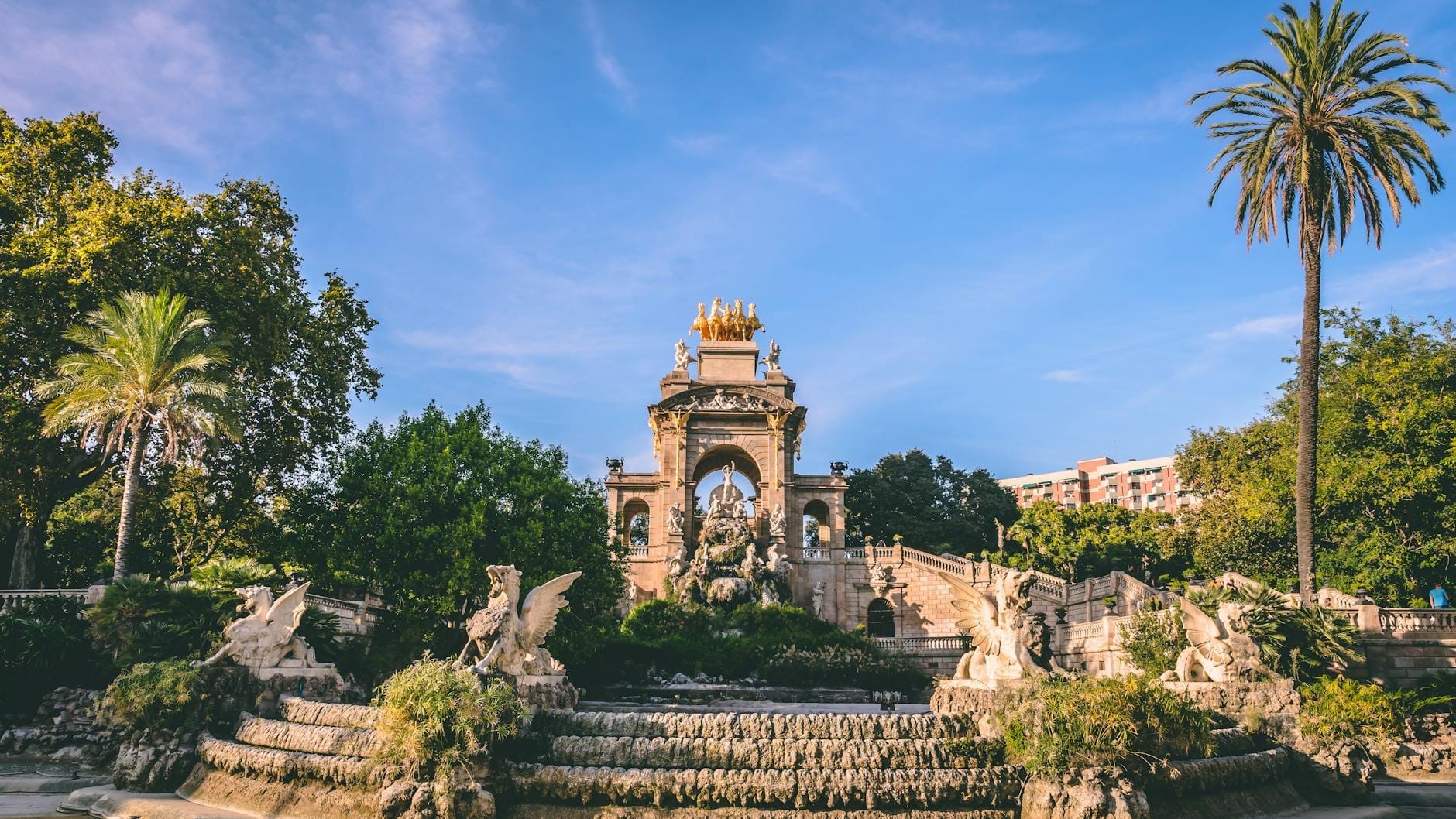
The Cascada Monumental is the most architecturally ambitious feature in the park, and it earns genuine attention. Built between 1875 and 1881, it is a neo-baroque fountain cascade on a theatrical scale: tiered stone terraces, spouting lions, allegorical sculptures, and a central arch framing Aurora's chariot. At its base sits a grotto of artificial stalactites and a pond where goldfish drift through the shadows.
In the morning, the fountain catches direct light from the east and the stone glows warm. By midday, the surrounding trees cast dappled shade over the lower basin, making it one of the cooler spots in the park. The Cascada is best photographed in early morning when crowds are sparse and the light is favorable. In the evening, when the park is busiest, it becomes a social hub rather than a contemplative one — children splash at the edges, couples take photos, and the noise level rises considerably.
ℹ️ Good to know
The Cascada Monumental is freely accessible within the park at all times during opening hours. It is illuminated on some evenings. Check with the park or local listings for special events, as it occasionally serves as a backdrop for outdoor performances.
The Lake and Rowing Boats
The artificial lake near the center of the park is one of the most reliably enjoyable features for visitors of almost any age. Rowing boats are available for hire and can hold two to five people depending on the vessel. Prices run approximately €6 to €10 per 30 minutes, paid at the rental kiosk on the lakeside. Boat rental operates seasonally: roughly March through late September until 9:00 PM, and in the cooler months until 6:00 PM, though exact dates and hours vary year to year.
The lake itself is small enough that rowing across it takes about three minutes, but the experience has a particular charm. Terrapins sun themselves on floating logs. Ducks negotiate territorial disputes near the reeds. A small island sits at the center, home to a few trees and some persistent pigeons. Weekend afternoons see a queue at the boat rental, so either arrive before noon or accept that you may wait 20 to 30 minutes.
Other Things Worth Finding Inside the Park
Beyond the Cascada and the lake, the park contains a number of smaller attractions that most visitors walk past without noticing. The Hivernacle (winter garden) is a 19th-century iron and glass greenhouse that occasionally hosts concerts and cultural events. Its wrought-iron structure is elegant without being showy, and the interior, when open, has the humid stillness of a Victorian conservatory.
The Umbracle, next door, is an open-air plant nursery sheltered by a timber slatted roof that filters the light into long stripes across the path below. It is undervisited compared to the rest of the park and offers a genuinely quiet ten minutes in the middle of a busy visit. Near the Parliament building, there is a monumental statue of a mammoth cast in iron, popular with children who attempt to climb it despite the signs suggesting they should not.
The Barcelona Zoo occupies a significant portion of the park's southern edge. Entry is separate and ticketed. The Cascada Monumental and the zoo share the same greenery but have nothing else in common logistically, so families who plan to do both should budget a full half-day at minimum.
The park is also a natural extension of the El Born neighborhood, one of Barcelona's most interesting quarters for food, culture, and architecture. Finishing a park visit with a walk into El Born for lunch or an afternoon coffee is a satisfying combination.
When to Visit and How the Experience Changes by Time of Day
Early mornings, especially on weekdays, are the most peaceful window. Between 8:00 AM and 10:00 AM, the park feels genuinely local: joggers, dog walkers, and a few older residents on their preferred benches. The light through the palm trees is soft, and the Cascada is often empty. This is also the best window for photography.
Midday from June through August can be harsh. The open lawns offer little shade, temperatures regularly exceed 30°C, and the park population thins to sunbathers and tourists who have miscalculated. If you visit in summer, the shaded paths near the Umbracle and the tree-lined perimeter are noticeably cooler than the central lawn. Bring water.
Late afternoons and evenings from May through September are the park's social peak. Students cluster on the grass with guitars and card games, families with young children occupy the benches around the lake, and the rowing boats develop queues. The atmosphere is lively and unpretentious. It is worth understanding that this is not a quiet-contemplation park at these hours.
⚠️ What to skip
The park sees some petty theft, as most crowded public spaces in Barcelona do. Keep bags zipped and visible, particularly on the main lawns during busy weekend afternoons. The perimeter paths near the zoo are notably quieter and lower-risk.
May, June, September, and October offer the best balance of weather and crowd levels across the park. If you are planning a broader Barcelona trip around ideal conditions, the best time to visit Barcelona guide covers seasonal considerations in more detail.
Getting There and Getting Around the Park
The most direct metro access is Arc de Triomf (Line 1, red line), which leaves you on the northern edge of the park about a 5-minute walk from the main entrance. Ciutadella-Vila Olímpica (Line 4, yellow line) serves the southern and eastern entrances, which is useful if you are coming from Barceloneta or the Olympic Port area. The park has multiple entry gates, so confirm which entrance suits your intended route before you go.
The internal layout of the park is not immediately intuitive. There is no official map at the gates, and the signage is minimal. The general rule is: the Cascada is in the northeastern quadrant, the lake is central, the zoo occupies the southeastern portion, and the Parliament building is in the southwest. Walking the full perimeter takes about 25 minutes at a slow pace.
The park connects naturally to Barcelona's public transport network and is within cycling distance of much of the city center. Bicing, the city's bike-share scheme, has several docking stations near the park's entrances.
Who May Not Enjoy This Park
Travelers specifically seeking manicured formal gardens or pristine facilities may find Parc de la Ciutadella underwhelming. The lawns get worn bare in patches during peak season, the public toilets are limited and not always well-maintained, and the zoo's presence at the southern edge makes that section noisier than expected. It is also not a destination for dramatic views or elevated vantage points; the park is entirely flat.
Anyone visiting Barcelona on a very short itinerary and prioritizing major architectural landmarks might reasonably deprioritize this park in favor of Gaudí's works or the Gothic Quarter. The park has no single unmissable feature that demands attendance the way that Sagrada Família or Park Güell do. Its value is cumulative and atmospheric rather than singular.
Insider Tips
- The Hivernacle greenhouse occasionally hosts free or low-cost evening concerts in summer. Check the Barcelona city events calendar before your visit rather than assuming it will be closed.
- If you want the rowing boats without a wait, arrive at the rental kiosk within 30 minutes of it opening, especially on Saturday and Sunday mornings.
- The benches along the path between the Umbracle and the Parliament building are almost always uncrowded, even when the main lawn is packed. This is the best reading spot in the park.
- Coming from Arc de Triomf station, take a moment on Passeig de Lluís Companys before entering the park. The palm-lined promenade leading to the arch is one of the more underappreciated urban walks in central Barcelona.
- Bring a picnic from the Mercat de Santa Caterina, which is a short walk from the park's western edge through El Born, and offers better prices and fewer crowds than the Boqueria.
Who Is Parc de la Ciutadella For?
- Families with children who need open space and the novelty of rowing boats
- Travelers on a free or budget day looking for a genuinely local Barcelona experience
- Architecture and history enthusiasts interested in 19th-century Barcelona
- Anyone combining a morning at the park with an afternoon exploring El Born's food and culture scene
- Visitors who want a comfortable, shaded place to recover mid-trip without leaving central Barcelona
Nearby Attractions
Other things to see while in El Born (Sant Pere):
- Arc de Triomf
Built as the ceremonial entrance to Barcelona's 1888 Universal Exhibition, the Arc de Triomf stands at the top of a wide pedestrian promenade leading to Parc de la Ciutadella. It's free, always accessible, and one of the few grand monuments in the city where you can simply stop and look without queuing or paying.
- Barcelona Zoo
Occupying over 14 hectares inside the historic Parc de la Ciutadella, Barcelona Zoo is one of Europe's oldest urban zoos, open since 1892. It balances conservation work with family-friendly programming, though the setting inside a 19th-century park gives it a character quite different from modern safari-style zoos.
- Basilica of Santa Maria del Mar
Built entirely between 1329 and 1383, the Basílica de Santa Maria del Mar stands as the finest example of Catalan Gothic architecture in existence. Funded and constructed by the waterfront workers of the Ribera district, it carries a human story that its stone geometry quietly amplifies. Fewer crowds, better proportions, and a profound atmosphere make it one of the most rewarding stops in Barcelona.
- Cascada Monumental
The Cascada Monumental is a sweeping neoclassical waterfall fountain inside Parc de la Ciutadella, designed in 1875 by Josep Fontserè and partially shaped by a young Antoni Gaudí. Free to visit and open daily, it rewards early morning visitors with calm light and empty paths, and makes for a striking photography subject at any hour.
Planning a trip? Discover personalized activities with the Nomado app.